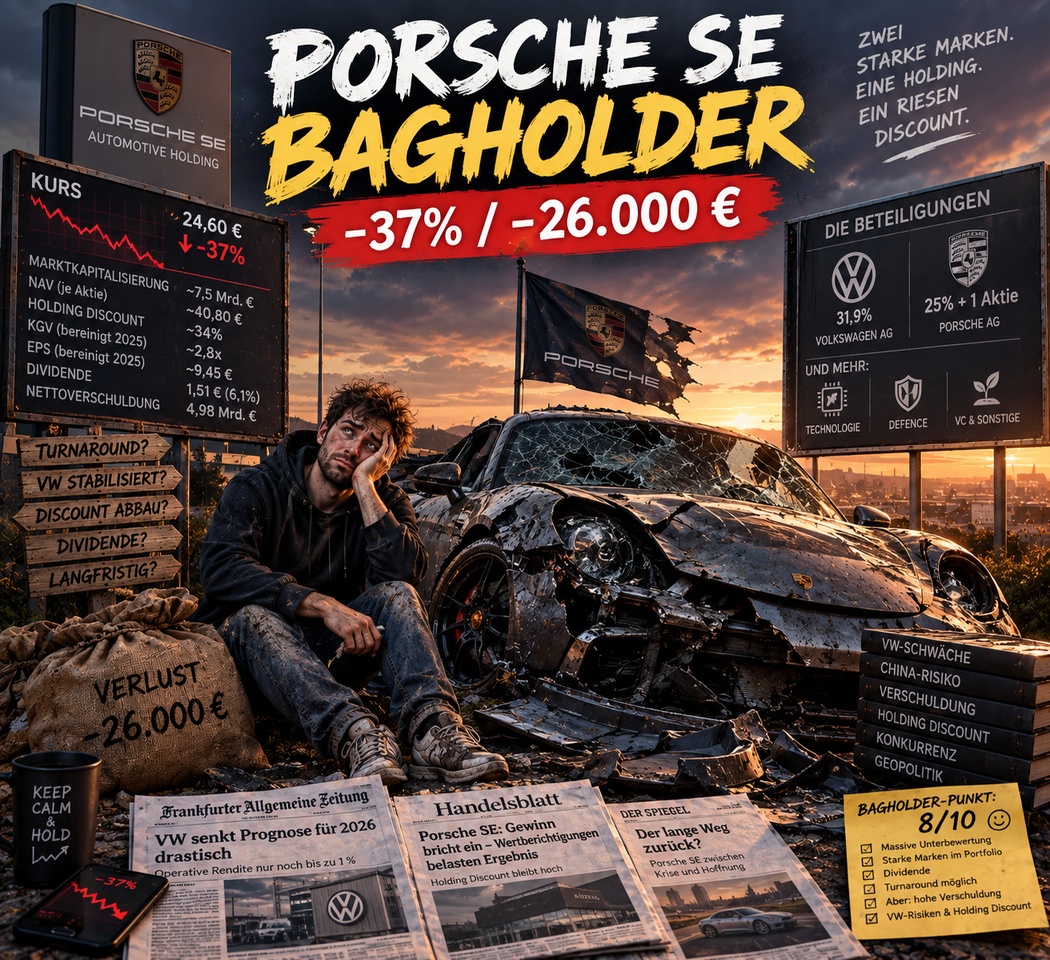
Day Two—my second “bagholder” post! Whatever Grenke can do, Porsche can do in half the time! With a Porsche, you’re just always a little bit faster... 😉
👉🏻 Purchase value: 70,000 euros
👉🏻 Loss: 26,000 euros (-37%)
🏎️ Brief Profile
The Porsche Automobil Holding SE ($PAH3 (+0.92%) ) is an investment holding company owned by the Porsche and Piëch families. Its two most significant holdings are Volkswagen AG with approximately 31.9% of the common stock, and Porsche AG with 25% plus one share of the common stock. In addition, Porsche SE is increasingly building a diversified portfolio of investments in technology, industry, defense, and venture capital.
The key point regarding the stock is this: Anyone who buys Porsche SE is essentially buying Volkswagen + Porsche AG at a significant discount.
📊 Fundamental Data
At a share price of around €24.60 , the figures are approximately as follows:
Market capitalization: ~€7.5 billion
P/E ratio (TTM): ~79x (heavily influenced by non-cash depreciation and amortization)
Adjusted P/E ratio based on 2025: ~2.8x
Adjusted EPS for 2025: ~€9.45
Dividend: €1.51
Dividend yield: ~6.1%
Net asset value: €12.5 billion
NAV per share: ~€40.80
Holding discount: ~34% (June 30, 2026)
📉 How is the business performing currently?
In the first half of 2026, Porsche SE reported adjusted consolidated net income of €949 million, down from €1.11 billion in the same period a year earlier. This represents a decline of approximately 15%. At the same time, reported consolidated net income fell to −€2.22 billion due to non-cash impairment charges. The Volkswagen investment accounted for an impairment charge of €3.0 billion, while Porsche AG accounted for €0.2 billion.
And this is precisely where the problem lies at the moment: Volkswagen is underperforming. In September, VW was forced to drastically reduce its forecast for 2026. The expected operating return on sales was lowered from an original range of 4–5.5% to as low as 1%. Approximately €10 billion in one-time items are weighing on operating income, of which about €6 billion is related to the Porsche business. As a result, Porsche SE had to lower its own forecast for adjusted consolidated net income from the original €1.5–3.5 billion to −0.5 to +1.5 billion.
However, there are also initial positive signs: In early September, Volkswagen adopted a comprehensive “Future Plan 2030” designed to significantly reduce costs, improve profitability, and strengthen competitiveness. Porsche SE expressly welcomes the plan and had previously called for a faster and more drastic turnaround itself.
There are also at least some operational bright spots at Porsche AG. In the first half of 2026, the operating margin rose to 7.8% from 5.5% in the prior year, while operating profit increased from €1.01 billion to €1.35 billion—despite significantly lower sales.
🧐 Why might the stock be a bargain?
For me, the investment case for Porsche SE is relatively simple:
The market currently values the holding company at only around €7.5 billion, even though the net asset value reported by Porsche SE was already €12.5 billion as of June 30, 2026.
This means that even based on the already depressed levels seen this summer, the stock is trading at a substantial discount to the value of its holdings. Porsche SE itself put the holding discount at 34% at the end of June. Following the stock’s further decline, the calculated discount to the NAV at that time now stands at around 40%. Added to this is a dividend yield currently around 6%. Despite the difficult situation, the company distributed €1.51 per preferred share for 2025.
For me, therefore, the interesting point is this: You don’t have to bet on Volkswagen suddenly booming again. It would be enough if the operating situation at VW and Porsche stabilizes, profits rise again, and the market at least partially reduces the holding discount. Then, theoretically, you’d have a combination of rising NAV + rising income from investments + dividends + a potential reduction in the holding discount.
At the same time, Porsche SE is working to reduce its dependence on the traditional automotive business over the long term. The portfolio of other investments now has a book value of more than €630 million and contributed approximately €150 million to earnings in the first half of the year. Most recently, Porsche SE invested once again in the aerospace sector, among other things, acquiring a stake in the U.S. aerospace company Stoke Space for a low double-digit million-dollar amount.
⚠️ Why is the stock still so cheap?
The key factor is the quality and debt levels of the underlying investments.
Porsche SE holds a roughly 32% stake in Volkswagen and an additional stake in Porsche AG. If Volkswagen runs into structural problems, Porsche SE will be disproportionately affected. That’s exactly what we’re seeing right now: China is weakening, competition from Chinese manufacturers is intensifying, the transformation is costing billions, and Volkswagen has had to drastically reduce its forecast.
Added to this is Porsche SE’s own debt. Net debt stands at just under €5 billion. While this is by no means a threat to the holding company’s survival, it does limit its financial flexibility and means that part of the value of its holdings is financed by debt.
The greatest risk, therefore, is a persistent value trap. Volkswagen and Porsche AG could remain weak for years, while Porsche SE remains heavily indebted. In that case, the holding discount could persist for years despite the supposedly favorable valuation.
And the latest forecast revision shows just how quickly the earnings situation can change. As recently as August, Porsche SE expected €1.5–3.5 billion; just a few weeks later, that figure had dropped to −0.5 to +1.5 billion.
On a positive note, at least one major source of uncertainty has now been eliminated: At the end of September, the Federal Court of Justice definitively dismissed the damage claims against Porsche SE related to the earlier VW takeover battle. This takes claims totaling around €5.4 billion off the table.
🎯 My “bagholder” verdict -> 8/10 bagholder points 🤑
To me, Porsche SE is an extremely unpopular holding company trading at a massive discount to the value of its holdings. At around €24.60, the stock currently trades at only about 60% of its most recently reported NAV. At the same time, investors receive a dividend yield of around 6% and a portfolio that, in addition to VW and Porsche, is increasingly being supplemented with technology, defense, and growth investments.
If Volkswagen actually follows through with its restructuring, margins return to normal, and Porsche AG can stabilize its profitability, I consider a significant reduction in the current holding discount to be entirely realistic.
Of course, Porsche will remain in my portfolio. Quality is important to me, after all. That applies to both cars and my portfolio… and once the stock really gets into high gear, then…! 😅
P.S.: Of course, I also hold both Porsche AG and VW directly in my portfolio. Both have, of course, performed significantly better—though not great—take that as you will.