1Wk·

Momentum Strategy Review: August 2026 - Recovery Following the July Setback 📈

Hello everyone,

After a significant setback in July, the Momentum strategy got back on track in August. Both models ended the month in the black and recouped some of their previous losses.


📊 The hard facts

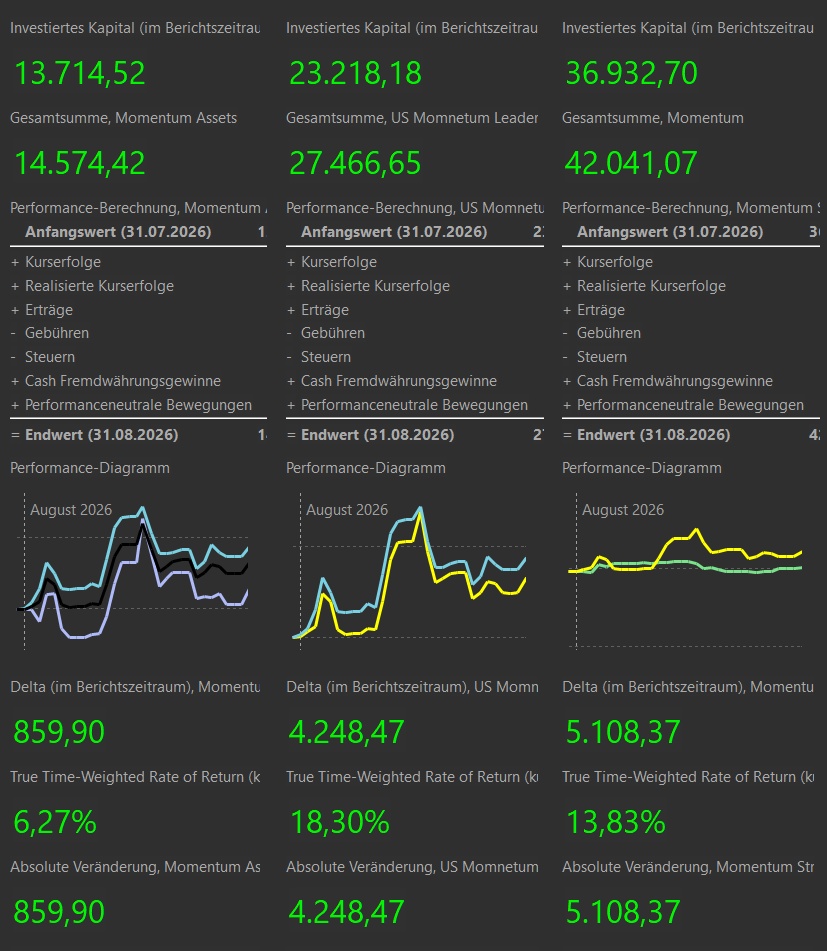
  • Starting capital for August: €36,932.70
  • Ending capital in August: €42,041.07
  • Absolute gain: +€5,108.37
  • August performance: +13.83%
  • YTD performance: +69.20%
  • CAGR over the last 365 days: +121.54%
  • CAGR since inception (10/2023): +79.04%


📈 Performance of individual strategies

🇺🇸 US Momentum Leaders (wikifolio $DE000LS9VVV3 (+0.14%) )

  • Monthly performance: +18.30%
  • Capital gain: +4,248.47 €


🌍 Global 1200 Momentum Leaders (wikifolio $19021982 (-0.36%) )


  • Monthly performance: +6.27%
  • Capital gain: +859.90 €


In August, the stronger performance contribution came from the U.S. model, while the Global 1200 model, though performing significantly more moderately, also contributed positively to the overall result.


🔄 Rebalancing for September


There are no changes to the allocation of either model.


🇺🇸 US Momentum Leaders Top 3 Ranking

SanDisk (SNDK)

Dell Technologies (DELL)

Micron Technology (MU)


The current allocation therefore remains:

✅ SanDisk (SNDK)

✅ Dell Technologies (DELL)


🌍 Global 1200 Momentum Leaders – Top 5 Momentum Ranking:

SanDisk (Score: 202.27%)

Kioxia (Score: 140.72%)

Dell Technologies (Score: 112.77%)

Micron Technology (Score: 109.93%)

Ibiden (Score: 101.54%)


The allocation remains unchanged:

✅ SanDisk (SNDK)

✅ Kioxia Holdings


Conclusion:

August shows that even after significant drawdowns, a rule-based momentum strategy can quickly regain momentum. With a monthly return of +13.83% , part of the July losses were recouped without requiring any adjustments to the rules or extraordinary interventions.


The rankings remain very stable. As long as SanDisk, Dell, Micron, and Kioxia can maintain their relative strength, there is currently no reason for rebalancing.


🚀 The rule set remains unchanged. The data decides.
attachment
28
16 Comments

profile image
Interesting. I hadn't even thought about your global version anymore. The U.S. version is too focused on the U.S. for my taste. But with the global version, I could definitely see myself putting in a few k in play money. Are the rules for the global version the same as those for the U.S. version?
1
profile image
@DonkeyInvestor The global version is also quite new. Basically, the rules and parameters are identical to those of the U.S. model. However, there are a few details that are different. For pool selection, there are country/region factors to ensure you don’t end up with fake momentum over the period, and I’ve increased the number of stocks in the pool to a total of 15—which still represents the top approximately 1.5% of the roughly 1,200 stocks. In exchange, however, the fixed oil and crypto assets have been omitted.
1
profile image
@Krush82 But all of it backed up by data, tested in backtests, and without relying on gut feelings?
profile image
@DonkeyInvestor The rules are exactly the same as in the U.S. model. (Trading only at the end of each month; momentum calculation—specifically, time period and weighting)—as in the U.S. model, if the parent index has negative momentum, then no investments are made in the stocks of that country or region. However, a detailed backtest like the one for the other model is not yet available. In 80 out of 100 cases, it is highly likely that at least one U.S. stock will be among the top 2. The goal of the model is to determine whether it is sufficient to invest only in the global model or whether adding a portion of the other model makes more sense.
1
profile image
@Krush82 But is the Wikifolio intended to be a long-term project, or is it just a trial that will be discontinued soon?
1
profile image
@DonkeyInvestor It's already planned as a long-term project ;-)
1
profile image
@Krush82 Then there's a good chance I'll be increasing my meager investment a bit in the near future 😁
profile image
Another strong month 💪🏼
1
profile image
MEGA, thanks for the update
1
profile image
Is the strategy actually designed so that you invest in stocks on a monthly basis, or only when you change your asset allocation?
profile image
@SilberSpekulatius I don't think there's a straightforward answer to that.
So if you're investing in the certificate, you can always buy more at any time.
When you implement a strategy like this manually, it depends a bit on the absolute values you find.

It depends on how much you’re saving and how much one share of the top stocks costs at any given time.
Basically, I think it always makes sense to do this when switching. If your savings rate is high enough, you can also top up your existing holdings on a monthly basis.
But I believe that this works that way for very few people, because in my opinion, it should be a supplement and not the core investment.
profile image
@SilberSpekulatius This strategy isn't intended for a specific type of investment (monthly savings / one-time investment). Personally, I've always invested whenever I had money available—which is usually on the 1st of the month.
profile image
@Wealth-Accelerator Well summarized... I'm probably the only one who actually practices this as a core investment strategy anyway. So don't try this at home—this isn't investment advice ;-)
2
Thank you very much for the monthly report!
Do you plan to split your investment equally (50/50) between the two models in the long term?
profile image
@Spouh Currently, the target allocation is roughly 2/3 U.S. momentum and 1/3 global momentum. I wouldn't consider a 50/50 split for at least a few years. Until then, I want to thoroughly analyze both models in live trading first.
@Krush82, Is this 2/3 to 1/3 breakdown due to the fact that the overall model was not subjected to such a comprehensive backtest?
Join the conversation