

In this post, I’d like to highlight the new U.S. tariffs and their potential economic consequences. I’ll discuss the background and the possible effects on inflation and businesses, as well as the winners and losers on the stock market.
Again, please note that the stocks mentioned here do not constitute investment advice; they are merely examples of potential beneficiaries or losers as trade restrictions intensify. Past performance is no guarantee of future returns.
__________
In this post:
- Impact on Inflation
- New Tariffs Take Effect
- Countries’ Reactions
- Consequences for the Global Economy
- Winners & Losers
- Investment Opportunities
__________
The topic of “tariffs” is currently not only very prominent in the media, but also in recent earnings calls by S&P 500 companies, where the term “tariffs” was already discussed in the context of a sharp increase, as shown in the following chart [1].
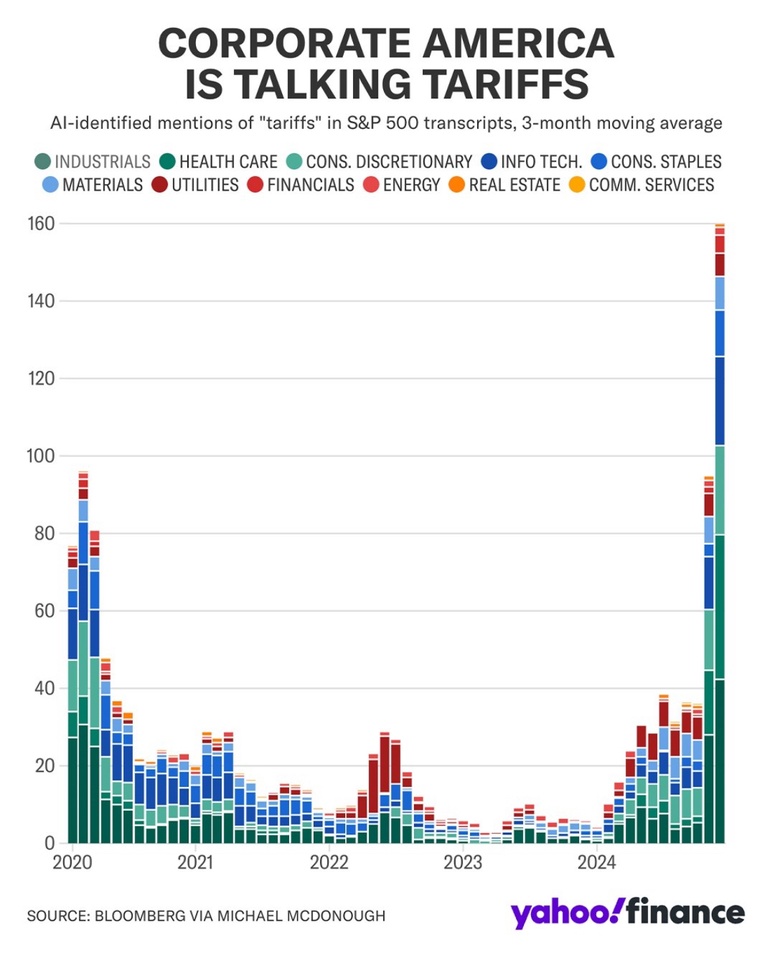
The chart shows that the discussion about tariffs has intensified over the past few months and is having an increasingly significant impact on the outlook in companies’ earnings reports.
The data is presented as a three-month average and broken down into various sectors, including, for example, industrials, healthcare, consumer goods, information technology, etc.
I’m curious to see how the stock markets will perform in the coming week. In addition to the ongoing earnings season, the topic of “tariffs” will certainly dominate.
Since the announced heavy tariffs were not immediately enforced after Trump took office—leading to a “slight” sigh of relief—there could now be a new reaction in the markets, as was already seen on Friday evening was on Friday evening when the markets turned around toward the end of the day.
A looming trade conflict could not only affect individual companies but also further fuel inflation in the U.S.:
💰 Impact on inflation
On January 31, Deutsche Bank already issued a forecast on the potential impact of tariffs on the inflation rate [2]:
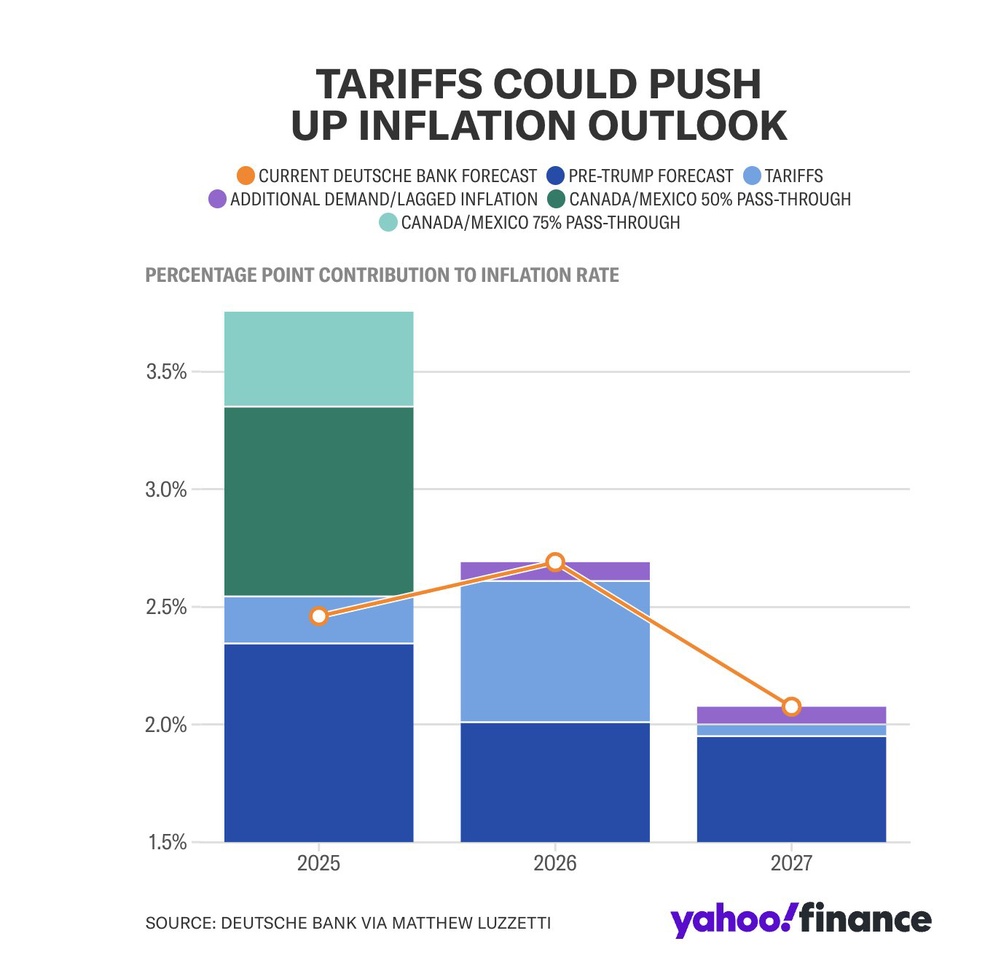
The chart compares the current forecast with the forecast from before the “Trump” era and takes into account various scenarios for the pass-through of tariffs by Canada and Mexico.
Two scenarios are considered: one with a 50% pass-through of tariffs (additional increase shown in dark green) and one with a 75% pass-through (light green). It becomes clear that, according to this, the inflation rate could rise sharply again this year and then decline again by 2027.
🛃 New Tariffs in Effect & Further Measures Planned
As of today, February 1, 2025, the U.S. government—specifically Donald Trump—has imposed new import tariffs on Mexico, Canada, and China:
- 25% on imports from Mexico and Canada
- 10% on imports from China
According to the White House spokesperson, these measures are, among other things, a response to these countries’ failure to stop the influx of fentanyl and illegal immigrants into the U.S. [3]
But that’s just the beginning:
Starting in mid-February, the U.S. will also impose tariffs on strategic goods [4], including:
- Computer chips
- Pharmaceuticals
- Steel, aluminum, and copper
- Oil and gas imports (though not until February 18, with reduced 10% tariffs to avoid immediately driving up U.S. gas prices).
🚨 Trump Bets on Escalation—Canada Announces Retaliation
Yesterday, Canadian government officials, including Foreign Minister Mélanie Joly, tried in vain to prevent the tariffs in Washington.
Before departing for Mar-a-Lago, Trump made it clear [5]:
“We have a $200 billion trade deficit with Canada. Why should we subsidize Canada?”
The EU could also soon be targeted, as Trump hinted:
“Absolutely! The European Union has treated us so terribly!”
🔄 Canada’s response:
Prime Minister Justin Trudeau announced that Canada will not back down and will respond with “swift and robust countermeasures.”
The government is planning a three-stage retaliation strategy [5]:
- 1️⃣ Targeted punitive tariffs on U.S. products originating from Republican states (e.g., orange juice, whiskey, ketchup, peanut butter, and motorcycles).
- 2️⃣ Tariffs on steel products and machine parts from the U.S.
- 3️⃣ Escalation: Halting exports of oil, gas, and electricity to the U.S.
This last step, in particular, would be a double-edged sword, however, as Canada is heavily dependent on energy cooperation with the U.S.
Economic experts in the U.S. are already warning of the consequences of a trade war [5]:
- The new tariffs could increase the cost of living for an average U.S. household by $800 per year.
- The oil and gas tariffs could raise the price of gasoline in the U.S. by up to 20 cents per liter.
But Trump remains firm:
“There may be disruptions in the short term, but in the long term, the tariffs will make us very rich and very strong.”
🌎 Possible consequences for the global economy
(a) Rising prices in the U.S.
- Technology & Electronics: Higher chip prices are affecting companies such as Apple $AAPL (+0.13%) , Dell $DELL and HP $HPQ (+1.8%) , as many of their components come from China.
- Healthcare Costs: Pharmaceutical companies such as CVS Health $CVS (+0.69%) and Walgreens Boots Alliance $WBA are expected to face higher procurement costs.
- Construction & Infrastructure: Higher steel prices are weighing on companies such as Lennar $LEN (-1.15%) , D.R. Horton $DHI (-2.58%) and Caterpillar $CAT (-0.41%) .
(b) Retaliatory measures & new trade wars?
- China could impose tariffs on U.S. products, which could affect, for example, Archer Daniels Midland $ADM (-2.53%) , Boeing $BA (+1.14%) and Qualcomm $QCOM (+1.1%) .
- The EU could raise the cost of U.S. imports, which would affect companies such as Tesla $TSLA (+4.51%) , Ford $F (-1.81%) and General Motors $GM (-1.71%) .
(c) Impact on the Stock Market
- Volatility is increasing due to uncertainties about the consequences for various industries.
- Particularly affected: technology and automotive stocks with global supply chains.
🏆 Winners & Losers—Which companies will benefit, and which will suffer?
Potential beneficiaries of the tariffs
U.S. manufacturers of steel, aluminum, and copper
- Nucor $NUE (+1.97%) , U.S. Steel $X and Freeport-McMoRan $FCX (+0.32%) could benefit, as foreign competitors will become more expensive due to the tariffs.
Domestic pharmaceutical and biotech companies
- Pfizer $PFE (-0.19%) , Moderna $MRNA (+5.18%) and Eli Lilly $LLY (-0.72%) could gain market share.
Energy companies with U.S. production
- ExxonMobil $XOM (-0.09%) , Chevron$CVX (+0.06%) and Expand Energy $CHK (-0.3%) could benefit from rising prices for U.S. oil and gas.
Semiconductor manufacturers with U.S. production
- Intel $INTC (+2.77%) and Texas Instruments$TXN (-0.06%) have US factories and could gain market share.
😥 Companies that could suffer from the tariffs
Chip manufacturers with global supply chains
- Apple $AAPL (+0.13%) , NVIDIA $NVDA (+1.48%) , AMD $AMD (+1.74%) are dependent on imports from Asia and could face higher production costs.
Automakers with global suppliers
- Tesla $TSLA (+4.51%) , Ford $F (-1.81%) , General Motors $GM (-1.71%) are under pressure because components from Mexico and Canada could become more expensive.
Companies with strong export businesses
- Boeing $BA (+1.14%) and Caterpillar $CAT (-0.41%) are suffering from potential retaliatory tariffs.
U.S. retailers with a high proportion of imports
- Walmart $WMT (+0.27%) , Target $TGT (-0.29%) and Nike $NKE (+0.48%) may have to pass on rising prices to customers.
🧠 Possible investment strategies
Favor defensive sectors:
- Utilities (e.g., NextEra Energy $NEE (-1.83%) , Duke Energy $DUK (-1.16%) ) and healthcare companies (e.g., UnitedHealth $UNH (+1.88%) , Johnson & Johnson $JNJ (-0.64%) ) remain more stable.
Capitalize on long-term opportunities in “reshoring”:
- Intel $INTC (+2.77%) , Eli Lilly $LLY (-0.72%) , Nucor $NUE (+1.97%) could benefit in the long term.
Conclusion: Will the trade conflict continue to escalate?
With the new tariffs, Trump is taking a confrontational stance, and Canada, Mexico, and China are preparing retaliatory measures. If further tariffs on European goods follow, the situation could escalate even further.
❓What do you think—which stocks might be most affected? Which companies do you see benefiting?
Thanks for reading! 🤝
__________
Sources:
[4]
[5] https://www.tagesschau.de/ausland/amerika/usa-trump-strafzoelle-100.html


