

A Brief History of the Stock Market:
First off:
This is a look back at what happened during the dot-com bubble. No comparison
In 1969, with the ARPANET . Initially, it was intended primarily for researchers and universities. It wasn’t until much later…
in the early 1990s, the World Wide Web became accessible to more and more people. And that marked the beginning of a truly new era.
Companies slowly began to realize what the Internet could make possible.
Selling products, reaching customers, advertising... all online.
The U.S. economy was doing quite well in the 1990s; unemployment was falling, and optimism reigned on the stock market. Things really took off in the mid-1990s.
Suddenly, everyone wanted to be part of the be part of the . Start-ups went public, some without ever having turned a profit. Many of these companies invested huge sums in advertising, employees, and growth. The only problem was: Revenue often couldn’t keep up with costs, and debt piled up.
Good examples: Pets.com, Webvan, eToys.com— wiped out of the stock market.
Nevertheless, valuations continued to rise. Hopes for the future was, in some cases, worth more than the actual business!
Warren Buffett and Charles Munger steered clear of ".com" in the name
A Few Big Players in 1999–2000
- Cisco $CSCO (-0.35%) supplied routers and networking equipment—in other words, the infrastructure for the Internet.
- AOL got millions of people online in the first place. A pioneer in chat, email, and dial-up Internet?—do I even need to know what dial-up Internet is anymore? Apparently, it used to be more common.
- Yahoo was the first place many people went when they wanted to search for something online or read the news. There was something to that…—today, 90% of Yahoo is owned by the U.S. financial investor Apollo Global Management and 10% by the telecommunications company Verizon $VZ (+0.55%)
Today’s Big Players: 1999–2000
- Apple
$AAPL (-0.6%) mainly sold Macintosh computers and was just fighting its way out of a difficult period. - Microsoft
$MSFT (-0.66%) was already making a lot of money with Windows and Office. - Amazon
$AMZN (-2.38%) was still primarily an online bookseller, but was rapidly expanding into other areas while still operating at a loss. And today?
And then came the crash...
In March 2000 , sentiment took a turn for the worse. The Federal Reserve had raised interest rates, many stocks were overvalued, and investors began to question whether the promised profits were even realistic and whether companies could cover their investment debt .
After the crash, it became difficult for many young companies to raise new capital. Without capital, they could not continue. Bankruptcies and massive stock price declines followed.
The Internet hadn’t failed… but expectations for many Internet stocks were too high.
The Nasdaq lost in March 2000 until it hit its low in October 2002 approximately 78 percent! Read that again...
The S&P 500 lost -49% and the Dow Jones fell by -38%. You can probably guess why... the tech weighting in each index
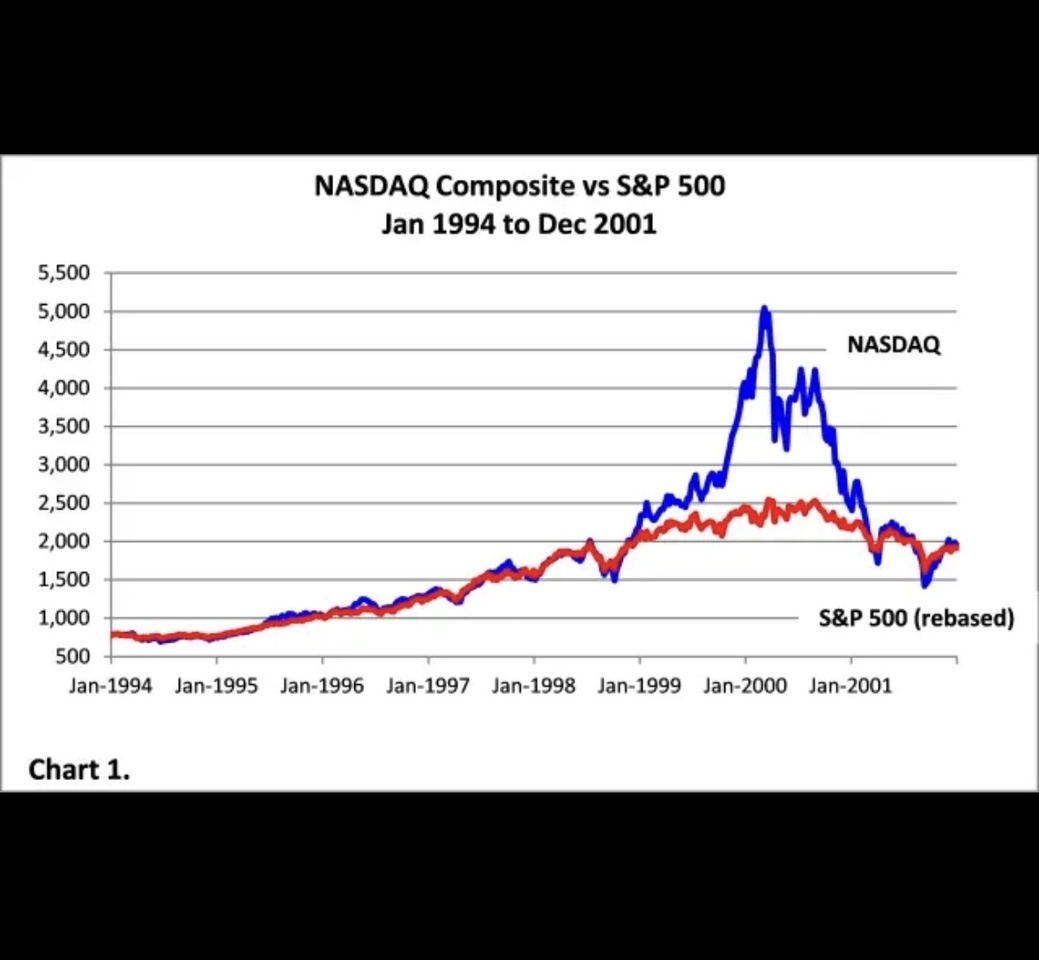
Not all stocks fell by the same amount. Walmart
$WMT (+0.62%) (-37%) continued to sell groceries and everyday items, Coca-Cola $KO (+0.69%) (-55%) continued to sell beverages. Businesses like these were less dependent on whether the internet would change the world. Nevertheless, every company was affected. JPMorgan Chase
$JPM (-1.7%) (-72%), on the other hand, was more heavily dependent on the overall economy and the financial markets. Banks, too, came under pressure.
- Microsoft fell as much as -65%
- Apple -80%
- Alphabet ?
$GOOGL (-3.21%) didn't go public until August 2004
Who fared better? 2000–2002
- Johnson & Johnson:
$JNJ (-1.13%) -25% - Procter & Gamble: $PG (+2.15%) -25% (after 2000)
- ExxonMobil: $XOM (-1.9%) -30%
- PepsiCo:
$PEP (+1.09%) -25%
Winners of the crisis?
- Altria
$MO (+0.69%) at the time Philip Morris
$ (-1.03%)PM (-1.03%) .. The stock rose by 150%! - Berkshire Hathaway
$BRK.B (-0.02%) rose as much as 50% because they avoided tech stocks - UnitedHealth Group
$UNH (+1.27%) fell by -20% and then doubled...
So you can see: Outside of the tech sector, you weren’t automatically safe. What mattered was how each company made its money and how highly its stock had been valued previously.
What else happened, by the way
In 2001, the U.S. slipped into a recession. On top of that, the terrorist attacks of September 11, 2001, further shook confidence. So the stock market wasn’t just dealing with the bursting dot-com bubble .
How long did the recovery take?
The Nasdaq didn’t reach its 2000 high again until 2015—15 years later.
The S&P 500 managed to do so as early as 2007, before the next financial crisis struck. — Excluding dividends
What were Warren Buffett and Charles Munger doing at that time?
In his 1999 letter to shareholders, Buffett explained, in essence:
“We believe that technology companies will change society. But we don’t know which companies will have a sustainably superior competitive advantage.”
So... he and Munger simply didn’t want to gamble on hope.
What did Buffett and Munger buy instead?
In late 1999—that is, before the crash—he and Charlie Munger bought:
Coca-Cola: $11.6 billion
American Express $AXP (-0.48%)
: $8.4 billion
Gillette (P&G says hello): $3.95 billion
Wells Fargo $WFC (-1.37%)
: $2.39 billion
Berkshire has been criticized for being out of touch because it largely ignored the tech boom.

Image generated with AI :)


