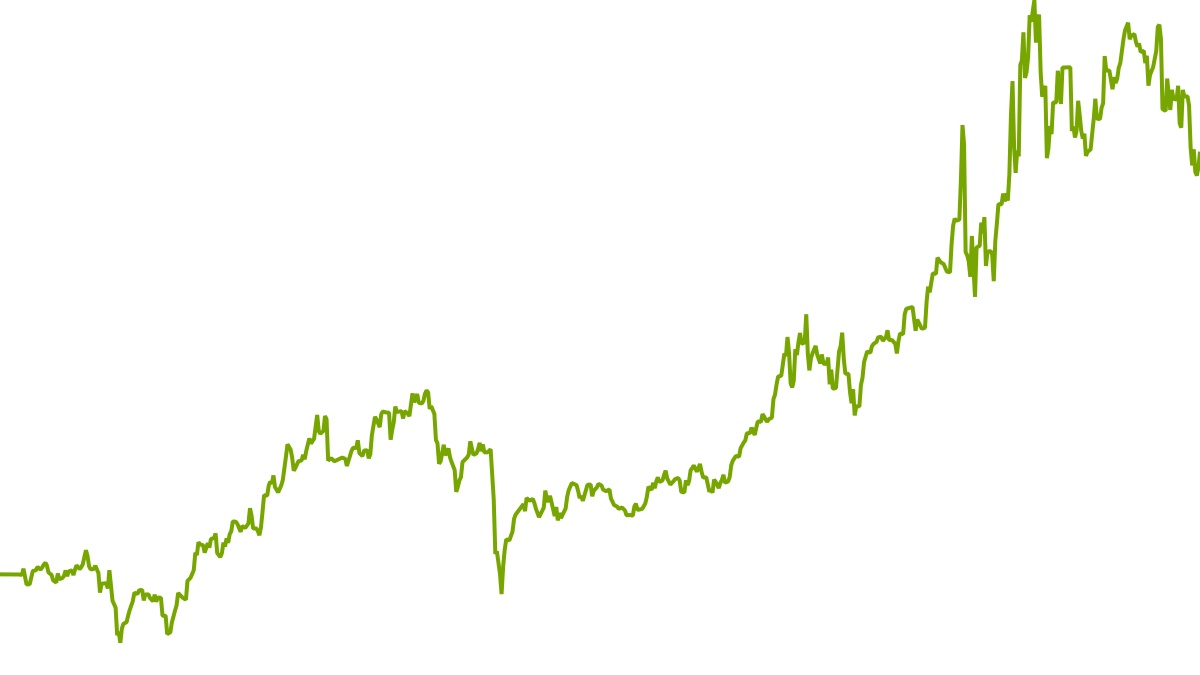
A golden autumn month is behind us. Here is the report:
Asset Performance 09/26 (August 31–September 30, according to Wikifolio)
3xQQQ: +12.4%
2xWTI: +28.7%
1xBTC: +11.1%
3xGTAA Portfolio (Sept. 30, according to Getquin)
Aug. 31, 26: €127,700
Sept. 30, 26: €144,900
Wikifolio Certificate (Oct. 30, according to Wikifolio)
Aug. 31, 2026: €198.60
Sept. 30, 2026: €225.35
Month: +12.4%
YTD: +38.5%
Review 09/26
With a gain of +12.4%, 3xGTAA posted an above-average performance in September. The gains came from all three assets held, with WTI accounting for the largest share. This is surprising because both WTI and interest rates rose, which theoretically should have led to falling risk assets. But this demonstrates once again why it’s better to follow trends than to predict them.
Outlook 10/26
As expected, WTI, BTC, and QQQ remain the assets with the strongest momentum in the portfolio and will therefore stay in the portfolio. Aside from minimal rebalancing, the strategy is: Just keep going!
Report from the 3xGTAA Workshop
I’ve decided not to include -3xTLT in the asset pool (even though the ETF gained +25% last month). At first, there simply weren’t any backtests, which understandably raised some critical voices among you. Then @flyingsquirrel actually managed, with the help of AI, to create a synthetic backtest going back to 2004 for 3xGTAA, including -3xTLT! This revealed three key points:
1. Overall, the performance contribution of -3xTLT is negative, meaning the model performs just as well—or better—in the long term without it. However, it’s important to note that the backtest is based on a regime of falling inflation and interest rates.
2. In 2022, when interest rates suddenly rose significantly after a long period of stability, the performance contribution was clearly positive. However, as a single data point, its significance is rather limited.
3. The inclusion of -3xTLT becomes interesting only when combined with various other strategies, as -3xTLT significantly reduces the correlation among the models and thereby also lowers the maximum drawdown of the overall portfolio by approximately 5%. However, this is irrelevant for most 3xGTAA investors, so the only real advantage is negligible.
For myself, I conclude that in the coming period of rising interest rates, I will tactically use -3xTLT in my trading portfolio depending on the signal situation. For me, this will essentially become a private “4th asset” within the 3xGTAA strategy. The Wikifolio remains unaffected by this.
The extensive backtests of @flyingsquirrel have also shown results that definitely have an impact on the 3xGTAA Wikifolio. All sorts of scenarios were tested, some dating back to the early ’90s: asset baskets with and without BTC, lookback periods, averages, trading days, number of assets, asset weightings, leverage, etc. An incredible effort at the forefront of LevGTAA research! The results are sometimes quite complex, but they consistently point in the same direction: the 3xGTAA base model is close to optimal across nearly all parameters and behaves very robustly. Any further optimization significantly increases the complexity of the model and its rules. Some are willing to tolerate greater complexity for a few more percentage points of performance probability, while others prefer the simplicity and robustness of the base model. I myself belong to the latter group and have decided to return to the simple 3xGTAA model:
Asset Pool: 3xQQQ, 3xEU50, 3xGLD, 3xTLT, 2xWTI, 1xBTC, CASH
Selection: Signal execution on the 1st of the month, Top 3 momentum over the last 1 to 9 months, SMA10 > SMA150
Attentive readers will notice that Forex (EURUSD, USDEUR) has been omitted. Longer backtests have not demonstrated any added value here. Apart from increased portfolio turnover, they offer neither advantages nor disadvantages. Real-time experience to date confirms this.
However, some questions remain unanswered:
1. The longer tests show a measurable advantage of 3xEM compared to 3xEU50, despite the lack of a momentum effect in China (likely due to the EM boom in the early 2000s). I need to delve deeper into this to make an informed decision.
2. The tests were run on a synthetic 3xTLT. But such a product does not exist on the market. There is only a 3xIEF (10-year) or a 5xTLT (from Leverageshares). It will still take some time before that happens and interest rates fall again.
3. The longer-term tests have shown that while adding WTI boosts performance, it also causes portfolio volatility to rise even more significantly. This has a negative impact on risk metrics. Nevertheless, commodities should not be missing from a comprehensive asset model. However, since there is currently no leveraged commodity ETF on the German market, the 2xWTI is a compromise that will be discontinued as soon as the offering improves.
What do you think about returning to the simple model? Not that it changes my decision, but I’m interested in your opinion. And remember:
GTAA is a process, not a result.
Yours, Epi