So far, my two posts have been about future AI bottlenecks on the topics of test & metrology and photonics. Both areas revolve around the question of how increasingly powerful AI infrastructure can still be controlled, connected and scaled.
However, another possible future infrastructure layer could be directly outside the data centers: Edge AI.
Today, the majority of modern AI still takes place centrally in large data centers. At the same time, more and more systems are being created to perform AI locally: Cameras, vehicles, drones, robots, sensors or industrial machines. Data often has to be processed there in real time. Not every request can be sent to the cloud first. As a result, AI is gradually moving closer to the physical world.
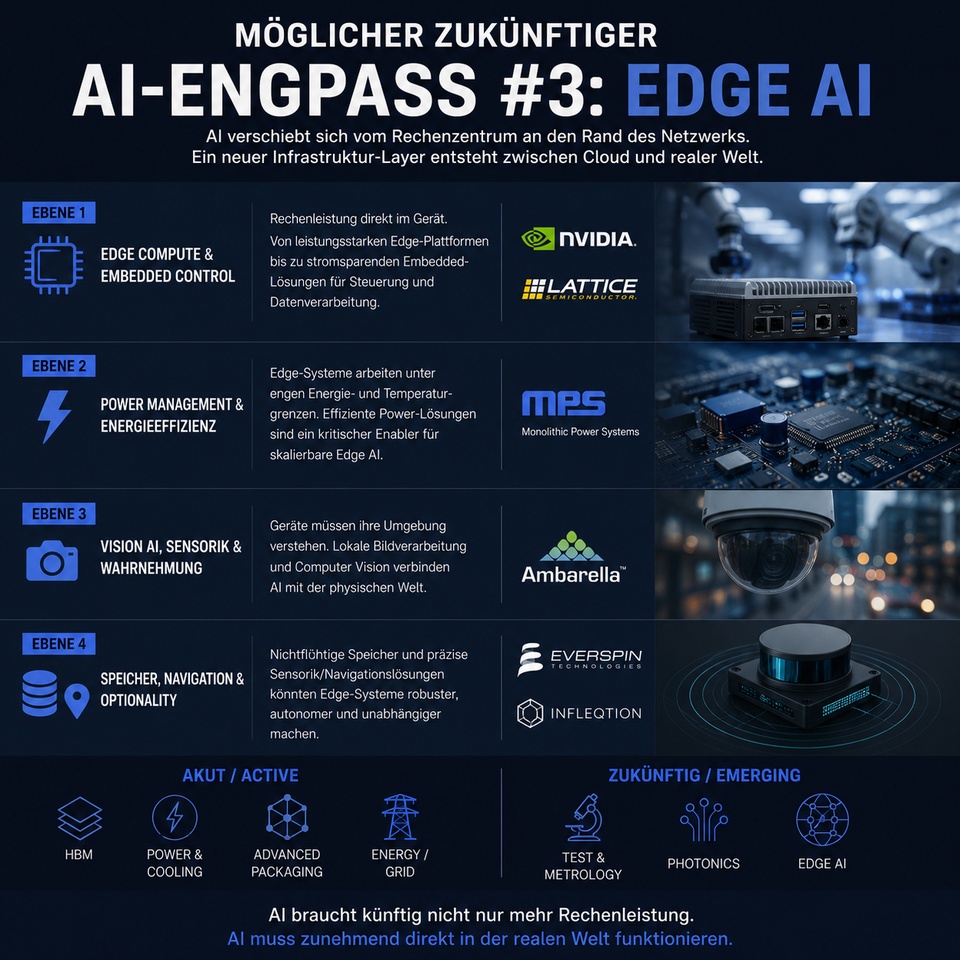
Edge AI describes precisely this development: AI inference runs locally on devices, machines or sensors instead of exclusively in the central data center. This creates a new infrastructure stack between cloud AI and the real world.
Level 1: Edge Compute & Embedded Control
Computing power also remains the foundation in the edge area. NVIDIA is increasingly addressing this market with Jetson platforms for robotics, industrial AI and autonomous systems.
I also think it is worth mentioning $LSCC (+0.93%) (Lattice Semiconductor). While many AI systems prioritize maximum performance, Lattice focuses more on low-power embedded control, sensor fusion and flexible local data processing. It is precisely such efficient control systems that could become more important in the edge area than pure maximum performance.
Level 2: Power management & energy efficiency
As local AI grows, the importance of energy efficiency also increases. Edge systems often operate under tight energy and temperature limits. Many systems run permanently, mobile or autonomously.
This is precisely why power management could become even more critical in the long term than in traditional data centers. Companies such as $MPWR (+0.98%) (Monolithic Power Systems) address this level with highly efficient power solutions for AI, automotive and embedded systems.
Level 3: Vision AI, sensor technology & perception
Many future edge systems will need to understand their environment locally. Cameras, machines, vehicles and autonomous systems increasingly require computer vision directly on the device itself.
$AMBA (+6.72%) (Ambarella) is one of the most interesting pure plays in this area for me. Its strength lies primarily in energy-efficient local image processing and vision AI. This is exactly where the connection between AI and physical reality arises. I have also added Ambarella to my wikifolio "NextLimits" today.
Level 4: Storage, navigation & optionality
As autonomy increases, so do the requirements for memory, sensors and navigation. $MRAM (-0.47%) (Everspin Technologies) is working with non-volatile memory architectures, which could become particularly interesting for robust and energy-efficient edge systems in the long term.
$INFQ (Infleqtion) is also expanding the topic to include quantum sensing and high-precision navigation technologies, for example for autonomous or GPS-independent systems. For me, these are not yet certain future winners. But possibly early infrastructure options for a world in which AI no longer only exists in data centers.
The exciting thing is that the next big AI shift could not just mean more compute. But the shift of AI from central cloud systems into machines, vehicles, sensors and robotics.
AKUT/ACTIVE:
HBM + Power & Cooling + Advanced Packaging + Energy/Grid
FUTURE/EMERGING:
Test & Metrology + Photonics + Edge AI
AI will not only need more computing power in the future. AI must increasingly function directly in the real world "out in the field".
On the graphic you can see Edge AI in context. At the bottom you can also see all the acute (4) and future (3) AI bottlenecks from my last posts.
Next, I will point out potential bottlenecks in other emerging fields independent of AI.