Hello, everyone,
Today, we have a special midnight screening to mark a certain occasion.
I hope to see lots of comments.
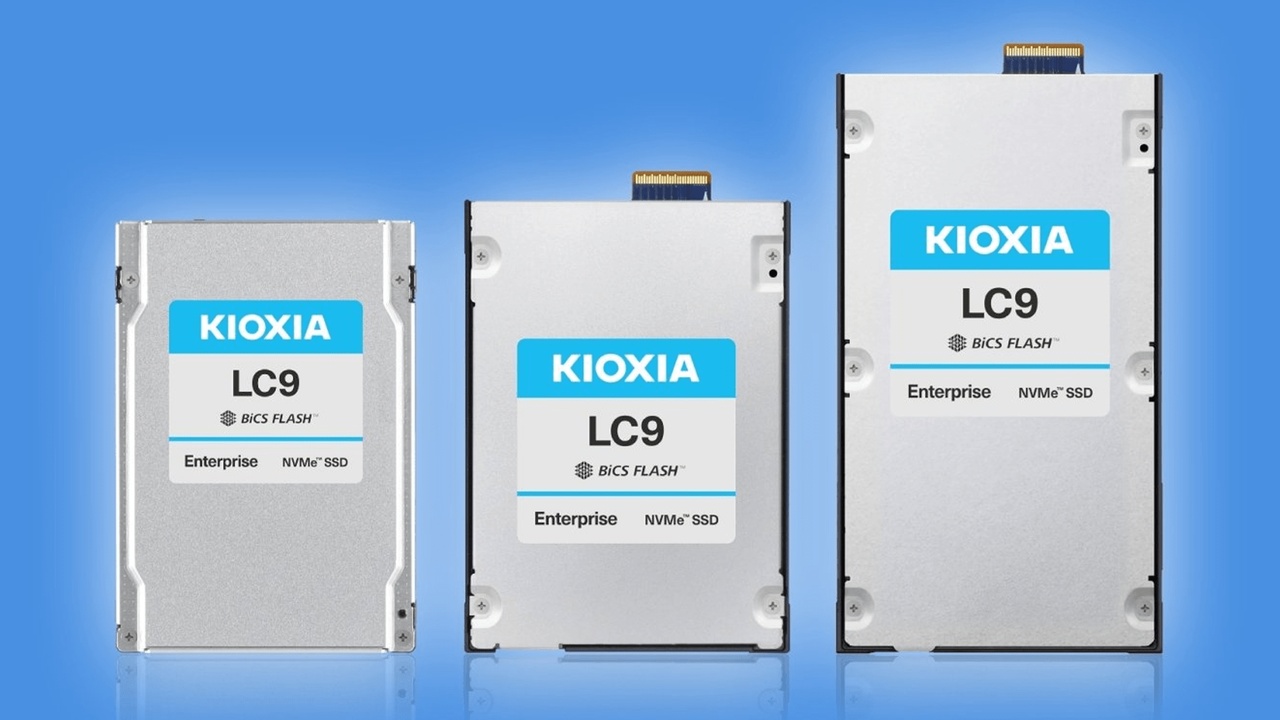
The “fastest” SSD in the world:
The Kioxia GP1 hits a whopping 10 million IOPS
Storage technology for AI is taking a giant leap forward. A new SSD from Kioxia achieves a full ten million I/O operations per second. The next generation is expected to surpass this figure by a factor of ten.
New Storage for AI Systems
Storage manufacturer Kioxia unveiled the world’s first SSD mit fast 250 Terabyte Speicherkapazität and, with its mobilen Speicherchips auf Basis der UFS-5.0-Technologie transfer rates of more than 10 gigabytes per second. Now, another new product from the company is making waves. Earlier this month, the Japanese manufacturer unveiled its GP1 SSD at a trade show in California. With approximately ten million input/output operations per second (IOPS), the GP1 is the “fastest” SSD in the world. It was developed specifically for data centers to eliminate bottlenecks in data processing künstliche Intelligenz .
The first generation uses the PCIe 6.0 standard and serves as a direct memory extension for graphics processors, since fast HBM memory in graphics cards is expensive and severely limited in capacity. Future models are expected to exceed this speed by a factor of ten, reaching a whopping 100 million operations. The first test samples of the SSD are expected to reach enterprise customers by the end of 2026.
Die 'schnellste' SSD der Welt: Die Kioxia GP1 erreicht satte 10 Mio. IOPS
Kioxia Holdings Corp is a Japan-based company primarily engaged in the manufacture, sale, research and development, and other services related to memory and related products. Its business is divided into Solid State Drive (SSD) & Storage, Smart Devices, and Other, based on the use of its products. SSD & Storage includes SSD products and storage products primarily for personal computers (PCs), data centers, and enterprises. Smart Devices include embedded storage products with control functions used in consumer devices such as smartphones, tablets, and televisions, as well as in vehicles and industrial applications. “Other” includes retail products such as SD memory cards and Universal Serial Bus (USB) storage.
Number of employees: 15,042
On August 12, the Japanese memory chip manufacturer announced the completion of a share buyback program intended to remove up to 30 million shares, worth up to 800 billion yen, from the market.
At the same time, the shareholder base is shifting: As of August 3, Toshiba reduced its stake to 14.12 percent, down from the 14.48 percent it previously held.
The largest single shareholder is now the Bain Capital-affiliated company BCPE Pangea Cayman2, with 14.19 percent—although, according to Kioxia’s own announcement regarding convertible bonds, SK Hynix effectively controls nearly all voting rights associated with this stake.
Operations Provide a Boost
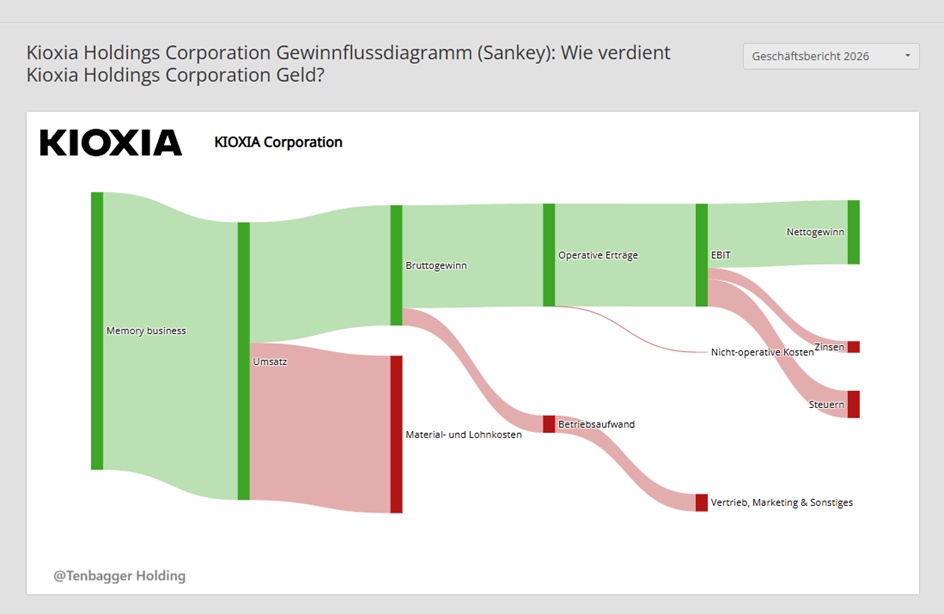
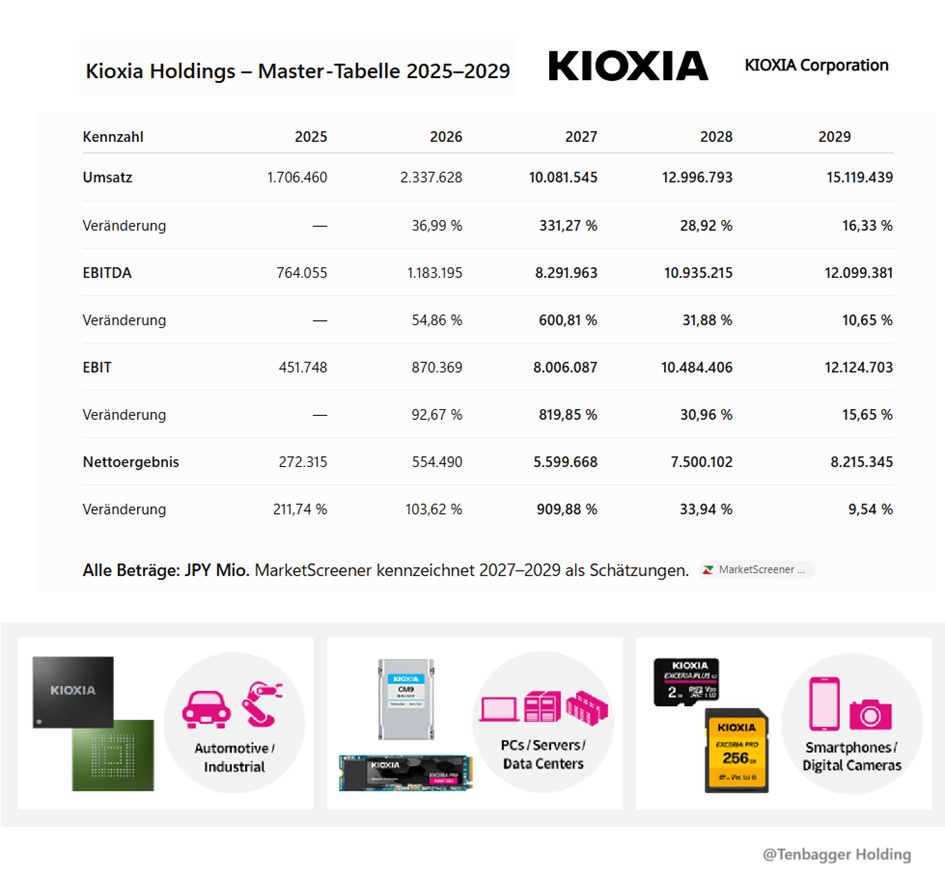
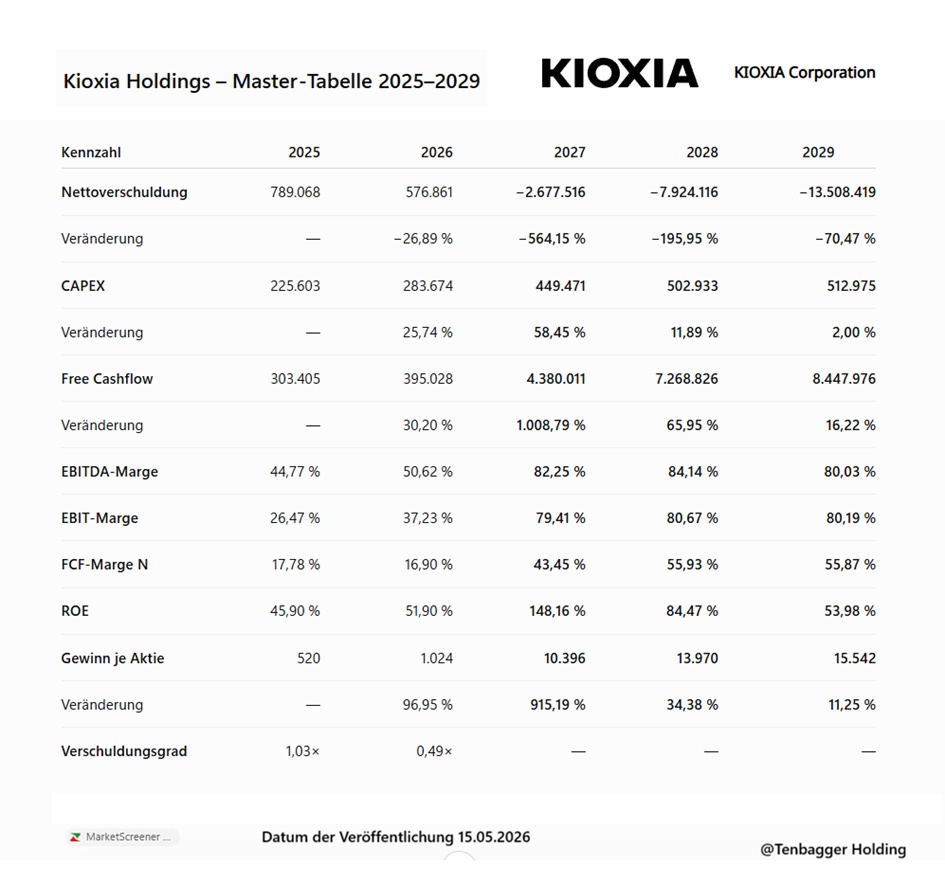
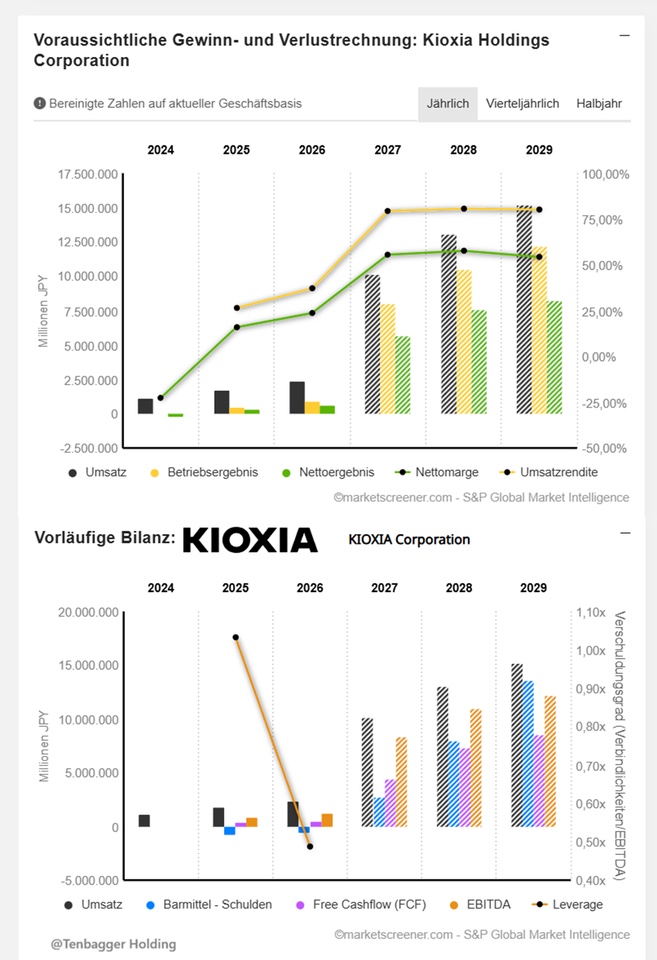
These capital measures follow an exceptionally strong quarter. Kioxia reported a 415.5 percent year-over-year jump in revenue to 1.77 trillion yen for the first quarter of fiscal year 2026, with an operating profit of 1.33 trillion yen and a margin of 75 percent.
For the current second quarter, the company forecast a further increase in revenue to 2.39 trillion yen—a 35 percent rise from the previous quarter—driven by higher prices and a slight increase in sales volume. Operating profit is expected to rise by 70 percent.
Awards Highlight Technological Leadership
In addition to the financial news, Kioxia also achieved technological successes. The GP series of super-high-IOPS SSDs was named “Best of Show” at the FMS: The Future of Memory and Storage trade show. Together with SanDisk, Kioxia also unveiled a new 3D flash memory technology that, according to the company, achieves the industry’s highest bit density for QLC NAND memory.
Outlook and Capacity Expansion
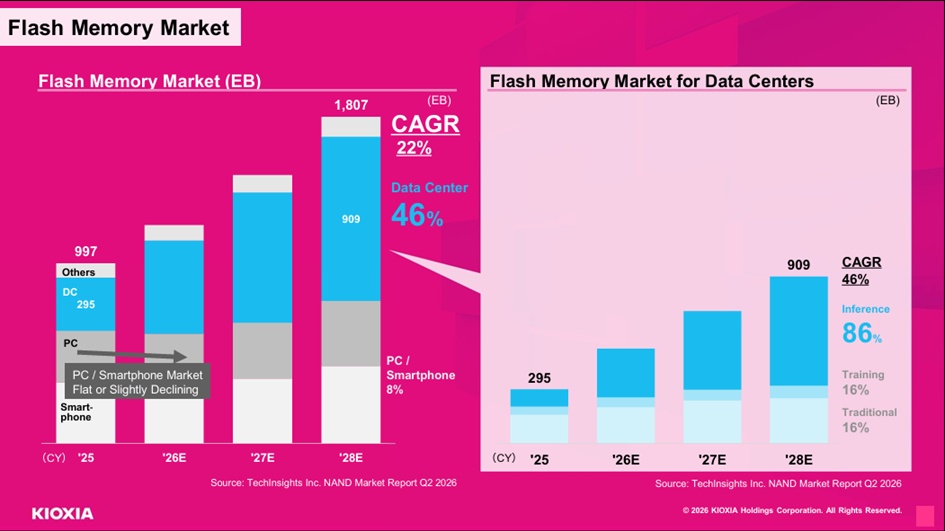
AI data centers continue to drive growth in Kioxia’s NAND flash business. According to Nikkei, revenue from data centers and related segments reached 1.1747 trillion JPY in the April–June quarter, more than five times as much as a year earlier. The company generated nearly as much revenue in a single quarter as it did in the entire fiscal year ending in March 2026.
Looking ahead, the company expects bit demand to grow in the high teens in calendar year 2026, with its own bit shipment growth in line with the broader market. Furthermore, demand is expected to continue to exceed supply in calendar year 2027.
Meanwhile, Kioxia expects the strong momentum to continue in the second fiscal quarter, with a revenue forecast of 2.390 trillion JPY, a 35.2% increase quarter-over-quarter, as well as non-GAAP net income of 1.280 trillion JPY, representing a 44.3% year-over-year increase. However, Nikkei points out that the company’s net income forecast fell short of the consensus estimate of 1.3431 trillion JPY.
(July 31, 2026)
Geographic Revenue Breakdown:
2026 (JPY)
United States 1.099 billion
China 382 billion
Taiwan 301 billion
Asia Excluding China and Taiwan 174 billion
North America and Europe Excluding the U.S. 119 billion
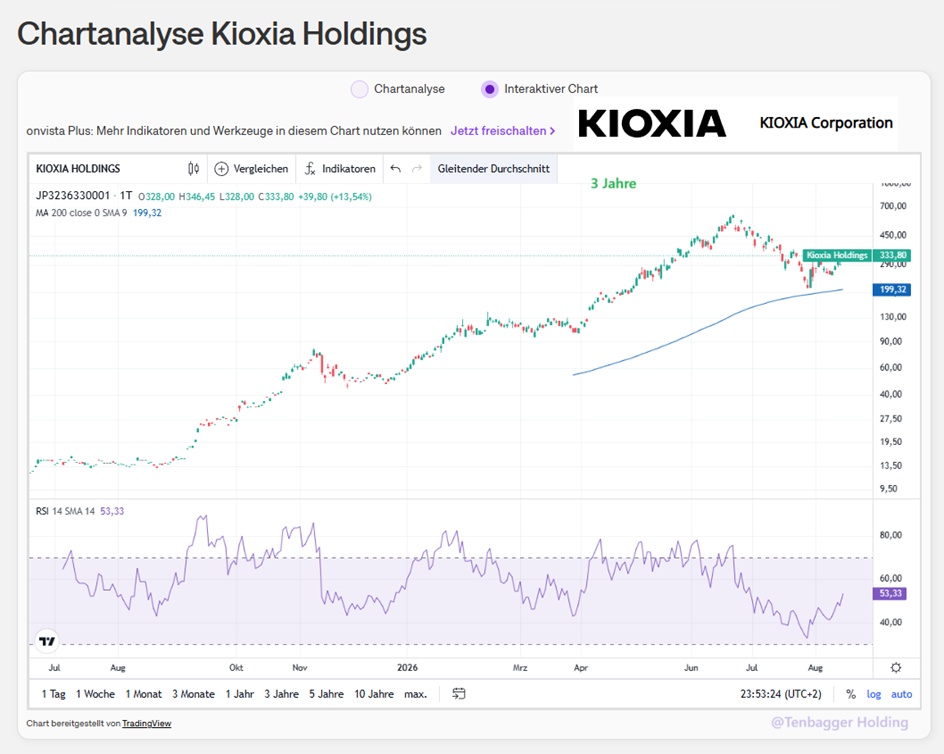
August 18, 2026, 3:05:05 PM •
Tradegate BSX (EUR)
334.00 EUR
+40.00 EUR +13.61%