My PORTFOLIO 2036
Hello, everyone,
I often post my new purchases for my Portfolio 2036 here. To some, it might look like I’m buying stocks here without any rhyme or reason.
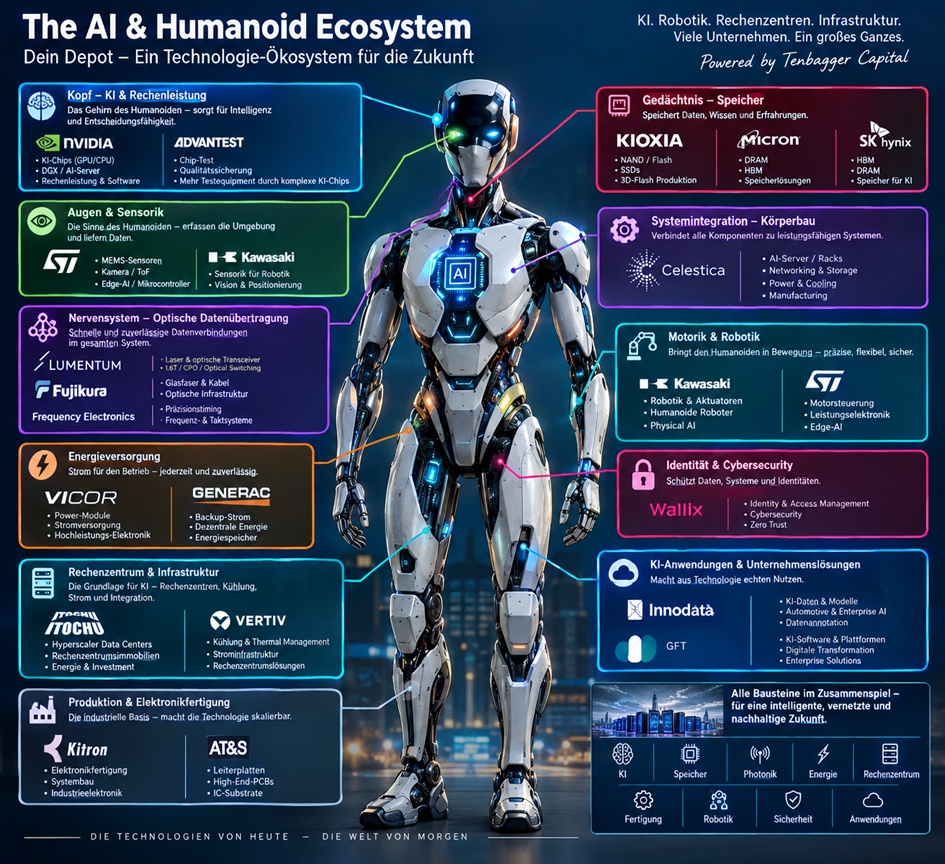
But you shouldn’t just see my portfolio as a collection of stocks—rather, as a complete technological ecosystem centered around AI, Physical AI and humanoid robotics.
That’s why today I’d like to try to explain my way of thinking to you a little.
Of course, my portfolio doesn’t cover only this growth area, but in today’s presentation, I’d like to use the technology sector to illustrate a portion of my portfolio and the thinking behind it.
After all, this sector accounts for 50% of my portfolio.
My friends,
I hope you enjoy this weekend reading, and please let me know in the comments if you liked it.
Here, I’m looking at several levels:
Sector
🧠 AI chips NVIDIA
💾 HBM / Memory SK Hynix, Micron
💽 NAND / SSD Kioxia
🤖
Semiconductors / Mixed-Signal & Embedded Systems STMicro
🔬 Chip Testing Advantest
🔌 Power Supply Vicor, Vistra
❄️ Data Center Vertiv, IES Holding
🏢Hyperscaler data centers Itochu
⚡ Decentralized Energy Generac
🌐 PHOTONICS / OPTICAL DATA TRANSMISSION Lumentum
🌐 Fiber Optics Fujikura
🤖 Physical AI / Robotics Kawasaki
🏭 Electronics Manufacturing Kitron, AT&S
🕐 Precision/Timing Frequency Electronic
🧑💻 AI Applications Innodata, GFT
🔐 Cybersecurity/Identity Wallix
This is much more diversified than it appears at first glance.
While I do place a strong emphasis on AI and technology—within this megatrend, I focus on very different stages of the value chain.
My 2036 vision would therefore look more like this now:
Phase 1:
AI Training → NVIDIA / HBM / Micron / SK Hynix
Phase 2:
AI Inference → Kioxia / SSD / Networking / Fujikura
Phase 3:
AI Infrastructure → Vertiv / Vicor / Generac / AT&S
Phase 4:
Physical AI → Kawasaki / Advantest / Robotics / Sensors
Phase 5:
AI in the Enterprise → Innodata / GFT / Wallix
And specifically Phases 3–5 could prove more decisive for the portfolio over the next ten years than today’s purely GPU-driven narrative.
That’s why, from a 10-year perspective, I would by no means view Japan as a side bet. On the contrary: Kioxia, Fujikura, and Kawasaki give my portfolio three different long-term options in memory, connectivity, and physical AI.
If these theories pan out, my portfolio could look significantly different in 2036 than it does today—and some of the smaller positions today, in particular, could then have become disproportionately important.
🇯🇵 Kioxia – Memory Is Becoming an AI Infrastructure Theme
Kioxia is an excellent fit alongside Micron and SK Hynix because it covers another aspect of the memory boom: NAND/Flash and SSDs.
The company is now explicitly positioning itself for the next phase of AI: After training comes, increasingly, inference, and Kioxia sees rapidly rising storage demands, particularly in agent-based and physical AI.
Especially interesting for my 10-year horizon:
AI → more data → more storage → more SSDs → more flash capacity.
And Kioxia continues to invest heavily: Together with SanDisk, investments totaling over $31 billion in Japan , including an expansion of 3D flash production.
To me, this is an important addition to my existing semiconductor thesis.
https://www.kioxia-holdings.com/en-jp/news/2026/20260602-1.html?utm_source=chatgpt.com
🔵 Fujikura – perhaps one of the most underrated AI infrastructure plays
Why do I hold a position in Fujikura?
Because as data centers continue to grow larger, data must must be transmitted at extremely high speeds within and between data centers.
And that requires fiber optics.
In March 2026, Fujikura announced plans to invest up to 300 billion yen in additional capacity for fiber optics and optical cables in Japan and the U.S. The goal is to eventually triple production capacity.
In May, among other things, a new plant was opened in Sakura with an 40 billion yen ; production is scheduled to begin in late 2030
https://prtimes.jp/main/html/rd/p/000000182.000056990.html?utm_source=chatgpt.com
In May, among other things, a decision was made to build a new plant in Sakura with an investment of approximately 40 billion yen in investment ; production is scheduled to begin in late 2030.
This fits extremely well into my portfolio:
NVIDIA → Data Center → Vertiv → Vicor → Fujikura → Kioxia
This means I not only own the chips, but also an increasing number of companies in the infrastructure needed for the chips to function at all.
🤖 Kawasaki – this is where things get really exciting in the long term
With Kawasaki, I see a completely different option:
Physical AI + Robotics.
And in 2026, something actually developed here that makes the question of robotics at Kawasaki very interesting.
In May, Kawasaki opened Silicon Valley and is collaborating there with companies including NVIDIA, Microsoft, Analog Devices, and Fujitsu. https://global.kawasaki.com/en/corp/newsroom/news/detail/?f=20260522_8524&utm_source=chatgpt.com
This was followed in July by a partnership with Fujitsu to implement Physical AI in the healthcare sector —for example, autonomous robots for transporting medications and samples in hospitals. https://global.kawasaki.com/en/corp/newsroom/news/detail/?f=20260716_2992&utm_source=chatgpt.com
And the key point:
Kawasaki doesn’t just want to treat Physical AI as a research topic, but explicitly wants to bring it into real-world applications—factories, logistics, hospitals, construction, agriculture, and so on. https://global.kawasaki.com/en/corp/newsroom/news/detail/?f=20260716_2992&utm_source=chatgpt.com
That makes Kawasaki, in my view, an interesting player in the second wave of AI:
🏢 ITOCHU
ITOCHU is now explicitly positioning itself in the hyperscale data center sector as a growth area and investing in the corresponding real estate and infrastructure chain.
https://www.itochu.co.jp/en/business/general/project/12.html?utm_source=chatgpt.com
Even more interesting: ITOCHU cites “Capturing rapidly growing power demand from AI and data centers” as an explicit investment theme. At the same time, the group is expanding its own AI and data capabilities through a Global Tech Center.
ITOCHU
- Hyperscaler Data Centers
- Data Center Real Estate
- Power Supply for AI Data Centers
- Financing & Investment
- Network of Technology Companies
This even results in a rather nice “humanoid system” from my portfolio:
🧠 Brain / AI chips
NVIDIA
💾 Memory
Kioxia, Micron, SK Hynix
🤖 Senses + Motor Skills + Edge AI
ST Microelectronics
👁️ Senses / Sensors
Kawasaki + others
🕐 Nervous System / Timing
Frequency Electronics
🕐 Nervous System Lumentum
🌐 Data Cables
Fujikura
🔬 Quality Control
Advantest
⚡ Power Supply
Vicor, Generac
⚡ Energy Vistra Corp.
🏢 Data Center
ITOCHU, Vertiv
🦾 Body / Robotics
Kawasaki
🏭 Manufacturing & System Integration
Celestica
🏭 Manufacturing / Electronics
Kitron, AT&S
🔐 Identity / Security
Wallix
🤖 AI Applications
Innodata, GFT
And ITOCHU is particularly interestingbecause the company serves as a sort of bridge between several sectors: data centers, energy, real estate, technology, and finance. This also aligns with ITOCHU’s business model, which is based on corporate investments and trading.
🤖 STMicroelectronics = Sensors + Motor Control + Edge AI
I would place ST in a humanoid directly on the head, arms, and joints .
ST itself now lists more than 500 componentsfor humanoids, including MEMS sensors, microcontrollers, motor drivers, power management, and edge AI. Of particular interest are 3D depth sensors, motion/acceleration sensors, and local AI processing.
This means that, for my thesis, ST is not just a traditional semiconductor stock:
ST → Perception → Processing → Motion
🔧 STMicro = “Sensor Technology + Embedded Intelligence + Motor Control”
The key areas are:
- 👁️ Sensors – MEMS, motion, pressure, environmental, and ToF sensors
- 🧠 Microcontrollers & Embedded Processing – STM32 and other MCUs
- ⚡ Power Semiconductors – SiC, Power Management
- 🦾 Motor Control – Control of electric motors and actuators
- 🤖 Edge AI – AI processing directly on the device
- 🚗 Automotive – Very broad range of applications
- 🏭 Industrial – Automation, robotics, and industrial electronics
STMicroelectronics describes its business as a combination of analog, digital, power, and MEMS/sensing.
🌐 Lumentum = optical nervous system
I would describe Lumentum as between the head/data center and the entire body .
Among other things, the company supplies lasers, optical transceivers, and optical circuit switching for AI clusters. Especially with AI data centers getting larger and larger, the optical connection between GPUs, memory, and racks is becoming increasingly important.
https://www.lumentum.com/en/products/data-center?utm_source=chatgpt.com
This is particularly interesting for my portfolio because Lumentum thus covers a different segment than Fujikura:
- Fujikura → fiber optics/cable infrastructure
Lumentum → optical components/lasers/switching
NVIDIA → computing power
Kioxia/Micron/SK Hynix → Storage
Vertiv/Vicor → Power & cooling
Lumentum itself views 1.6T optics and CPO as important next steps in the development of AI networks.
🏭 Celestica = “Fabrication & System Integration”
In my model, Celestica is essentially the “system integrator” for the AI data center: The company integrates networking, storage, rack integration, power, and cooling. Particularly exciting are the 800G/1.6T networks and the collaboration with AMD on the Helios Rackscale AI platform.
For our humanoid, I would therefore describe Celestica as follows:
🏭 Celestica = “Physical Structure & System Integration”
- AI servers/racks → connects the individual components
- Networking → High-speed connections within the AI cluster
- Storage → Data supply to the GPUs
- Power & Cooling → Rack-level integration
- Manufacturing → Builds systems on a large scale
- 1.6T Networking → Infrastructure for the next generation of AI
Particularly interesting for my 10-year thesis: Celestica also has a CPO program with a hyperscaler , with production scheduled to begin in 2027. This means Celestica even overlaps with my Lumentum/Fujikura optics thesis.