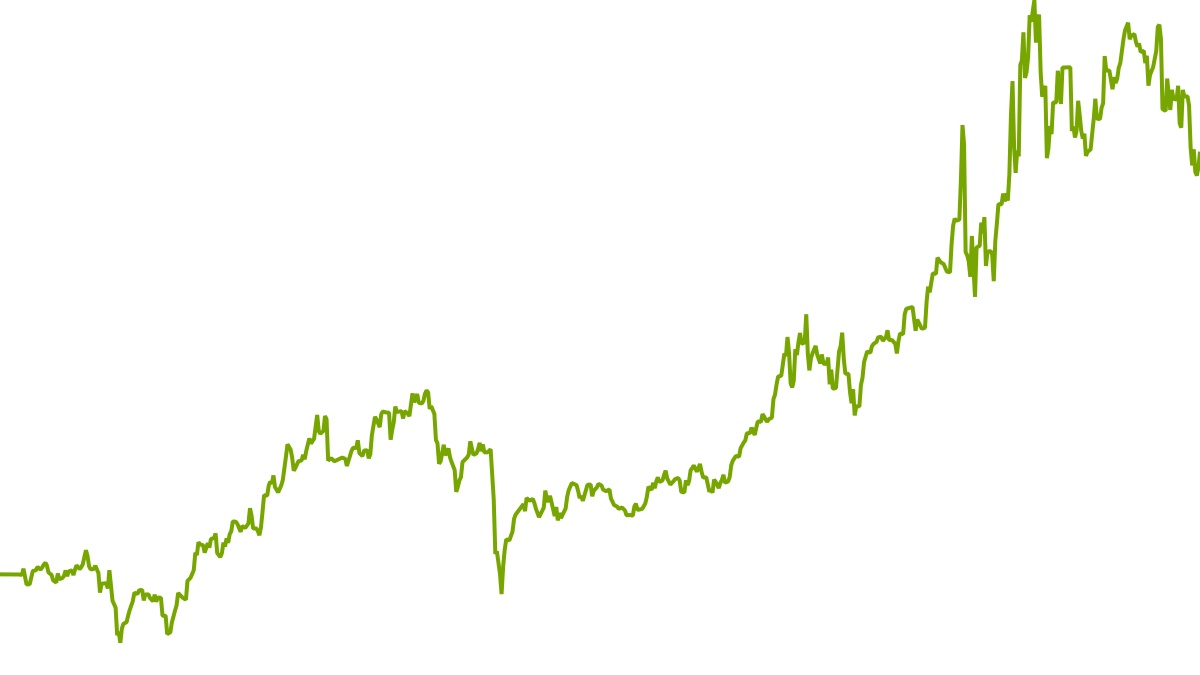
July was another month to hang in there. Here’s the update:
Asset Performance 07/26 (June 30–July 31, according to Wikifolio)
3xUSDEUR: -2.3%
3xQQQ: -16.0%
3xEU50: +4.3%
3xGTAA Portfolio (June 30, according to Getquin)
June 30, 2026: €136,040
July 31, 2026: €124,540
Wikifolio Certificate (June 30, mid-market rate according to Wikifolio)
June 30, 26: €211.60
July 31, 26: €193.70
Month: -8.5%
YTD: +18.7%
Review 07/26
With a loss of -8.5%, 3xGTAA has posted another month of losses. This time, the losses were driven by the Nasdaq 100. In particular, the high volatility there is taking a significant toll on leveraged ETFs, which reset their leverage to 3 every day. The USD and Euro STOXX 50 are trading virtually unchanged after minor fluctuations.
Outlook 08/26
The markets seem to be slowly shifting their focus to U.S. interest rates, as already suggested in the last update. While the price of oil is rising significantly again, interest-rate-sensitive growth stocks are losing ground. WTI is trading above the SMA150 again and, due to its higher momentum, is once more taking the place of USDEUR.
The allocation for 8/26 is therefore:
2xWTI
3xQQQ
3xEU50
Report from the 3xGTAA Workshop
The price movement of WTI clearly illustrates the systematic risk of a rule-based momentum strategy. Right at the turn of the month, the price hits an interim low and then rises again. In the meantime, 2xWTI is up 60%. What conclusions can be drawn from this? The answer is: none. Why?
Across most asset classes and regions, the momentum effect is only measurable over a time horizon of at least one month. Below that, other effects dominate, such as mean reversion or political factors. From a momentum perspective, the fact that the WTI price turns right at the start of the month is therefore unpredictable and thus likely a coincidence. The backtests and model parameters have already factored this coincidence in. Perhaps next month an asset will turn to “sell” just in time before it drops significantly? We don’t know, and we don’t need to. And it’s not worth getting upset about.
Incidentally, this presents a certain psychological challenge: continuing to follow the rules and trusting the model, even when it occasionally generates signals that, in hindsight, do not seem optimal. This challenge is likely also a major reason why momentum strategies have not yet gained widespread acceptance. Trust in momentum is lacking because understanding is lacking. That’s why it’s not enough to cobble together a few parameters for a model that look good in backtesting—understanding the asset basket, the chosen parameters, and momentum in general is essential for long-term success. Otherwise, you’ll change your strategy at the first sign of volatility or abandon it entirely—just before it starts performing again. Therefore:
May the understanding of momentum be with you!
Yours, Epi
EDIT: Due to the sharp decline, WTI is trading well below the signal line as of August 1. So the July allocation remains in effect.