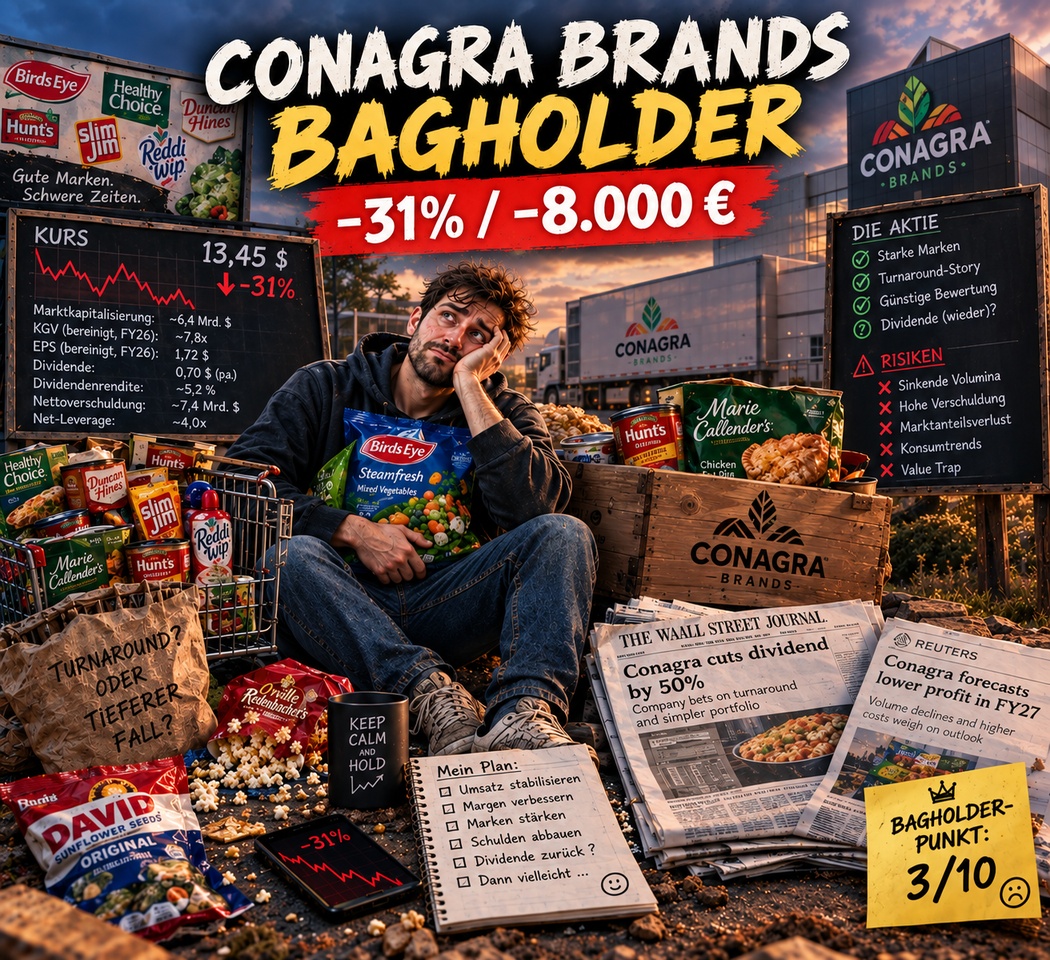
It's day three, and it's time to introduce you to my third "bagholder" stock: Conagra Brands ($CAG (+0.14%)) definitely isn’t sitting well with the portfolio...
👉🏻 Purchase value: 26,000 euros
👉🏻 Loss: 8,000 euros (-31%)
🌽 Brief Profile
Conagra Brands is one of the major U.S. food companies and focuses on branded foods for everyday consumption. Its portfolio includes, among others, Birds Eye, Healthy Choice, Marie Callender’s, Slim Jim, Duncan Hines, Reddi-wip, Hunt’s, Orville Redenbacher’s, BOOMCHICKAPOP, and DAVID Seeds (who doesn’t know these brands?! 😉)
The business ranges from frozen meals and snacks to shelf-stable foods, refrigerated products, and foodservice. In fiscal year 2026, Conagra generated revenue of approximately $11.3 billion.
📊 Fundamental Data
At a share price of around $13.45, the figures are approximately:
Market capitalization: ~$6.4 billion
P/E ratio (adjusted, FY26): ~7.8x
P/E ratio (based on FY27 guidance): ~9.0–9.6x
EPS (adjusted, FY26): $1.72
FY27 EPS Forecast: $1.40–1.50
Dividend: $0.70 p.a. (cut by 50%)
Dividend Yield: ~5.2%
Revenue FY26: $11.3 billion
Net debt: ~$7.4 billion
At first glance, the valuation looks quite attractive. Unfortunately, however, this isn’t a classic “everything’s going well, but the stock is cheap” scenario. Adjusted EPS is declining, and debt is relatively high. In addition, the 2026 dividend was cut by 50% from $1.40 to $0.70.
📉 How is the business performing right now?
Conagra is in the midst of a turnaround. In fiscal year 2026, revenue declined by 2.9% to $11.3 billion. Adjusted earnings per share were $1.72, while the adjusted operating margin fell to 11.3%. At the same time, the company had to report a balance sheet loss of $4.00 per share due to impairments of brands and goodwill.
The new CEO, John Brase, plans to significantly streamline the company. Non-strategic business units are to be reviewed and, if necessary, sold. At the same time, the company plans to invest more heavily in its brands again.
The recently released Q1 FY27 results paint a mixed picture:
Revenue fell by 1.4%, with organic revenue down 1.1%. Even more concerning: sales volumes declined by 2.1%. At the same time, Conagra was able to increase adjusted EPS by 5.1% to $0.41.
Profits are currently performing better than revenue. Conagra is therefore already trying to stabilize margins through productivity, cost control, and pricing. The FY27 forecast was confirmed after Q1. Revenues and profits are also expected to continue falling in 2027 (Ouch)...
🧐 Why might the stock be a bargain?
The market currently values Conagra as if the turnaround were proceeding very slowly.
At around $13.45, the stock trades at less than 8 times last year’s adjusted earnings and about 9 times the earnings expected for FY27. At the same time, Conagra owns some extremely well-known brands (at least in the U.S.) and is very strongly positioned in categories such as frozen foods and snacks.
Conagra doesn’t need to become a growth company. If the company manages to stabilize revenue, push margins up slightly, and reduce debt at the same time, even a relatively small operational improvement could have a significant impact on the stock price.
The new strategy is based on reducing complexity, placing greater emphasis on strong brands (primarily through increased advertising spending), and debt reduction.
The new CEO even plans to increase advertising spending by about 14%, as Conagra believes it had recently underinvested in its brands. At the same time, non-strategic business units are to be sold off.
And there are already early signs that not everything is going badly: In Q1, for example, Conagra gained market share in several categories, including frozen meals, frozen vegetables, meat snacks, and pudding.
⚠️ Why is the stock still so cheap?
Revenue is shrinking, volumes are declining, and the operating margin is under pressure. In Q1 FY27, organic volume declined by 2.1%. Conagra was able to partially offset this through pricing and mix—but at some point, you can’t keep offsetting falling volumes with rising prices indefinitely.
On top of that, there’s the debt. With about $7.4 billion in net debt and a net leverage ratio of just under 4x, Conagra is significantly more indebted than I’d like to see in a defensive food company. Even though the company is currently in the process of reducing its debt—halving the dividend will help significantly here and is, in my opinion, unfortunately necessary for that reason.
Not to mention the high inflation in transportation and logistics. The consumer side is also challenging: U.S. consumers have become more price-sensitive and are increasingly turning to cheaper private-label brands. At the same time, the trend toward healthier eating is changing long-term demand for certain highly processed foods.
🎯 My Bagholder Conclusion -> 3/10 Bagholder Points 🤑
Conagra isn’t currently an investment case for me, despite its seemingly attractive valuation. The biggest risk, in my view, is a value trap. The stock looks cheap with a P/E ratio of ~8, but if revenue and margins continue to fall, that supposedly cheap P/E ratio could quickly look significantly higher again.😅
Nevertheless, I’m staying invested for now. However, I’m not planning any additional purchases at this time.
All in all, all is not lost yet. Conagra doesn’t even need to make a major return to growth. The only thing they need to do is stop getting worse!
I really hope they succeed, and until then, I’ll “enjoy” the 5% dividend yield (based on the current price) ... 🫠