Summary
- Extreme short positioning in the oil market.
- The physical market remains tight despite weak sentiment.
- A bullish catalyst could trigger short covering and CTA buying.
- Asymmetric risk-reward ratio on the upside.
Catalyst
During the NATO summit in Ankara, Donald Trump strongly hinted that the Memorandum of Understanding has now come to an end. The MOU had already been struggling for weeks; the 14-point plan failed to gain traction, and now the show has come to an end. $BRNT (+2.82%) reacted to the news with a 5% rise.
Managed Money
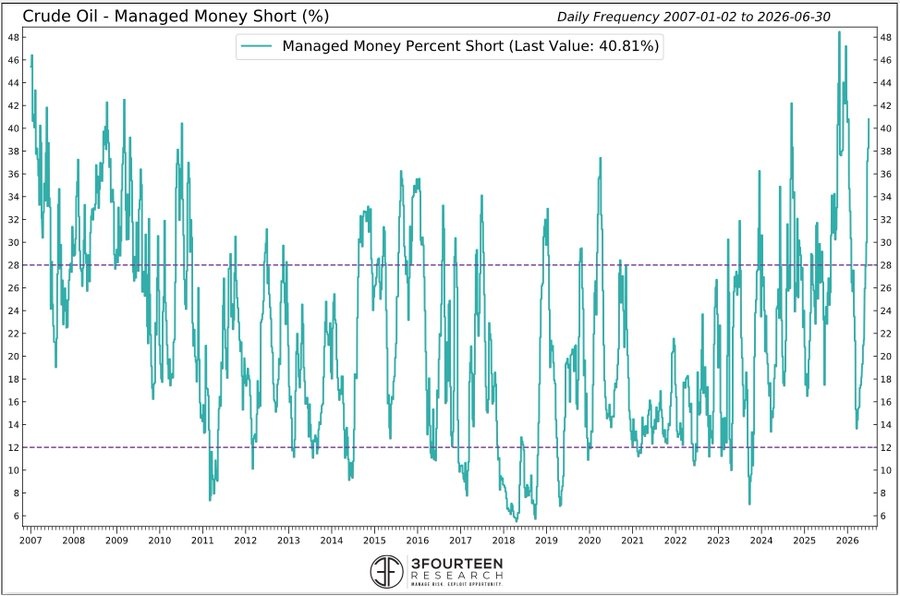
The Managed Money Short (MMS) statistics show that approximately 40% are short on oil, due to the ongoing talks, the ceasefire, and the rhetoric from the Trump administration. If news emerges that contradicts this strategic thinking (as the current news cycle suggests), these short positions must be closed out quickly. This pressure drives the price higher, which in turn forces more short sellers to cover their positions.
CTA Positioning
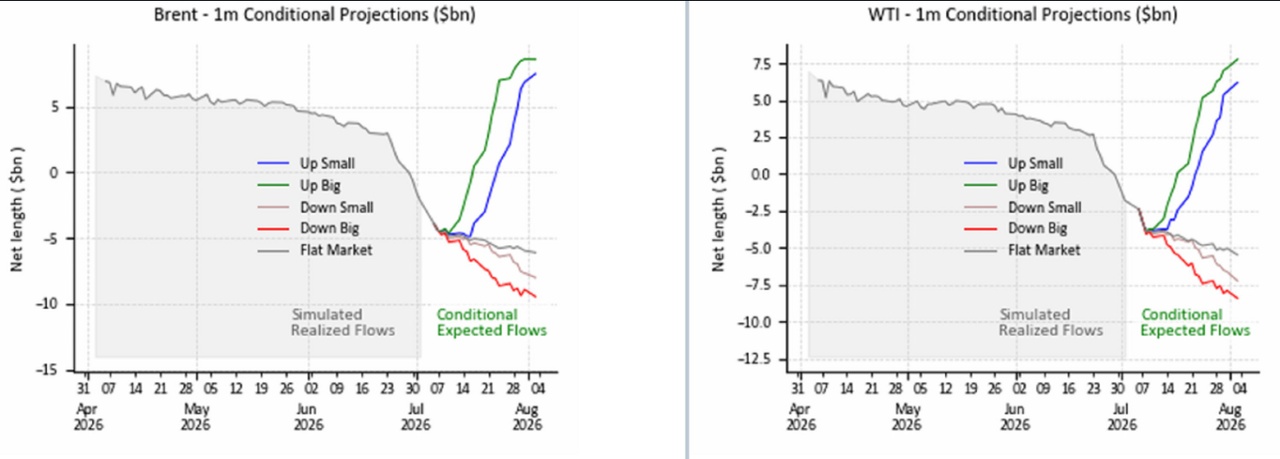
Current CTA positions also indicate a speculative opportunity. Both $BRNT (+2.82%) as well as $CRUD (+1.25%) show a net short level of about -5 billion USD. The CTAs are currently heavily overcrowded and are betting on falling prices. Both have simulated strong “Up Small” and “Up Big” potential. Should a catalyst drive the market higher, the simulations (Conditional Expected Flows) indicate a massive reallocation, as mentioned above. This would mean that, in the event of a price breakout, the CTAs would have to quickly close their short positions and switch to massive long purchases. If, on the other hand, the market continues to fall, there is potential for a “Down Big” move—that is, a further strengthening of short positions.
Physical Market
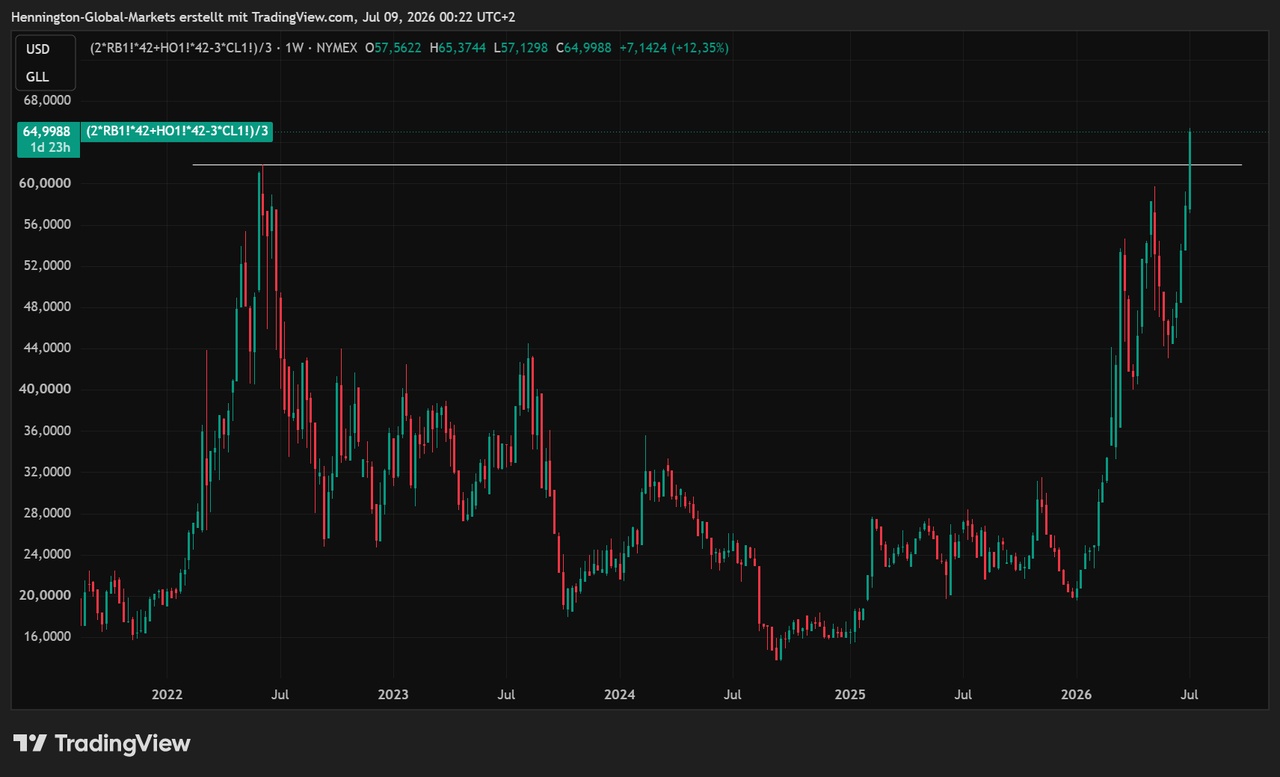
Additionally, one can focus on the crack spread. A high crack spread indicates that refined products, such as $B4N2 (+2.29%) and $B4N1 (+3.01%) relative to $BRNT (+2.82%) are very expensive. This means that refineries are currently achieving exceptionally high gross margins. Such a spread typically arises when demand for products is high, product supply is tight, or refinery capacity is limited! Currently, refinery utilization stands at around 96%. At the same time, inventories of gasoline and other distillates have recently continued to decline and are below their 5-year average. The high refinery utilization rate therefore suggests that the market is not well-supplied. This is relevant for oil in that a persistently tight product market generally supports refineries’ demand for crude oil.
Trade Rationale
The market currently exhibits a rare combination of:
- extremely bearish positioning,
- a tight physical market, and
- potential geopolitical catalysts
Should the geopolitical situation continue to escalate or market sentiment shift, this could trigger a disproportionately strong upward momentum driven by short covering and CTA buying.