
Anyone who believes that only big names count in aviation is underestimating the power of small parts. The recipe for success of TransDigm.
Small parts, big importance
TransDigm is not a classic aviation supplier. The company does not sell large systems, engines or aircraft. It concentrates on small, highly specialized components - and this is precisely where its strength lies.
The business model is as simple as it is effective. TransDigm develops and produces highly critical components for aircraft that make up only a tiny proportion of the overall costs, but are essential for operation. These include valves, pumps, sensors, actuators, seat belts, cockpit systems and parachutes for military applications.
These parts usually fulfill a single, clearly defined function. If one component fails, the entire aircraft is grounded. This is precisely why quality, certification and reliability are crucial - and this is where TransDigm builds its moat.
The crucial point is specialization. Around 90 % of the products are proprietary, i.e. developed in-house and often only available from TransDigm.
The moat: Certification and monopolies
Once a component has been integrated into an aircraft design, it often remains there for decades. Replacing it with another supplier would be expensive, time-consuming and involve new certifications. This is not worth it for airlines.
This creates a second, even more important revenue stream: the spare parts business. Aircraft typically remain in service for over 20 years and some aircraft types for over 50 years.
The Boeing 747, for example, had its maiden flight in 1969. It was built until 2023 and will therefore continue to fly for decades to come.
During this time, components will need to be regularly serviced or replaced. TransDigm therefore not only earns money from initial sales to aircraft manufacturers such as Boeing or Airbusbut above all in the lucrative aftermarket. This model ensures stable, predictable income and high margins.
The product portfolio is broad, but consistently focused. In the cabin segment, TransDigm supplies seat belts, latches and interior systems, among other things. In the technical area, more complex components such as pumps, valves, sensors and control elements are added. In addition, there are avionic components such as antennas or cockpit hardware, which are necessary for communication and data transmission.
The company also has a strong presence in the defense sector. Here, TransDigm supplies components for military aircraft, helicopters and special applications. These programs often run for decades and offer correspondingly long-term sales.
A specialist for takeovers
Acquisitions are another key component of the Group's strategy. TransDigm must be seen as a specialist in acquisitions.
Over the years, the company has consistently acquired small to medium-sized suppliers of niche components.
The decisive factor is always the same pattern: proprietary products, high entry barriers and a significant share of the spare parts business. TransDigm only buys companies with monopolistic or oligopolistic structures. After the takeover, the companies continue to operate independently, but are strictly optimized for profitability and cash flow.
TransDigm plays a special role in the industry. While large suppliers such as Safran or Honeywell supply complete systems, TransDigm specifically occupies small, often overlooked niches - and dominates them.
A large part of its turnover comes from parts that only bring in a few million dollars a year. This enormous diversification contributes significantly to the company's resilience.
Diversification as a stability factor
This is why TransDigm is what it is today: a group made up of a large number of small monopolies and oligopolies.
The result is a company with exceptional pricing power. TransDigm does not sell interchangeable products, but certified key components with high relevance for safety and operation.
This strategy has enabled TransDigm to increase its turnover from USD 3.17 billion to USD 8.83 billion within ten years.
At the same time, the operating margin has improved from around 41% to around 47%. Earnings have multiplied from USD 11.49 to USD 37.33 per share.
The expansionary strategy was not financed by capital increases; the number of shares outstanding Aktien has only risen from 56 to 58 million shares during this period.
The positive development has continued in the current financial year, although growth rates are currently comparatively low.
In the first quarter, earnings of USD 8.23 per share exceeded expectations of USD 8.10. With sales of USD 2.29 billion, analysts' estimates of USD 2.26 billion were also exceeded.
For the year as a whole, this corresponds to a 14% increase in sales and a 5% rise in profit.
The next subsidiaries
TransDigm is suffering from the difficult conditions in the sector. Boeing and Airbus are experiencing enormous demand, but Boeing is still having internal problems and Airbus is not getting enough parts.
Meanwhile, TransDigm is carrying out one acquisition after another as usual. In October, the acquisition of Simmonds Precision Products, a former subsidiary of RTX Corp.
In addition, agreements were reached for the purchase of Stellant Systems, Jet Parts Engineering and Victor Sierra Aviation. In total, TransDigm is investing USD 3.2 billion in the three new subsidiaries, following the usual pattern.
Stellant is a leading global designer and manufacturer of high-performance electronic components and subsystems for the aerospace and defense sector.
Jet Parts Engineering is a leading independent designer and manufacturer of solutions for the aerospace aftermarket, particularly for repair and proprietary original equipment manufacturer ("OEM") parts.
Valuation: Not a bargain, but justified?
Victor Sierra Aviation is a leading developer, manufacturer and distributor of proprietary PMA ("Parts Manufacturer Approval") parts and other aftermarket parts for the civil aviation market - primarily in the general aviation and business aircraft sectors.
The sales forecast for the current financial year has been raised from USD 9.85 billion to USD 9.94 billion and the earnings expectations from USD 36.49 - 38.53 to USD 37.42 - 39.34 per share.
As TransDigm raises its outlook in the majority of quarters, there is a good chance that it will end up with a little more.
TransDigm currently has a forward P/E of 30.6, which means that the share is not a classic bargain, but the valuation is justifiable. In the last five years, the P/E was 35
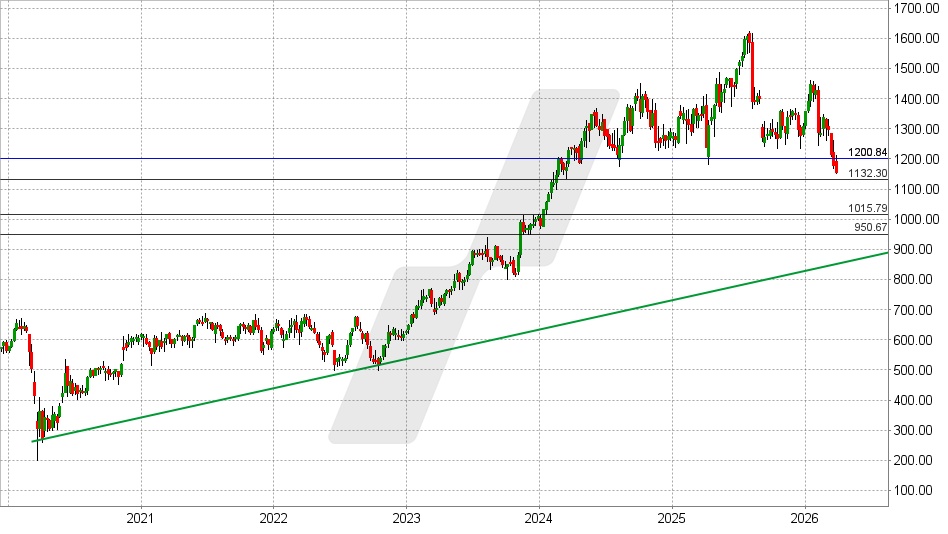
TransDigm share: Chart from 20.03.2026, price: USD 1,153 - abbreviation: TDG | Source: TWS
The current environment is putting pressure on the share price. If the share falls below USD 1,200 on a sustained basis, there is a risk of further price losses. The next relevant support levels are USD 1,130, USD 1,100 and USD 1,015.
However, if the share price manages to return above USD 1,200, the situation will ease again.
The direction in which the price will develop in the short term will depend primarily on political decisions. However, the underlying business trends are intact.
Source


