
The master hits the nail on the head.
AI eats software or maybe not...we will see...
a few thoughts on the example of Roper from my favorite stock analyst...
Have fun
At a time when software is being labeled as an AI loser, even companies like Roper are falling by the wayside. Is the threat real?
Decentralization meets iron capital discipline
Roper Technologies is an unusual company. At first glance, it appears to be an ordinary group. But if you take a closer look, you will discover a decentralized and disciplined capital manager that systematically acquires important niche players.
Acquisitions are not an accessory, they are the core of the business model. Roper specifically buys companies that meet three criteria: recurring income, a leading position in a niche and attractive margins with low capital commitment.
The teams are then left to continue working locally, with capital and strategy being managed from above. This combination of decentralization and strict capital allocation is at the heart of the business model.
Roper gives the subsidiaries a great deal of freedom. Product development, sales and customer contact remain local. The head office hardly interferes in operational details, but fulfills two tasks: Distributing capital efficiently and setting strategic guidelines.
To a certain extent, this is reminiscent of Berkshire.
From a financial point of view, the model is elegant. The business divisions tie up little capital. Software has high gross margins and generates predictable and recurring revenues.
This results in a steadily increasing cash flow, which Roper can systematically reinvest.
Why Roper is reminiscent of Berkshire Hathaway
The structure of the Group is clearly organized. Roper reports its activities in the Application Software, Network Software and Technology-Enabled Products divisions. Application Software delivers vertical, mostly mission-critical software solutions with a high SaaS and subscription component.
Network Software operates data and transaction platforms with long-term contracts and network effects.
Technology-Enabled Products comprises specialized, often technically complex products such as measurement or medical technology, which complement the software portfolio in a meaningful way.
The competitive advantage lies less in technological wonders than in customer loyalty and specialization. Vertical software is deeply embedded in the processes of hospitals, insurers or construction companies. Switching to a new system costs time and money.
These moats protect Roper.
But risks still exist. The business model is heavily dependent on the ability to find suitable acquisitions and to acquire them at fair prices.
However, as software has been sidelined on the capital markets, further acquisitions should not be a problem at present.
Why the current market environment plays into Roper's hands
In the software environment, whether on the Börse and beyond, valuations are currently being called up that were unimaginable a few years ago - and this plays into Roper's hands.
Roper itself is a good example of this. The business figures for the last few quarters and the outlook are at roughly the same level as they have been for many years.
In the financial year just ended, profits rose by 9 % to a record result of USD 20.00 per share.
In the current financial year, earnings are expected to rise by 7 % to USD 21.45 per share.
The current situation could justifiably be described as "business as usual".
What is not business as usual, however, is Roper's valuation. The company is currently valued at a forward P/E of 16.3.
In the long term, the P/E hovers around a value of 28.7. Even at the absolute lows of 2020 and 2022, the P/E was still over 20.
Why Roper is traded as an AI loser
You can probably already guess why this is the case. Roper is traded as an AI loser, just like many other software companies.
The probability that Roper will be disrupted by KIdisruption is, in my view, low, at least significantly lower than for many other software or technology companies.
Roper's offerings are primarily focused on critical workflows in narrow niches. This makes the business model more robust in the face of disruptive technological leaps.
AI changes tools, but it does not automatically replace deeply embedded processes, regulatory expertise and customer relationships that have grown over decades.
You can rely on inertia
The most important protective shield here is vertical alignment. Roper's software often sits right at the operational heart of its customers. Hospital billing, insurance administration, construction project management or regulatory documentation are not playgrounds for experimentation. Customers don't switch here because of a better feature, but only if the existing provider is fundamentally failing.
AI can improve this software, but it will not make it obsolete overnight. A new AI startup would not only have to build a better product, but also master regulatory approvals, integrations and data migrations.
But above all, one thing would have to be achieved. The new systems would have to be so good and so cheap that it would be worth retraining all the employees who have been working with Roper's systems up to now.
And even if this were the case from the company's point of view, resistance from the workforce is to be expected.
Very few people are happy about change. They would much rather keep the old systems than laboriously familiarize themselves with new ones.
Could Roper even be an AI winner?
What's more, people seem to completely ignore the fact that Roper could just as easily be an AI winner.
Most subsidiaries can use AI to make existing products more efficient, accurate or automated. Examples include better forecasting, automated classification, smarter workflows or reduced manual labor. All of this strengthens the benefits of the software and further increases the switching costs.
So where is the Risiko? It lies less in the disruption of existing sales and more in the long-term competitive dynamics. AI lowers the development costs for software in some areas. This can give rise to new competitors, especially in less regulated segments.
Price pressure or faster innovation cycles could arise in peripheral areas of Roper's portfolio. This mainly concerns functions with less process criticality or where data standardization is high.
However, this is not yet the case and it is completely unclear which factor will ultimately prevailIncreasing pressure from competitors or in-house efficiency gains through AI?
It should not be forgotten that Roper employs thousands of developers whose productivity is likely to increase significantly thanks to AI.
Numbers don't lie
So far, the figures do not indicate any problems. Roper's earnings of USD 5.21 per share in the last quarter exceeded expectations of USD 5.14. With sales of USD 2.06 billion, the company fell slightly short of analysts' estimates of USD 2.08 billion.
For the year as a whole, this corresponds to a 10 % increase in sales and an 8 % rise in profits.
All business segments contributed to this growth. In the Application Software segment, sales increased from USD 1.057 billion to USD 1.159 billion.
Sales in the Network Software segment climbed from USD 374 million to USD 426 million and the Technology Enabled Products segment recorded an increase in sales from USD 447 million to USD 474 million
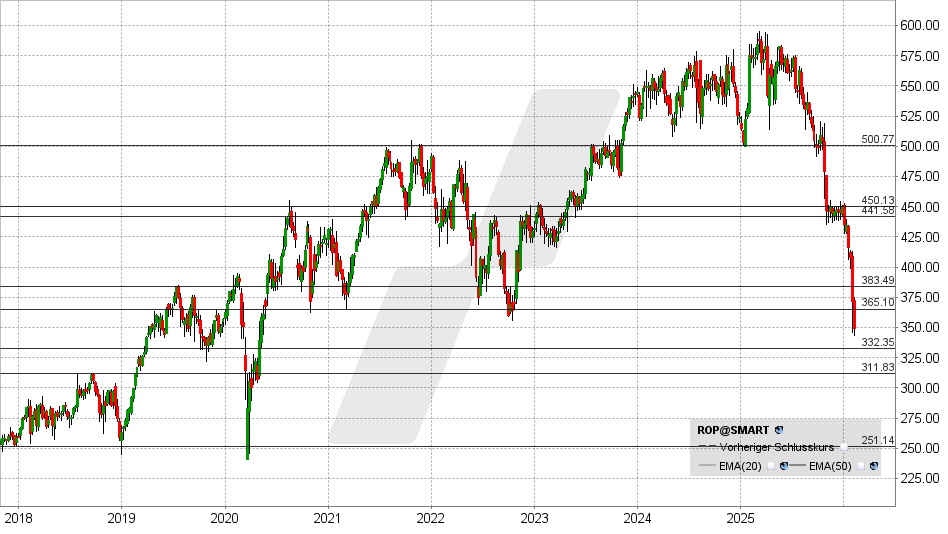
Roper Technologies share: Chart from 04.02.2026, price: USD 348 - symbol: ROP | source: TWS
The same applies to the financial year just ended. The bottom line is that sales increased by 12% to USD 7.90 billion. Organic growth amounted to 5 % and 7 % was attributable to acquisitions.
Profit increased by 9 % to USD 20.00.
In addition, share buybacks with a volume of USD 3.0 billion were recently approved. In the fourth quarter, the company followed up the announcement with action and bought back USD 500 million of its own shares. Aktienshares.
Source