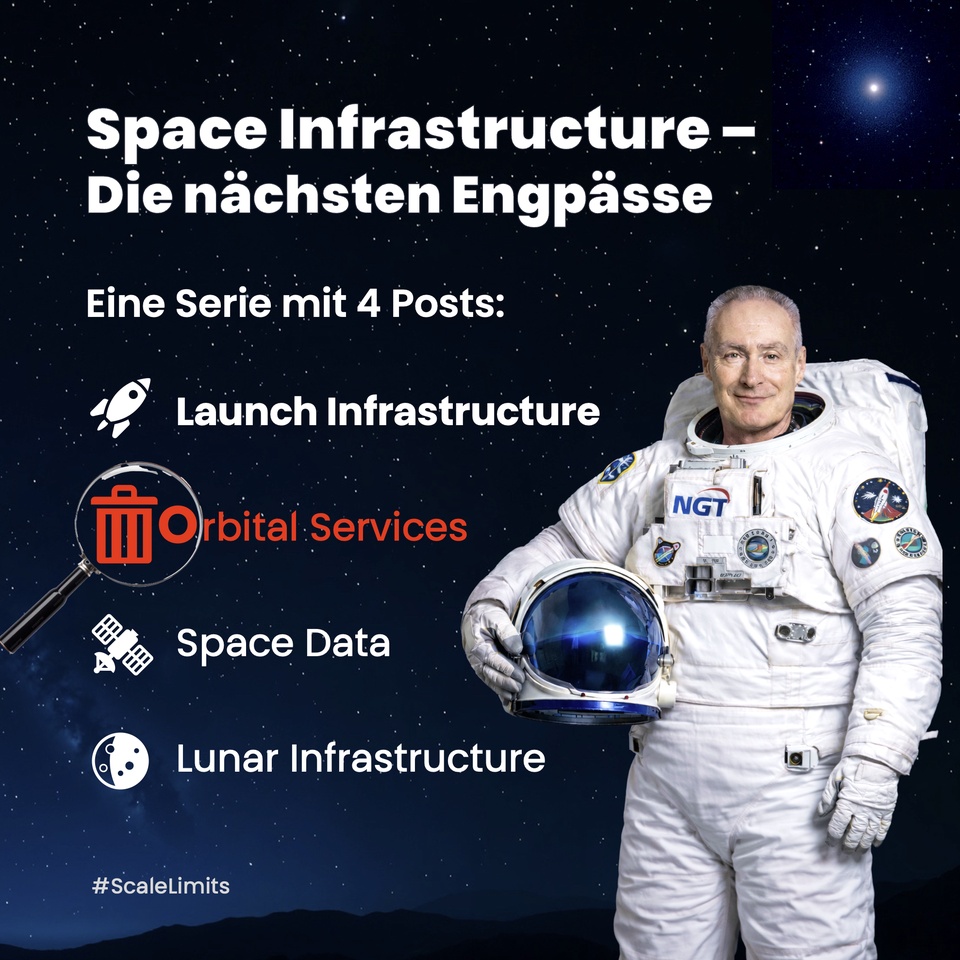
With increasing activity in orbit, the bottleneck is slowly shifting further. Access to space is becoming cheaper and more frequent. At the same time, however, a new problem is growing: Who will control, maintain and protect the emerging infrastructure up there?
This is where the next level of space infrastructure begins. The more satellites, stations and military systems there are in orbit, the more important visibility, control and operational monitoring become increasingly important. Orbit is gradually developing from a largely unregulated space into an increasingly dense infrastructure zone.
Orbital Services encompasses much more than just "space repairs". The new bottleneck arises in areas such as:
- Space domain awareness - Overview and control of orbital activities
- Debris Removal - Removal of hazardous space debris
- On-Orbit Servicing - Maintenance of technical systems in space
- Refueling - Refueling of orbital infrastructure
- Repair and maintenance systems - Longer service life of critical systems
- precise navigation and control - Stable positioning in orbit
- secure communication between orbital systems - resilient data and control levels
- frequency and spectrum management - limited communication resources in orbit
- re-entry services - Controlled return of satellites, samples and materials to earth
With increasing satellite density stability more important than mere presence in orbit. A single failure, collision or uncontrolled space debris could have a major impact on entire communication and infrastructure systems in the future. This is precisely why control and maintenance more strategically relevant in the long term.
Companies such as $186A (+4,78%) (Astroscale, Japan) are addressing early debris and servicing issues. $MDA (MDA Space, Canada) is working on robotic servicing and control systems. $OHB (+0,19%) (OHB, Germany) is increasingly positioning itself along European satellite and infrastructure programs. $RDW (-2,4%) (Redwire, USA) addresses technical systems for the permanent operation of orbital infrastructure.
In addition, new requirements are arising from military use, resilient communication networks and the increasing commercialization of orbit.
However, many of these areas are still at an early stage. Numerous specialized companies are privately financed, small or not yet investable. Especially in debris removal, reentry and orbital maintenance, an independent industrial ecosystem is only slowly emerging. In my view, this makes the development strategically interesting, but at the same time difficult to invest in directly.
The bottleneck is therefore shifting again. No longer just: Can we get infrastructure into space? But rather: Can we control and operate it up there permanently?
More on this in the third post in the series on "Space Data".