

Amazon is earning more than ever before: In the third quarter of 2026, revenue rose 12% to $201.9 billion, and operating income jumped 61% to $28.1 billion—the operating margin of 13.9% is a record. The driving force is the AWS cloud division, which, at 39%, is growing faster than it has in years and now generates annual revenue of $184 billion. The cost of this growth: approximately $220 billion in investments in data centers, AI chips, and satellites in 2026 alone; free cash flow for the past twelve months is deeply negative at −$42.4 billion. As a result, the stock has been fluctuating for months within a wide trading range between $227.40 and $276 and is currently trading at $256.51 (Nasdaq, Nov. 17, 2026), about 11% below its all-time high of $287.20. Only a breakout above the record high would make the price target of $332.68 likely; a break below $227.40, on the other hand, would trigger a massive pullback to $163.45. Analysts’ average target is $328.54.
Key Points
- Q3 2026: Revenue $201.9 billion (+12%), operating income $28.1 billion (+61%), margin 13.9%
- AWS: Revenue of $46.0 billion (+39%), operating profit of $17.8 billion, annualized revenue of $184 billion
- Earnings per share of $1.89, slightly below the expected $1.96
- Q4 Outlook: Revenue of $240 billion to $247 billion, operating income of $28.5 billion to $33.5 billion
- Investments in 2026: approximately $220 billion; free cash flow (12 months): −$42.4 billion
- No dividend—Amazon is investing every dollar in growth
- Analysts: Average price target $328.54, range $250 to $390
- Chart levels: Trading range $227.40 to $276, all-time high $287.20, price target $332.68, downside risk to $163.45
What are Amazon’s current key metrics?
With a market capitalization of approximately $2.77 trillion, Amazon is one of the world’s most valuable companies, and according to Aktienfinder, its adjusted P/E ratio of around 18 makes it one of the most attractively valued stocks in recent memory: On average over the past ten years, investors have paid 41 times earnings.
In terms of operating cash flow, the price-to-cash-flow ratio of 16.7 is also below the ten-year average of 22.7. In terms of revenue, however, the stock is slightly more expensive than average (3.1), trading at 3.5 times revenue. Amazon does not pay a dividend.
- Price (Nasdaq: AMZN): $256.51 (Nov. 17, 2026)
- All-time high = 52-week high: $287.20 (August 2026)
- 52-week low: $196.00 (February 2026)
- Year-to-date performance: approximately +10% (November 17, 2026)
- Market capitalization: approx. $2.77 trillion (November 17, 2026)
- Revenue for Q3 2026: $201.9 billion (+12%) (October 29, 2026)
- Operating income for Q3 2026: $28.1 billion (+61%, margin 13.9%) (October 29, 2026)
- AWS revenue for Q3 2026: $46.0 billion (+39%) (October 29, 2026)
- AWS operating profit for Q3 2026: $17.8 billion (Oct. 29, 2026)
- North America Q3 2026: $112.9 billion (+6%), operating profit $8.7 billion (Oct. 29, 2026)
- International Q3 2026: $43.1 billion, operating profit $1.6 billion (Oct. 29, 2026)
- Earnings per share Q3 2026: $1.89 (expected approx. $1.96) (Oct. 29, 2026)
- Free Cash Flow (12 months): −$42.4 billion (September 30, 2026)
- Capital expenditures for 2026 (planned): approximately $220 billion (Oct. 29, 2026)
- Adjusted P/E ratio (current / 10-year average): 18.2 / 41.2 (Aktienfinder, Nov. 17, 2026)
- Current P/B ratio / 10-year average: 16.7 / 22.7 (Aktienfinder, Nov. 17, 2026)
- Current P/S ratio / 10-year average: 3.5 / 3.1 (Aktienfinder, November 17, 2026)
- Average Analyst Price Target: $328.54 (+28%) (FMP Consensus, November 17, 2026)
- Q4 2026 Outlook: Revenue $240–247 billion, operating income $28.5–33.5 billion (Oct. 29, 2026)
- Dividend: none (—)
- Next Date: Q4 earnings expected in early February 2027 (not yet confirmed)
- Index: Nasdaq 100, S&P 500, Dow Jones (—)
- WKN / ISIN / Ticker: 906866 / US0231351067 / AMZN (—)
What news is currently driving Amazon stock?
Amazon stock is currently driven primarily by the question of whether the massive investments of around $220 billion in AI data centers and satellites are paying off—the Q3 results on October 29 provided the strongest evidence to date, with AWS growing at a rate not seen in years.
Nevertheless, the stock subsequently faltered again at the resistance zone between $267 and $276 because earnings per share were slightly below expectations and free cash flow remains deeply in the red. On top of that, the Amazon Leo satellite project suffered a setback on November 15: a Vulcan rocket carrying 40 satellites failed. My analysis of the SpaceX Aktie.
- November 15, 2026 – False Start for Amazon Leo: A Vulcan rocket carrying 40 Amazon Leo satellites fails—the first of 38 scheduled Vulcan launches. Next launch planned for November 23 with Ariane 6 and 36 satellites. (Bearish)
- November 3, 2026 – Price Targets After Q3: Phillip Securities (Buy, $330) and Freedom Capital (Buy, $330); Morgan Stanley, Wells Fargo, UBS, RBC, TD Cowen, Mizuho, and Cantor reaffirm their buy recommendations on October 30. (Bullish)
- October 29, 2026 – Q3: AWS +39%, record margin: Revenue of $201.9 billion (+12%), operating income of $28.1 billion (+61%), margin of 13.9%. Earnings per share of $1.89, slightly below expectations. (Bullish)
- October 29, 2026 – Investments continue to rise: Approximately $220 billion in investments in 2026; free cash flow for the last twelve months: −$42.4 billion. (Bearish)
- October 20, 2026 – €16 billion for Germany: Amazon plans to invest more than €16 billion in Germany by 2027, including €4.8 billion in the AWS Frankfurt region. (Neutral)
What does Amazon’s management say about the Q3 figures?
Amazon CEO Andy Jassy sees AI demand as a growth driver: AWS growth continues to accelerate, demand for Amazon’s own AI chips is growing strongly, and AWS management expects growth rates of over 40% for 2027 and 2028.
That’s why Amazon is investing more aggressively than ever in data centers and power infrastructure.
What went well: AWS increased revenue by 39% to $46.0 billion and generated an operating profit of $17.8 billion—more than half of the company’s total net income. Retail is also becoming more profitable: North America generated $8.7 billion in operating profit on $112.9 billion in revenue, while the international business generated $1.6 billion. The consolidated operating margin reached a record 13.9%.
The catch: Earnings per share came in at $1.89, slightly below the expected $1.96. Above all, investments of approximately $220 billion in 2026 will consume the entire operating cash flow; free cash flow for the past twelve months stands at −$42.4 billion. Added to this are high startup costs for the Amazon Leo satellite internet service.
Outlook: For the holiday quarter, Amazon expects revenue of $240 billion to $247 billion and operating income of $28.5 billion to $33.5 billion. Fourth-quarter results are expected in early February 2027.
What does Amazon do, and how does the company make money?
Amazon is the largest online retailer in the Western world and, with Amazon Web Services (AWS), also the largest cloud provider—today, the Seattle-based company earns the majority of its profits not from package deliveries, but from providing computing power to other companies.
Amazon was founded in 1994 by Jeff Bezos; Andy Jassy has led the company since 2021.
Three segments: North America (USD 112.9 billion in revenue in the third quarter of 2026) and International (USD 43.1 billion) encompass online retail of the company’s own products, commissions and logistics fees from marketplace sellers, the Prime subscription with Prime Video, advertising, and groceries. AWS (USD 46.0 billion) provides computing power, storage, and AI services—with an operating margin of nearly 39%, it is by far the most profitable segment.
How Amazon Makes Money: Retail generates revenue, while AWS and advertising generate profit. New growth areas include the company’s own AI chips, the online pharmacy, the Amazon Now express delivery service, and the Amazon Leo satellite internet service, which is intended to compete with Starlink. My analysis of Zalando Aktie.

Highlights of Amazon Stock (AMZN) in the Third Quarter of 2026: Devices, Pharmacy, Advertising, AWS, Logistics, and Amazon Now (as of November 17, 2026) – Source: Amazon Investor Relations / Christian Lill
Amazon Stock Fundamental Analysis: Is Amazon Stock Undervalued Right Now?
Fundamentally, Amazon stock is cheap relative to its own history: According to Aktienfinder, the adjusted P/E ratio is around 18, compared to a ten-year average of 41—the discount reflects concerns that record-high investments will depress returns.
The key question is whether AWS will recoup the invested capital in the coming years.
Growth: Consolidated revenue grew by 12% in the third quarter of 2026, while AWS revenue surged by 39%. Amazon is projecting revenue of $240 billion to $247 billion for the fourth quarter. This puts the company on track for annual revenue well above $800 billion in 2026.
Margins: The operating margin rose to a record 13.9%. The drivers are AWS, with a margin of nearly 39%, highly profitable advertising, and more efficient logistics. The international business remains the weak spot, with $1.6 billion in operating profit on $43.1 billion in revenue.
Cash Flow and Investments: This is where the problem lies. Approximately $220 billion in investments in 2026 significantly exceed operating cash flow; free cash flow for the last twelve months stands at −$42.4 billion. A large portion is flowing into AI data centers and in-house chips—precisely the market in which Nvidia is the leading supplier, as my analysis Nvidia Aktie shows.
Valuation: The price-to-cash-flow ratio of 16.7 is below the ten-year average of 22.7, while the price-to-earnings ratio of 3.5 is slightly above it. Based on adjusted earnings and the average P/E ratio over the past ten years, the Stock Finder calculates a fair value of approximately $507 as of the end of 2027. However, this figure is heavily skewed because, in the years leading up to 2021, investors paid as much as 80 to 100 times earnings in some cases. A more meaningful figure: Even a P/E ratio of 25 based on the earnings expected for 2027 would result in a share price above the current level—provided the investments pay off.
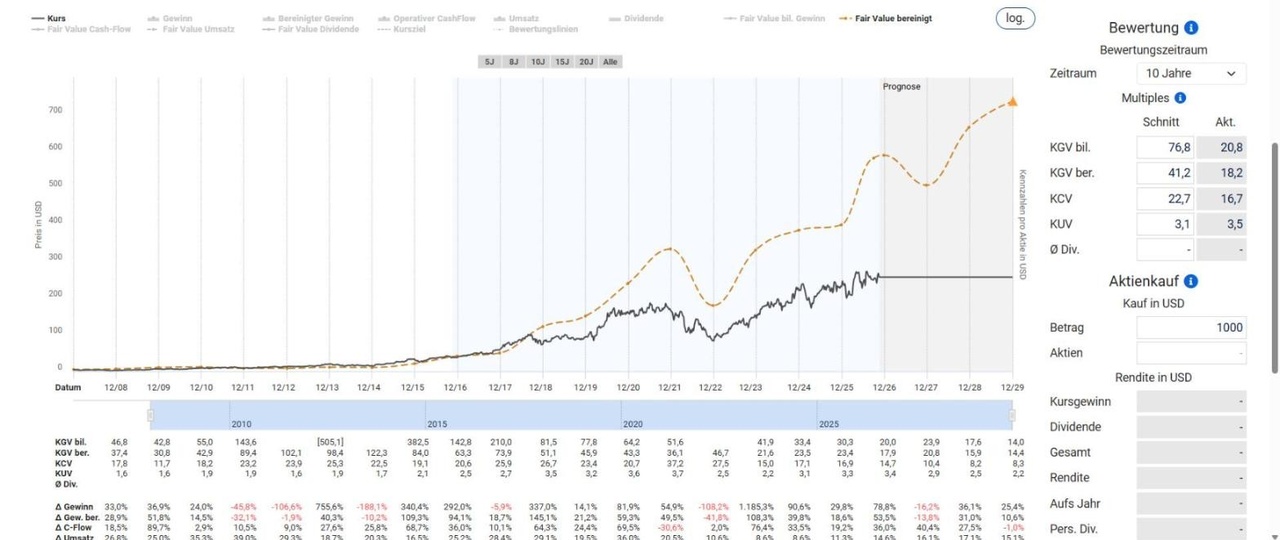
Fair Value Valuation of Amazon Stock (AMZN) for 2027 (as of November 17, 2026) – Source: Aktienfinder / Christian Lill
Amazon Stock Price Targets and Forecast for 2027
Analysts see an average price target of $328.54 for Amazon stock, representing about 28% upside potential—though from a technical analysis perspective, the price target of $332.68 is only likely to be reached after a breakout above the all-time high of $287.20.
Until then, the stock will fluctuate within a trading range between $227.40 and $276. If the lower boundary is breached, a pullback to $163.45 looms. My analysis of AMD Aktie.
Key price levels:
- 52-week high = all-time high: $287.20 (August 2026)
- Current price: $256.51 (Nasdaq, Nov. 17, 2026)
- Resistance zone: $267.10 to $276.06
- Buy signal: Breakout above $287.20
- Price target after breakout: $332.68
- Support: $227.40 (along with the 100-week EMA)
- Critical downside level: $227.40; below that, a pullback to $163.45
Analyst price targets:
- Average price target: $328.54, range $250 to $390 (FMP consensus, Nov. 17, 2026)
- Phillip Securities: Buy, $330 (November 3, 2026)
- Freedom Capital: Buy, $330 (November 2026)
- DZ Bank: Buy, $320 (July 31, 2026)
- Morgan Stanley, Wells Fargo, UBS, RBC, TD Cowen, Mizuho, Cantor: Buy recommendation confirmed (October 30, 2026)
- DA Davidson: Neutral (October 30, 2026)
Chart Analysis:
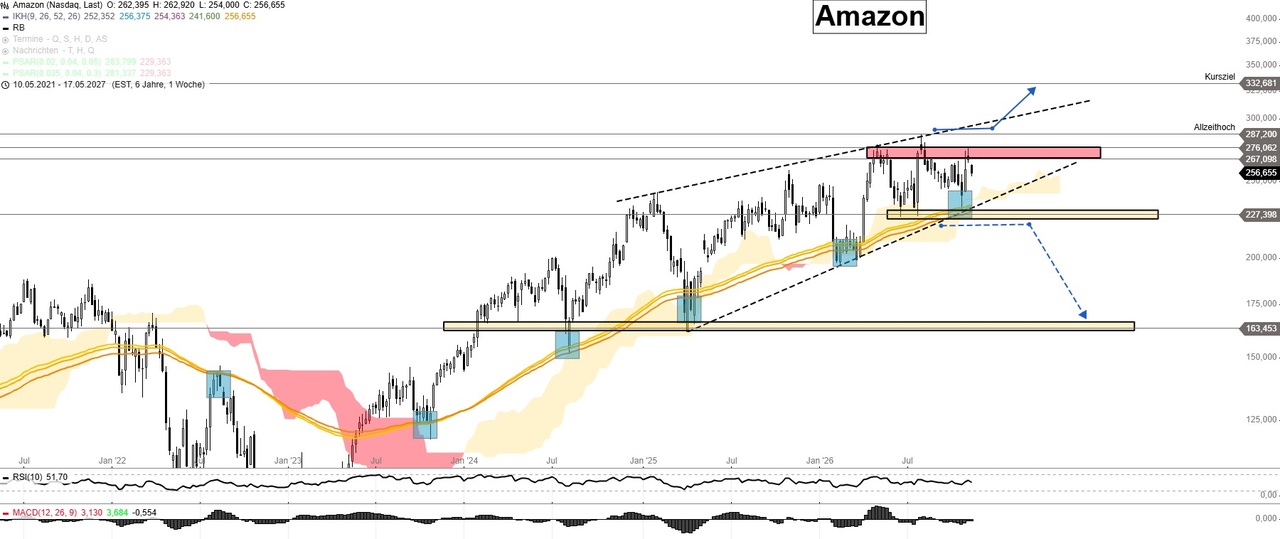
Amazon Stock (AMZN) Chart Analysis and Price Targets for 2027 (as of November 17, 2026) – Source: Stock3 / Christian Lill
On the weekly chart, Amazon stock has established itself in a wide trading range between $227.40 and $276. Since spring 2026, the price has been fluctuating within this range; on the upside, it is held back by the red resistance zone between $267.10 and $276.06, where the stock most recently failed to break through again following the Q3 earnings report. Above that lies the all-time high of $287.20 set in August 2026. The RSI stands at 51.7, right in the middle, while the MACD is just below its signal line—the market is indecisive.
The buy signal (blue arrow): For sustained buying interest, this range must be broken, particularly the record high of $287.20. Only a weekly close above that level would make the price target of $332.68 likely. Then the upward consolidation zone would be broken, and Amazon would enter new territory without resistance.
The risk (blue dashed arrow): If the stock breaks out of the trading range to the downside—that is, falls below $227.40—there is a risk of a massive pullback to $163.45. This yellow zone marks the major support levels from 2024 and 2025.
The 100-day EMA as a pacing factor (blue rectangles): It’s fascinating to see how reliably the weekly 100-period EMA has driven price action since mid-2022. In the summer of 2022 and early 2023, it marked the turning points; in August 2024 and April 2025, it cushioned the major corrections; in the spring of 2026, the stock turned upward again right there, and most recently in October 2026, the pullback once again found support at the EMA 100. Currently, the EMA 100 is trading just above the support level at $227.40, meaning the two levels coincide. Whether this year’s latest pullback already represents the overarching buying opportunity remains to be seen in the coming weeks.
My assessment: For now, I prefer to remain unpositioned. The decision will be made at the edges of the trading range: above $287.20 toward $332.68, below $227.40 toward $163.45.
What is the forecast for Amazon stock in 2030?
According to the FMP consensus (as of November 17, 2026), analysts expect Amazon’s revenue to reach approximately $1.47 trillion and earnings per share to reach approximately $23 —at a P/E ratio of 20 to 25, that would correspond to a share price of around $460 to $575.
This is a sample calculation, not a price forecast: It assumes that Amazon will more than double its earnings per share in four years.
The case for this: AWS is growing at a rate of 39% and, according to management, is expected to grow by over 40% in 2027 and 2028. Investments of approximately $220 billion in 2026 are building the capacity needed for this growth. Amazon Leo, proprietary AI chips, advertising, and healthcare services will add further sources of revenue.
Arguments against this: The earnings estimates for 2030 are based on only one data source and are inherently uncertain. If AI demand falls short of expectations, the high depreciation expenses on the new data centers will weigh on profits. From a technical analysis perspective, a breakout above $287.20 is first needed to make the price target of $332.68 a likely next step.
Does Amazon pay a dividend?
No, Amazon does not pay a dividend and has never paid one since its 1997 IPO—the dividend yield is therefore 0%, and there is no dividend payment scheduled for 2027 either.
Amazon invests all of its money in growth: approximately $220 billion in 2026 in data centers, AI chips, logistics, and satellites. Investors in Amazon therefore earn exclusively through rising stock prices. Those looking for regular payouts will have to turn to other stocks—a dividend would only be on the table for Amazon once free cash flow returns to a significantly positive level.
Conclusion: Should you buy or sell Amazon stock?
Amazon is posting record operating results, but the stock is stuck in a wide trading range between $227.40 and $276—which is why I’m not taking a position here for now and am waiting for a breakout at either end of the range.
Factors in Amazon’s favor include the AWS business growing by 39%, a record margin of 13.9%, the outlook for over 40% AWS growth over the next two years, and an adjusted P/E ratio of around 18, which is well below the ten-year average. My analysis of SAP Aktie.
Factors weighing against the stock include investments of around $220 billion, deeply negative free cash flow, third-quarter earnings per share that fell slightly short of expectations, and costly setbacks with the Amazon Leo satellite project. From a technical analysis perspective: Only a breakout above the record high of $287.20 makes the price target of $332.68 likely. If the stock breaks below the trading range, a massive pullback to $163.45 looms. The 100-week EMA remains a key indicator, as it has repeatedly signaled a reversal since mid-2022.
✅ Opportunities
- AWS is growing by 39%; growth of over 40% expected in 2027/2028
- Record margin of 13.9% in the third quarter
- Adjusted P/E ratio around 18 instead of the 10-year average of 41
- Advertising, AI chips, and Amazon Leo as new sources of profit
- Analysts’ average price target: $328.54
- If the price exceeds $287.20, the price target is likely to rise to $332.68
⚠️ Risks
- Approximately $220 billion in investments in 2026 alone
- Free cash flow (12 months) at −$42.4 billion
- Earnings per share in Q3 slightly below expectations
- A rocky start for Amazon Leo is driving up the cost of satellite expansion
- Red resistance zone of $267 to $276 is holding the stock back
- Below $227.40, a pullback to $163.45 looms
Sources
- Amazon Investor Relations: Third Quarter 2026 Results (Oct. 29, 2026)
- Amazon Press Release: Third Quarter Results 2026 (October 29, 2026)
- Amazon Press Release: €16 Billion in Investments in Germany in 2027 (October 20, 2026)
- Analyst reports via dpa-AFX, MarketScreener, and finanzen.net: Phillip Securities (November 3, 2026), Freedom Capital (November 2026), Morgan Stanley, Wells Fargo, UBS, RBC, TD Cowen, Mizuho, Cantor, DA Davidson (October 30, 2026), DZ Bank (July 31, 2026)
- Consensus estimates and average price target: Financial Modeling Prep (FMP), November 17, 2026
- Reports on the Vulcan launch failure and Amazon Leo: Reuters, SpaceNews (November 15–16, 2026)
- Nasdaq prices: FMP and Stock3, as of November 17, 2026
- Stock3: Weekly chart for Amazon.com Inc. (Nasdaq), as of November 17, 2026
- Aktienfinder: Fair value calculation (adjusted earnings), Amazon valuation metrics, as of November 17, 2026
This is not investment advice—all information is provided solely for financial education purposes.
What are your current thoughts on $AMZN (+3,91%) ?