Hello, everyone,
Anyone who knows me should know that I keep a very close eye on growth sectors for you all. I’m always on the lookout for new opportunities and innovations.
And I’m sure the success of Muse hasn’t escaped your notice either.
As most of you know, I naturally look for potential beneficiaries—that is, companies set to profit.
I look forward to your comments on whether you also see today’s company as a potential beneficiary of Meta Muse.
Meta has achieved surprisingly rapid success with Muse. Just over a week after its U.S. launch, the personal AI agent tops the rankings of free iPhone apps in the U.S., overtaking ChatGPT.
Muse doesn’t just answer questions—it also completes tasks. The agent manages emails and appointments, makes reservations, compares prices, cancels subscriptions, and makes purchases once authorized. It continues to run in its own virtual machine even when the user closes the app and remembers the user’s preferences. Muse is available in the U.S. as an iPhone app and via WhatsApp.
🚀 1. Why Sinch Benefits from Meta Muse
Meta Muse is Meta’s new AI layer for personalized communication, content generation, and automated interactions via WhatsApp, Instagram, and Messenger. These are precisely the channels where Sinch operates.
Sinch is a CPaaS providerthat enables businesses to:
- Messaging (SMS, WhatsApp, Rich Messaging)
- Voice
- Verification
- Omnichannel automation
Meta Muse is driving up demand for precisely these services.
📈 2. The specific profit drivers for Sinch
A) More WhatsApp and Instagram automation
Muse generates AI-powered responses, product recommendations, and support workflows. To do this, companies need:
- Messaging APIs
- Routing
- Deliverability
- Scalability
Sinch provides this infrastructure. → More traffic, more volume, more revenue.
B) AI Personalization → Higher Campaign Volume
Muse enables hyper-personalized campaigns. Sinch is the delivery channel for:
- Rich SMS
- WhatsApp Business
- Email (250 billion emails/year)
→ More campaigns = more CPaaS revenue.
C) Verification & Login
Meta Muse is integrated into commerce flows (e.g., WhatsApp Shops). Every commerce interaction requires:
- MFA
- OTP SMS
- Phone number verification
Sinch is extremely strong in this area (3.5 billion email verifications per year, large-scale SMS verification use cases such as EasyPark)
→ Muse increases the number of verifications → Sinch benefits.
D) Meta is shifting advertising budgets toward messaging
Companies are investing less in traditional ads and more in:
- Conversational Commerce
- Chat-based customer journeys
- AI-powered lead conversion
Sinch is the technical backbone of these messaging journeys.
→ Budget shift = structural tailwind.
3. Strategic Fit: Sinch + Meta Muse
Sinch is already:
- a global Tier-1 messaging carrier (600+ direct connections)
- one of the world’s largest CPaaS players, with 700 billion interactions per year
- a Magic Quadrant Leader (4 years in a row)
Meta Muse needs:
- global deliverability
- Carrier routing
- Phone verification
- Omnichannel APIs
That is exactly Sinch’s core competency.
🔮 4. Conclusion
Yes—Sinch benefits significantly from Meta Muse. Not just tactically, but strategically. Muse is driving up demand for messaging infrastructure, verification, omnichannel flows, and AI-powered customer journeys. Sinch is one of the few providers capable of delivering this level of global scale.
Sinch AB (publ), formerly CLX Communications AB (publ), is a Sweden-based company primarily engaged in providing cloud computing services under the Sinch brand. It operates a communications platform that enables companies to communicate with their customers. The company’s operations are divided into four business segments: Enterprise Division, Operator Division, Sinch Voice & Video, and Vehicle. The Enterprise Division is responsible, among other things, for handling business messaging via Short Message Service (SMS), voice, and mobile data. The Operator Division provides mobile network operators with software, licenses, and technical support. The Sinch Voice & Video business unit encompasses the company’s real-time voice and video products. The Vehicle business unit offers a mobile video marketing platform.
Number of employees: 3,579
September 24, 2026
Schwedische Aktie auf 4-Jahres-Hoch: JP Morgan sieht erhebliches Aufwärtspotenzial
Pro
- Investing.com
- Sept. 8, 2026
sinch-q2-2026-presentation_.pdf
Sinch Stock Plummets: Weak Profitability and Management Change Weigh on the Stock
July 22, 2026
Sinch Aktie bricht ein: Schwache Profitabilität und Führungswechsel belasten Von Investing.com
The Sinch stock falls by about 6%after the company reported its Q2 2026 interim results . The market is reacting strongly negatively because several factors are weighing on the stock simultaneously:
1) Weak profitability despite organic revenue growth
- Organic revenue up 6% to 6,866 million SEK
- Gross profit declines from SEK 2,322 million → SEK 2,300 million
- Adjusted EBITDA falls from SEK 869 million → SEK 858 million → Investors had expected a turnaround in profitability—instead, there is margin pressure.
2) Currency impact
- Revenue growth due to FX of –2 percentage points reduced
- Gross profit growth impacted by FX by –3 percentage points reduced → Sinch remains vulnerable to currency fluctuations.
3) Leadership change creates uncertainty
- CEO Laurinda Pang has stepped down
- Interim CEO Jonas Dahlberg is leading the company simultaneously serving as CFO → This dual role raises doubts about strategic stability.
4) High expectations were not met
- DNB Carnegie Target price: 52 SEK
- Danske Bank Price target: 43 SEK → The figures fall short of expectations → “Sell the news” reaction.
5) Market conditions aren’t helping
- U.S. tech indices under pressure
- No positive momentum from Sweden or the Riksbank → Intensifies the sell-off.
Brief summary
Sinch shows organic growth, but no improvement in profitability.
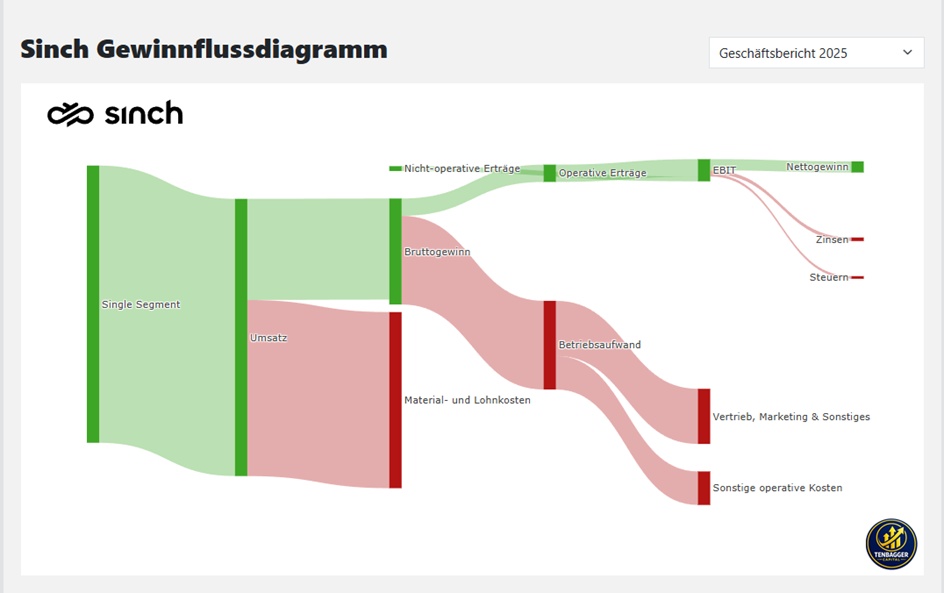
Geographic revenue breakdown:
2025 (SEK)
United States 15.23 billion
Rest of the World 3.49 billion
United Kingdom 2.16 billion
India 1.39 billion
Australia 1.09 billion
France 936 million
Brazil 832 million
Singapore 543 million
Germany 492 million
Sweden 475 million
Netherlands 442 million
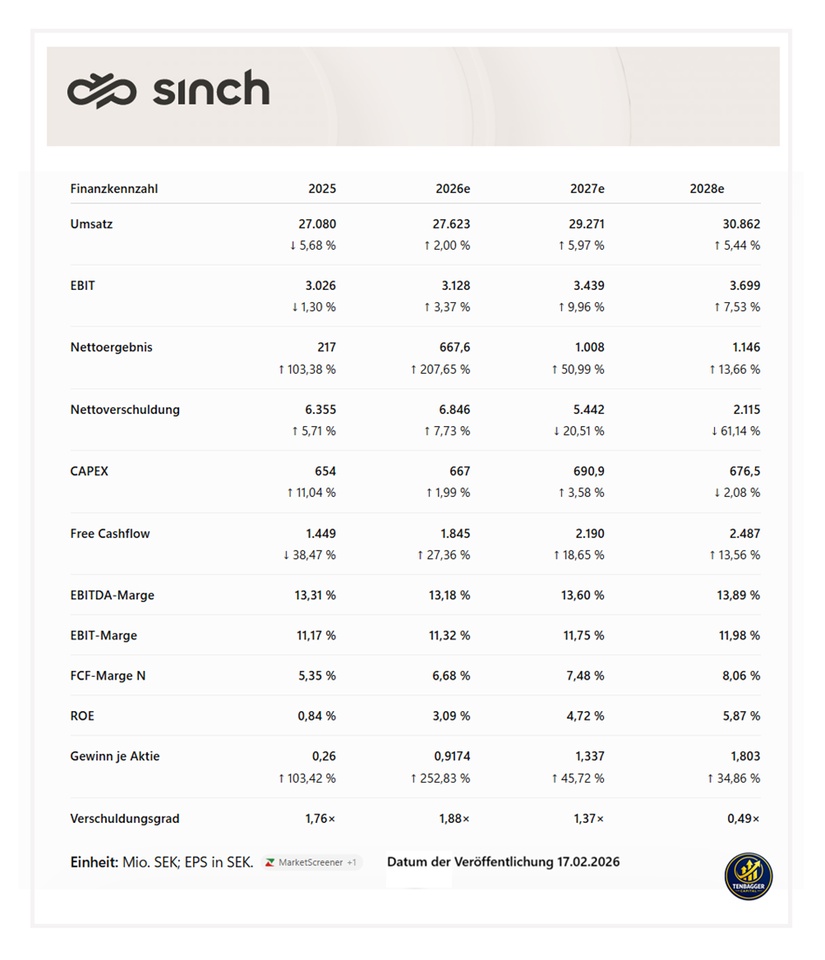
📈 Growth & Profitability
- Revenue: 27.08 → 30.86 billion SEK by 2028
- → Growth resumes after a -5.68% decline in 2025, but at a a moderate 2–6% per year
EBIT: 3.03 → 3.70 billion SEK- → growing significantly faster than revenue.
- EBIT margin: 11.17% → 11.98%
- → continuous operational improvement.
- EBITDA margin: 13.31% → 13.89%.
💰 Cash flow is the key point
- FCF: 1.45 → 2.49 billion SEK
FCF margin: 5.35% → 8.06%- This means that free cash flow is growing significantly faster than revenue.
🧾 Profit Development
- Net income: 217 million → 1.15 billion SEK
EPS: 0.26 → 1.803 SEK- The projected growth for 2026–2027 is particularly strong.
🏦 Balance Sheet
The forecast calls for a significant reduction in debt:
Net debt:
6.36 → 6.85 → 5.44 → 2.12 billion SEK
Debt-to-equity ratio:
1.76× → 1.88× → 1.37× → 0.49×
This means: After an initially high level of debt, the balance sheet is expected to improve significantly starting in 2027.
🎯 My take on the outlook
According to these MarketScreener estimates, Sinch is primarily a turnaround/efficiency story rather than a pure growth story.
Revenue ↗ moderate
EBIT ↗ stronger
Profit ↗ very strong
FCF ↗ very strong
Margins ↗
Debt ↘ significantly
The key point for me, therefore, would be whether Sinch actually delivers the projected improvement in FCF, EPS, and debt. That is exactly how I would evaluate the investment thesis in the coming quarters.
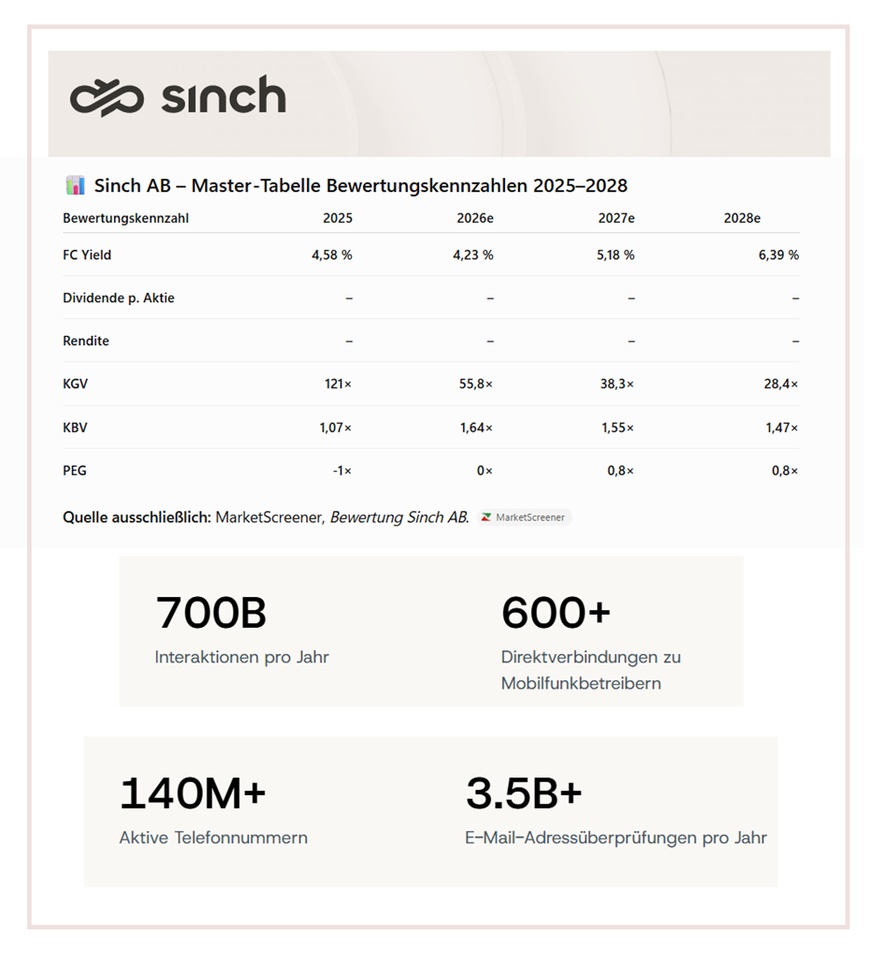
🔎 Valuation at a Glance
- P/E ratio: 121× → 28.4× – the P/E ratio falls very significantly due to expected earnings growth.
- FC Yield: 4.58% → 6.39% – The expected free cash flow is becoming increasingly attractive relative to the valuation.
- P/B ratio: 1.07× → 1.64× → 1.47× – Declining again after the increase in 2026.
- PEG: 2027/28 at 0.8×.
- Dividend: MarketScreener shows that shows no dividend or dividend yield .
Of particular interest is the combination of a sharply falling P/E ratio and a simultaneously rising FCF yield. This aligns with the trend previously observed at Sinch: Revenue is growing at a relatively moderate pace, while earnings and free cash flow are expected to increase significantly more
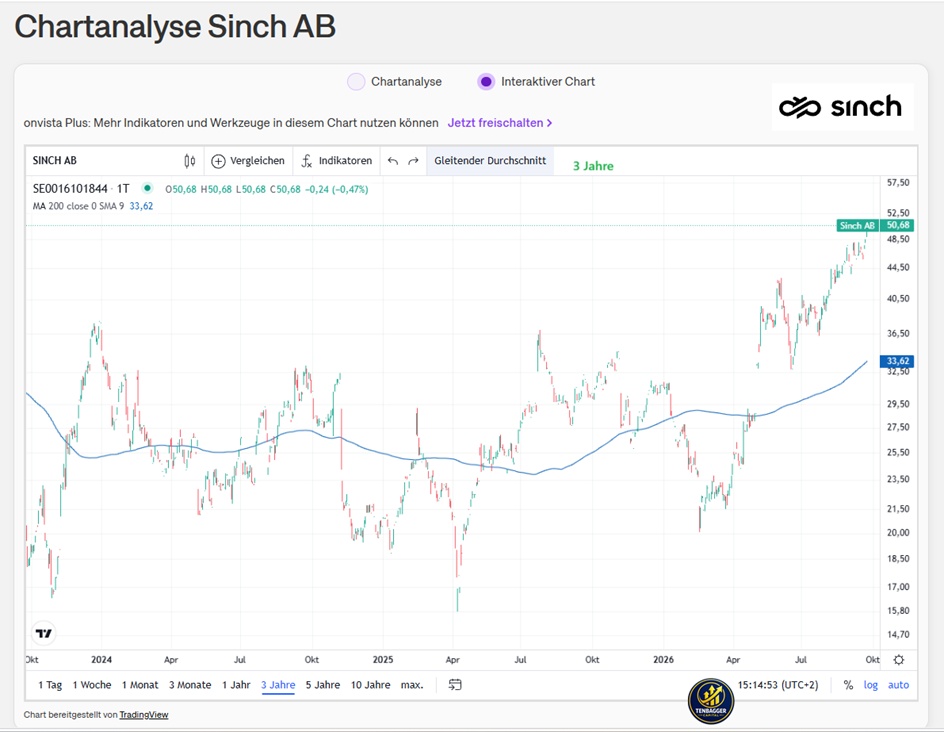
Performance
1 week +7.91%
1 month +13.50%
6 months +127.86%
1 year +61.30%
3 years +145.96%
(@Aktienhauptmeister , @Raketentoni )
September 24, 2026, 4:26:20 PM •
Tradegate BSX (EUR)
4.504 EUR