6G·

📊 Retirement Savings Account Breakdown: At What Tax Rate in Retirement Does the Tax Credit Pay Off Compared to a Regular ETF Account?

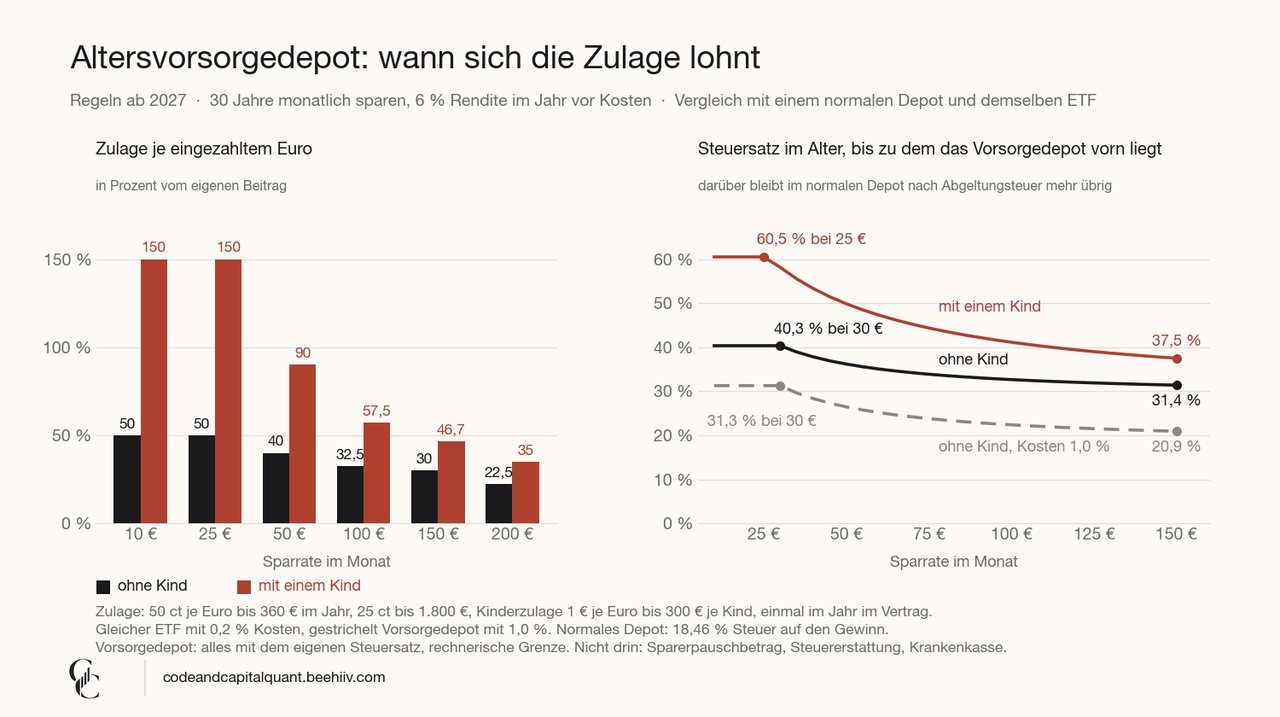
60.5 percent. That’s how high my tax rate would have to be in retirement for the retirement savings account to no longer be worth it with one child. That’s higher than the highest tax rate in Germany. We’re expecting our first child next year, so I did some research. Starting in January, the account will be available, and everywhere I look, I see the same number: a 540-euro annual allowance. That’s correct. But you don’t get the same amount for every euro, and when you retire, the tax office will want a portion of it back.


👶 Where the 60.5 percent comes from


For every child receiving child benefit, the government adds to every euro you contribute, up to 300 euros per year. On top of that, there’s the basic allowance: 50 cents per euro on the first 360 euros per year. If you contribute 25 euros a month, you pay 300 euros a year and receive an additional 450 euros. Once you reach 25 euros, the child allowance is maxed out; every euro above that only counts toward the basic allowance.


Over 30 years with 18 years of child allowance, you’ll end up with 52,958 euros in the retirement account. In a standard ETF account, the same amount of money leaves you with 20,914 euros after taxes. At 150 euros per month with a child, the limit is still 37.5 percent. Calculated with a 6 percent return before fees, using the same ETF with 0.2 percent fees in both accounts. This is a theoretical limit based on my assumptions. In reality, the payout is spread over many years, and the applicable rate depends on income in each respective year.


🤔 Why there’s a limit at all


In a regular investment account, you ultimately pay tax only on the profit—18.46 percent, including the solidarity surcharge and partial exemption for equity ETFs. With a retirement savings account, you’re taxed at your personal rate in retirement on everything derived from the subsidized contributions, including your own money and the government subsidies. At a certain tax rate, this eats up the subsidy.


Then there’s the lock-in period. The money is locked in until age 65—previously, this was only possible with a statutory pension. Anyone who wants to withdraw early must repay the subsidies and the tax benefits. When you start receiving your pension, you can withdraw a maximum of 30 percent at once, fully taxed without the one-fifth rule. The rest is paid out as a pension or through a payout plan until at least age 85. If you’re voluntarily enrolled in statutory health insurance in retirement, you generally pay health insurance premiums on these payments; pensioners covered by mandatory insurance do not.


📉 Without children, the picture is less rosy


At 30 euros per month, the limit is 40.3 percent. With 10,800 euros contributed, 25,097 euros remain under normal circumstances, and 42,074 euros are in the retirement account before taxes. At 150 euros per month, the figures are 125,486 versus 182,891 euros, and the threshold drops to 31.4 percent.


This is due to the structure of the tax credit. For up to 30 euros per month, the government matches half; from 360 to 1,800 euros per year, it matches only 25 cents per euro. At 150 euros per month, the match is still 30 percent; at 200 euros, it’s only 22.5 percent. The maximum is 540 euros; nothing more is added for amounts over 150 euros per month. The minimum must be 120 euros per year. Anyone under 25 at the time of enrollment receives a one-time bonus of 200 euros.
attachment

With a 4 or 8 percent return, little changes; at 30 euros, the threshold is 38.6 and 41.6 percent, respectively, and at 150 euros, it’s 29.3 and 32.9 percent.


💸 Costs matter more than the return


For a standard brokerage account, the effective costs are capped by law at 1.0 percent per year, including fund fees. That’s a cap—not a good price. If you pay the full amount, you’ll only reach 31.3 percent with a 30-euro investment and 20.9 percent with a 150-euro investment. Trade Republic and Scalable have announced that they will not charge account or savings plan fees for the standard account and will cover the ongoing costs for select ETFs. At Scalable, this coverage in the standard brokerage account is initially guaranteed until at least the end of 2027; over a 30-year period, that’s not much. At Union Investment, the fees range from 0.55 to 1.0 percent, depending on the product.


In 2026, the top tax rate of 42 percent will apply only to taxable income of 69,879 euros or more. Not included in this calculation are the saver’s allowance in a standard account, which lowers the threshold somewhat, and the tax refund during one’s working life, which raises it. The tax office pays the difference if the deduction for contributions yields more than the tax credit—for a single person making the full contribution, this applies starting at a marginal tax rate of about 23 percent. I didn’t factor in anything over 150 euros per month, as there’s no tax credit for that amount.


🧒 And what do the children themselves receive?


The Early Start Pension. The Bundestag approved it on October 16. From their 6th to their 18th birthday, the government will pay 10 euros per month into the child’s retirement savings account, totaling 1,440 euros. The program starts in 2027 for children born in 2020 and 2021. Parents are allowed to make additional contributions. Without a contract, the money will go into a government fund starting in 2028. Payouts will begin at age 65 at the earliest. As far as I know, the Bundesrat hasn’t approved it yet, so the law isn’t finalized.


For us, it’ll probably be the 25 euros; if we have a child over 15, the money stays freely available in the regular investment account. Are you setting up the retirement savings account, and how much are you contributing? Post your savings rate and number of children in the comments, and I’ll calculate the limit for you.


Which stock market rule should I check next? Just comment with the number:


1️⃣ The stock has doubled. Is it too late to jump on board?

2️⃣ What happens in the weeks following strong quarterly earnings

3️⃣ Holding leveraged ETFs for many years


➡️ Every Sunday, I send out my newsletter with the market barometer and the latest from Wikifolio: https://codeandcapitalquant.beehiiv.com/subscribe?utm_source=getquin


This is not investment or tax advice; do your own calculations. The rules apply starting in 2027, as of today.

12
49 Commenti

immagine del profilo
What’s completely missing are the amounts you can contribute up to €1,800 even without the subsidy. These are fully tax-deductible as retirement savings contributions—depending on your personal tax rate during the savings phase—and can result in significant additional tax refunds (reinvesting is probably a good idea). If you do it this way, your calculations will definitely shift (whether you have a child or not), in some cases quite significantly. I spent about 2 hours using ChatGPT to compare countless variations of the AVD against each other and against a simple MSCI World savings plan in my own portfolio, and what can I say: the AVD wins—with the exception of one calculation based on an assumed return of about 3%—virtually every time.

You just have to be clear about what “earmarking” means for retirement planning; purely from a return perspective, an AVD should actually be an absolute no-brainer if you’re consciously choosing to save exclusively for retirement.
•
17
•
immagine del profilo
@Get_Rich_or_Die_Tryin And to take it to the absolute extreme: you could claim up to a maximum of €6,840 per year as retirement savings contributions for tax purposes. If those funds were also invested there, the tax refund would be taken to a whole new level. Advantage: You can withdraw this “unsubsidized” portion in full at the start of your retirement (theoretically—though based on my calculations, this isn’t practical; however, if you’d like to have a large lump sum, it does make sense) and convert only the remainder (or, alternatively, withdraw another 30% of the “subsidized” capital in a lump sum at the outset) converted into an annuity (not recommended in my opinion, since it’s a life annuity—meaning no inheritance upon death, etc.) or transferred to a payout plan.

For the non-subsidized portion, the well-known 12/62 rule presumably applies; that is, with a minimum term of 12 years and the earliest pension start age of 62, half of the difference (i.e., 50% of the profit) is taxed upon withdrawal.
•
1
•
immagine del profilo
@Get_Rich_or_Die_Tryin That's right, I deliberately didn't factor in the tax refund during the savings phase. It's briefly mentioned at the bottom of the post. It only pushes the threshold up, never down. So my numbers are on the conservative side. For those who earn well and reinvest the refund, the outlook is even better. That lines up with your conclusion.
•
3
•
immagine del profilo
@Codeandcapital You should figure out what this means in terms of your tax refund in combination with the child allowance. I earn a lot. My wife works part-time and doesn’t earn much. Through tax refunds, I get almost as much as I do from the child allowance. But if I apply for the child allowance, the tax refund shrinks. It’s different for my wife. She pays less in taxes and gets a correspondingly smaller tax refund.

So the most advantageous arrangement for us is to have all the child allowances go to my wife, so that I can get the highest possible tax refund.

This is definitely a relevant factor you should take into account.
•
5
•
immagine del profilo
@DonkeyInvestor Good point—I hadn't thought of that. I was only counting one person. If the tax office offsets the child allowance against your tax refund, it’s basically worthless to you. For your wife, though, she gets the full amount on top of that. I’ll look into that for us, too—my wife also earns less. Thanks!
•
3
•
@DonkeyInvestor It depends on the tax filing status, right? So, with joint filing, isn't the "more favorable tax treatment" test based on your average tax rate? Or am I missing something here?
•
1
•
immagine del profilo
@Migu11 That's what I thought, too. Various computers and AI systems believe that this makes a difference even for spouses who file a joint tax return.
•
1
•
@DonkeyInvestor Okay, that's exciting. We'll have to figure out what to do before we make a decision :D
•
2
•
immagine del profilo
@Get_Rich_or_Die_Tryin But later on, you can only withdraw 30 percent at a time. That sucks, KB. But I have a Riester pension plan that I haven't contributed to in a long time. That one will be transferred over.
•
1
•
immagine del profilo
@Korni1987 Unless you contribute more than 1,800€ per year. Anything above that is not eligible for the AVD subsidy (even if it can be claimed on your income tax return) and is therefore not subject to the same rules as the subsidized portion.😉
••
immagine del profilo
Yeah, and that's why I have a Netto policy for it. ;)
•
1
•
Visualizza tutti 3 ulteriori risposte
immagine del profilo
Am I the only one who feels a bit skeptical about this topic?
•
6
•
immagine del profilo
@Ned-Flanders No, not at all, I think. I'm extremely skeptical because, at the end of the day, you're naturally giving up any flexibility and you never know how tax laws, progressive tax rates, etc., will change by the time you start receiving your pension. Purely from a return perspective (assuming you get at least close to the average market return), it’s actually a no-brainer in almost all scenarios.
•
3
•
immagine del profilo
Yeah, I wasn't trying to question the math at all.
I just mean—without wanting to get into a political debate here (I consider myself a centrist and am not a die-hard fan of any particular party or anything)—that whenever I hear the words “government” and “pension system” in the same sentence, my brain kind of shuts down a little.
I mean, there are negative examples.
•
3
•
immagine del profilo
@Get_Rich_or_Die_Tryin You yourself write that you give up all flexibility, commit to a contract for sometimes decades, and end up pulling out prematurely—which actually hurts your returns. So it’s not a no-brainer, because the risk is completely different from that of a traditional ETF savings plan.
•
3
•
immagine del profilo
@Ned-Flanders No, there are many who are rightly skeptical about this (lack of flexibility, future tax changes, etc.).
The fact that the AVD adds a few (thousand) euros to your income is undisputed in most cases. But you just won’t be able to access it until age 65 (or however long they want us to work in the future).
•
3
•
immagine del profilo
@Ned-Flanders Definitely more than just a cautionary tale. That’s why, personally, I’ll be exploring other options.

I’ll probably contribute the maximum amount to claim the full tax credit (i.e., the €1,800 per year, to use it as an additional return booster) and keep everything else in my own investment account as before. Honestly, the €150 a month doesn’t hurt, and there’s still enough capital left to generously fund my “own” portfolio.👍🏻
•
2
•
immagine del profilo
@Ned-Flanders I understand the skepticism. For me, too, it’s the commitment that’s holding me back, not the return. That’s why I’m only investing the 25 euros with the child benefit—the benefit is so great that it’s worth it to me. The rest stays in my regular brokerage account.
•
2
•
immagine del profilo
@FairValue By the way, that's also the case with your mandatory contributions to the statutory pension insurance. 😅🤷🏼‍♂️
•
1
•
immagine del profilo
@Psychedelic_Sunflower Yeah, I think it's a really tough decision. How are you going to handle it?
•
1
•
immagine del profilo
@Get_Rich_or_Die_Tryin Yeah, I'd uncheck it too if I could 😆
•
1
•
Visualizza tutti 4 ulteriori risposte
immagine del profilo
I think I'll do the minimum required for two children and the two of us as parents to get the maximum allowance.
•
2
•
immagine del profilo
@Keineui Keep in mind that the child allowance is limited to the amount of your own contribution. To receive two full child allowances, the parent receiving them must contribute €600 per year—that is, €50 per month. With the minimum contribution of €120, the child allowance is also limited to €120.
•
1
•
immagine del profilo
@Codeandcapital That's what I meant by "minimum." In other words, just enough to get the maximum allowance. €600 a year isn't that hard to come by.
••
I think the 30 euros per person for a 50% subsidy—whether with or without children—is a no-brainer for everyone. Your skepticism always assumes far above-average financial knowledge, a lot of experience, and—especially here in this bubble—above-average savings that are already available or can be invested for retirement or other investments.
But for the single-income father who has saved little to nothing so far and is now getting a subsidy of 960 euros a year—2 x 30 euros a month for himself and his wife, plus a hypothetical 2x child allowance—that’s a huge deal every single year. Every year as long as there’s child allowance for the kids, and after that, another 360 euros for free! Every year!! The costs don’t even matter at all...
I think skepticism about future tax changes is misplaced—nothing will change about the logic behind these subsidies. I myself work in financial sales, in the broadest sense.
In the early 2000s, a savings plan with 100 euros was a really big deal, and today he gets that for free with a really small personal contribution of 60 euros a month...
•
2
•
immagine del profilo
@Migu11 I totally agree—for ordinary families, this is a real blessing. There’s just one catch in your calculation: The child allowance can’t exceed the amount of your own contribution. At €30 a month, that’s €360 a year; to receive two full child allowances, the parent who receives them must contribute €50 a month. That comes to €960.
••
Oh yeah, that's true... When considering a single-income household, you still have to be careful if the spouse is "only" indirectly eligible.
It's a bit easier than the old Riester plans, but there are still a few hurdles to overcome to make sure everything goes smoothly.
••
immagine del profilo
@Migu11 But this only works if you count four children as 2x2.
••
Eagl, what the government "gives" you. The government has always taken its share. Look at heat pumps, taxes on electric vehicles, and bringing gas into homes—it's cheap. Sorry. I don't trust those crooks.
•
1
•
immagine del profilo
@Unbekannt1983 I've been using gas for 20 years, but you already know how the CO2 surcharge is going to go up, right? I don't know why Tagesschau and the like aren't reporting on this. But by 2040, no matter what fuel you use, the costs will double. So a single-family home has heating costs of about 3–4K per year. That’ll be 6K by 2040.
••
immagine del profilo
Is it actually known whether you can really count the child toward the allowance? With the Riester plan, it only applied to one parent. The other parent was considered childless and was therefore at a disadvantage. I looked into this a while back, and I only found out through an AI that it’s the same with the AVD.
Edit: The AI still says that the child is only counted once. So that’s how it stands.
•
1
•
immagine del profilo
@marda304 Yes, it’s the same with the AVD. The child allowance is paid only once per child; for married couples, it automatically goes to the mother, and changing this requires a joint application to the provider. The other spouse, however, receives their own basic allowance as usual. Since no child allowance is offset against their income, the tax refund through the “more favorable treatment” test is actually more beneficial for them. Therefore, the spouse who earns more should generally leave the child allowance with the other spouse.
••
immagine del profilo
Well, now it's time to guess what tax rate I'll be subject to when I reach the withdrawal threshold.
••
immagine del profilo
@GoDividend Check your pension statement to see roughly how much pension you'll receive. Add in your company pension and any other income you'll receive in retirement. Enter the total amount into an online tax calculator and see what marginal tax rate it comes up with.
•
1
•
immagine del profilo
@GoDividend Three fifty
•
1
•
immagine del profilo
@DonkeyInvestor Well then, let's get going
•
1
•
immagine del profilo
@GoDividend More than today's retirees. Much more.
••
Aren't you at all concerned that the repository could be looted because it isn't independent of the government?
••
immagine del profilo
@asset_sage_smmad If it's managed by a broker you chose, wouldn't you also have to worry about your personal investment account?
•
1
•
immagine del profilo
@asset_sage_smmad It's actually the other way around. That's actually a major reason why I'm going to use the AV Depot. It offers better protection against government intervention than any other investment.
•
3
•
immagine del profilo
••
Partecipa alla conversazione