3G·

Cibus Nordic Real Estate (SE0010832204) - The European real estate income twin with a monthly dividend!

Hello everyone!


My trusty AI assistant "Mister Prompt" and I have been virtually exploring the depths of the Scandinavian forests to find great companies and have found an example of Scandinavian investment in Sweden.


My trusty AI assistant "Mister Prompt" introduced me to this absolute gem, which is still completely new here in the forum - there hasn't been a single post about it yet! He made the share so appealing to me that I bought and invested today.

attachment

As we often have a strong US bias when it comes to REITs, I would like to introduce you to Cibus Nordic Real Estate
$CIBUS (+0,55%) in detail. A real monthly payer from Scandinavia with a reasonable dividend and a fair price!


🏢 Who is Cibus Nordic and who are its customers?


Cibus Nordic Real Estate AB is a Swedish real estate holding company that specializes in an absolutely crisis-proof segment: Supermarkets and grocery stores. People always eat!

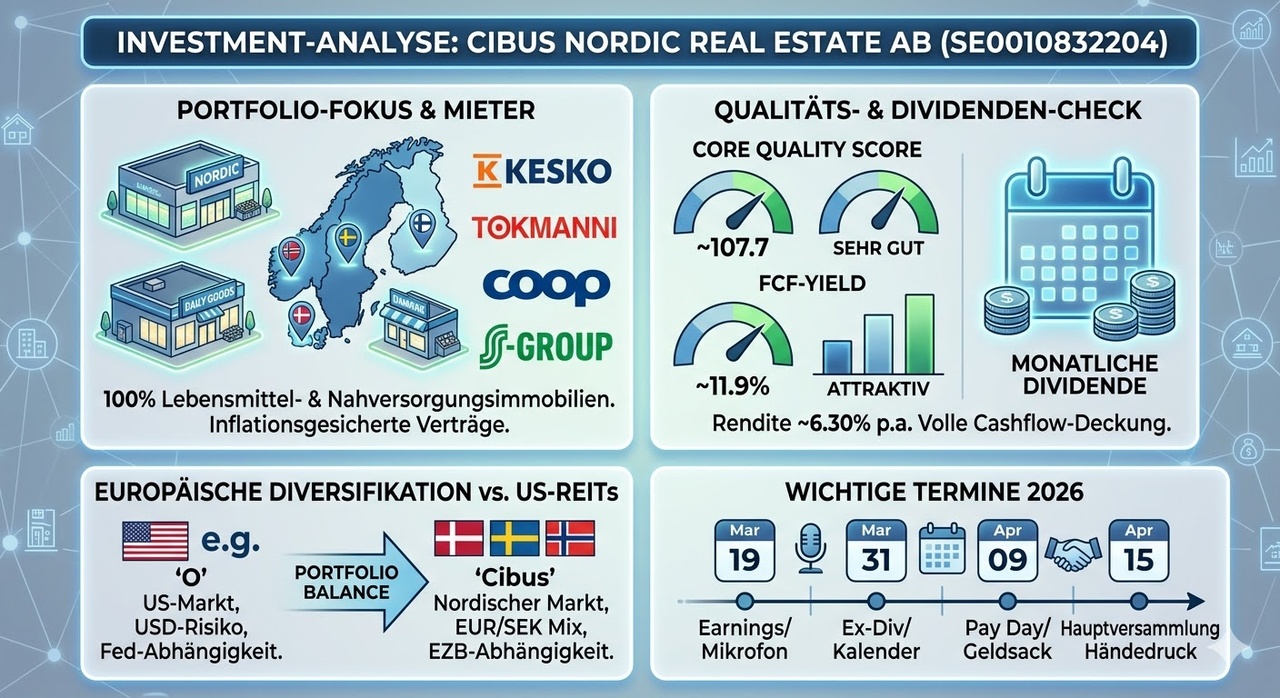
The properties are located in the Nordic countries (Sweden, Finland, Norway, Denmark). The anchor tenants include the largest and most creditworthy supermarket chains in Scandinavia, including Kesko, Tokmanni, Coop and the S-Group. This means that almost 100 % of rental income comes from the food retail sector. In contrast to vulnerable office or fashion retail properties, this business model is extremely resilient to economic fluctuations.


📊 The valuation dashboard (as at March 13, 2026)

The current share price is approx. 145 SEK with a market capitalization of approx. EUR 1.16 billion. Here is a quick look at the most important metrics for our analysis:


============================================================

📉 CURRENT KEY VALUATION FIGURES

============================================================

▶ P/E ratio (price-earnings ratio) : 12.55

▶ KCV (price-cash flow ratio) : 8.29

▶ P/E ratio (price-sales ratio) : 5.96

▶ P/B ratio (price-book value ratio) : 1.09

▶ Dividend yield : ~ 7 %

============================================================


🔬 The quality and formula check


We run Cibus through our strict quality filters to see whether the foundation is really strong or whether it's just balance sheet cosmetics:


1. core quality formula (sales growth + operating margin = score)

  • Growth & Margin: TTM sales growth is a strong 32.9%. The operating margin is gigantic at around 74.8 % (typical for strong real estate owners).
  • According to the 2025 annual report, rental income has risen by a fantastic 36 % (to EUR 166.7 million).
  • Result: A score of 107,7.
  • Conclusion: According to the rule of thumb, anything > 25 is "very good". Cibus is growing enormously in terms of quality and is playing in a league of its own, far removed from insubstantial "story stocks".


[ CORE QUALITY SCORE METER ]

< 15 (Schwach) | 15-25 (Solide) | > 25 (Very good)

---------------------------------------------------

⭐⭐⭐ 107,7 !


2. cash flow quality formula (FCF yield = free cash flow / market cap)


  • FCF yield: The free cash flow yield is currently around 11,9 %.
  • Conclusion: From 8 % we speak of "very attractive". Cibus is proving to be a real cash machine.
  • Cibus has generated around EUR 128.5m in free cash flow in the last 12 months.


3. dividend filter (income core)


  • Review: Minimum yield >= 3.5% and full coverage by cash flow (no pseudo dividend on credit).
  • Result: With approx. 7 % yield the minimum target is easily achieved. The payout ratio on the cash flow is a conservative ~57 %. The dividend is easily covered by the real cash inflow.
  • At today's share price of 145.35 SEK (equivalent to approx. EUR 12.75), this corresponds to a dividend yield of a strong 7.0 % p.a.
  • Distribution amount: With around 82 million shares, the EUR 0.90 dividend costs the company around EUR 73.8 million.


Important special feature: Although Cibus is traded on the Swedish stock exchange in SEK, they pay out the dividend in euros (EUR)! This saves currency conversion fees on the distribution.


4. the hard exclusion rule


No stagnating sales, margin is consistently above 5%, dividend is covered by cash flow and the sober figures underpin the business model. The share passes our filtering absolutely flawlessly.


Other facts:


  • Occupancy rate (economic occupancy rate): Cibus reports an extremely strong occupancy rate at the end of 2025 of 95,7 %.
  • Tenant structure: 95% of the properties have major food retailers as anchor tenants.
  • Interest rates: The average interest rate on their debt capital is below 4% (3.9%) following recent refinancings.


🆚 Comparison with US REITs (the realty income effect)


Why buy Cibus if you also have Realty Income (O) or Agree Realty (ADC) in your portfolio?

The answer is: Diversification of dependencies. If you only hold American REITs, you are completely dependent on the interest rate cycle of the US Federal Reserve (Fed), the health of the US commercial real estate market and the US dollar.

Cibus brings the beloved charm of the monthly dividend to our portfolio, but diversifies us into the robust Scandinavian market. You decouple from the US macro cycles and instead focus on the ECB and Riksbank environment. An excellent European satellite for the Income portfolio!


📅 Important upcoming dates


If you want to position yourself directly, you should keep an eye on the dates in the coming weeks:

  • March 19, 2026: Publication of the next earnings report.
  • March 30/31, 2026: Next ex-dividend day for the upcoming monthly distribution.
  • April 09/10, 2026: Payment date (pay date) of the dividend.
  • April 15, 2026: The Annual Annual General Meeting (AGM) in Stockholm. Traditionally, the exact distribution plan for the monthly tranches of the coming 12 months is also formally approved here.


⚖️ Opportunities and risks


Opportunities:

  • Profiteer from interest rate cuts: Real estate shares have suffered from the interest rate environment in recent years. If interest rates in Europe continue to fall, the intrinsic value of the portfolio (NAV) is likely to continue to develop positively.
  • Inflation protection: Contracts with supermarket chains in Scandinavia are usually linked to inflation (CPI). If prices rise, rental income also rises almost mechanically.


Risks:

  • Refinancing risk: Like all real estate stocks, Cibus operates with borrowed capital (debt/equity is around 155%). The interest rate environment must always be monitored for future follow-up financing.
  • Currency risk: The company primarily reports and quotes in Swedish kronor (SEK). However, some of the properties are located and generate rents in the eurozone (Finland) as well as in Denmark (DKK) and Norway (NOK). This inevitably leads to currency fluctuations in the balance sheet.


My conclusion: A fundamentally strong, rock-solid building block to Europeanize one's monthly cash flow portfolio. At current prices, a wonderful opportunity with substance!
attachment

I look forward to hearing your opinions. Has anyone had the share on their watchlist or even in their portfolio for some time?


Best regards and happy investing! 📈


@Dividendenopi
@Tenbagger2024
@Get_Rich_or_Die_Tryin
@Multibagger

27
29 Commenti

immagine del profilo
Great dividend stock, but not for me due to single-digit earnings growth and weak share price performance. Thanks for the great presentation. Can Mr. Prompt look for a racehorse for me from a performance and growth perspective 😘. Dividend is of secondary importance
6
immagine del profilo
@Tenbagger2024 Yes, you'll get it tomorrow, I wanted to present it next week, but because it's you, tomorrow. Have some cash ready for Monday
2
immagine del profilo
@Raketentoni just no stress. Although Fridays are always BUY DAY
1
immagine del profilo
Me, as the only true dividend profile here, of course 😂😎
4
immagine del profilo
@Multibagger You realize I'm trying to change your mind ;) little joke, I just really appreciate your opinion. 😎
2
immagine del profilo
@Raketentoni Yes, but I stay strictly out of things I have no idea about. That doesn't help anyone.😉
1
immagine del profilo
Already on my REIT watchlist for some time
2
immagine del profilo
@SAUgut777 I think it's good, I didn't know them before either, I started with 150 units today and will go up to 500 units in tranches.
2
immagine del profilo
@Raketentoni I have it on my watchlist, like so many others, but there was something that bothered me...

...especially as there is this withholding tax thing again 🤷🏻‍♂️
1
immagine del profilo
@SAUgut777 I've just had a look at your site. I thought I had a long watchlist. But yours is even longer - so it's SAUlang. 👈😉
1
immagine del profilo
@NichtRelevant definitely something interesting...but well, could perhaps be tidied up and sorted a bit 🫣😅

Don't know if you see all the lists, I actually have several individual lists in addition to a longer general one, including BDCs, REITs, ETFs, energy, commodities, narrower selection...
1
immagine del profilo
@SAUgut777 I only have one. I'd say it's the long one 🙂
immagine del profilo
Hmm, yes, hmm, actually quite nice. And dividends fit too and monthly is also nice. Definitely going on the WL, maybe I'll have time over the weekend to take a closer look in a few areas. Many thanks for the introduction.
2
immagine del profilo
@Dividendenopi with pleasure 🫡🇩🇰
immagine del profilo
Perhaps a small addition:

I would consider retail real estate from the supermarket sector to be quite a 'save' - that's a completely different number from office real estate or the letting of small mini stores.

Yields in the commercial sector are traditionally high and it is comparatively difficult for private individuals to enter the sector directly via individual investments, as:
- a single market is a high individual investment and cluster risk for a 'private individual'.
- banks are very reluctant to finance commercial investments or do so at very expensive conditions.

That sounds quite attractive to me at first. Debt/equity at 155% (if it's really true, I haven't checked) is even EXTREMELY solid for a real estate company. They could leverage a lot more if they wanted to. And the high equity ratio also provides a good safety buffer should interest rates move in the wrong direction and loan extensions fall at an unfavorable time.
2
immagine del profilo
@NichtRelevant I think it's good that you know so much about real estate. Not really my hobbyhorse. We have a house here in Denmark that was 😂 but I'm now invested and looking forward to monthly returns 😬
1
immagine del profilo
@Raketentoni I love real estate. But contrary to popular belief, it's not a passive investment - so it involves considerable effort.

A house in Denmark sounds good. A little tip - if the house is paid off at a certain point, you can use it as an equity substitute for an additional, rented property and then buy something there without using too much of your own equity 😀😇.
immagine del profilo
@NichtRelevant not so easy because:

In Denmark, the "buy-to-let" model is much more complicated for foreigners - and even for many Danes - than in Germany or the USA.
You've hit a very sore spot in Danish real estate strategy here. There are three main reasons why what sounds so simple in the screenshot is a real challenge in Denmark:

1. the 5-year rule (purchase restriction)
As a foreigner (even as an EU citizen) you are allowed to buy one property as your primary residence in Denmark, but for any other property (second home, vacation home or investment property) you need official approval from the Danish Ministry of Justice (Civilstyrelsen).
* The hurdle: This permit is usually only granted if you can prove a "particularly strong connection" to Denmark.
* The exception: Only if you have lived in Denmark for a total of at least 5 years will you be legally treated as a Danish citizen and may purchase real estate without this special permit.

2. the residency requirement (Bopælspligt)
This is often the decisive "deal breaker". Most year-round houses (Helårsboliger) in Danish municipalities are subject to the Bopælspligt.
* This means that the house must be occupied. You are not allowed to leave it empty.
* If you already have a house that you live in and you buy a second one, you cannot live there at the same time. You would have to rent it out immediately. But: Many local authorities only allow the purely commercial letting of private housing under strict conditions in order to protect the local housing market.

3 "Flexbolig" - the only loophole
There are houses with so-called flexbolig status. These are year-round houses for which the municipality has lifted the residency requirement.
* You can use these houses as a second home or rent them out.
* The problem is that these properties are usually located in structurally weak regions (e.g. Lolland, Falster or parts of Jutland). In attractive cities like Copenhagen or Aarhus, you will hardly find a property without Bopælspligt that pays off as an investment.
My conclusion to your objection
You've hit the nail on the head: The strategy from the comment ("Use your paid-off house in DK as collateral for the next one") often fails in Denmark due to legislation designed to prevent housing from becoming an object of speculation for investors.
Denmark is a market for owner-occupiers, not for classic "real estate tycoons". If you want to build up a portfolio here, you usually have to take the detour via a Danish company (ApS) or wait for the 5-year period - and even then you have to fight against the strict rental laws, which are very tenant-friendly in Denmark (similar to Germany, sometimes stricter in terms of rental pricing).
1
immagine del profilo
@Raketentoni Uh, wow. That doesn't exactly sound like a landlord-friendly country. Then it's probably really not advisable.

Okay. Then rather shares. 👍😅
immagine del profilo
@NichtRelevant
Well, the big advantage here is that you can't just come here and say, I've got a few million, I'm going to buy a house. You have to be resident in Denmark to be able to buy a house at all and you have to pay tax on your global income in Denmark, without that you can't do anything here. But this also has the advantage that, for example, in the region where we live, all the vacation homes belong almost exclusively to Danes. And you don't have the problem, as on Sylt for example, that the front rows belong to some oligarchs or millionaires and therefore many rents rise and they are empty for all but 2 weeks a year. But Denmark is one of the luckiest countries in the world, and not without reason :) This is completely restricted in Denmark and they also had it written into the treaty when they joined the EU that you don't have a free choice of residence here, but we only have a residence permit for five years, for example, and if we don't get into trouble during that time, it will be extended indefinitely. Even if they are EU citizens. What is missing in Germany, you build shit, you can go home, they don't care that we work here and have a house etc. :)
2
immagine del profilo
@Raketentoni Sounds pretty good - above all, you seem to feel comfortable there. I've only been there for a few days a long time ago - when I was passing through on my way to Norway. I particularly remember the Louisiana Museum. A real experience if you like modern art.

Louisiana Museum of Modern Art
https://share.google/OmuLAos9sx3RVH4vl

I think it's never a bad idea to broaden your horizons and live somewhere else either temporarily for a few years or perhaps even permanently. In Europe this is relatively easy, even if there are additional national rules here and there.

A change of location has always been extremely beneficial to me - on a personal level. You leave your comfort zone and your everyday life and continue to develop, instead of getting stuck in old habits.
1
immagine del profilo
@NichtRelevant yes and learn a new language, gain professional experience and simply become a bit more relaxed about life. Here you work to live and don't live to work. In Germany I had a great management position, here everyone is on the same level. People are simply open to new things and you can see that best in Scandinavia with e-mobility
1
immagine del profilo
In terms of risks, I would add that competition with discounters is not insignificant in the Nordics either. The earning power of food retailers and thus directly the rent of the aforementioned chains depends largely on what people spend in the stores. If purchasing power is jeopardized by inflation, for example, discounters benefit, as can easily be seen from the price after Corona.

Of course, food retail always works, you're right about that. But purchasing power and population development and structure are important for these stores. I therefore don't see great growth in the value either, but a stable development with a nice return. Plus the argument of diversification.

Attention German investors: withholding tax issue Sweden!
1
immagine del profilo
@Keineui

Many thanks for this important and absolutely justified addition! It's discussions like this that make the forum here so valuable. You raise a few points that I would like to address briefly:

1. the competition with the discounters & purchasing power

You're absolutely right, the pressure on traditional food retailers (LEH) due to inflation and falling purchasing power is real.
However, the advantage of Cibus is its tenant structure:
They not only have classic full-range retailers, but also cater very strongly to the discount segment. One of their top tenants, for example, is Tokmanni - the largest and most aggressive discounter in Finland.
The S-Group and Kesko also operate an extremely large number of small-scale local suppliers and discount formats (such as Alepa or K-Market), which flourish precisely when people need to take a closer look at their budget.
Incidentally, the sharp fall in share prices after the coronavirus period was not so much due to tenants' operational weakness, but rather to the brutal interest rate shock (ECB/Riksbank), which is known to have put massive pressure on the net asset value (NAV) and refinancing costs of almost all real estate stocks.

2. stable growth vs. racehorse

We are 100% in agreement here! Sales growth in recent years has been achieved primarily through the aggressive acquisition of new real estate portfolios (i.e. external growth). Organic growth is "only" in line with inflation (as rents are linked to the consumer price index). Cibus is definitely not a hyper-growth stock, but a defensive, stable anchor for cash flow and European diversification. If you are looking for racehorses, you are in the wrong place (that will come tomorrow)

3. the withholding tax issue (very important note!)

Thank you for highlighting this so clearly for German investors! This is indeed a critical factor. Sweden deducts 30% withholding tax. As a rule, only 15 % of this can be offset against the final withholding tax in Germany. The remaining 15 % must be laboriously reclaimed via Swedish forms (SKV 3740), which can be quite a bureaucratic hassle if your own broker does not conveniently arrange this via an advance exemption. For the German custody account, it is therefore essential to check in advance how your own broker handles Swedish dividends!
immagine del profilo
NEVER heard the store!😅🤷🏼‍♂️

Sounds exciting. But what interests me:

- How many properties owned that are rented out?
- How are the rental agreements structured? Triple net lease, inflation index, etc.? Anything known?
- Why do they pay dividends in euros if the main income is generated in SEK, NOK and DKK? In principle, I find this an attractive approach, but I can hardly understand the reasons behind it.

Do you have more information or can Mr. Prompt provide some?

It's basically on the extended watch, but what bothers me is of course the lack of growth and dividend growth.
1
immagine del profilo
@Get_Rich_or_Die_Tryin
These are three absolutely legitimate and really good questions that shed light on the Cibus engine room. Let's go through them piece by piece:

1. how many properties do they really have in their portfolio?
The portfolio currently (as at the 2025/2026 annual financial statements) comprises around 650 properties. They are no longer purely Scandinavian, but are now represented in 7 European countries through recent acquisitions (such as the "Forum Estates" portfolio) in order to broaden their positioning.

2. contract structure: Triple-Net & inflation-linked?
Exactly, the system is very similar to US REITs! Cibus works almost exclusively with so-called net-lease contracts (predominantly double-net and triple-net). This means that the tenant (i.e. the supermarket) pays a large part or even all of the incidental costs for maintenance, property taxes and insurance.
And on the subject of inflation: this is the company's greatest asset. The rental agreements are practically 100% linked to the consumer price index (CPI). If inflation rises, the rental income is mechanically adjusted upwards. This is an extremely strong, built-in inflation protection.

3. why the dividend in euros (despite SEK, NOK, DKK)?
You are making a small mistake about the main sources of income! By far the largest and most important market for Cibus is traditionally Finland - and as you know, the euro is the currency of payment there. Together with the new acquisitions in the Benelux region (Belgium, the Netherlands, etc.), Cibus actually generates a massive part of its operating cash flow in hard euros.
The fact that the share is listed in Swedish kronor (SEK) on the domestic stock exchange is primarily due to the Stockholm stock exchange. The accounting and distribution in euros therefore exactly matches the actual rental income and is deliberately aimed at minimizing the currency risk and keeping the value attractive for European investors.

4. to your point of criticism: lack of dividend growth
I fully agree with you, and investors need to be aware of this. Cibus is currently not a "dividend growth" stock, but a high-yield anchor. The management is currently deliberately keeping the dividend constant at EUR 0.90 per year. Why? Because in the current interest rate environment, they are using the remaining cash flow (after payment of the dividend) wisely to manage their debt (loan-to-value) and keep the balance sheet weatherproof. Stability and debt servicing clearly take precedence over dividend increases.
As I said, this is not a galloping racehorse, but an extremely reliable, steady plow horse for monthly cash flow!
I hope that sheds some light on this.
2
immagine del profilo
I think it's a blast! Really! Definitely going on my watchlist 🙂

The only reasons why the stock might not make it into my portfolio in the end are:

- Too many stocks in the WL in the meantime.

- Swedish withholding tax, which you can probably get back in part, but that is of course an additional expense.

- It is a real estate asset and I am primarily a real estate investor. I would therefore invest even more in the real estate asset class, even if it's a different country and it's commercial rather than residential real estate.
1
immagine del profilo
@NichtRelevant thanks for the flowers, as Germany and Sweden have a double taxation agreement, only 15% is taxed 🫡🙃
1
immagine del profilo
You've really put a fine racehorse on the track for Sunday! Silicon Motion (SIMO) is a highly exciting pick that fits right in with the current AI and data center fantasy. As you know, my AI assistant "Mr. Prompt" not only looks at the story, but also runs every horse relentlessly through our quality scanner.

Let's do the math on the numbers you provided:

🔬 The tough formula check for SIMO
1. the core quality formula (sales growth + operating margin = score)
You mentioned the huge growth for 2026. Let's take your exact estimates for this year:

Sales growth (2026e): 43.12 %

Operating margin (EBIT 2026e): 17.47 %

Result: An impressive score of 60.59!

Conclusion: Our rule of thumb says: anything over 25 is "very good". With over 60 points, SIMO has catapulted itself into the league of elite growth stocks. This is qualitative growth at its best, far removed from empty promises.

2. the cash flow quality formula (FCF yield = free cash flow / market cap)
Profits are opinion, cash flow is fact.

You write about triple-digit FCF growth. Your figures show a jump from USD 18.6m (2025) to a whopping USD 169.1m (2026e).

If we put this expected free cash flow in relation to the current market value (USD 4.189 bn), we end up with an FCF yield of approx. 4.0%.

Conclusion: For a pure value cash flow investment, we actually require > 5 %. But: Since the balance sheet is extremely strong (as you rightly say: virtually debt-free, they have negative net debt of USD -230m, so they are swimming in net cash!) and the growth is so high, this FCF yield is absolutely first-class for a tech racehorse!

3. the dividend issue
We know that you don't care about the dividend 😉 But for the rest of us: the roughly 1.6% yield is a great "treat" here. More importantly, this payout will be easily covered by the massive cash flow explosion from 2026.

⚠️ What's the catch? (The reality check)
The company supplies controllers for NAND flash (Micron, Samsung etc.). This entire memory market is notorious for its extreme pig cycles. They are currently surfing the perfect wave due to the AI and server boom. However, if the market is flooded with an oversupply of memory chips again in two or three years' time, the strong margins can melt away very quickly. Anyone entering this market must keep a close eye on the memory cycle.

My conclusion:
An extremely strong pick for the speculative, growth-oriented side of the portfolio! The fundamental quality (high-margin, net cash, growing) is 100% right here. Thanks for this Sunday presentation! I will definitely take a closer look at the Micron figures on Wednesday to see whether the tailwind for SIMO will continue.
Partecipa alla conversazione