
AMD is the big winner of the Nvidia crisis—and, at the same time, one of the most volatile stocks of the year. On November 12, 2026, the day Nvidia CEO Jensen Huang stepped down, AMD stock rose 5.9% to $585.30, while Nvidia fell 4.3%. Since hitting a low on November 5, the gain had totaled about 45% within five trading days. A setback followed on November 13: Along with the entire chip sector, AMD temporarily fell by about 10% to $527.52 (November 13, 2026, 6:08 p.m. CET, U.S. trading). Fundamentally, AMD is delivering: In the third quarter of 2026, revenue rose 45% to a record $13.4 billion, while the data center business grew 97% to $8.5 billion. AMD expects revenue of around $17 billion for the fourth quarter, and Lisa Su forecasts growth of more than 80% for 2027. Based on earnings estimates for 2027, the P/E ratio stands at around 30. Analysts see an average price target of around $650. From a technical analysis perspective, the $585 level is key: above it, a buy signal emerges up to around $750; below $404, a sell signal emerges down to $360.
Key Points
- Q3 2026: Revenue of $13.4 billion (+45%), Data Center segment at $8.5 billion (+97%)
- Outlook for Q4 2026: approximately $17 billion in revenue (+66%); according to Lisa Su, more than 80% growth in 2027
- Nvidia CEO Jensen Huang stepped down on November 12, 2026; AMD rose 5.9% that day
- On November 13, 2026, the chip sector suffered a setback, falling to around $527 (−9.9%, U.S. trading at 6:08 p.m. CET)
- Record high of $658.52 (October 6, 2026), currently down about 20%
- 2026e P/E ratio around 65, 2027e P/E ratio around 30
- Analysts: Average price target around $650; no sell recommendations from major firms
- Chart levels: Buy signal above $585 (target ~$750), sell signal below $404 (target $360)
What are the current key metrics for AMD stock?
With a market capitalization of approximately $865 billion (as of November 13, 2026), AMD stock is expensive based on current earnings, but significantly cheaper based on estimates for 2027: The P/E ratio falls from around 65 for 2026 to around 30 for 2027.
This gap illustrates how much growth the market has already priced in. AMD does not pay a dividend; the company reinvests its profits in research, capacity expansion, and acquisitions.
- Share price (Nasdaq: AMD): $527.52 (−9.9%) (November 13, 2026, 6:08 p.m. CET)
- Previous day’s closing price: $585.30 (+5.9%) (Nov. 12, 2026)
- All-time high / 52-week high: $658.52 (October 6, 2026)
- 52-week low: $188.22 (March 3, 2026)
- Year-to-date performance: approximately +146% (November 13, 2026)
- Market capitalization: approximately $865 billion (November 13, 2026)
- Revenue for Q3 2026: $13.4 billion (+45%) (November 3, 2026)
- Q3 2026 Data Center revenue: $8.5 billion (+97%) (November 3, 2026)
- Q3 2026 gross margin (non-GAAP): 56% (November 3, 2026)
- Earnings per Share Q3 2026: $1.46 (GAAP) / $2.09 (non-GAAP) (Nov. 3, 2026)
- Free cash flow for Q3 2026: $554 million (Nov. 3, 2026)
- Outlook for Q4 2026: Revenue of approximately $17 billion ± $0.5 billion (+66%) (Nov. 3, 2026)
- P/E ratio 2026e / 2027e: approx. 65 / approx. 30 (analyst consensus)
- Fair value at end of 2026 / end of 2027: approximately $374 / approximately $823 (Aktienfinder, Nov. 13, 2026)
- Average analyst price target: around $650 (range $465–$1,250) (Nov. 13, 2026)
- Dividend: none (—)
- Next Date: Q4 2026 earnings expected in early February 2027 (not yet confirmed)
- WKN / ISIN / Ticker: 863186 / US0079031078 / AMD (—)
What news is currently driving AMD stock?
AMD stock is currently being driven primarily by the leadership crisis at Nvidia: Following Jensen Huang’s resignation on November 12, 2026, money visibly flowed into AMD; one day later, the entire chip sector suffered a setback.
On the day of the resignation, AMD rose 5.9% to $585.30 and hit $594 during trading. As early as November 9, the stock had gained 13.3% when news of the Nvidia board’s investigation broke and Oppenheimer upgraded AMD to “Outperform.” On November 13, sentiment shifted: According to dpa-AFX, a sector-wide sell-off, investigations in the U.S. Congress following the Nvidia turmoil, and calls for stricter export controls on high-performance chips to China weighed on the stock. Added to this were profit-taking moves following the stock’s surge of about 45% over five trading days. To find out what’s behind Jensen Huang’s departure, read my news article on Rücktritt bei der Nvidia Aktie.
- November 13, 2026 – Chip sector under pressure: AMD falls by as much as about 10% to around $520 in U.S. trading. According to dpa-AFX, congressional investigations following the Nvidia turmoil and calls for stricter export controls are weighing on the stock. (Bearish)
- November 12, 2026 – Nvidia CEO Huang steps down: Colette Kress becomes interim CEO at Nvidia. AMD rises 5.9% to $585.30, while Nvidia falls 4.3%. William Blair upgrades AMD to “Outperform.” (Bullish)
- November 9, 2026 – Stock price jumps 13.3%: News of an investigation by Nvidia’s board of directors emerges; Oppenheimer upgrades AMD to “Outperform” with a price target of $600. Closes at $508.58. (Bullish)
- November 5, 2026 – 10.6% sell-off: Broad pullback in AI stocks following the U.S. election; AMD closes at $404.40—exactly at the level that determines today’s sell signal. (Bearish)
- November 3, 2026 – Record quarter and strong outlook: Q3 revenue: $13.4 billion (+45%); Data Center: +97%. Q4 outlook: approximately $17 billion; growth of more than 80% expected in 2027. (Bullish)
- October 6, 2026 – Record high at $658.52: Highest price in company history during trading, record closing price of $649.42. (Neutral)
What does AMD management say about the quarterly results?
AMD CEO Lisa Su calls it a record quarter in which revenue exceeded the upper end of the company’s own forecast—and she is significantly raising the bar for 2027.
During the conference call on November 3, 2026, Su said AMD expects revenue growth of more than 80% for 2027—more than double the figure in the long-term financial model presented at the Analyst Day in November 2025.
What went well: The data center business grew by 97% to $8.5 billion and accounted for approximately 64% of revenue for the first time. This growth was driven by the EPYC server processors and the launch of the Instinct MI450 AI accelerators. The operating margin in the data center segment rose from 25% to 34%. The embedded division grew by 29%. The adjusted gross margin climbed to 56%, and adjusted earnings per share rose 74% to $2.09, exceeding analysts’ estimates.
The catch: Free cash flow in the third quarter totaled only $554 million because AMD increased inventory by about 35% to $11.5 billion—an upfront investment for the ramp-up of the MI450 racks. In the gaming business, revenue plummeted by 40%, and AMD is forecasting a double-digit decline in the PC market for 2027. According to CFO Jean Hu, the GAAP earnings of $1.46 per share include a non-cash charge of $1.1 billion from warrants that AMD issued as part of a major customer contract. The gross margin is expected to decline to around 55% in the fourth quarter.
Outlook: For the fourth quarter of 2026, AMD expects revenue of approximately $17 billion (± $0.5 billion), an increase of about 66%. For 2027, Su anticipates a doubling of server revenue, with the data center segment accounting for more than 80% of total revenue and customer data centers featuring approximately 3 gigawatts of planned AMD capacity.
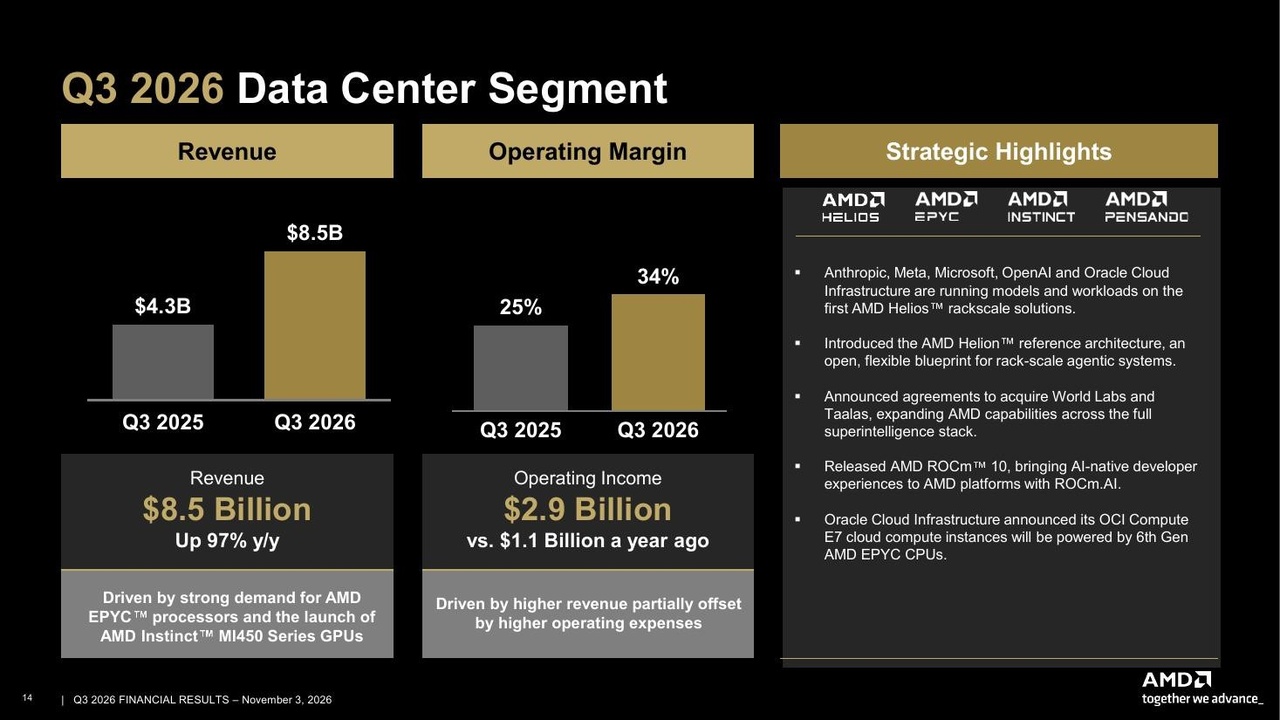
Data Center Segment of AMD Stock (AMD) in the Third Quarter of 2026 (as of November 13, 2026) – Source: AMD Investor Relations / Christian Lill
What does AMD do, and how does the company make money?
AMD (Advanced Micro Devices) develops processors and graphics chips for data centers, PCs, gaming consoles, and industrial applications, primarily having them manufactured by TSMC.
The Santa Clara, California-based company has been led by Lisa Su since October 2014, who has transformed AMD from a struggling company into the leading challenger to Intel and Nvidia.
Data Centers as a Money-Making Machine: In the third quarter of 2026, approximately 64% of revenue—totaling $8.5 billion—came from the data center segment. This includes the EPYC server processors, the Instinct series of AI accelerators, the complete Helios racks, and Pensando’s network chips. According to AMD, the first Helios systems are already in operation at Anthropic, Meta, Microsoft, OpenAI, and Oracle. My analysis of Anthropic Aktie.
Client & Gaming: Ryzen processors for PCs and laptops, Radeon graphics cards, and chips for game consoles generated $3.7 billion (−8%). The PC business grew by 7%, while gaming revenue plummeted by 40%.
Embedded: The former Xilinx division, which produces programmable chips for industrial, automotive, medical, and communications applications, contributed $1.1 billion (+29%).
The OpenAI Deal: In October 2025, AMD agreed with OpenAI to supply AI accelerators with a total capacity of 6 gigawatts across multiple generations, with the first gigawatt of MI450 chips scheduled for delivery starting in the second half of 2026. In return, OpenAI received warrants for up to 160 million AMD shares, which are tied to AMD’s growth milestones and stock price targets.
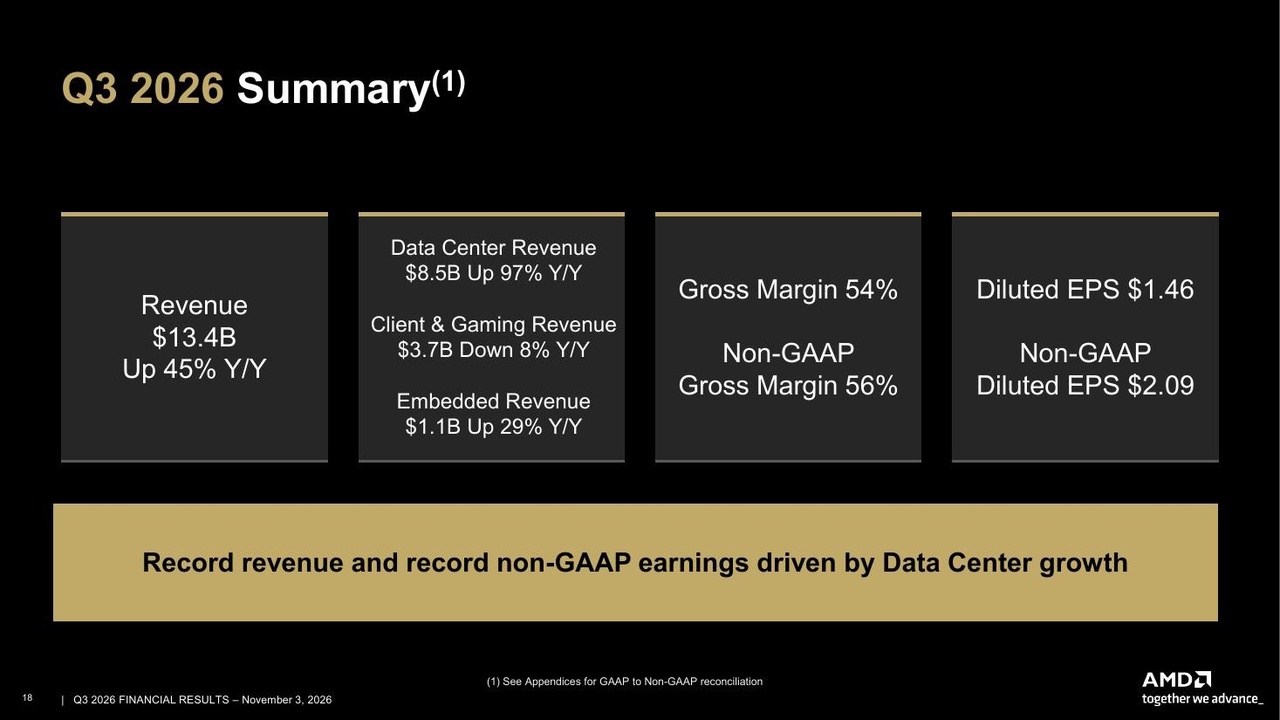
Revenue by segment for AMD (AMD) in the third quarter of 2026 (as of November 13, 2026) – Source: AMD Investor Relations / Christian Lill
AMD or Nvidia Stock: Is AMD the New Nvidia?
AMD is not (yet) the new Nvidia: Nvidia most recently generated roughly ten times as much revenue as AMD in the data center segment and dominates the market for AI accelerators with an estimated 75% share—but since November 12, 2026, AMD has been the clearest beneficiary of the leadership crisis at the market leader.
While Nvidia is searching for a new CEO—with CFO Colette Kress serving as interim CEO following Jensen Huang’s resignation—AMD has Lisa Su, who has been CEO for twelve years, and a clear roadmap through 2027.
Size: In the second quarter of fiscal year 2027 (through July 2026), Nvidia generated $89.0 billion in data center revenue, an increase of 117%. AMD posted $8.5 billion in revenue in the third quarter of 2026 (+97%). In percentage terms, both companies are growing at a similar rate, but in absolute dollar terms, Nvidia is far ahead.
Margin: With a gross margin of 75%, Nvidia earns significantly more per chip than AMD, which has a margin of 56% (non-GAAP). This highlights the market leader’s pricing power.
Market Share: According to estimates by Bloomberg Intelligence and IDC (cited by Silicon Analysts), AMD could reach a market share of around 7 to 10% in the AI accelerator market by 2026, while Nvidia could reach around 75%. These are estimates, not company figures. Even a few percentage points more would represent a business worth billions for AMD.
Valuation and Chart: AMD stock is trading about 20% below its all-time high, while Nvidia stock closed on November 12 about 31% below its record closing price of October 6, 2026. AMD thus clearly has the relative strength. You can read my assessment of the market leader following the CEO change in my analysis of Nvidia Aktie. The next test for both stocks will be Nvidia’s earnings report on November 17, 2026.
- Data Center Revenue (last quarter): AMD $8.5 billion (+97%), Q3 2026 | Nvidia $89.0 billion (+117%), Q2 FY 2027
- Gross margin: AMD 56% (non-GAAP) | Nvidia 75%
- AI Accelerator Market Share in 2026 (estimate): AMD approx. 7–10% | Nvidia approx. 75%
- CEO: AMD: Lisa Su (since 2014) | Nvidia: Colette Kress, interim CEO since November 12, 2026
- Stock price reaction on November 12, 2026: AMD +5.9% (585.30 USD) | Nvidia −4.3% (166.19 USD)
- Distance from all-time high: AMD approximately −20% (high of $658.52) | Nvidia approximately −31% (record closing price of $239.24)
- Key drivers: AMD MI450 racks, OpenAI deal, EPYC servers | Nvidia Blackwell and Vera Rubin
- Upcoming Earnings: AMD expected in early February 2027 | Nvidia November 17, 2026, after-hours
AMD Stock Fundamental Analysis: Is AMD Stock Overvalued?
Based on 2026 earnings, AMD stock is expensive with a P/E ratio of around 65; based on estimates for 2027, however, it is fairly valued with a P/E ratio of around 30 —it all depends on whether the ramp-up of the MI450 racks succeeds as planned.
This is precisely the bet the market is currently pricing in.
Growth: Quarterly revenue rose from $9.2 billion in the third quarter of 2025 to $13.4 billion in the third quarter of 2026. For the full year 2026, analysts expect revenue of approximately $52 billion, and for 2027, approximately $96 billion—an increase of about 84%, which is in line with Lisa Sus’s statement of more than 80%.
Margins and Profit: The adjusted gross margin was 56% in the third quarter, and the adjusted operating margin was 29%, up from 24% in the prior year. According to the analyst consensus, adjusted earnings per share are expected to rise from approximately $8.05 (2026) to approximately $17.65 (2027). Following the third-quarter results, estimates for 2027 were raised by about 11% within a week.
Balance Sheet and Cash Flow: AMD has cash and short-term investments of $15.8 billion, with debt of $7.1 billion, resulting in net financial assets of approximately $8.7 billion. The weak point is cash flow: In the third quarter, free cash flow after investments amounted to only $554 million; after nine months, it totaled $4.7 billion. Rising inventories and accounts receivable are tying up a significant amount of capital.
Fair Value: Based on adjusted earnings and historical valuation, the Stock Finder calculates a fair value of approximately $374 at the end of 2026 and approximately $823 at the end of 2027 (range: $675 to $1,100). Based on 2026 earnings, the stock is thus about 30% overvalued; based on 2027 earnings, it is about 55% undervalued. My analysis of Infineon Aktie.
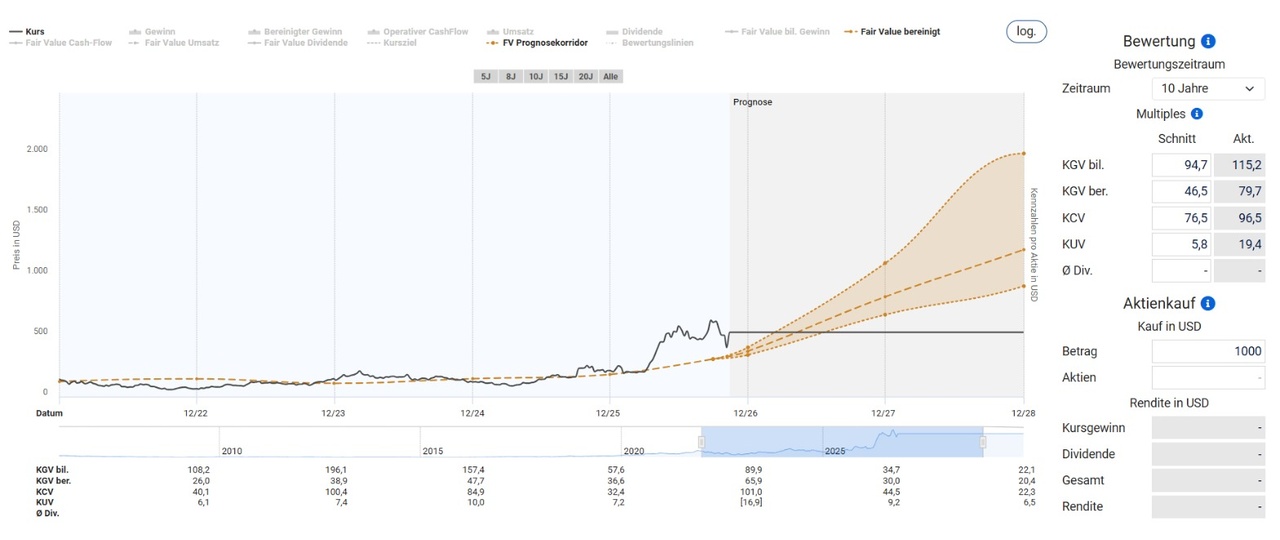
Fair Value of AMD Stock (AMD) in 2027 (as of November 13, 2026) – Source: Aktienfinder / Christian Lill
AMD Stock Price Targets and Forecast for 2027
Analysts see an average price target of around $650 for AMD stock, leaving a good 20% upside—from a technical analysis perspective, a strong buy signal emerges above $585 with a target of around $750, while below $404, there is a sell signal down to $360.
In between, I rate the stock as neutral to slightly bullish.
Key price levels:
- All-time high and 52-week high: $658.52 (Oct. 6, 2026)
- Current price: $527.52 (November 13, 2026, 6:08 p.m. CET, U.S. trading)
- Resistance and buy signal: above $585
- Price target after buy signal: around $750
- Support zone: $425 to $440
- Critical downside level: $404 (below this, a sell signal down to $360; below $360, target $263)
Analyst price targets:
- Average price target: around $650 (range $465 to $1,250, as of Nov. 13, 2026)
- Oppenheimer: Outperform, $600 (upgrade on November 9, 2026)
- JPMorgan: Neutral, $575 (November 4, 2026)
- RBC Capital: Sector Perform, $540 (November 12, 2026)
- William Blair: Upgraded to Outperform (November 12, 2026)
Chart Analysis:
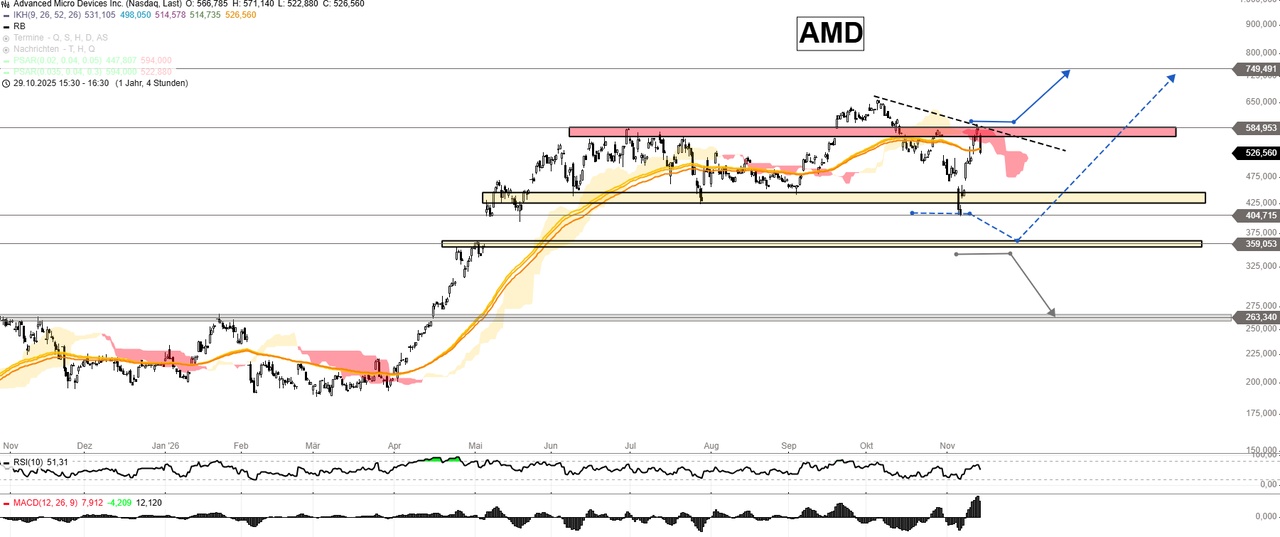
AMD Stock (AMD) Chart Analysis and 2027 Price Targets on the 4-Hour Chart (as of Nov. 13, 2026) – Source: Stock3 / Christian Lill
The AMD stock is showing extreme relative strength compared to the entire peer group—especially compared to Nvidia. While many chip stocks have recently been under pressure, AMD has more than doubled since its breakout in the spring of 2026 and continues to trade well above the rising moving averages. In the short term, however, over the course of several trading days, the stock has been trading sideways on the 4-hour chart: Below the red resistance zone around $585 and a falling trendline dating back to the October high, the price is gathering momentum. The RSI stands at 51, placing it in neutral territory with room to rise, while the MACD is crossing above its signal line and showing positive momentum once again.
The buy signal (blue arrow): Things will get exciting as soon as the AMD stock breaks above the $585 mark. That would trigger a strong and rapid buy signal, with a price target of around $750—representing a potential gain of over 40% from current levels.
The neutral zone: I consider anything above $404 to be neutral to slightly bullish. Between $425 and $440 lies a broad support zone where the stock has rebounded several times over the summer and most recently in early November.
The sell signal (dotted blue arrow): Below $404, a sell signal is triggered down to $360. That is where the next support zone lies—the breakout level from May. From there, strong buying could well resume, enabling a new push toward $585 and beyond.
The warning signal (gray arrow): If the $360 level does not hold, it is likely that AMD stock will fall to $263—where the large sideways trading range began before the breakout in April 2026.
Conclusion: Should you buy or sell AMD stock?
Following its record quarter and the Nvidia shakeup, AMD stock is one of the most exciting AI plays—but to trigger a clear buy signal, it must first break above the $585 mark; above that, a rise to around $750 is possible.
Factors working in AMD’s favor include 97% data center growth, the outlook for more than an 80% increase in revenue by 2027, Helios racks deployed at five of its key AI customers, a CEO with a clear plan, and a P/E ratio of around 30 based on 2027 earnings. However, the market has Palantir Aktie shown on multiple occasions.
Factors weighing against the stock include a P/E ratio of around 65 based on 2026 earnings, weak free cash flow, the execution risk associated with the MI450 ramp-up, potential export restrictions, and extreme volatility with daily swings of more than 10% in either direction. Nvidia remains the clear market leader with an estimated market share of around 75%. From a technical analysis perspective, the stock remains neutral to slightly bullish above $404; below that level, there is a risk of a pullback to $360 and, in an extreme case, to $263.
✅ Opportunities
- Data Center +97% in Q3 2026, accounting for approximately 64% of revenue
- Outlook: Q4 around $17 billion (+66%), more than 80% growth in 2027
- Helios racks at Anthropic, Meta, Microsoft, OpenAI, and Oracle
- Nvidia’s leadership crisis makes AMD the top alternative for major customers
- 2027e P/E ratio around 30, earnings estimates rising
- Buy signal above $585 with a target of around $750
⚠️ Risks
- 2026e P/E ratio around 65 – high expectations already priced in
- Q3 free cash flow only $554 million, inventory up 35%
- Execution risk related to the MI450 ramp-up and dependence on TSMC
- Export controls on AI chips to China under discussion
- OpenAI warrants could result in up to 160 million new shares
- Below $404: Sell signal down to $360; below that, target $263
Sources
- AMD Investor Relations: AMD Reports Third Quarter 2026 Financial Results (November 3, 2026)
- AMD Third-Quarter 2026 Earnings Presentation (November 3, 2026)
- SEC: AMD Form 8-K, Exhibit 99.1 for the third quarter of 2026
- Nvidia Newsroom: NVIDIA Announces CEO Transition (November 12, 2026)
- AMD Third-Quarter 2026 Conference Call (November 3, 2026), transcript via Alpha Vantage; AMD press release on partnership with OpenAI (October 6, 2025)
- dpa-AFX via finanzen.net: Analyst reports from RBC (November 12, 2026), JPMorgan (November 4, 2026), and the semiconductor market report (November 13, 2026); Analyst ratings and consensus price targets: Financial Modeling Prep (November 13, 2026)
- Nvidia Q2 FY 2027 quarterly results (August 26, 2026) according to Constellation Research and HotHardware; market share estimates from Bloomberg Intelligence/IDC according to Silicon Analysts (April 13, 2026)
- Nasdaq Prices: Financial Modeling Prep (November 13, 2026, 6:08 p.m. CET) and Alpha Vantage (closing price November 12, 2026)
- Stock3: AMD 4-hour chart (Nasdaq, USD), as of November 13, 2026
- Stock Finder: Fair Value Calculation (Adjusted Earnings) and Valuation Ratios for AMD, as of November 13, 2026
This is not investment advice—all information is provided solely for financial education purposes.
What are your current thoughts on $AMD (-2,44%)?

