
Dear Community,
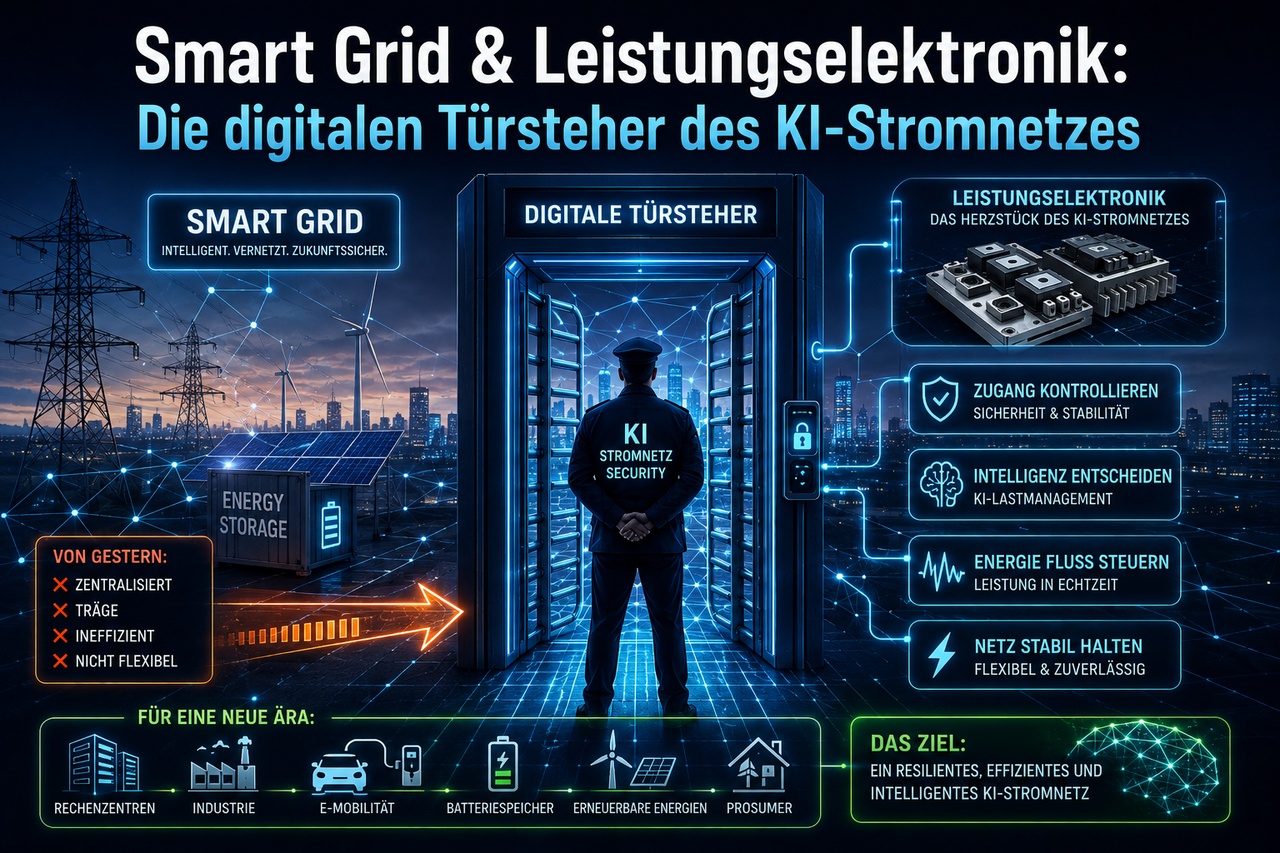
In my last post, we explored the radical trend toward “grid bypassing.” We saw how data center operators are disconnecting from ailing public power grids and using heavy-duty hardware—such as Powell’s switchgear or Bloom Energy’s fuel cells—to build their own self-sufficient microgrids right on site. But once the mini-power plant is up and running and the megawatt cables are in place, we immediately run into the next, much more delicate problem: How do we safely and efficiently manage this massive, highly volatile flow of energy?
AI workloads are physically relentless. When a massive model begins training simultaneously on thousands of GPUs, power demand can reach massive peak loads in a very short time. This poses an enormous challenge for a conventional power grid and the underlying infrastructure. Even the slightest fluctuation in voltage quality or a faulty protective shutdown can cause significant downtime and economic damage for critical data center applications.
Anyone who wants to win the race for AI infrastructure therefore needs more than just raw energy. The new key discipline is: efficiency, digital control, and next-generation power electronics. Today, we’re moving up a level in the engine room of the AI revolution—away from the heavy iron hardware in the basement and toward the intelligent “gatekeepers” and semiconductors in the server rack.
The companies I’d like to introduce to you today fly almost entirely under the radar in the German-speaking world. They provide the highly specialized technology without which modern high-power data centers simply couldn’t operate:
1. Navitas Semiconductor ($NVTS (-9,09 %))
The Materials Revolution Right in the Server Rack
- Technology & Product: Navitas is revolutionizing power electronics with highly integrated gallium nitride (GaN) ICs. By combining switches, drivers, and protection circuits on highly integrated chips, traditional silicon solutions can be supplemented or replaced in certain applications. The result: higher energy efficiency, lower heat generation, and enormous space savings—essential for the extreme power density of modern AI chips. Navitas now develops both GaN and silicon carbide (SiC) solutions for powering AI data centers. In 2026, the company unveiled, among other things, solutions for 800-V DC architectures.
- Business Model: As a lean fabless company, Navitas focuses exclusively on design and IP development, while outsourcing resource-intensive manufacturing to specialized foundries. Revenue comes from chip sales, IP licenses, as well as turnkey reference designs and technical support.
- Sales & Customer Benefits: Sales are conducted through a flexible mix of direct sales, global distributors, and OEM partnerships with manufacturers of AI data centers, e-mobility, and industrial equipment. The key customer benefit is clear: maximum efficiency, lower system costs, and a drastically reduced time to market.
- Opportunities & Market Potential: The company’s technological positioning in GaN and silicon carbide (SiC) chips aligns with an extremely promising growth market. Strategic partnerships and the focused expansion of the customer pipeline in the areas of AI infrastructure and e-mobility offer significant growth potential. Thanks to scalable platforms and the growing importance of high-voltage DC architectures, Navitas has significant leverage over future margins. At the same time, part of this market opportunity is still in the commercialization phase.
- Risks & Obstacles: On the downside, there is intense competitive pressure from established semiconductor giants. Past operating losses and capital requirements carry the risk of future dilution through capital actions. Furthermore, significant stock price volatility, a certain degree of dependence on a few major customers, and execution and manufacturing risks in external supply chains make the stock a speculative investment. Added to this is a current legal dispute with Renesas over alleged trade secrets—an additional source of uncertainty whose outcome remains unclear.
2. American Superconductor ($AMSC (-5,19 %))
The superconductor pioneers for a crisis-resistant power grid
- Technology & Product: AMSC focuses on the pinnacle of physics: high-temperature superconducting wires (HTS) and programmable power electronics. This key technology enables extremely compact components with high current density. They can improve efficiency, reliability, and power density in generation, transmission, and drive systems, and enable particularly interesting applications in heavily loaded power grids. The increasing power density of data centers, in particular, is making more powerful transmission and grid solutions increasingly attractive. In 2026, for example, Microsoft publicly highlighted the potential of high-temperature superconductors for powering data centers.
- Target Markets & Applications: The range of applications is broad and critical: AMSC supplies specialized grid stabilizers and integration solutions for energy utilities, turbine control systems and electrical components for wind turbines, as well as highly complex propulsion, protection, and energy management systems for naval and defense applications.
- Business Model & Revenue Sources: Revenue is derived from direct sales of HTS products and power electronics, engineering and system integration services, as well as the licensing of patents and designs. In addition, there are project-based collaborations and contracts with utilities, OEMs, and government institutions. By contrast, a traditional maintenance contract model—guaranteed over decades—is not the core of the business.
- Opportunities & Market Potential: The deep technological divides in HTS superconductors intersect with massive megatrends such as global grid modernization, the data center boom, and the expansion of defense infrastructure. AMSC has recently achieved significant improvements in revenue and margins; the 2025 fiscal year brought record revenue of just under $300 million and a gross margin of over 30%.
- Risks & Challenges: The business is heavily project- and order-based, which has historically led to high volatility in revenue and earnings. A pronounced dependence on individual major customers and government contracts poses concentration risks. In addition, intense competitive pressure, technological development processes, global supply chain risks, and potential cybersecurity threats require careful risk management.
3. IES Holdings ($IESC (-4,06 %))
The Reliable Electronics Giant for Physical Tech Infrastructure
- Overview & Focus: IES Holdings operates as an operating holding company whose specialized subsidiaries design, install, and maintain heavy electrical and digital infrastructure for megaprojects. They serve as the indispensable link when it comes to channeling massive amounts of energy into modern industrial facilities and data centers.
- Services & Markets: The portfolio ranges from turnkey design-build projects to complex electrical installations and grid connections for hyperscale data centers, as well as industrial repair services and electromechanical components. The company serves customers in the residential, commercial, industrial, and utility sectors.
- Business Model & Structure: Revenues are based on a smart combination of high-margin large-scale projects and recurring revenue from service and maintenance. Regionally managed, highly specialized units ensure rapid project execution on-site, while the holding company oversees central strategy, M&A, and capital allocation.
- Opportunities & Market Potential: The unabated boom in demand for data centers, the modernization of aging power grids, and the expansion of residential and commercial infrastructure are creating excellent tailwinds. The Infrastructure Solutions business is currently experiencing particularly strong growth: In the second quarter of fiscal year 2026, its revenue rose by 64% to $192.4 million; strong demand from the data center market was cited as a key driver. The acquisition of Gulf Island contributed an additional $37.5 million to quarterly revenue.
- Risks & Challenges: The business is subject to fundamental construction and investment cycles, which means that economic headwinds can impact the order book. Rising material and labor costs, global supply chain bottlenecks, execution and integration risks associated with acquisitions, and a selective dependence on major customers can weigh on margins and cash flow. The rapid expansion of capacity, in particular, must therefore be accompanied by disciplined capital management.
4. Bel Fuse Inc. ($BELFB (-5,37 %))
The Unassuming Protectors of Server Electronics
- Overview & Technology: Bel Fuse manufactures highly specialized circuit protection components, magnetics (specialty transformers), power supply modules, and highly complex connectors. In the age of high-performance computing, its passive components and power supply components ensure that sensitive AI circuit boards are reliably powered and protected from dangerous power surges and other electrical disturbances.
- Services & Markets: Through its three main divisions (Connectivity, Power Solutions & Protection, and Magnetic Solutions), the company serves the key sectors of the modern tech world: high-end data centers, telecommunications, aerospace, e-mobility, and general industrial automation.
- Business Model & Structure: Bel Fuse generates its revenue primarily through the sale of high-precision mass-produced components and custom-designed assemblies. The company combines organic innovation in the data center market with targeted acquisitions to capture higher-margin niches.
- Opportunities & Market Potential: The massive upgrade of server racks to AI standards requires a dramatically higher power density and more sophisticated protection. As an established supplier, Bel Fuse benefits from the rising demand for power and connectivity components in hyperscale data centers. Significant margin improvements and a focused transformation toward higher-margin tech applications offer substantial upside potential.
- Risks & Challenges: As a traditional component supplier, Bel Fuse is dependent on fluctuating raw material prices (such as copper) and the global electronics supply chain. Cyclical declines in demand in traditional end markets (such as traditional telecommunications) as well as intense competition with Asian manufacturers can put temporary pressure on the operating margin.
5. XP Power Ltd. ($XPP (-0,89 %))
Ultra-precise power control in the engine room of AI
- Overview & Technology: XP Power is a leading developer and manufacturer of critical power electronics solutions (AC-DC power supplies, DC-DC converters, and high-voltage modules). These components ensure that highly sensitive, expensive electronics are supplied with clean and stable direct current—indispensable in applications where voltage fluctuations and power quality issues can compromise sensitive systems.
- Services & Markets: The British-Singaporean company serves three key markets: semiconductor manufacturing facilities (where AI chips are first produced), industrial control systems, and medical technology. XP Power benefits indirectly from the boom in AI accelerators, particularly through the expansion of semiconductor manufacturing: When giants like ASML, Applied Materials, or Lam Research ramp up their capacity, the demand for precise power supply solutions for the necessary manufacturing equipment increases.
- Business Model & Structure: XP Power relies on a high-margin “design-in” model. Its power supply solutions are often integrated directly into customers’ hardware during the early stages of development. This results in long product lifecycles and reliable revenue over many years.
- Opportunities & Market Potential: As giants like ASML, Applied Materials, and Lam Research ramp up their capacity to meet global demand for AI chips, XP Power is right at the source. Following operational streamlining, the upswing in the semiconductor cycle offers attractive leverage potential for revenue and margins.
- Risks & Challenges: The business is heavily dependent on the cyclical nature of the global semiconductor industry. Customer inventory destocking, volatile raw material prices, and potential bottlenecks in global manufacturing supply chains can have a noticeable negative impact on earnings in the short term.
6. Ideal Power Inc. ($IPWR (-8,33 %))
The Technological Game-Changer for the Smart Grid
- Overview & Technology: Ideal Power is a highly specialized semiconductor innovation lab that has developed B-TRAN® (Bidirectional Bipolar Junction Transistor), a patented, disruptive switching technology. While conventional power switches operate with varying losses and switching characteristics depending on the technology and application, B-TRAN® enables bidirectional current control. This can significantly reduce energy losses—and thus heat generation—compared to conventional solutions.
- Services & Markets: The technology directly addresses the pressing challenges of the energy transition and AI infrastructure: efficient power flow in battery energy storage systems (BESS), electric vehicles, solar and wind energy, as well as private microgrids for data centers that need to flexibly switch energy back and forth between the grid and their own generation.
- Business Model & Structure: As a highly focused technology developer, Ideal Power is building a purely fabless platform. The business model is intended to be monetized through the delivery of B-TRAN® modules, as well as licensing agreements and strategic partnerships with industrial and infrastructure companies.
- Opportunities & Market Potential: B-TRAN® has the potential to address the multi-billion-dollar market for power semiconductors. Particularly exciting is the increasing commercialization in the field of high-voltage DC applications. In May 2026, Ideal Power announced an agreement with an industrial partner to jointly develop a B-TRAN®-based solid-state circuit breaker prototype for evaluation within the NVIDIA Rubin Ultra 800V DC architecture. This is not yet a production order, nor is it proof of future broad market penetration—but for me, it’s an important step because it brings the technology closer to one of the most exciting new power architectures for AI data centers.
- Risks & Pitfalls: This is a speculative binary play (high-risk/high-reward). The company remains in the transition phase from development to commercial scaling. Until sustainable profits are achieved, there is a risk of dilution through equity financing, as well as the risk that established semiconductor giants will bring their own alternatives to market. With Ideal Power in particular, it is therefore essential to strictly distinguish between technological potential and revenue already generated.
My personal favorites:
If I had to pick two stocks from this list that offer the best risk-reward ratio for different types of investors, they would be IES Holdings ($IESC (-4,06 %)) and Ideal Power ($IPWR (-8,33 %)):
IES Holdings (The Quality Anchor): For me, it’s the perfect combination of a reliable foundation and massive tailwinds. While the market continues to focus primarily on pure-play tech stocks, IES is profiting from the physical implementation of megaprojects. The market for data centers and power grid upgrades offers structural tailwinds for years to come, and through disciplined capital management, IES demonstrates how to combine organic growth with smart acquisitions. What I find particularly compelling is that the data center boom is already having a measurable impact on the business and isn’t just a vision for the future.
Ideal Power (The Leverage Favorite): For the speculative
portfolio segment, B-TRAN® is a fascinating technology. Should Ideal Power
succeed in establishing its bidirectional switches on a large scale in microgrids,
battery storage systems, e-mobility platforms, or high-voltage DC systems,
we’re talking about potentially enormous
growth potential. I find the concrete developments
surrounding 800V DC AI data centers particularly exciting (https://www.nvidia.com/de-de/data-center/technologies/800-vdc-architecture/).
However, the current evaluation process is still a long way from proving
commercial scalability—and that’s exactly why, for me, it remains
a true high-risk/high-reward play.
I’d now like to hear your thoughts:
Technology vs. Fundamentals: When it comes to power infrastructure, do you tend to favor established, highly profitable operators like IES Holdings, or are you drawn to the upside potential of technology stocks like Navitas or Ideal Power?
Concentration risk in the rack: Do you see the biggest risk for these suppliers in a potential pause in investment by hyperscalers (CapEx cuts), or in the possibility that established semiconductor giants will take over these niches with their own solutions?
Best regards,
Anderlé ✌🏼


