3J·

From electricity payer to investor: My BKW project goes live

attachment

📊

Hello everyone,

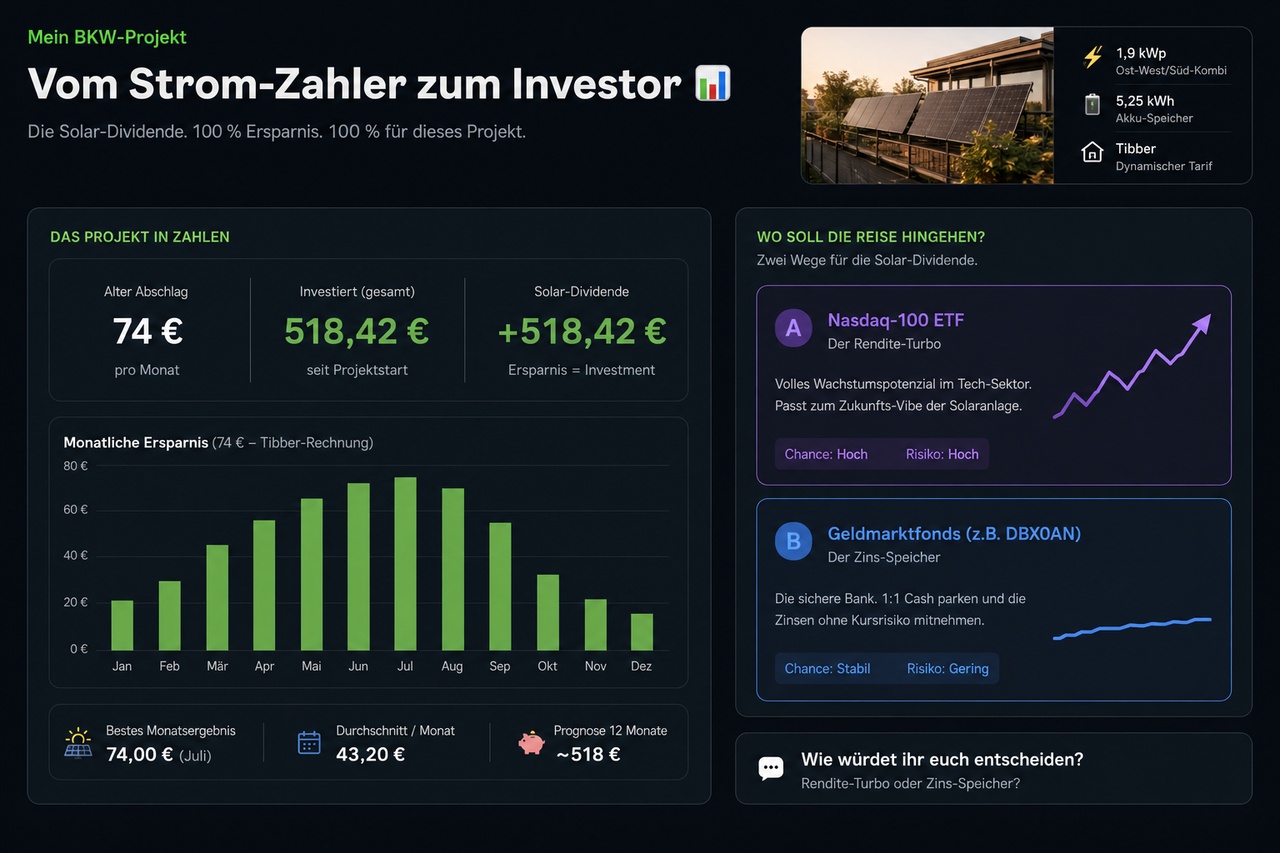
I have been running my balcony power plant (1.9 kWp east-west/south combination with 5.25 kWh battery) in test mode for the last few months.


The dynamic Tibber tariff has recently been added.


In order to make the success of the system in the depot really tangible, I want to visualize the savings completely separately and put them in a single position.


As my own solar dividend, so to speak.


The logic behind this is simple:

My old discount was €74. I use the refund from the old contract as starting capital for the first one-off purchase. From now on, the real difference goes into the deposit every month - i.e. €74 basic discount minus the current Tibber monthly bill. If the bill runs towards €0 in the summer, almost the full €74 will go into the share.

As my core portfolio (World ETF) is to remain untouched, I am currently wavering between two completely different approaches for this pure visualization project:


Option A: A classic Nasdaq-100 ETF.

This puts the money directly into the tech sector. Maximum growth potential in the long term, which somehow fits in quite well with the "future vibe" of the solar system.


Option B: A simple money market fund (e.g. $XEON (+0,02 %) ).

The safe bank. The savings are parked virtually 1:1 as cash and take the current interest rates completely without price risk. The stable counterpart to fluctuating electricity prices.


What would you choose for such an experiment? The yield turbo or the interest storage?


@DividendenWaschbaer How are you doing it? Is your large investment already running?

9
14 Commentaires

image de profil
Would choose Rendite-Turbo.
At €500/year, I'm not even thinking about overnight money. You won't get 10€ out of it
3
image de profil
@Alpalaka If you're honest, you won't actually get anything out of it. The fact is the visualization that I can see when the costs are back in. When the €2000 position is deposited, I know that the thing is paid for 😂 . Yes, the nasdac actually tickles me a bit more than the money market fund
1
image de profil
Is this an app with the project or something else
image de profil
Nice idea. I actually don't know if I'll do anything with it. Maybe I'll just let it run and be done with it. It's not connected yet. Not until the end of June.

The experiment is interesting. But the NASDAQ (especially in the current situation) also has great potential to fall, which of course makes a savings plan attractive. But for it to really ("safely") pay off, you would definitely have to let it run for longer.

You could also invest the money in solar parks.
$HRPK
$UKW
$IBE

Or in infrastructure such as $EOAN or $RWE

Alternatively, of course, a solar etf. I'm sure there is one.
image de profil
Do you have Pulse or a smartmeter with gateway? If 2. who installed it?
image de profil
@Investor_in_Jogginghose I use the Pulse in an apartment building. It works very well. I received a new electricity meter from EnBW just over a month ago (but no smart meter gateway)
image de profil
@GoDividend I am with rabot Energy and already have a gateway which is finally working after 8 months. I would like to switch to Tibber, but I don't know if the switch will go smoothly. I'll give it a try this winter. Tibber has the better tariff, with rabot you always pay some commission.
1
image de profil
@Investor_in_Jogginghose Feel free to contact us again 😅 there should be something like customer advertising😂
image de profil
@GoDividend I'm trying to think about it. In any case, these tariffs are game changers. I only had €39 in electricity costs in April because I was able to charge my Taycan at negative prices. I earned €7.50 in one day of consumption.
image de profil
@Investor_in_Jogginghose I don't have an e-runabout yet, but never say never. Maybe one day when the old carrot no longer wants it
image de profil
@GoDividend Very nice idea to share this here. I'm also thinking about getting a balcony power station. I'm wondering whether a storage system is really worthwhile. What brand of modules and storage system do you have? How much did the investment cost you?
image de profil
@Schnurze Anker solix 3pro with 3x 500w and 2x200w (for space reasons). With additional memory and cable etc total approx. 2000€
1
I have simply passed your explanation 1:1 to MS Copilot...
Here is his analysis/answer:

"Your approach is really good - especially because you completely separate the **solar savings mentally**. That makes the effect visible and motivating.
The decision is not so much "right or wrong", but rather: **What should this position represent for you?

I give you a clear, practical recommendation:

***

# 🧭 Short answer

* **If you want a "real solar dividend with growth" → Option A (Nasdaq-100)**
* **If you want a "measurable, stable savings performance" → Option B (money market fund)**

👉 For your goal ("visualization") **Option B is objectively cleaner**
👉 For motivation and wealth accumulation, **option A is stronger**

***

# 🔍 What you are actually building

You unconsciously have two possible concepts:

### 1. 💡 "Solar = cash flow"

→ You want to show: *How much money does this thing really save me?

✅ Then you need:

* stable performance
* no price distortion
* direct comparability

👉 **Money market fund clearly wins**

***

### 2. 🚀 "Solar = investment leverage"

→ You want to show: *What happens if I invest this saving?

✅ Then you need:

* Yield
* growth effect
* long-term compound interest

👉 **Nasdaq ETF wins**

***

# ⚖️ Honest comparison

## Option A: Nasdaq-100 ETF

**Advantages**

* Very high long-term return potential
* fits thematically well (tech + energy future)
* makes "fun factor" high → important for motivation
* Compound interest has a strong effect (even for small amounts)

**Disadvantages

* strong fluctuations
* your "solar dividend" is distorted by market movements
→ can even have a negative effect (psychologically dangerous)

👉 Example:

* You save €70/month
* Market falls → Deposit at -15 %

➡️ Feeling: "My solar system is making losses"
(= actually wrong, but it happens mentally)

***

## Option B: Money market fund (e.g. XEON)

**Advantages**

* virtually no fluctuation
* very clean measurability
* almost corresponds to real cash savings
* ideal benchmark for your investment

**Disadvantages

* boring
* currently ok interest rate, but limited (\~3-4%, depending on phase)
* hardly any motivation boost

***

# 🧠 The most important point (psychology!)

You say it yourself:

> "make it really tangible in the depot"

👉 That's the crucial sentence.

If you:

* need motivation
* want to see the whole thing grow visibly
* want to have fun with it in the long term

👉 then **Nasdaq is the emotionally better choice**

If you:

* really want to evaluate whether your setup is worthwhile
* build a "mini business evaluation", so to speak

👉 then **money market is the logically cleaner choice**

***

# 💡 My clear recommendation (best-of-both)

The best solution is actually:

## 🔀 Hybrid approach (highly recommended)

Share your "solar dividend", for example:

* **50 % money market (XEON)**
** **50 % Nasdaq-100 ETF**

👉 Result:

* Stable basis (real benefit visible)
* Growth component (motivation + upside)
* No frustration during crashes

***

# 🧮 Alternative: Visualize even better

If you want to make it really clean:

### 🟢 Portfolio = Nasdaq (100 %)

### 🔵 Parallel tracking:

* Excel / App: "cumulative savings"

👉 Then you see:

* **real solar performance (neutral)**
** **Investment performance (separate)**

This is the most **professional solution**.

***

# ✅ Conclusion

If I **had** your exact setup, I would:

👉 **choose variant:**

* 50% Nasdaq-100 ETF
* 50% money market fund

OR (even better):

👉 **Invest everything in Nasdaq**

* Track savings separately

***

# 🧾 Clear decision set

* Want to **measure reality** → money market
* Want to **build wealth & motivation** → Nasdaq
* Want to **both** → Hybrid

***
If you want, I can do a quick calculation with your setup (incl. summer/winter effect and realistic annual savings)."
Participez à la conversation