
El Niño could affect Munich Rea lot of money. But does this justify a price slump of this magnitude?
A business model in transition
Munich Re is one of the largest reinsurance groups in the world. In addition to its core business of reinsurance, the company, which was founded in 1880, also offers primary insurance throughout Europe via the ERGO Group and worldwide via Munich Health. Munich Re is also active as an asset manager.
Reinsurers cannot take large risks and are dependent on the bond markets and their returns. Billions of euros must be held in liquid and easily predictable investments. In times of key interest rates close to zero, the business was put to the test.
Since the turnaround in interest rates, however, the share has been one of the big winners on the German stock market. However, the share price has recently slumped from around 615 to 475 euros. Should you use the setback to get in?
The business model is simple at its core, but highly complex in its implementation. Reinsurers cannot make large individual bets, but have to spread risks widely and calculate them in an extremely disciplined manner.
Global oligopoly
A key driver of earnings is therefore not only the level of premiums, but also the investment of capital. A large proportion of the balance sheet total is parked in fixed-interest securities because the obligations are predictable but long-term.
Munich Re is one of the three globally dominant reinsurers in the industry alongside Swiss Re and Hannover Re.
This oligopoly structure ensures that there is no need to compete on price and that the necessary discipline is maintained.
This applies in particular to the pricing of major risks such as natural catastrophes, industrial insurance and special risks.
This is not only important for Munich Re, but for the entire financial system. It would not benefit anyone if reinsurers took on too many risks and stopped earning money.
In recent years, rising losses due to extreme weather events, inflation in claims costs and geopolitical uncertainties have driven up premiums in the market.
Munich Re has benefited disproportionately from this, as the company traditionally writes conservatively and focuses on underwriting quality rather than growth.
The sharp rise in the share price in the wake of the interest rate turnaround was therefore logical. Higher interest rates significantly improved investment income, while reinsurance prices rose at the same time.
Profits soaring - but how sustainable is that?
This has led to significant profit increases from the 2021 financial year onwards. In total, earnings have more than doubled in the last five financial years, from €20.93 to €47.15 per share.
The dividend was increased from EUR 11.00 to EUR 24.00 per share during this period. The payout is therefore well financed.
The dividend yield is impressive and currently stands at 5.42%. However, the next payment is not expected until May of next year.
This is probably one of the reasons currently weighing on the share. The distribution of the dividend has led to a drop in the share price. Many investors are likely to have subsequently exited the market, which is putting additional pressure on the share price and the chart.
Added to this are the current concerns surrounding El Niño. El Niño is a climate phenomenon in which the sea surface in the central and eastern Pacific periodically warms up considerably, usually every two to seven years.
This warming changes air pressure and wind patterns and thus influences the weather worldwide.
El Niño as a risk factor
The US authority NOAA estimates the probability of El Niño forming between June and August 2026 at around 62%. Some climate models even consider a very strong or so-called "super El Niño" to be possible.
In the event of a strong El Niño, significantly more extreme weather events are to be expected worldwide, including heat waves, droughts and heavier rainfall in various regions.
This is indeed a relevant macroeconomic risk factor for reinsurers like Munich Re.
If NOAA's assessment is confirmed and El Niño sets in as early as summer 2026, the probability of an accumulation of so-called "correlated major losses" will increase. This is more dangerous for reinsurers than individual isolated events because several regions can be affected at the same time.
Typically, a strong El Niño is followed by extreme rainfall in parts of South America, while droughts and heatwaves occur simultaneously in North America, Africa or Asia. For Munich Re, this means potentially higher claims payments in several regions at the same time.
Major losses worldwide
However, the issue should not be overdramatized. El Niño is not a new challenge for Munich Re and the industry, but a well-known phenomenon that occurs every two to seven years.
It is quite possible that El Niño will impact the result in the short term, but this will make little difference to the underlying business. If particularly high losses occur, this will inevitably lead to rising insurance premiums.
The real damage is caused to the people affected by severe weather. For them it is a potential catastrophe, but not for Munich Re.
The recent setback could therefore be a buying opportunity. As a result, the P/E ratio (blended P/E) has fallen from 13.6 to 9.8.
If earnings rise by EUR 50 per share in the current financial year as expected, this corresponds to a P/E ratio of 9.5. The long-term P/E ratio has been hovering around 13.8
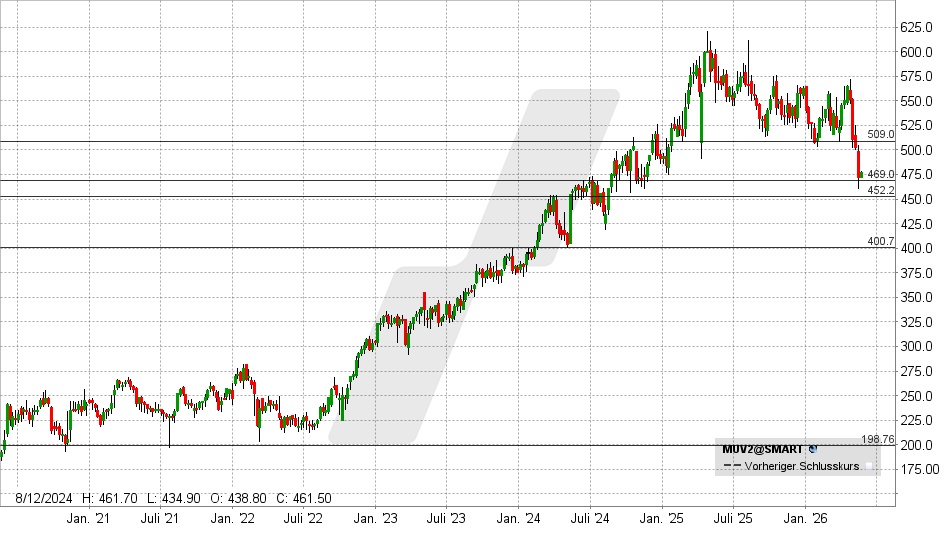
Munich Re shares: Chart from 18.05.2026, price: EUR 475 - symbol: MUV2 | Source: TWS
The shares have returned to the support zone at EUR 450-470 and appear to be attracting interest there.
If it now manages a sustained rise above EUR 475, this could trigger a recovery towards EUR 500-510. Above this level, a procyclical buy signal would be issued.
If, on the other hand, the share falls below EUR 470, losses can be expected to extend in the direction of EUR 450-455. Below this level, losses of up to EUR 425 or 400 are conceivable.
Source


