3J·

AI FOMO

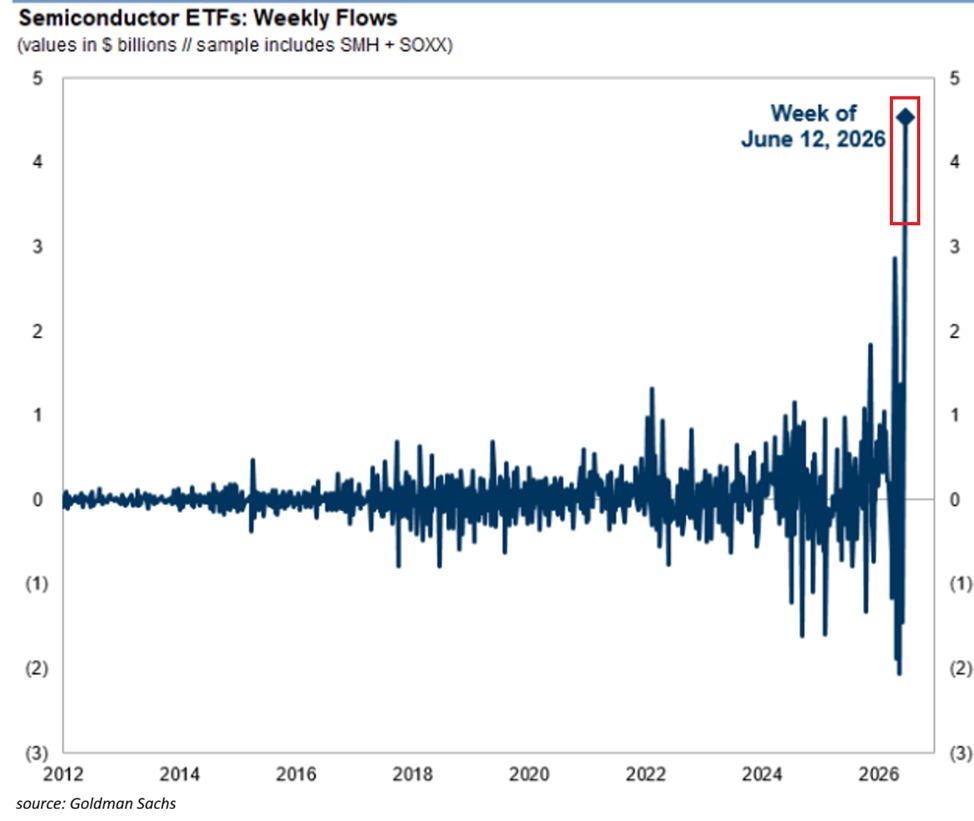
U.S. AI and chips ETFs, such as $SMH (+1,93 %) and $SOXX (+1,7 %) , just recorded the biggest weekly inflow in their history.
attachment

During the week of June 12, around $4.7 billion flowed into these two ETFs alone. To understand how big this is, the chart shows that nothing like this has happened since 2012.


In simple terms, investors are not just buying individual names like $NVDA (+1,03 %) , $AMD (+1,46 %) , or $AVGO (-0,55 %) . They are putting massive amounts of money into the entire chips sector, meaning the companies behind the AI boom.


The reason is clear. AI remains the strongest story in the market, and chips are the heart of this growth. Without chips, there are no data centers, AI models, cloud infrastructure, or the huge demand we are seeing today.


But this has two sides.


On one hand, it shows that the sector still has huge momentum and continues to attract capital. On the other hand, when this much money flows into one sector so quickly, short-term risk usually increases as well.


This does not mean that AI and chips stocks are done or that we should avoid them. It simply means we should not blindly chase everything that has already moved a lot.


Personally, I still strongly believe in AI and chips long term. But in phases like this, discipline matters. We need patience, good entry prices, and no FOMO.

5
3 Commentaires

image de profil
At this points I’m not doing the convencional dca anymore, I’ve splitted it in two, making two buys a month instead of one and I’m only buying semis when having a pullback of 6% at least since my position is almost built.
Im also leaving 10%-15% of my dca in cash for bigger pullback opportunities. We gotta take advantage of this volatility the best way possible
1
image de profil
@emppsb At this stage, I also think it’s better to be more selective instead of blindly buying every month at any price. Splitting the DCA into two buys gives you more flexibility, and keeping 10%-15% in cash can help you take advantage of bigger pullbacks. The only thing I would be careful with is being too strict with the 6% rule. Sometimes a stock or sector may pull back 4%-5%, then continue higher without giving the perfect entry. So for me, the key is balance, don’t chase strength, but also don’t become so strict that you miss every opportunity. Overall, I agree with the logic. In a volatile sector like AI and chips, cash and patience are not weakness. They are part of the strategy.
1
image de profil
@G_Lappas10 yeap I understand what you say about 6% rule, and that actually happened to me last week when I wanted to open a position in $MU and my price target was 740 euros and it only reached the 760 euros, now is up already 30% from there… so I lost 30% because of 20 euros. It hurts a lot, I use the 6% as reference, depends on the stock or etf. Anyway I’m happy that my logic makes sense not only for me. Thanks mate for your comment
Participez à la conversation