I remain invested.
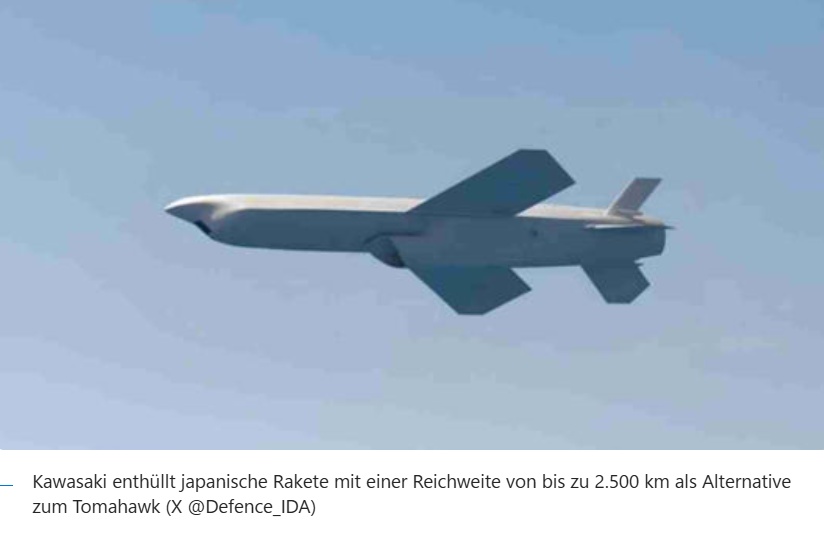
Kawasaki Heavy Industries presented progress in the development of a prototype cruise missile at a technology symposium in Japan, which has already been dubbed the "Japanese Tomahawk" by the press.
The project, which was published on the website of the Acquisition, Technology and Logistics Agency (ATLA), aims to test critical technologies for a future national long-range weapon.
The goal is to develop a versatile platform that can employ different types of warheads against sea and ground targets while integrating electronic warfare systems, countermeasures, reconnaissance and special configurations for attacks on fortified structures such as bunkers and command centers. The idea is that the missile serves as the technological basis for a weapon system that can fulfill multiple roles on the modern battlefield.
The system is powered by the KJ-301 turbojet engine, which Kawasaki unveiled at the end of 2024 and which enables a high subsonic speed and an estimated range of 1,500 to 2,500 km - twice as much as the 12SSM-ER currently in service.
Another highlight is the development of integrated software for anti-aircraft missile defense maneuvers, designed to increase the weapon's survivability against short-range maritime defense systems such as Phalanx and AK-630.
Although the prototype is not intended for direct deployment to the Japan Self-Defense Forces, it will serve as a technology demonstrator for a new national cruise missile, the development of which began in late 2024 and is expected to be completed between 2030 and 2033.
Although the prototype is not intended for direct deployment to the Japan Self-Defense Forces, it will serve as a technology demonstrator for a new national cruise missile, the development of which began in late 2024 and is expected to be completed between 2030 and 2033.