

There is a difference, often neglected, between looking at the market and seeing what kind of thing one is looking at. A price chart is not a single object observed at different magnifications. At different temporal scales it reveals different properties of the same uncertain creature.
The fifteen-minute chart and the hourly chart may describe the same Bitcoin $BTC (+0,34 %) prices (graphs courtesy from okx.com), yet they do not contain the same sort of knowledge.
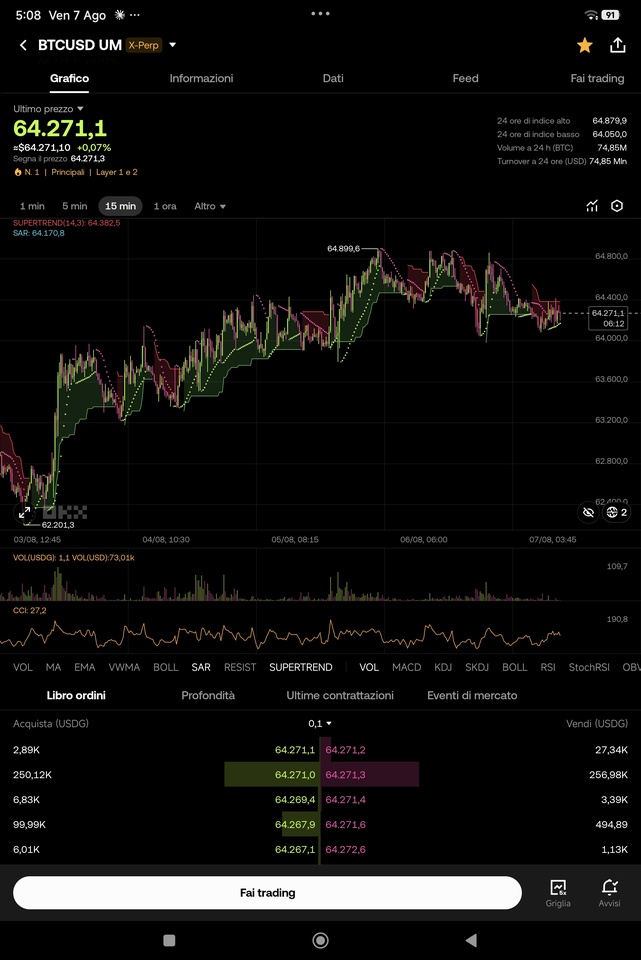
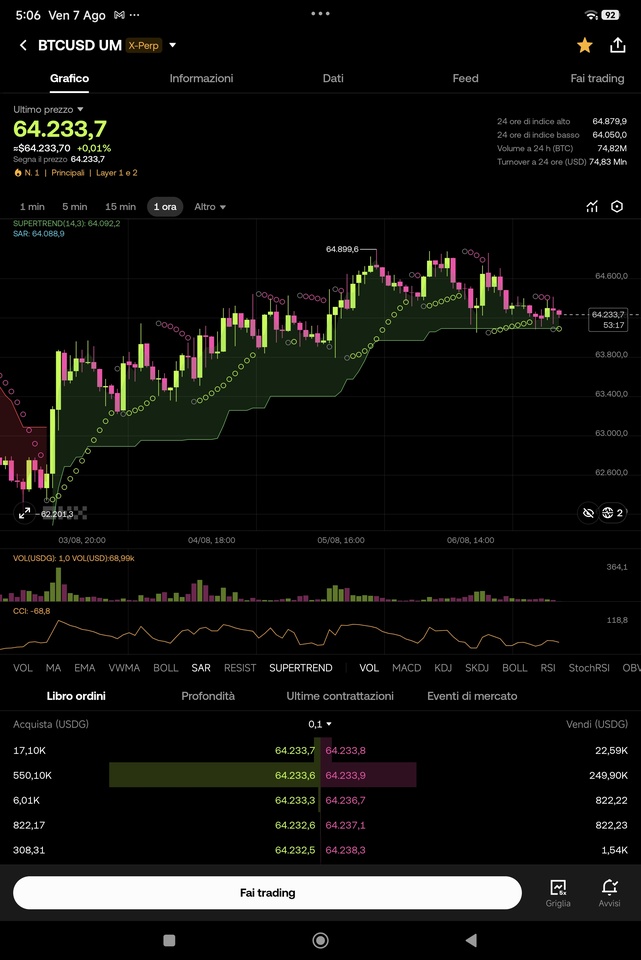
Below fifteen minutes, the market belongs to the (human, hopefully) discretionary trader, and algotithms, too, of course. Here price is a restless thing, continually altering its character before the observer has quite finished naming it.
A Supertrend changes, the SAR follows, volume suddenly expands, momentum turns, and what appeared a moment ago to be a developing movement may prove to have been nothing more than an excursion into noise. Such information may nevertheless be valuable. The trader does not require prophecy. He requires a small asymmetry between what is likely to happen and what he must risk should he be wrong.
We may call this timeframe (and less) trading grade.
Its virtue is necessarily temporary. A configuration that possesses an edge for the next thirty minutes may possess none for the next six hours. Indeed, to ask it to do so is already a category error. The short-term trader is not attempting to discover the permanent nature of the market. He is attempting to exploit a local irregularity before the market has had time to erase it.
The longer timeframes belong to another order of thought. At one hour, four hours, or a day, much of the agitation of the shorter chart disappears into the process of aggregation. Individual reversals cease to matter. What begins to appear instead is persistence: a sequence of higher highs and higher lows, a sustained directional movement, a change in volatility, a regime which survives the innumerable small accidents of which it is composed.
We may call these timeframes, investment grade.
Yet investment grade should not be mistaken for certain. That would be precisely the sort of semantic fraud of which financial markets are so fond. A longer timeframe does not make the future predictable. It merely permits us to ask a different question. We are no longer asking what the next few candles will do, but whether the present state of the market has enough persistence to justify maintaining exposure.
The distinction is therefore not simply between speculation and investment. It is between an event and a state. Trading grade identifies an opportunity within the movement of prices; investment grade identifies the regime within which that opportunity exists.
The distinction becomes particularly important when viewed through a Talebian lens. The purpose of analysis is not to construct an increasingly elaborate machine for predicting an unknowable future. Markets are too discontinuous, too reflexive, too fat-tailed, and too capable of producing events which were absent from the historical sample to permit such intellectual comfort. The more interesting question is not whether one can be right, but what happens when one is wrong.
A trading signal may therefore be useful precisely because its error can be made small. If a fifteen-minute configuration offers a modest positive asymmetry while the loss is strictly contained, it may be worth taking. The trader need not know what Bitcoin will do tomorrow. He needs only to ensure that tomorrow cannot destroy him because of what he believed about today.
Investment grade operates differently. Here the principal danger is not being stopped out by an ordinary fluctuation, but remaining exposed to a regime which has ceased to exist. The investor therefore tolerates considerably more local noise in exchange for participation in a persistent movement. His enemy is not volatility itself, but fragility to a change in the underlying state.
Thus the two horizons ought not to compete. They should form a hierarchy. The higher timeframe tells us what sort of world we appear to inhabit; the lower timeframe tells us whether this particular moment offers a tolerable way of entering or leaving it.
The hourly chart may say that the tide is rising. The fifteen-minute chart tells us whether we are presently being carried by the tide or merely watching a wave break upon the shore.
And the Talebian precaution is to remember that neither chart has sworn an oath to reality.
The finest use of technical analysis is therefore not to abolish uncertainty, an ambition suitable chiefly to clever economists and other respectable people, but to organise one's exposure to it. Investment grade determines the regime in which one is willing to remain exposed. Trading grade determines the moment at which one is willing to act. Risk management determines whether the inevitable failure of both remains survivable.
That last distinction is perhaps the only one that ultimately matters. A model need not foresee the storm. It must merely ensure that the sailor does not require fair weather in order to survive.