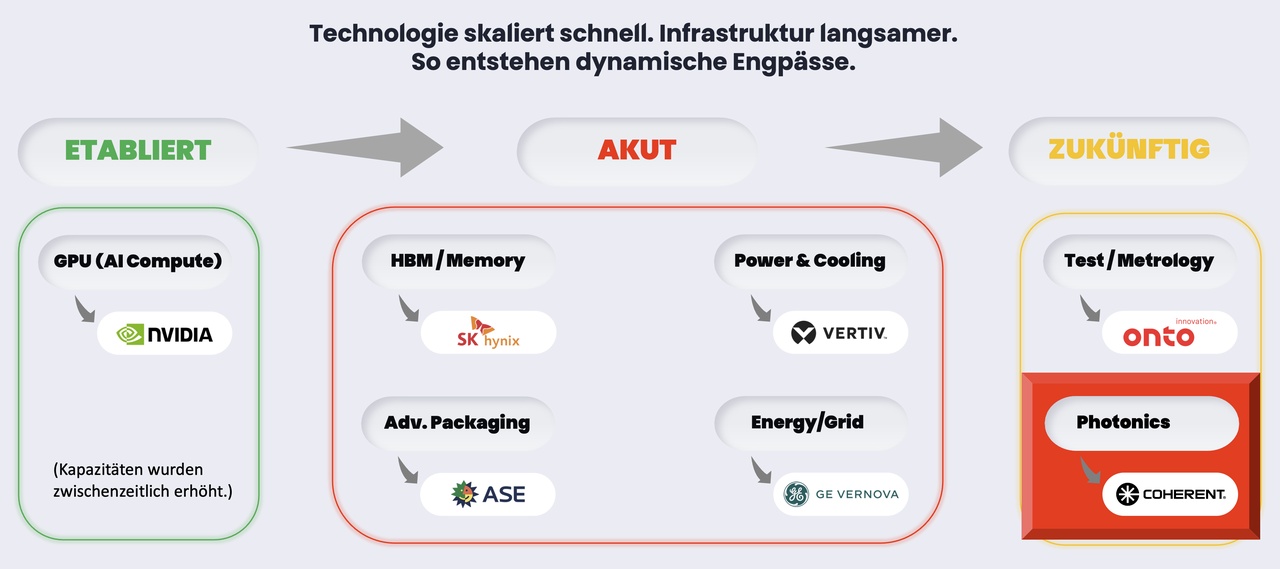
Many AI investors are primarily looking at GPUs, memory or energy supply. I believe that the next big bottleneck is already slowly emerging: Photonics.
The background: modern AI systems have to move ever larger amounts of data. However, classic copper cabling is increasingly reaching its physical physical limits. Energy consumption, heat generation, signal losses and susceptibility to errors are increasing massively. This is why the industry is moving step by step towards light instead of electricity.
- Photonics simply put, means that data is no longer transmitted primarily electrically, but optically via light signals.
- Optoelectronics as a sub-sector combines electronics and lighting technology.
- CPO/Co-Packaged Optics describes the approach of placing optical components directly next to AI chips in order to massively improve speed, energy efficiency and bandwidth.
NVIDIA is now visibly driving this development forward. The company is investing billions in optical infrastructure and partners in the field of AI photonics. (For example, Lumentum and Coherent are currently benefiting from a 2 billion dollar investment each).
For me, this is therefore likely to be the next big upcoming AI bottleneck. What I find particularly interesting is that photonics does not consist of just one area. There are very different levels of risk and maturity within the stack.
Level 1: Established photonics infrastructure
This is where the more stable infrastructure players are located. Companies such as $COHR (+1,71 %) (Coherent), $LITE (+0,6 %) (Lumentum), $CIEN (+0 %) (Ciena) or even $FN (-1,67 %) (Fabrinet) are already benefiting from the fact that optical systems are increasingly moving into AI data centers.
This is mainly about:
- lasers
- optical components
- Fiber optic infrastructure
- transceivers
- Optical Networking
Level 2: Optical Interconnects & Data Center Connectivity
A field in which there is currently a lot of momentum. AI clusters require ever faster connections between GPUs, storage and switches. I'm thinking of companies like $AAOI (+0,99 %) (Applied Optoelectronics), $ANET (-0,33 %) (Arista Networks) or in some cases also $5802 (-3,93 %) (Sumitomo Electric). Optical interconnects could develop into a central AI bottleneck in the next few years.
Level 3: Materials, substrates & manufacturing bases
This area usually receives much less attention, although it is here that important prerequisites for modern photonics systems are created. Photonics requires highly specialized materials, new substrates and precise manufacturing structures. I find companies such as $AXTI (+2,75 %) (AXT), $SOI (-2,29 %) (Soitec), $5802 (-3,93 %) (Sumitomo Electric) or in some cases also $TSEM (-7,13 %) (Tower Semiconductor).
Materials such as indium phosphide (InP), special wafer technologies and optical integration platforms are becoming increasingly important as data rates and integration density rise. And the more complex optical systems become, the more relevant the future bottleneck of "test & metrology" becomes, because these structures have to be controlled and measured with extreme precision (see my last post).
Level 4: Optionality & Next Generation Photonics
The risk increases significantly here. At the same time, however, the potential leverage effect also increases. Companies such as $LWLG (Lightwave Logic), $SIVE (+5,01 %) (Sivers Semiconductors), $INFQ (Infleqtion) or even $LASR (nLight) are working on technologies that could make future optical systems even more efficient or powerful. For me, these are not sure winners. But they are often the early technological options for the next wave of infrastructure. Incidentally, Sivers will soon also be listed in parallel on the NASDAQ.
The exciting thing is that the AI bottleneck is shifting further and further away from pure compute and into the physical infrastructure of data movement.
Acute/Active:
HBM + Power & Cooling + Advanced Packaging + Energy/Grid
Future/Emerging:
Test & Metrology + Photonics
AI will not only need more computing power in the future. Above all, AI needs the ability to move gigantic amounts of data efficiently, quickly and stably.
A third AI bottleneck in the "future/emerging" category could already arise: Edge AI. More on this soon.