3D·

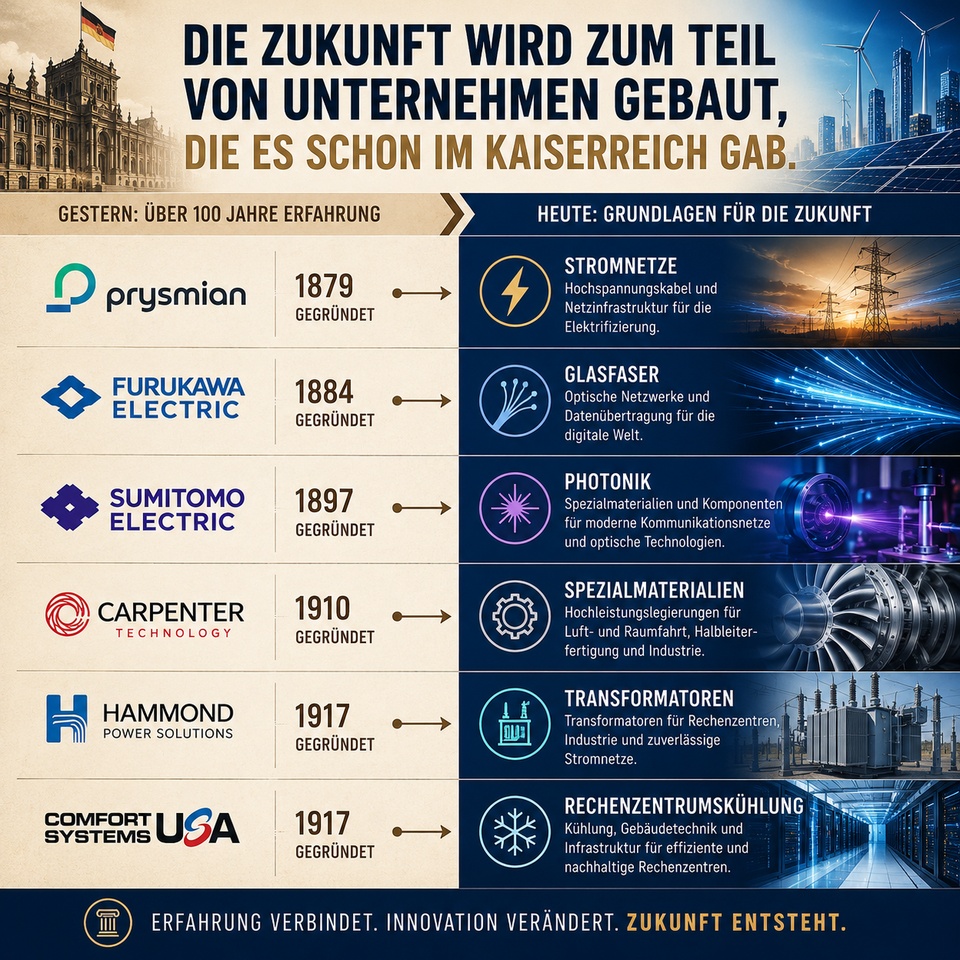
Did you know? The future is being shaped in part by companies that already existed during the German Empire.

When people talk about future technologies or next-gen technologies, the first thing that comes to mind is startups. In my research, however, I keep coming across companies that have been around for more than 100 years!


A few examples from my portfolio:


Prysmian (1879)
$PRY (+2,74 %)

Electric highways, high-voltage cables, and grid infrastructure for electrification.


Furukawa Electric (1884)
$5801 (+8,19 %)

Fiber optics, optical networks, and data transmission.


Sumitomo Electric (1897)
$5802 (+3,6 %)

Photonics, specialty materials, and components for modern communication networks.


Carpenter Technology (1910) $CRS (+0,51 %)

Specialty alloys for aerospace, semiconductor manufacturing, and high-performance systems.


Hammond Power Solutions (1917)
$HPS.A (+2,39 %)

Transformers for data centers, industry, and power grids.


Comfort Systems USA (1917)
$FIX (+1,02 %)

Cooling, building services, and infrastructure for modern data centers.


The more I delve into AI, energy, photonics, or data centers, the more often I come across companies like these.


New technologies can emerge within just a few years. The industrial infrastructure behind them often takes decades to develop.


That is precisely why it’s not just the companies making headlines that benefit from technological upheavals. Often, those who have been laying the groundwork for generations also benefit.


Another example is Caterpillar $CAT (+0,59 %). The company was founded as early as 1925 and today supplies, among other things, the emergency power systems that play a key role in many data center projects.
attachment

#dibs
#scalelimits
#wikifolio

30
4 Comentarios

That’s an interesting angle, Oliver! However, if you take a really close look at the history, there’s actually a rather curious fact hidden behind your phrase “there were in the Empire”:
Strictly speaking, only two companies on your list were actually founded during the Empire: Furukawa and Sumitomo. Prysmian was founded in Milan in 1879—but Lombardy had already seceded from the Austrian Empire 20 years earlier and had long since become part of the Kingdom of Italy (and the U.S. and Canadian companies were founded in republics and the British Empire, respectively). The paradox here is that the only true empire on your list (Japan) is, formally speaking, the only one still in existence anywhere in the world today! 😉

But setting historical geography aside: When it comes purely to the combination of over 100 years of tradition and the fundamental foundation for cutting-edge technologies of the future, there’s actually one very specific giant missing from your portfolio:
IBM $IBM (founded in 1911).
The company that’s building the invisible backbone for global enterprise AI today—and, above all, the actual hardware for tomorrow’s quantum computing—would fit perfectly into this lineup.

How do you view IBM compared to the other infrastructure stocks you mentioned?
1
Imagen de perfil
@TomInvest That’s right—I deliberately didn’t write that the companies were founded during the German Empire, but rather that they already existed at the time of the German Empire. 😊

I’m more cautious when it comes to IBM. It’s undoubtedly an impressive company with enormous technological significance. In my DIBS approach, however, I specifically look for companies that are situated at—or directly benefit from—a concrete infrastructure bottleneck.

I see IBM more as a diversified technology provider. With companies like Prysmian, Hammond, Comfort Systems, or Sumitomo, I can establish a much more direct link to a specific bottleneck.

But it’s precisely these kinds of discussions that make the approach so exciting.
@ScaleLimits
Touché, Oliver! You’ve certainly nailed the time frame “during the German Empire.” 😉

As for your DIBS approach and the specific infrastructure bottlenecks: that’s exactly where my argument for IBM comes in. I completely understand why, at first glance, you see them as a broad, almost sluggish technology provider. But if you look under the hood, IBM sits at one of the most critical and irreplaceable bottlenecks of all—and that across two generations:

1. Today’s physical bottleneck (mainframes):
In the core banking systems of traditional global banks, there is still simply no equivalent alternative in practice for high-volume, critical transactions when it comes to extreme stability, speed, and massive throughput. A complete replacement of these legacy systems is akin to a risky “open-heart surgery.” The mainframe is to global payment transactions exactly what Prysmian’s high-voltage cables are to the power grid: a physical bottleneck without which the lights would go out immediately in the global system.

2. Tomorrow’s physical bottleneck (quantum computing):
IBM isn’t just playing around with software here; it’s building the physical hardware infrastructure for the next era of computing. While competitors like Google often focus on purely scientific laboratory milestones, IBM is driving industrialization forward—with its own quantum foundries (factories), a transparent hardware roadmap, and the seamless integration of these quantum chips with classical supercomputers.
IBM is thus providing the indispensable “building blocks” for the computing power of the next 50 years.

Doesn’t this dual hardware infrastructure approach (mainframe + quantum foundry) make the company extremely interesting again for your strategy?
1
Imagen de perfil
@TomInvest That’s an interesting point. When it comes to the mainframe business, I’d even agree that you have a very strong market position.

For DIBS, however, a strong market position alone isn’t enough. I’m looking for the most direct exposure to supply bottlenecks possible, so I often prefer pure players or companies where a bottleneck is a key part of the investment story.

Rolls-Royce is a good example for me. I find the topic of SMR extremely exciting. Nevertheless, Rolls-Royce isn’t a typical DIBS stock because the company has a much broader overall business, and SMR is only part of the story.

I view IBM similarly. I’m certainly keeping an eye on quantum computing. For me, however, quantum computing isn’t yet a technology that’s currently failing due to an acute infrastructure bottleneck. That could change in a few years, much like with SMR.

If quantum computing eventually evolves from a scientific discipline into a real-world scaling challenge, I would look for the specific bottlenecks and then consider which companies are most directly exposed to them.
1
Únase a la conversación