
RWE is earning more than it has in a long time: In the first nine months of 2026, adjusted EBITDA rose 35% to €4.58 billion, and adjusted earnings per share rose 42% to €2.52. As a result, the Essen-based energy company has already achieved 85% of its annual target and expects to reach the upper end of its forecast for 2026. With a majority stake in the grid operator Amprion (about 58%), three new gas-fired power plants with 15-year contracts, and 4.5 GW of offshore wind under construction, RWE is building its business in an increasingly predictable manner. The stock is trading at €56.60 (Stock3, Nov. 25, 2026), which is about 25% above the start of the year, but has not risen further since the spring. On the weekly chart, the RWE stock is rated neutral in the short term within the range of €54.33 to €61.77. A new annual high above €61.77 would signal a buy up to €68.37; if the price falls below €54.33, a contrarian buying opportunity would arise at €49.22. Analysts’ average target is around €70.
Key Points
- 9M 2026: Adjusted EBITDA €4.58 billion (+35%), adjusted net income €1.85 billion (+43%), earnings per share €2.52
- 2026 Forecast: Earnings per share €2.60 to €3.30; upper end expected
- Target by 2031: Earnings per share around €4.55, +10% annually
- Dividend: €1.32 planned for 2026 (yield around 2.3%), followed by a 10% increase per year
- Amprion stake increased to approximately 58%, financed through a capital increase of approximately €4 billion
- Analysts: Average price target around €70; Exane BNP upgrades to “Outperform” (€75.60)
- Chart levels: neutral between €54.33 and €61.77; buy signal above €61.77 up to €68.37; contrarian level at €49.22
What are the current key metrics for the RWE stock?
With a market capitalization of approximately €44 billion and a P/E ratio of around 19 based on the earnings per share of approximately €2.95 projected for 2026, the RWE stock is trading at a higher valuation than its ten-year average, during which, according to Aktienfinder, investors paid only about 12 times the adjusted earnings.
Based on the 2027 earnings target of around €3.15, the P/E ratio drops to around 18. The dividend yield is around 2.3%.
- Price (Xetra: RWE): €56.60 (Stock3, Nov. 25, 2026)
- Xetra closing price the previous day: €56.96 (Nov. 24, 2026)
- 52-week high: €62.00 (end of April 2026)
- 52-week low: €42.82 (December 2025)
- All-time high: approximately €100 (January 2008)
- Year-to-date performance: approximately +25% (November 25, 2026)
- Market capitalization: approximately €44 billion (November 25, 2026)
- Adjusted EBITDA for 9M 2026: €4.58 billion (+35%) (November 11, 2026)
- Adjusted EBITDA for Q3 2026: €1.56 billion (+13%) (November 11, 2026)
- Adjusted net income for 9M 2026: €1.85 billion (+43%) (November 11, 2026)
- Adjusted earnings per share for 9M 2026: €2.52 (previous year: €1.77) (Nov. 11, 2026)
- Net investments for 9M 2026: €10.7 billion (including Amprion) (November 11, 2026)
- Net debt: €17.0 billion (year-end target: approximately €12 billion) (September 30, 2026)
- 2026 adjusted EBITDA forecast: €5.75–6.35 billion, upper end (November 11, 2026)
- 2026 Earnings Per Share Forecast: €2.60–3.30, upper end (November 11, 2026)
- 2027 earnings per share forecast: €2.80–3.50 (target: approximately €3.15) (RWE, July 28, 2026)
- P/E ratio 2026e / 2027e: approximately 19 / 18 (based on RWE earnings targets)
- Fair value (adjusted) per Aktienfinder: €40.47 at end of 2026 / €42.54 at end of 2027 (Aktienfinder, November 25, 2026)
- Average analyst price target: approximately €70 (range €60–77.50) (TradingView/finanzen.net, November 25, 2026)
- Dividend for 2025 / Target for 2026: €1.20 / €1.32 (yield of approximately 2.3%) (RWE IR)
- Next Date: 2026 Annual Results on March 4, 2027 (RWE Financial Calendar)
- Annual Shareholders’ Meeting: April 29, 2027 (RWE Financial Calendar)
- Index: DAX (—)
- WKN / ISIN / Ticker: 703712 / DE0007037129 / RWE (—)
What news is currently driving RWE’s stock?
RWE stock is currently being driven by strong nine-month results, a wave of price target hikes, and the expansion of its predictable business segments—yet the share price has been fluctuating between around €55 and €60 for weeks.
On November 11, RWE reported a 35% increase in adjusted EBITDA; according to analysts, third-quarter earnings were about 10% above expectations. Following this, Barclays, Goldman Sachs, Deutsche Bank, and Exane BNP raised their price targets or reaffirmed their “buy” recommendations. In addition, several media outlets reported that the German government intends to acquire RWE and E.ON’s stake in Urenco for around €4 billion—though this has not been confirmed. My analysis of Bloom Energy Aktie.
- Nov. 23, 2026 – Exane BNP upgrades: Exane BNP Paribas upgrades RWE from Neutral to Outperform, price target €75.60. (Bullish)
- Nov. 23, 2026 – Hydrogen turbine in Lingen: RWE is testing a hydrogen-powered gas turbine with Kawasaki in Lingen—a building block for H2-capable power plants. (Neutral)
- November 23, 2026 – Deutsche Bank Raises Target: Deutsche Bank Research raises the price target from €65 to €67 (Buy) and expects higher earnings than the market. (Bullish)
- Nov. 2026 – KKR’s investment in Vanguard completed: KKR acquires 50% of the British offshore wind farms Vanguard East and West (2.8 GW); financing of 13 billion pounds is secured. (Bullish)
- Nov. 12–13, 2026 – German government considers Urenco acquisition: According to Die Welt, the Süddeutsche Zeitung, and Reuters, the German government could buy RWE and E.ON’s stakes in Urenco for around €4 billion. Unconfirmed. (Neutral)
- Nov. 11, 2026 – 9M: EBITDA +35%: Adjusted EBITDA of €4.58 billion, earnings per share of €2.52. Full-year results expected at the upper end of the forecast. (Bullish)
- Nov. 2026 – Contracts awarded for three gas-fired power plants: Voerde, Weisweiler, and Werne, with a combined capacity of 2.5 GW, receive 15-year contracts starting in November 2031. (Bullish)
- Sept. 16, 2026 – Amprion stake rises to 58%: RWE becomes the majority shareholder of the holding company M 31 and holds a calculated stake of approximately 58% in Amprion. (Bullish)
What does RWE management say about the nine-month results?
RWE management, led by CEO Markus Krebber and CFO Michael Müller, expects 2026 results to be at the upper end of the forecast—after nine months, 85% of the annual target for adjusted earnings per share has already been achieved.
RWE has confirmed the dividend of €1.32 per share for 2026 and the annual dividend increase of 10% through 2031.
What went well: All business segments posted growth. Offshore wind increased adjusted EBITDA from 915 to 1,110 million €, as new wind farms such as Sofia, Thor, and Nordseecluster A began supplying electricity and wind speeds were higher. Onshore wind and solar grew from 1,242 to 1,497 million €, while flexible generation using gas and battery storage rose from 1,076 to 1,343 million €. Energy trading generated €543 million—more than three times the previous year’s figure.
The catch: Part of the increase is not repeatable. Energy trading fluctuates greatly, and flexible generation benefited from a one-time effect. Net debt rose to €17.0 billion by the end of September because RWE made net investments of €10.7 billion, including €3.6 billion for the Amprion acquisition. It is expected to fall to around €12 billion by year-end. RWE financed the acquisition in June with a capital increase of approximately €4 billion at €54 per share.
Outlook: By 2031, RWE plans to invest a net total of approximately €42 billion, including €17 billion in U.S. power generation and €7 billion each in European wind and solar farms as well as in power grids. Adjusted earnings per share are expected to rise from €2.50 (2025) to approximately €2.95 (2026), €3.15 (2027), and €4.55 (2031). According to RWE, more than 75% of the 2031 earnings target is already covered by regulated or contractually guaranteed revenues. RWE will present its 2026 annual results on March 4, 2027.
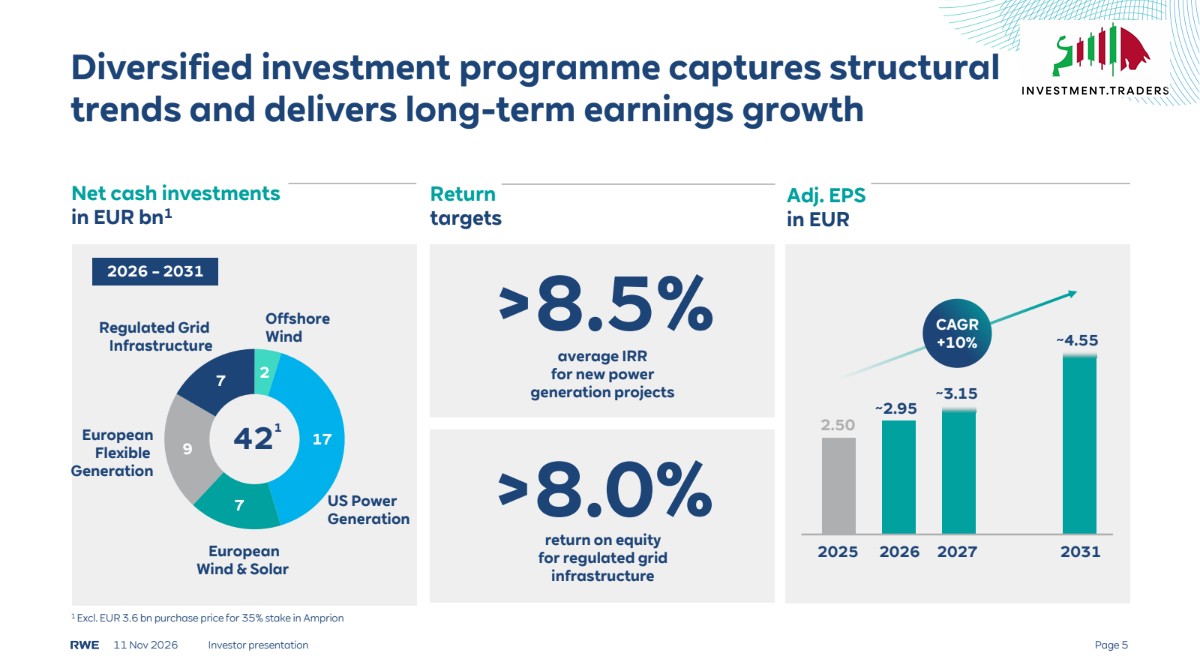
Investment Program and Profit Target for RWE Stock (RWE): €42 billion in net investments from 2026 to 2031 and earnings per share through 2031 (as of November 25, 2026) – Source: RWE Investor Relations / Christian Lill
What does RWE do, and how does the company make money?
RWE is Germany’s largest electricity producer and one of the world’s leading operators of wind and solar farms—the Essen-based conglomerate generates revenue by selling electricity from renewable energy sources, through gas-fired power plants and battery storage systems that step in when wind and solar power are unavailable, as well as through energy trading.
Coal and nuclear power are being phased out; RWE plans to phase out lignite by 2030.
The segments: Offshore Wind (offshore wind farms, primarily in the United Kingdom, Germany, and Denmark), Onshore Wind/Solar (onshore wind turbines, solar and storage parks in Europe and the U.S.), Flexible Generation (gas and hydroelectric power plants, battery storage), and Supply & Trading (energy trading). In addition, there is a roughly 58% stake in the transmission system operator Amprion, which RWE accounts for using the equity method and which is included in the “Other” segment.
How RWE Makes Money: A growing portion of its revenue is locked in for the long term—through difference contracts with fixed electricity prices for wind farms, through power supply contracts with industrial and technology companies, and through Amprion’s regulated grid return. This makes profits more predictable. When it comes to hydrogen technology for the new gas-fired power plants, RWE is banking on future H2 turbines—my analysis of Plug Power Aktie.
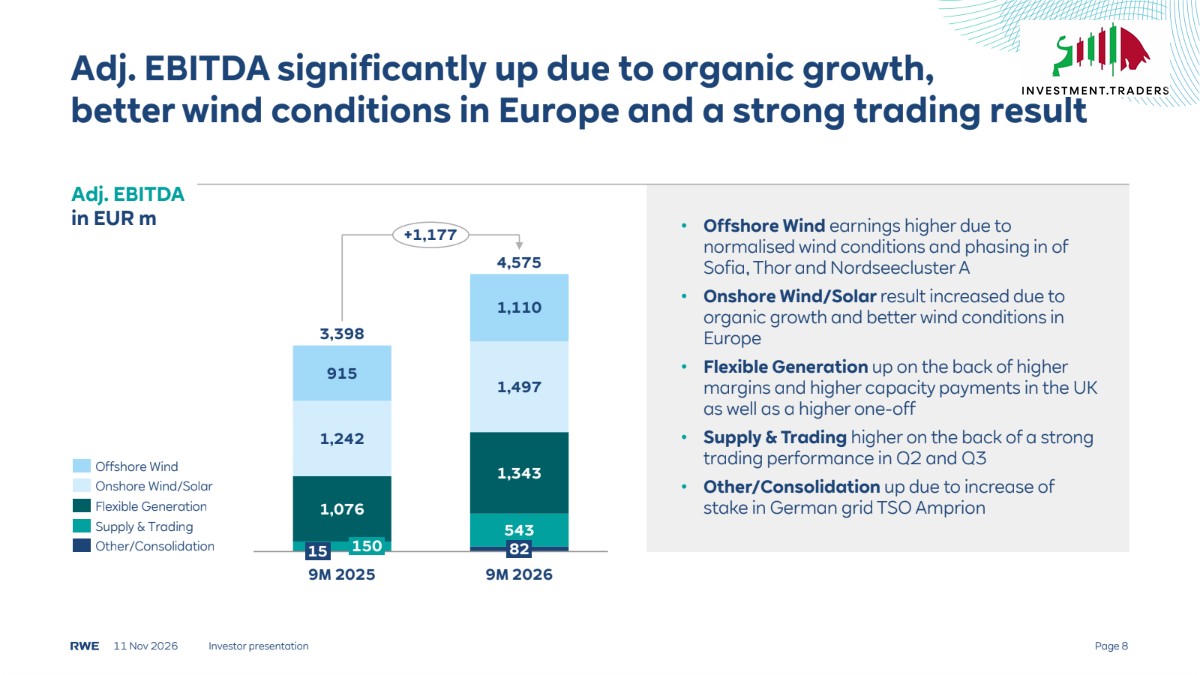
Adjusted EBITDA for RWE Stock (RWE) by Segment, 9M 2026 vs. 9M 2025 (as of Nov. 25, 2026) – Source: RWE Investor Relations / Christian Lill
RWE Stock Fundamental Analysis: Is the RWE Stock Too Expensive?
Measured against its own historical performance, the RWE stock is no longer undervalued: With a P/E ratio of around 19 based on the 2026 earnings target and around 18 based on 2027, investors are paying significantly more than the ten-year average of around 12 based on adjusted earnings.
The market is thus primarily pricing in the projected growth of 10% per year through 2031.
Growth: Adjusted EBITDA rose by 35% to €4.58 billion in the first nine months of 2026, adjusted EBIT increased from €1.86 billion to €2.77 billion, and adjusted net income by 43% to €1.85 billion. For the full year, RWE is forecasting adjusted EBITDA of €5.75 to €6.35 billion and adjusted net income of €1.95 to €2.45 billion, at the upper end of each range. For 2027, RWE raised its forecast in July to €6.7 to €7.3 billion in EBITDA and €2.2 to €2.7 billion in net income.
Cash Flow and Debt: Adjusted operating cash flow stood at €1.93 billion after nine months, weighed down by gas inventories and receivables. Net investments of €10.7 billion far exceed this amount—RWE is financing its growth through partners such as KKR and Apollo, project financing, and the capital increase. The debt-to-equity ratio is expected to be at the lower end of the target range of 3.0 to 3.5. My analysis of Siemens Energy Aktie.
Valuation: Based on the adjusted earnings estimates of 12 analysts and the average P/E ratio over the last ten years, the Stock Finder calculates a fair value of €40.47 at the end of 2026 and €42.54 at the end of 2027. According to this, the stock would be overvalued by about 25% at €56.60. However, this metric underestimates the fact that RWE’s earnings are now much more predictable—thanks to its grid assets and long-term contracts—than they were in the years after 2015, when coal and nuclear power were in decline. Measured against analysts’ price targets of around €70, there is still room to grow.
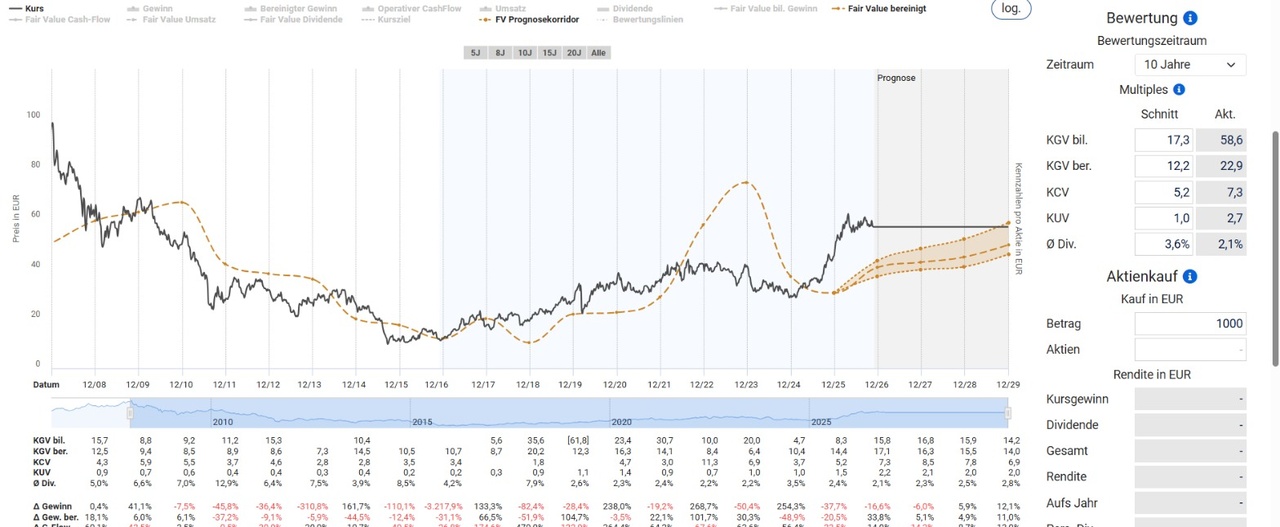
Fair Value Valuation of RWE Stock (RWE) for 2027 Based on Adjusted Earnings (as of November 25, 2026) – Source: Aktienfinder / Christian Lill
RWE Stock Price Targets and Forecast for 2027
On average, analysts see a price target of around €70 for RWE stock, representing about 24% upside potential—from a technical analysis perspective, a buy signal will only emerge with a new annual high above €61.77, which would unlock potential up to €68.37.
Between €54.33 and €61.77, the stock is neutral in the short term. Below €54.33, a contrarian buying opportunity would arise at €49.22.
Key price levels:
- 52-week high: €62.00 (end of April 2026), all-time high around €100 (2008)
- Current price: €56.60 (Stock3, Nov. 25, 2026)
- Buy signal: new annual high above €61.77
- Resistance / Price Target after Breakout: €68.37 (resistance range from 2008 to 2010)
- Neutral range: €54.33 to €61.77
- Critical support level: €54.33; below that, a contrarian buying opportunity at €49.22
Analyst price targets:
- Average price target: around €70 (TradingView €70.30, range €60 to €77.50, Nov. 25, 2026)
- Exane BNP Paribas: Outperform (previously Neutral), €75.60 (November 23, 2026)
- Deutsche Bank Research: Buy, €67 (previously €65, November 23, 2026)
- Goldman Sachs: Buy, €74 (previously €75, November 16, 2026)
- Barclays: Overweight, €73 (previously €72, November 12, 2026)
- LBBW: Buy, €66.60 (previously €63.20, Nov. 12, 2026)
Chart Analysis:
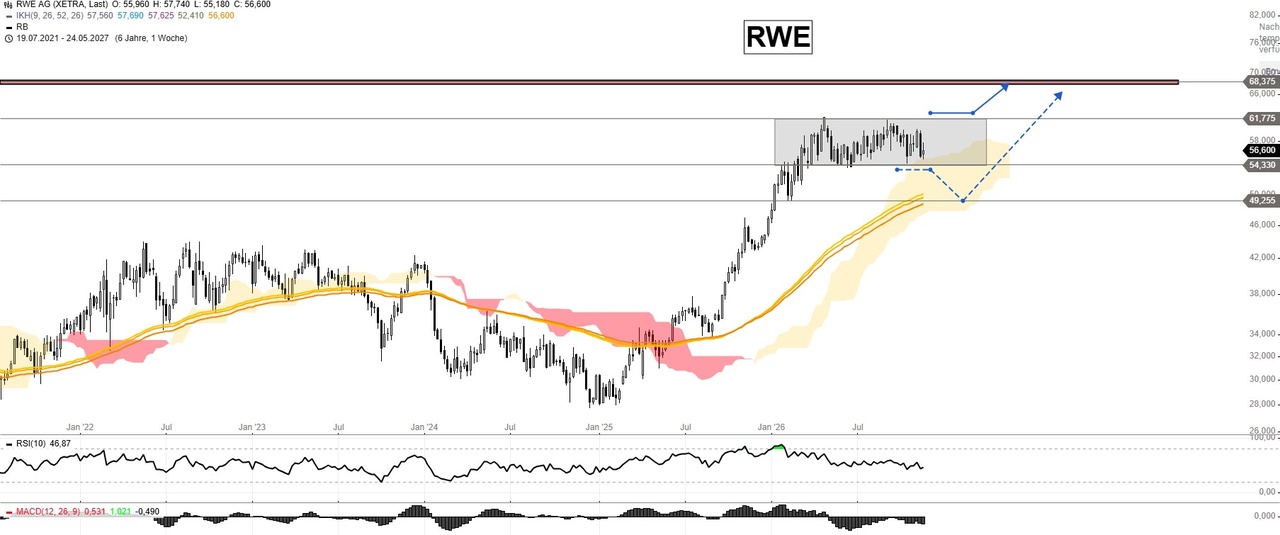
RWE Stock (RWE) Chart Analysis and Price Targets for 2027 (as of Nov. 25, 2026) – Source: Stock3 / Christian Lill
The RWE stock shows a very interesting pattern on the weekly chart—though in the short term, it’s best to wait and see. Since hitting a low of €42.82 in December 2025, the stock has staged a strong rally and reached a new annual high of around €62 in the spring of 2026. Since then, it has been trading in a sideways range (gray box). The price is trading above the moving averages and above the Ichimoku cloud; the RSI is in the neutral zone at around 47, and the MACD is slightly negative—a sign that the uptrend lacks momentum in the short term.
The neutral range (gray box): As long as the stock price trades between €61.77 and €54.33, the RWE stock should be rated neutral in the short term. Within this range, there is no clear signal.
The procyclical trigger: A clear procyclical trigger would be a new annual high above €61.77. That would be the buy signal up to €68.37. That is where the red resistance zone from 2008 to 2010 lies.
The countercyclical buying opportunity (blue dashed arrow): Should the price break below the lower range at €54.33, countercyclical buying opportunities would arise at €49.22. The RWE stock has extremely strong support at this level. From there, the path back up would be open again.
What is the forecast for RWE stock in 2030?
There is no reliable price forecast for 2030, but RWE has a clear earnings target: Adjusted earnings per share are expected to rise from €2.50 (2025) by about 10% per year to around €4.55 in 2031—which, based on these figures, would amount to approximately €4.15 per share in 2030.
At a P/E ratio of 12—the ten-year average—that would correspond to a share price of around €50; at a P/E ratio of 16 to 18, as is the case today, it would correspond to a share price of around €66 to €75. This is a sample calculation, not a price forecast.
The case for this: RWE will invest a net total of around €42 billion by 2031, targeting returns of over 8.5% for new power plants and over 8% for the grid business. According to RWE, more than 75% of the 2031 profit target is already secured through regulated grid revenues, difference contracts, and long-term electricity supply contracts. According to the International Energy Agency, electricity demand in Europe and the U.S. is expected to grow by more than 10% by 2030, driven in part by data centers.
Arguments against this: Growth depends on the timely implementation of major projects such as the Vanguard and Nordseecluster B offshore wind farms. Rising interest rates make financing more expensive and weigh on the valuations of utilities. In the U.S., the business also depends on government policies supporting renewable energy.
How much is RWE’s dividend?
RWE plans to pay a dividend of €1.32 per share for the 2026 fiscal year, which is 10% more than the previous year and, at a share price of €56.60, represents a yield of around 2.3% —the Annual Shareholders’ Meeting on April 29, 2027, will decide on the distribution, which is typically paid out a few days later in early May.
For the 2025 fiscal year, a dividend of €1.20 per share was paid in May 2026.
The dividend plan: RWE plans to increase the dividend by 10% annually through 2031. Mathematically, this amounts to approximately €1.45 for 2027, €1.60 for 2028, €1.76 for 2029, and €1.93 for 2030. The payout ratio will remain moderate at around 45% of adjusted earnings in 2026, with the majority of earnings going toward investments.
Dividend per share at a glance:
- Fiscal Year 2024: €1.10 (paid in 2025)
- Fiscal Year 2025: €1.20 (paid in May 2026)
- Fiscal Year 2026: €1.32 (target, Annual Shareholders’ Meeting April 29, 2027)
- Fiscal Year 2027: approximately €1.45 (calculated at +10%)
- Fiscal Year 2030: approximately €1.93 (calculated at +10% per year)
Those looking for a higher current yield are more likely to find it in real estate or insurance stocks—my analysis of the Münchener Rück Aktie.
Conclusion: Should you buy or sell RWE stock?
Operationally, RWE is delivering its best results in years and is building an increasingly predictable business based on grids, wind, gas, and storage—but on the weekly chart, we’ll have to wait and see in the short term, as the stock is rated neutral between €54.33 and €61.77.
Factors in RWE’s favor include a 35% increase in profits, a profit target of €4.55 per share by 2031, a majority stake in Amprion, a 10% annual dividend increase, and analysts’ price targets of around €70. Factors working against the stock include its high valuation relative to its own historical performance, net debt of €17 billion, dependence on volatile energy trading, and interest rate risk—a risk RWE shares with other interest-rate-sensitive dividend stocks such as Vonovia Aktie.
From a technical analysis perspective: A clear procyclical trigger would be a new annual high above €61.77. That would signal a buy up to €68.37, a resistance zone from 2008 to 2010. Should the price break below the lower range at €54.33, countercyclical buying opportunities would arise at €49.22—where RWE has extremely strong support.
✅ Opportunities
- Adjusted EBITDA after 9 months: +35%
- Earnings target of €4.55 per share by 2031, over 75% secured
- Majority stake in Amprion provides predictable grid returns
- Dividend rises 10% annually
- Analysts’ average price target around €70
- Above €61.77: Buy signal up to €68.37
⚠️ Risks
- P/E ratio around 19—significantly above the ten-year average
- Net debt of €17.0 billion (September 30, 2026)
- Energy trading is highly volatile
- Rising interest rates weigh on utilities
- Project risks associated with offshore wind farms
- Below €54.33, a pullback to €49.22 is possible
Sources
- RWE Investor Relations: Results for the First Three Quarters of 2026 (Nov. 11, 2026)
- RWE Investor Presentation following Q3 2026 (November 11, 2026)
- RWE Press Release: RWE Further Increases Stake in Amprion (September 16, 2026)
- RWE Investor Relations: Dividend and Shareholder Information
- RWE Investor Relations: Financial Calendar
- Analyst reports via dpa-AFX, finanzen.net, and Deutsche Börse: Exane BNP Paribas, Deutsche Bank Research (November 23, 2026), Goldman Sachs (November 16, 2026), Barclays, LBBW (November 12, 2026); Average price target from TradingView and finanzen.net (November 25, 2026)
- Reports on Urenco: Welt, Süddeutsche Zeitung, Reuters, and dpa-AFX (November 12–13, 2026); Capital increase: dpa-AFX and Börsen-Zeitung (June 22, 2026)
- Xetra prices: Alpha Vantage (daily and weekly data through November 24, 2026), Stock3 (November 25, 2026)
- Stock3: Weekly chart for RWE AG (Xetra), as of November 25, 2026
- Aktienfinder: Fair value calculation (adjusted earnings), RWE valuation metrics, as of Nov. 25, 2026
This is not investment advice—all information is provided solely for financial education purposes.
What are your current thoughts on $RWE (+0,86 %)?