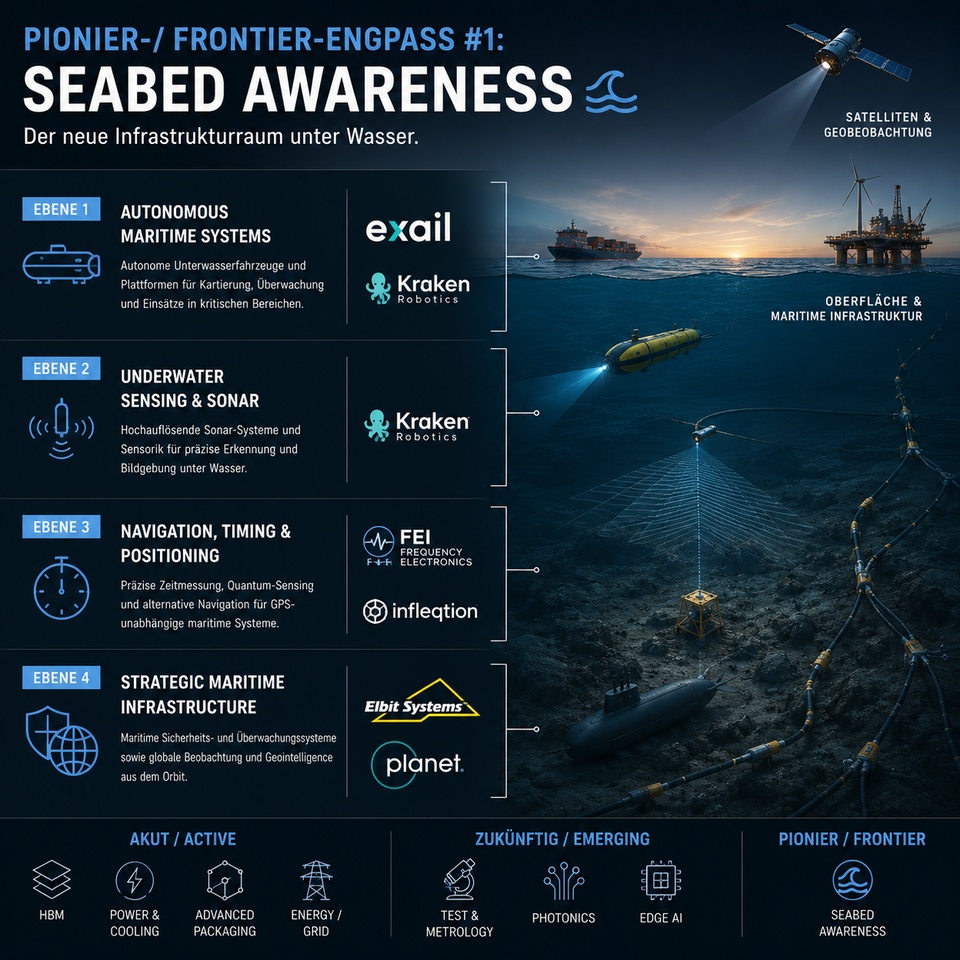
If you are looking for bottlenecks, it is worth taking a look 🤿 under water: with the seabed is creating a new infrastructure space that has long gone unnoticed.
Large parts of the global data, communication and energy infrastructure already run there today. Submarine cables transport the majority of the world's internet traffic. Offshore energy plants, pipelines and maritime supply systems are also becoming increasingly important.
At the same time, geopolitical tensions surrounding maritime infrastructure are increasing significantly. Critical sea routes such as the Strait of Hormuz illustrate how important secure underwater and transportation corridors have become for energy, trade and communication.
This creates a new strategic issue: Seabed Awareness.
Put simply, it is about making the underwater space visible, controllable and autonomously monitorable autonomously. Autonomous underwater vehicles, maritime sensors, sonar systems, navigation technologies and underwater mapping could therefore become much more important in the long term.
Level 1: Autonomous Maritime Systems
Autonomous maritime systems are a key area. Companies such as $EXA (+1,41 %) (Exail Technologies) or $PNG (-2,21 %) (Kraken Robotics) are working on unmanned underwater vehicles, autonomous platforms and maritime robotic systems.
Such systems can map the seabed, monitor infrastructure or autonomously control safety-critical areas. As the complexity of maritime infrastructure increases, so does the importance of such platforms.
Level 2: Underwater Sensing & Sonar
Under water, perception itself becomes the core technological problem. Visibility there is limited. This creates new requirements for sonar, sensor technology and high-precision underwater detection.
Kraken Robotics in particular addresses this level very directly. The focus is on high-resolution sonar technology, underwater imaging and autonomous detection of maritime environments.
Level 3: Navigation, timing & positioning
Traditional GPS systems only work to a very limited extent under water. This is why alternative navigation and timing technologies are becoming increasingly important.
Companies such as $FEIM (-0,39 %) (Frequency Electronics) or $INFQ (Infleqtion) could benefit from this development in the long term. Precise time measurement, quantum sensing and GPS-independent navigation in particular are becoming increasingly relevant in the context of autonomous systems.
Level 4: Strategic Maritime Infrastructure
The topic does not end with autonomous systems. The higher-level maritime infrastructure is also becoming strategically more important.
$ESLT (+3,14 %) (Elbit Systems) addresses maritime security and monitoring systems, for example. $PL (-2,39 %) (Planet Labs) also expands the view to include global observation and geointelligence from orbit. This is increasingly creating a networked infrastructure layer between satellites, the surface and the underwater world.
In my view, seabed awareness is not yet an acute bottleneck like HBM or power & cooling. But it is possible that a future strategic infrastructure layer will emerge here, which will become increasingly important as global networking grows.
After all, data, energy and communication don't just run through data centers or satellites. A significant part of the global infrastructure runs under water.
Exail Technologies (under the old name Groupe Gorge), Frequency Electronics and Planet Labs are also stocks in my wikifolio for future bottlenecks "NextLimits".