$285A (-8,73 %)
$HY9H (-8,13 %)
Is a merger on the horizon here? I’ll just stay invested in both companies for now. And I’ll simply wait and see how things play out.
Japan remains an interesting market when it comes to technology.
My friends, the expansion of production means potential for machinery manufacturers. What do you see here?
(@PikaPika0105 , @Aktienhauptmeister , @Raketentoni )
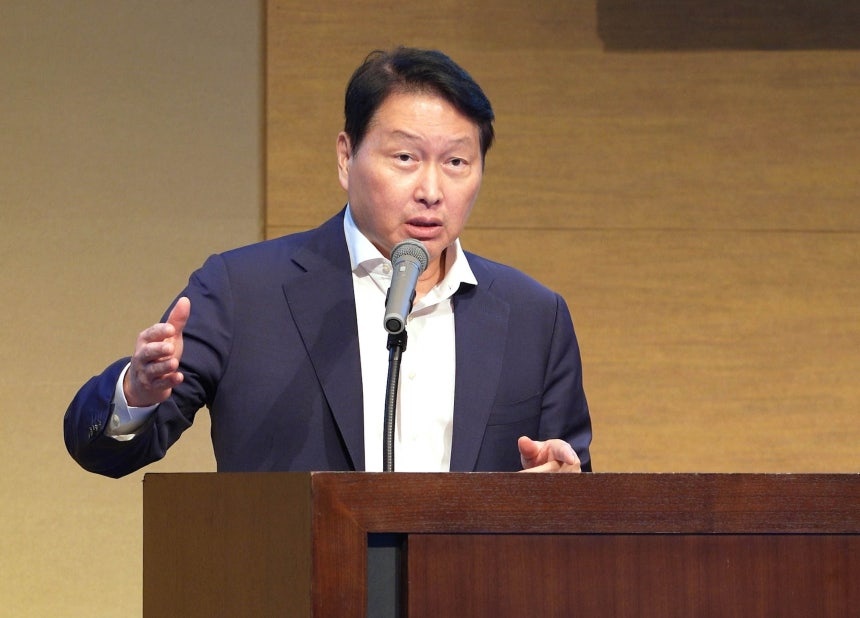
Chey Tae-won is considering joint production and research & development, while chipmaker Samsung aims to challenge the memory market.
SK Group Chairman Chey Tae-won is considering building a chip plant in Japan, possibly in partnership with NAND flash manufacturer Kioxia, as the South Korean conglomerate seeks closer cooperation with its Japanese competitor.
“One possibility would be joint production,” Chey said in an interview with the Asahi Shimbun published on Tuesday during his visit to Tokyo. He also cited supply chain coordination and joint research and development as potential areas of cooperation.
This move underscores SK hynix’s ambition to leverage its leading position in high-bandwidth memory to challenge Samsung Electronics across the entire memory market. It could also fundamentally transform the global NAND industry, as SK hynix already holds an indirect stake in Kioxia.
“Japan is an extremely attractive candidate in terms of both risk and culture,” Chey said, adding that SK had received proposals from several local governments interested in hosting the planned facility. He did not name any specific locations.
Chey described Kioxia as “a company with many strengths” and explained that SK is ready to become a partner if it can play a role in the Japanese chipmaker’s growth strategy.
“If SK hynix were to be included in Kioxia’s future strategy, we are ready to become a partner at any time,” he said, referring to Kioxia’s manufacturing partnership with SanDisk. Kioxia and SanDisk jointly operate NAND manufacturing facilities in Japan but market their products separately.
Chey also hinted that SK might end its investment in Kioxia if the two companies fail to establish a closer partnership.
SK hynix competes directly with Kioxia in the NAND flash memory sector, but is also a significant indirect investor in the Japanese company. The investment was made through a special purpose company (SPC) managed by Bain Capital, which was established by the consortium that acquired Toshiba’s memory business. In August, the SPC became Kioxia’s largest shareholder with a 14.19 percent stake.
SK hynix holds securities that are convertible into shares with the most voting rights in the SPC and could thus potentially expand its influence over Kioxia. However, an existing agreement prohibits SK hynix from holding 15 percent or more of Kioxia’s direct or indirect voting rights without Kioxia’s consent until 2028.
According to reports, the SK Group is also exploring the acquisition of Japanese semiconductor materials and equipment companies, suggesting a broader effort to establish a stronger position in the Japanese chip ecosystem.
Closer collaboration between SK hynix and Kioxia could alter the competitive dynamics in the global NAND market. Counterpoint Research estimates that Samsung Electronics will lead NAND shipments in the second quarter of 2026 with a 25 percent market share, followed by SK hynix with 22 percent and Kioxia with 14 percent. Together, the latter two have a larger market share than Samsung, even though they remain separate competitors.
Chey’s remarks come as SK hynix is strengthening its position in the High-Bandwidth Memory (HBM) sector, which is used in AI systems and data centers. The sharp rise in demand has brought the company record profits and provided it with the necessary funds to expand beyond HBM.
Lee Jong-hwan, a professor of system semiconductor engineering at Sangmyung University, said, SK hynix appears ready to leverage the profits and confidence it has gained through its leadership in the HBM sector to aim for the top spot in the broader memory market.
“Expanding production capacity is crucial in the semiconductor industry,” Lee said. “SK hynix appears to view Kioxia as a partner that could strengthen its position in the NAND sector and help it challenge Samsung.”
SK hynix is also working with the U.S.-based company SanDisk to develop global standards for High-Bandwidth Flash (HBF). This new technology combines NAND chips to improve performance and storage capacity, using a structure similar to that of HBM. Kioxia’s long-standing partnership with SanDisk could give SK hynix an additional strategic advantage in further developing this technology.
Unlike Samsung, whose business areas include memory, contract manufacturing, and consumer electronics, SK hynix can focus on memory chips. The shift in the AI industry from model development to inference is likely to boost demand for high-capacity NAND memory and potentially create a new market for HBF, according to Lee.
Japan’s strength in semiconductor materials and equipment also makes the country an attractive manufacturing location that SK hynix cannot ignore, he added.