Siemens Energy has already received inquiries from the United States, Canada and Australia. TenneT Deutschland estimates that around 30 similar systems are needed in Germany alone.
Siemens Energy and Tennet want to provide instantaneous reserve and reactive power with the world's first supercapacitor-based Statcom.
Tuesday, December 23, 2025, 7:56 p.m.
If coal and nuclear energy gradually disappear, grid stability could be jeopardized. In response to this, Siemens Energy and TenneT Deutschland have now built the world's first E-STATCOM in Mehrum - a static reactive power compensator with supercapacitors, also known as SVC PLUS FS, which enables both voltage and frequency stabilization.
"No one has built a supercapacitor-powered STATCOM before," says Hauke Jürgensen, Senior Vice President Grid Solutions at Siemens Energy. "This really is a benchmark in the global energy transition."
Technical grid stability with artificial inertia
Supercapacitors deliver short power surges within milliseconds, creating an "artificial inertia". "The grid is like the human circulatory system: voltage is the blood pressure, current is the blood and frequency is the heartbeat," says Hans-Günther Platz, Project Manager at Siemens Energy. By adding supercapacitors, E-STATCOM can stabilize both voltage and frequency - two parameters instead of one."
Platz also points out that this stability is not temporary, but constant. "Because it's fully automated, it runs around the clock," he says. "This system takes care of the grid while we sleep."
"With this E-STATCOM, we can mitigate key challenges in the grid - and ultimately help to prevent power outages," says Florian Martin, Director of Asset Management at TenneT Deutschland. "It provides important additional services such as frequency stabilization and voltage support and reduces costs thanks to lower maintenance. We are in the middle of the energy transition and time is of the essence - that's why the rapid construction of these systems is essential."
Inside the world's first E-STATCOM
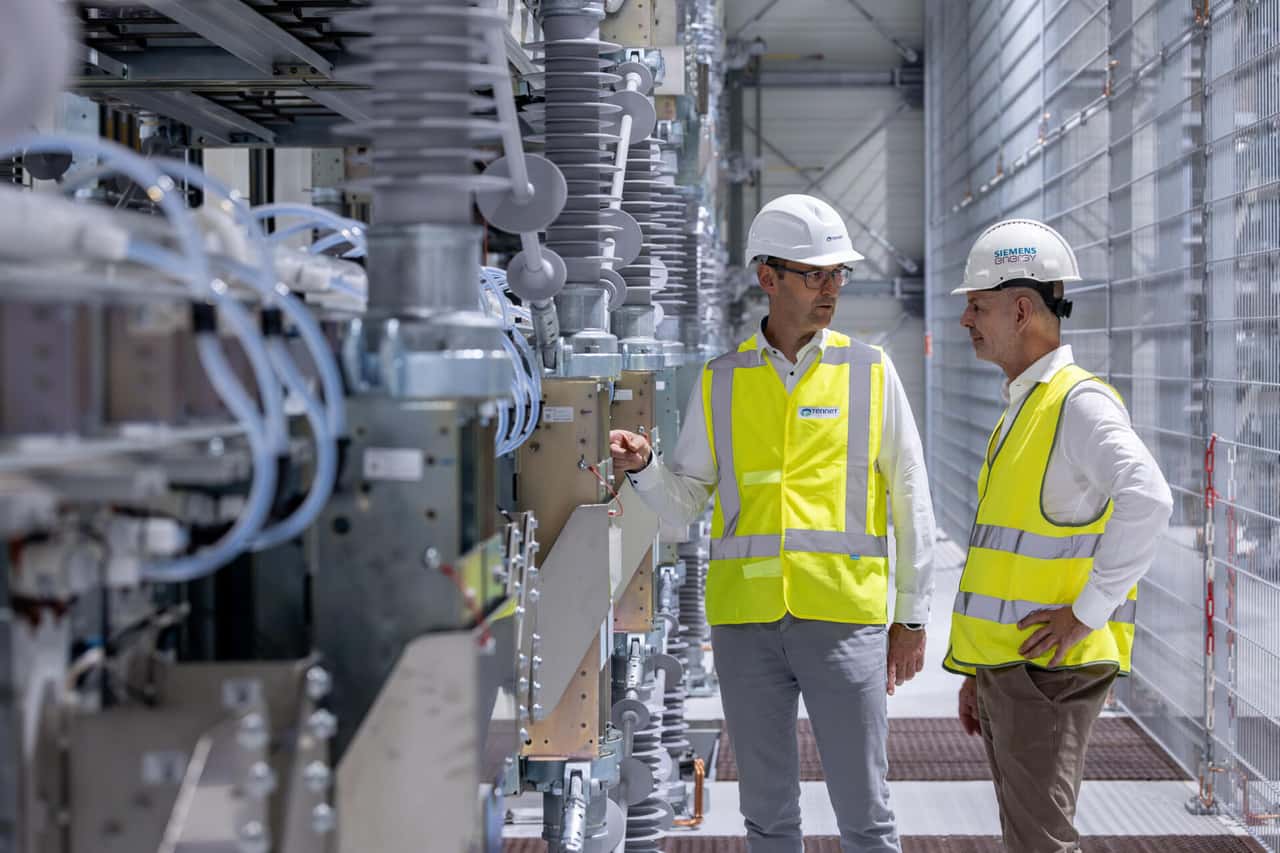
It took three years to build the E-STATCOM facility in Mehrum. Today, the new facility is protected by NATO-compliant security measures such as barbed wire and intrusion protection systems. Anyone entering the air-conditioned halls in Mehrum immediately recognizes the scale of the solution.
In one room, individual supercapacitor cells - each the size of a soda can - are stacked in towers, forming a reservoir of instant electrical energy that can be fed into the grid as artificial inertia. Unlike batteries, which rely on chemical processes, supercapacitors store electricity directly and can deliver power surges in milliseconds.
Next door, power converters consisting of submodules control these pulses and switch huge currents in microseconds. Their systems are cooled by deionized water and pink antifreeze circuits. In the control room, rows of monitors display the system's vital signs: Temperature gauges, system status and a virtual reservoir that fills and drains as the system responds to grid events. And thanks to advanced control systems and monitoring, the entire system operates automatically and is fully remotely controlled and monitored.
Test phase begins
With the construction work completed, the project is now in its final phase. The plant will be tested for months before going into commercial operation, gradually proving that artificial inertia can replace the mechanical stability that fossil fuels once provided.