
BMW is facing its most challenging year since the pandemic: In the third quarter of 2026, revenue fell by 5.8% to 30.45 billion euros, and operating profit in the automotive division plummeted by 39.7% to 901 million euros. On November 4, the company lowered its forecast for the second time this year: The EBIT margin in the Automotive segment is now expected to range between −0.5% and +0.5% in 2026, down from the originally planned 4% to 6%. The reasons include the weak market in China, U.S. tariffs, and the costly acceleration of the Group’s restructuring. The hope lies with the New Class: According to the Executive Board, the new electric models are in high demand, and the share of fully electric cars in deliveries rose to 20%. The stock has lost about 41% since the start of the year and is trading at 55.00 euros (Xetra, Nov. 18, 2026)—just above the major support level around 50 euros, which dates back to 2007. Only if the stock breaks above the resistance zone of 63.86 to 68.15 euros would a recovery to 91.88 euros be possible; below 49 euros, a sell signal looms with a target of 43.24 euros.
Key Points
- Q3 2026: Revenue 30.45 billion euros (−5.8%), net income 1.45 billion euros (−14.7%), earnings per share 2.46 euros
- Automotive business: EBIT 901 million euros (−39.7%), margin 3.4% compared to 5.2% in the prior year
- 2026 forecast lowered again: Automotive EBIT margin −0.5% to +0.5%
- Medium-term targets: 3 to 5% margin in 2028, 8 to 10% in the early 2030s
- Preferred shares converted to common shares as of June 30, 2026—there is now only one type of BMW share
- Dividend for 2025: 4.40 euros per share, approximately 8% yield at the current price
- Analysts: Average price target around 66 to 67 euros; several firms have lowered their targets following the Q3 results
- Chart levels: Resistance at 63.86 to 68.15 euros, target at 91.88 euros, support around 50 euros, sell signal below 49 euros with a target of 43.24 euros
What are the current key metrics for BMW stock?
With a market capitalization of around 34 billion euros, BMW stock is valued more favorably than it has been in a long time: According to Aktienfinder, the P/E ratio stands at 5.5—below the already low ten-year average of 6.8—and the dividend yield is around 8%.
The price-to-cash-flow ratio, at 7.4, is also slightly below the average of 7.7. The reason for the low valuation: Earnings are set to fall sharply in 2026, and investors are skeptical about how quickly margins will recover.
- Price (Xetra: BMW): 55.00 euros (Nov. 18, 2026)
- 52-week high: approximately 97.90 euros (Nov. 18, 2026)
- 52-week low: approximately 52.00 euros (Nov. 18, 2026)
- Year-to-date performance: approximately −41% (Nov. 18, 2026)
- Market capitalization: approximately 34 billion euros (November 18, 2026)
- Revenue for Q3 2026: 30.45 billion euros (−5.8%) (November 4, 2026)
- Profit before taxes for Q3 2026: 2.08 billion euros (−10.6%), margin 6.8% (November 4, 2026)
- Consolidated net income for Q3 2026: 1.45 billion euros (−14.7%) (Nov. 4, 2026)
- Earnings per share for Q3 / 9 months 2026: 2.46 euros / 7.19 euros (Nov. 4, 2026)
- Automotive EBIT for Q3 2026: 901 million euros (−39.7%), margin 3.4% (Nov. 4, 2026)
- Deliveries Q3 2026: 551,075 vehicles (−6.3%) (Nov. 4, 2026)
- Share of electric vehicles in Q3 2026: 20.0% (previous year: 17.5%) (Nov. 4, 2026)
- 2026 EBIT margin forecast for the Automotive division: −0.5% to +0.5% (previously 1% to 3%) (Nov. 4, 2026)
- 2026 Free Cash Flow for the Automotive Division (Forecast): over 2.5 billion euros (November 4, 2026)
- Automotive margin target: 3 to 5% (2028), 8 to 10% (early 2030s) (Nov. 4, 2026)
- Current P/E ratio / 10-year average: 5.5 / 6.8 (Aktienfinder, November 18, 2026)
- Current P/B ratio / 10-year average: 7.4 / 7.7 (Aktienfinder, November 18, 2026)
- Dividend (fiscal year 2025): 4.40 euros per share, yield approximately 8% (paid May 19, 2026)
- Average analyst price target: approximately 66 to 67 euros (TradingView / aktien.guide, November 18, 2026)
- Largest shareholders: Stefan Quandt 25.3%, Susanne Klatten 20.5%, free float 51% (July 31, 2026)
- Class of shares: only common stock remaining (preferred shares converted on June 30, 2026) (June 30, 2026)
- Next date: 2026 financial results expected in mid-March 2027 (not yet confirmed)
- Index: DAX (—)
- WKN / ISIN / Ticker: 519000 / DE0005190003 / BMW (—)
What news is currently driving BMW stock?
The BMW stock is currently being driven primarily by the second downward revision of its forecast within five months: On November 4, BMW cut its margin target for the automotive business in 2026 to −0.5% to +0.5% because the corporate restructuring is being implemented faster and at a higher cost than planned.
Several analysts subsequently lowered their price targets, including JPMorgan from 82 to 68 euros and Deutsche Bank from 71 to 66 euros—though both still recommend buying the stock. Headwinds are coming primarily from China, where demand for German premium cars remains weak. Just how hard the crisis is hitting the archrival from Stuttgart is shown by my analysis of the Mercedes Aktie.
- Nov. 2026 – New Class launches in China: Market launch of the long-wheelbase version of the iX3 in November; additional New Class models are set to follow in 2027. (Bullish)
- Nov. 5, 2026 – Price targets lowered: Deutsche Bank lowers its target from 71 to 66 euros (Buy), JPMorgan on Nov. 4 from 82 to 68 euros (Overweight), Jefferies confirms Hold at 60 euros. (Bearish)
- November 4, 2026 – Q3 results and second forecast cut: Revenue −5.8%, Auto EBIT −39.7%, margin 3.4%. 2026 forecast for the automotive margin lowered to −0.5% to +0.5%. (Bearish)
- June 30, 2026 – Preferred shares converted: All preferred shares were converted 1:1 into common shares; trading in the preferred shares ended on June 30, 2026. (Neutral)
- June 16, 2026 – First forecast revision downward: BMW lowers its automotive margin for 2026 from 4% to 6% to 1% to 3%—due to headwinds from China, tariffs, and restructuring. (Bearish)
What does BMW management say about the Q3 results?
BMW CEO Milan Nedeljković, who has been in office since the annual shareholders’ meeting in May 2026, is focusing on speed: Industry developments require decisive action and rapid implementation, which is why structural measures are being specifically intensified and accelerated.
He aims to complete the bulk of the restructuring by mid-2027, with the number of top management positions decreasing by 20%.
What went well: The New Class is catching on. Nedeljković cites high demand for the new models; the plant in Debrecen is already operating on a three-shift schedule; and the share of fully electric vehicles rose to 20% in the third quarter, totaling 110,000 vehicles (+7.2%). Deliveries in Europe and the U.S. rose slightly.
The catch: Overall, deliveries fell by 6.3% to 551,075 vehicles, primarily due to China. The margin in the automotive business dropped to 3.4%, and BMW has announced additional costs for the fourth quarter resulting from portfolio and structural measures. These measures alone will cost the margin about 2.5 percentage points in 2026, with tariffs accounting for another 1.25 points.
Outlook: For 2026, BMW expects an automotive margin between −0.5% and +0.5% and a significantly lower pre-tax profit. Free cash flow in the automotive business is nevertheless expected to exceed 2.5 billion euros. Starting in 2027, the Group plans to set its sights on the interim target of a 3–5% margin in 2028.
What does BMW do, and how does the company make money?
BMW is one of the world’s largest premium automakers and sells cars under the BMW, MINI, and Rolls-Royce brands, as well as motorcycles under the BMW Motorrad brand—in addition, it operates its own bank that finances and leases cars.
The Munich-based group was founded in 1916 and remains under the control of the Quandt family to this day: Stefan Quandt holds 25.3% and Susanne Klatten 20.5% of the voting rights.
Three business segments: The Automobiles segment generated 26.67 billion euros in revenue in the third quarter of 2026 and is the heart of the group. Financial services provide stable income from loans and leasing, while the Motorcycles segment is small but profitable.
How BMW Makes Money: Through large, expensive cars like the X5, the 7 Series, and the M models, which generate high margins. The New Class is intended to secure the future: a completely new generation of electric cars with proprietary battery and drive technology, which is gradually being introduced across all model series, from the iX3 to the new 3 Series. My analysis of VW Aktie.
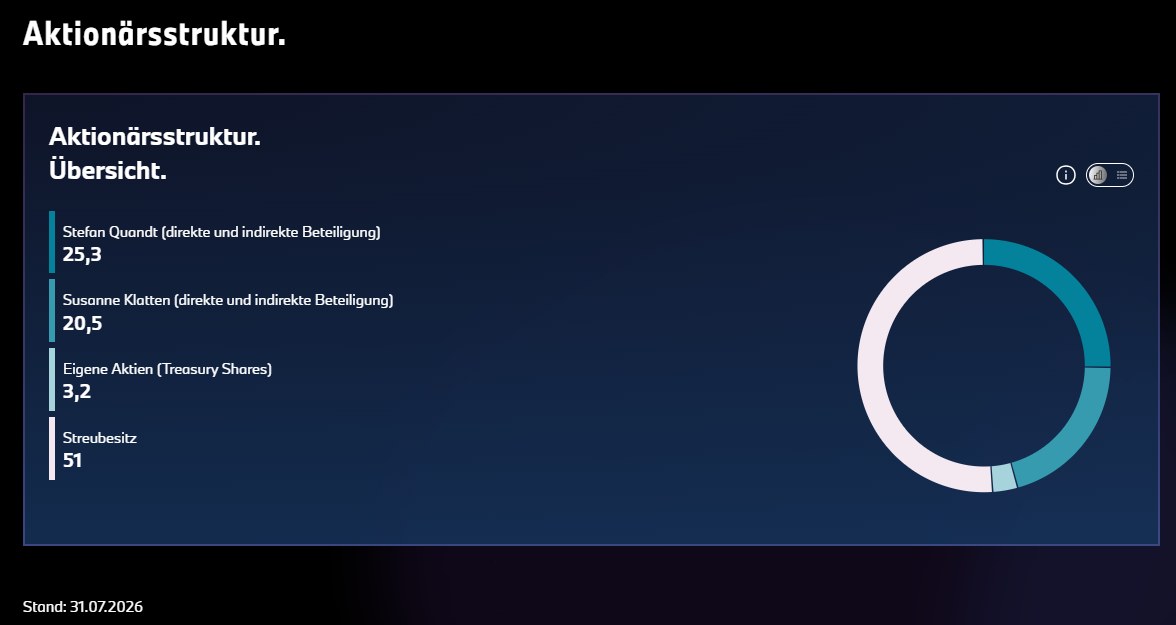
Shareholder structure of BMW stock (BMW): Stefan Quandt 25.3%, Susanne Klatten 20.5%, free float 51% (as of November 18, 2026) – Source: BMW Group Investor Relations / Christian Lill
BMW Stock Fundamental Analysis: Is the BMW Stock Undervalued Right Now?
Fundamentally, BMW stock is extremely undervalued based on past earnings: According to Aktienfinder, the P/E ratio stands at 5.5, and the market capitalization of around 34 billion euros corresponds to only about a quarter of annual revenue.
The catch: Profits are set to fall sharply in 2026, which is why Aktienfinder, based on analyst estimates, expects a fair value of only 50.75 euros by the end of 2027.
Growth: BMW is currently shrinking. In the first nine months of 2026, revenue fell by 7.3% to 92.7 billion euros, and net income dropped by 24.4% to 4.32 billion euros. Growth is limited to the electric vehicles in the New Class lineup.
Margins: The margin in the automotive business stood at 3.5% after nine months; adjusted for one-time effects from the acquisition of the Chinese joint venture BBA, it was 4.7%. For the full year, BMW is now targeting a margin of around zero, as the fourth quarter will bear the costs of the Group’s restructuring. My analysis of the Infineon Aktie.
Cash Flow and Balance Sheet: Despite the slump in profits, the automotive business is expected to generate more than 2.5 billion euros in free cash flow in 2026. This will secure the dividend and the ongoing share buyback program. Starting in 2027, capital expenditures and R&D costs are expected to decline again, as the costly development of the New Class is largely complete.
Valuation: Based on earnings and an average P/E ratio of 6.8, the Stock Finder calculates a fair value of 50.75 euros as of the end of 2027 (range: 38.98 to 61.70 euros, 13 analysts) and €64.97 at the end of 2028. The stock is therefore only undervalued if profits rise again as expected starting in 2027—according to the Stock Finder, analysts anticipate a roughly 39% increase in profits for 2027.
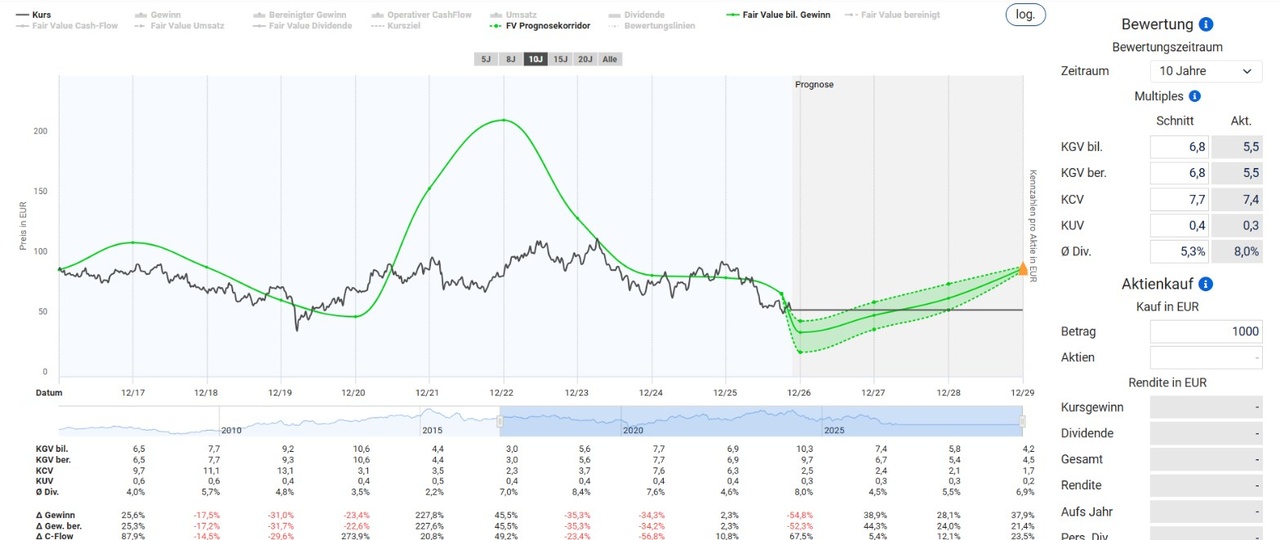
Fair Value Valuation of BMW Stock (BMW) for 2027 (as of November 18, 2026) – Source: Aktienfinder / Christian Lill
BMW Stock Price Targets and Forecast for 2027
On average, analysts see a price target for BMW stock of around 66 to 67 euros, leaving a good 20% upside – from a technical analysis perspective, however, a recovery to 91.88 euros is only possible after a break above the resistance zone of 63.86 to 68.15 euros.
Until then, the downtrend remains intact. If the support level around 50 euros fails to hold, a sell signal could trigger below 49 euros, with a target of 43.24 euros. My analysis of Porsche Aktie.
Key price levels:
- 52-week high: around 97.90 euros
- Current price: 55.00 euros (Xetra, Nov. 18, 2026)
- Major resistance: 63.86 to 68.15 euros
- Target after breakout: 91.88 euros (high liquidity)
- Support: around 50 euros (breakout range from 2007, already tested in 2026)
- Critical downside level: 49 euros; below this, a sell signal with a target of 43.24 euros
Analyst price targets:
- Average price target: 65.96 euros, range 52 to 82.50 euros (TradingView, Nov. 18, 2026); aktien.guide: 67.32 euros (24 analysts)
- JPMorgan: Overweight, 68 euros (November 4, 2026, previously 82 euros)
- Deutsche Bank Research: Buy, 66 euros (November 5, 2026, previously 71 euros)
- Jefferies: Hold, 60 euros (November 4, 2026)
Chart Analysis:
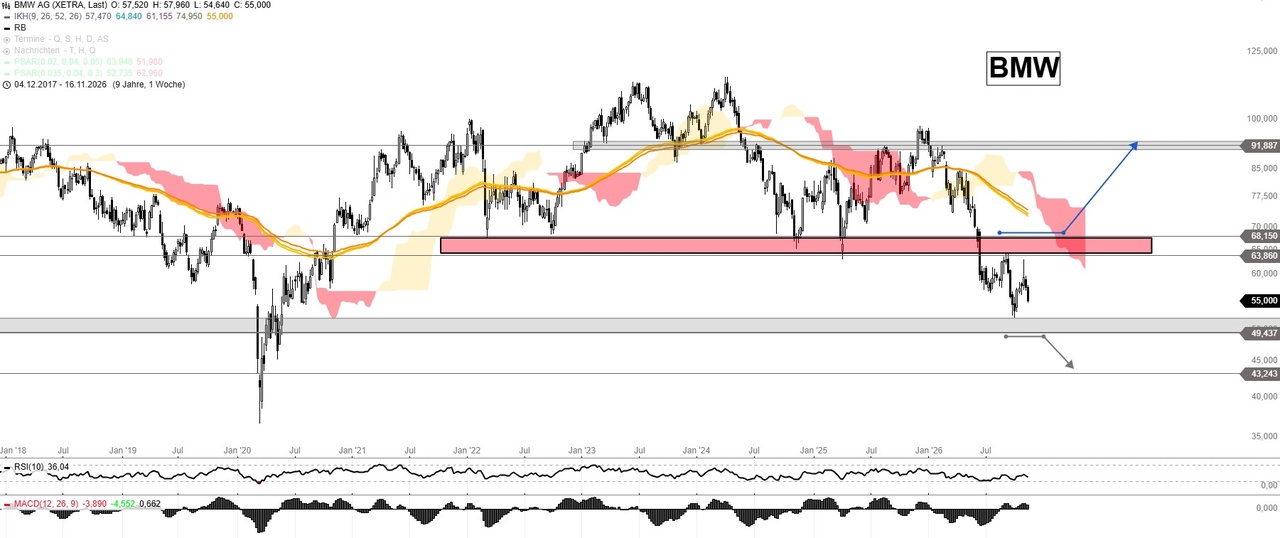
BMW Stock (BMW) Chart Analysis and Price Targets for 2027 (as of Nov. 18, 2026) – Source: Stock3 / Christian Lill
On the weekly chart, the BMW stock is in a sustained downtrend. Since its 52-week high of just under 98 euros, the price has nearly halved; the stock most recently closed at 55.00 euros. The RSI stands at 36, near the oversold zone, while the MACD is clearly in negative territory at −3.89—sellers remain in control.
The major resistance zone (red zone): The range between 63.86 and 68.15 euros is the key hurdle. This is where the downtrend’s resistance lies. As long as this range isn’t broken, I personally wouldn’t take a long position.
The recovery scenario (blue arrow): If the price breaks above 68.15 euros, the path would be clear for a significant rally up to 91.88 euros. There is a great deal of liquidity at that level, meaning it’s an area where there has been heavy trading in the past.
The support around 50 euros (yellow zone): The breakout zone around 50 euros has already been tested this year and dates back to 2007. This makes it a very, very important area where buyers have repeatedly stepped in over the past nearly 20 years.
The risk (gray arrow): If this area were to be sustainably breached, a sell signal with a target of 43.24 euros would be triggered below 49 euros.
My assessment: Personally, I won’t take a long position below the 63.86 to 68.15 euro range. The key factor is whether the support around 50 euros holds: above that level, there remains a chance of a bottom forming; below 49 euros, the situation becomes critical with a target of 43.24 euros.
What is the forecast for BMW stock in 2030?
For 2030, BMW itself is targeting an EBIT margin of 8 to 10% in its automotive business; the company cites 3 to 5% as an interim target for 2028 —based on these figures and analyst estimates, the Stock Finder calculates a fair value of 64.97 euros as of the end of 2028.
There are no reliable analyst estimates for 2030; therefore, any price forecast for 2030 is merely a theoretical calculation.
The case for this: If BMW brings its margin back up to 8 to 10% by the early 2030s, that would be on par with the record years of 2021 through 2023. At that time, the stock briefly traded above 100 euros. The New Class, declining investments starting in 2027, and a leaner corporate structure are the drivers behind this.
Arguments against it: BMW had to lower its 2026 forecast twice, which has undermined the credibility of its targets. China remains weak, Chinese manufacturers are gaining strength, and tariffs are weighing on exports. From a technical analysis perspective, the stock must first break above 68.15 euros for a recovery to 91.88 euros to become a likely next step.
How much is BMW’s dividend?
BMW paid a dividend of 4.40 euros per share for the 2025 fiscal year (paid on May 19, 2026)—at a share price of 55.00 euros, this corresponds to a dividend yield of around 8%; the next dividend will be decided at the annual shareholders’ meeting in May 2027.
However, for the weak 2026 fiscal year, it is likely to be significantly lower: According to Aktienfinder, analysts expect a decline of around 44%, or about 2.50 euros per share. At the current share price, that would still represent a yield of around 4.5%.
Dividend History: BMW has paid a dividend every year for decades, though the amount fluctuates with profits. In record years, the dividend was 8.50 euros (for 2022) and 6.00 euros (for 2023), followed by 4.30 euros (for 2024) and 4.40 euros (for 2025). Former preferred shareholders still received 4.42 euros for 2025; this 2-cent premium will be eliminated following the conversion to common stock.
What happened to the BMW preferred stock?
The BMW preferred stock no longer exists: The Annual General Meeting approved the conversion on May 13, 2026; on June 30, 2026, all preferred shares were converted into common stock at a 1:1 ratio, and trading in the preferred shares was discontinued.
Anyone who held BMW preferred shares in their portfolio has automatically owned the same number of common shares with voting rights since then. Custodian banks completed the transfer by early July 2026; investors did not need to take any action.
What has changed for investors: There is now only one BMW share with the ISIN DE0005190003 and the WKN 519000. The slight dividend advantage of the preferred shares—2 cents per share—has been eliminated; in return, all shareholders now have voting rights at the Annual General Meeting. Previously, approximately 91% of the share capital consisted of common stock and approximately 9% of preferred stock. The question “Preferred stock or common stock—which is better?” therefore no longer applies to BMW.
Conclusion: Should you buy or sell BMW stock?
With a P/E ratio of 5.5 and a dividend yield of around 8%, BMW stock appears cheap at first glance, but it is in a sustained downtrend—personally, I would not take a long position below the resistance level of 63.86 to 68.15 euros.
Factors in BMW’s favor include the popular New Class, a 20% share of fully electric vehicles, stable free cash flow of over 2.5 billion euros, and clear margin targets for 2028 and the 2030s. My analysis of Tesla Aktie.
Factors working against the stock include two earnings forecast cuts in five months, a margin near zero in 2026, the weak market in China, tariffs, and a dividend that is likely to drop significantly in 2026. From a technical analysis perspective: Only if the price rises above 68.15 euros will a recovery to 91.88 euros become likely. The support level around 50 euros, which dates back to 2007, is a very, very important area. If it is sustainably breached, a price below 49 euros will trigger a sell signal with a target of 43.24 euros.
✅ Opportunities
- High demand for the New Class
- Electric vehicle share has risen to 20%
- P/E ratio of 5.5 and a dividend yield of around 8%
- Free cash flow from the automotive segment to exceed 2.5 billion euros by 2026
- Margin targets: 3 to 5% (2028), 8 to 10% (2030s)
- Above 68.15 euros, a rebound to 91.88 euros is possible
⚠️ Risks
- Two downward revisions to forecasts in 2026
- Automotive margin in 2026 only −0.5% to +0.5%
- Weak sales in China, deliveries down 6.3%
- U.S. tariffs cost about 1.25 percentage points in margin
- Dividend for 2026 is likely to fall significantly
- Below 49 euros, a sell signal could trigger a decline to 43.24 euros
Sources
- BMW Group Investor Relations: Quarterly Report as of September 30, 2026 (November 4, 2026)
- BMW Group: Remarks by Milan Nedeljković, Q3 2026 Conference Call (November 4, 2026)
- BMW Group Investor Relations: BMW Stock – Conversion of Preferred Shares, Dividend, Shareholder Structure (as of June 30/July 31, 2026)
- Analyst reports via dpa-AFX: JPMorgan (November 4, 2026), Jefferies (November 4, 2026), Deutsche Bank Research (November 5, 2026)
- Average price target: TradingView and aktien.guide, as of Nov. 18, 2026
- Reports on Q3 results and forecast revision: Börsen-Zeitung, RTTNews, Quartr (November 4, 2026)
- Xetra prices: TradingView and onvista, as of November 18, 2026
- Stock3: Weekly chart for BMW AG (Xetra), as of November 18, 2026
- Aktienfinder: Fair value calculation (reported earnings), valuation metrics, and dividend estimate for BMW, as of November 18, 2026
This is not investment advice—all information is provided solely for financial education purposes.
What do you currently think of $BMW (-0,19 %)?


