

## Introduction to the Series
I’ve been deeply involved with artificial intelligence for quite some time now, and I also deal with this topic repeatedly in my professional life.
At the same time, I’m the kind of person who likes to try new things and doesn’t just want to read about what might be possible in theory.
I’ve been active in the stock market for more than 15 years now.
During this time, I’ve experienced various market phases, strategies, and, of course, my own mistakes. One question has always been on my mind:
How can investment decisions be better prepared, made in a more structured way, and then reviewed more consistently?
This combination gave rise to the idea for my latest project.
It all started relatively unspectacularly with a standard prompt and a few initial questions about stocks. After that, I tried out various AI systems, compared their results, and tested where their respective strengths, weaknesses, and limitations lay.
Individual questions turned into more detailed analyses, which led to the first set of rules—and eventually, a complete research and monitoring system took shape.
Over the past four to six weeks, I’ve been working very intensively on this project, revising it repeatedly and incorporating new insights.
It was important to me not to simply have an AI suggest as many stocks as possible. I wanted to find out whether a transparent and sustainably usable decision-making process could be developed through the collaboration between human experience and artificial intelligence.
Incidentally, this is not my first experiment in this area. In a previous project, an AI was given its own real-money portfolio and was allowed to decide for itself which stocks to buy within defined parameters.
At the time, it opted for a momentum strategy involving three stocks.
You can follow the progress of that experiment through my previous posts on my account.
The new project, however, takes a different approach:
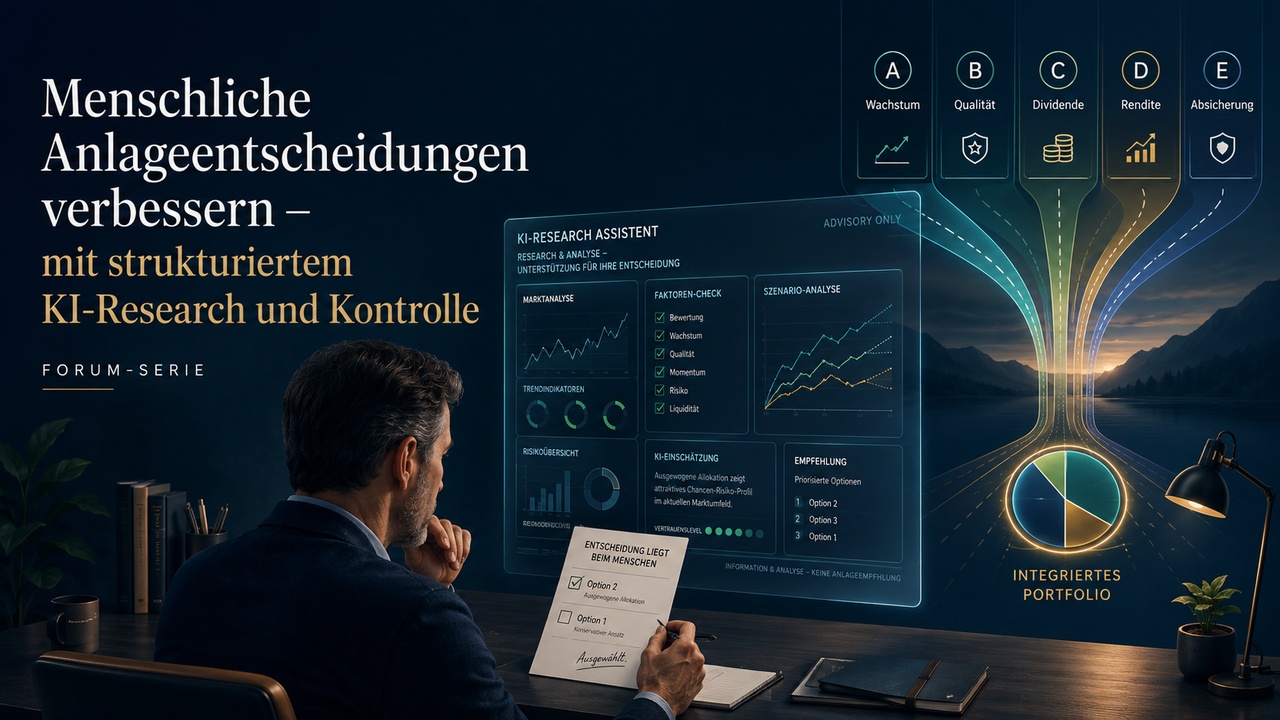
This time, the AI will not make autonomous decisions about the portfolio. It will serve as a research assistant, critical reviewer, and oversight body—while the final decisions remain in human hands.
Part 1 explores how the **55555 Portfolio System** gradually took shape, the goals behind it, and why numerous individual discussions ultimately resulted in a binding set of rules.
Part 1: From Gut Feelings to a Binding Set of Rules
Many investors are probably familiar with this situation:
You discover an interesting stock, read a few compelling arguments, look at a promising chart—and suddenly, buying it seems almost inevitable.
A few weeks later, the next exciting candidate pops up, and your original conviction begins to waver.
That’s exactly where my project began.
My goal wasn’t to find the one perfect stock or simply hand my portfolio over to artificial intelligence.
I wanted to develop a system that sensibly combines different investment ideas, makes decisions more transparent, and protects me from typical mistakes like impulsive trading, FOMO, or spontaneous strategy changes.
From this idea, the 55555 Portfolio System —as for why that name, well, you’ll find out as this 4-part series unfolds.
Why I Didn’t Want a Standard Portfolio
A globally diversified ETF may be perfectly sufficient for many investors.
However, I wanted to combine several goals:
- long-term wealth accumulation,
- a growing future cash flow,
- investments in high-quality growth companies,
- deliberately limited speculative opportunities,
- and enough flexibility to capitalize on special market opportunities.
It quickly became clear that not every position can be evaluated by the same standards.
A high-dividend real estate stock serves a different purpose than a growth company.
An ETF requires different rules than a biotech speculation, and a short-term event trade must not inadvertently become a permanent long-term position.
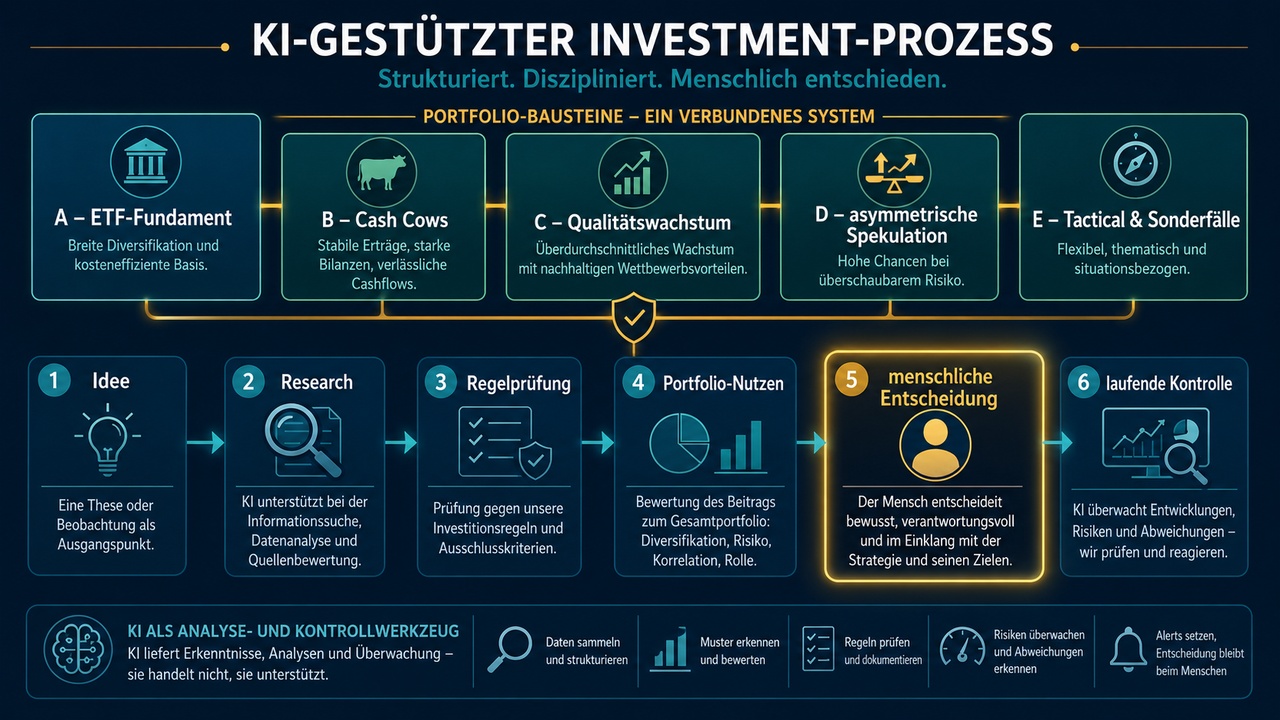
For this reason, the portfolio was divided into five functional areas.
The five building blocks of the system
Category A – ETF Foundation
This category forms the long-term foundation.
The focus here is on broad diversification, stability, and a reliable underlying structure. Normal price fluctuations are not a reason to sell, and there is no pressure to constantly rebalance the portfolio.
Category B – Cash Cows
This category is about ongoing distributions and cash flow that is as sustainable as possible. However, a high dividend yield alone is not enough.
The key factor is whether the distribution can actually be sustained by the respective business model.
Category C – Quality Growth
Category C is intended to be the engine of long-term growth and compounding.
We seek companies with structural growth, high or rising profitability, a resilient balance sheet, transparent capital allocation, and a genuine competitive advantage.
Category D – Asymmetric Speculation
This category allows for deliberately riskier ideas.
Prerequisites include a coherent story, concrete milestones, and an attractive ratio between potential profit and limited investment.
Hope alone is not an investment case.
Category E – Tactical, Events, and Special Cases
Category E provides a clearly defined space for situations that do not fit neatly into Categories A through D: tactical trades, special events, historical exceptions, or so-called “free rides” following a partial sale with over 100% profit.
This category is intended to allow for flexibility but must not be used to circumvent the rules of the other categories.
The following applies to all categories
The categories do not have to be fully allocated at all times.
There is also no rigid equal weighting and no automatic obligation to rebalance. If no compelling opportunity arises, a slot may remain vacant and cash may be held.
Discussions Led to a Real Set of Rules
In the beginning, the project consisted mainly of analyses, ideas, and many discussions. That was helpful, but it wasn’t yet a robust system.
Over time, typical problems arose:
- Different companies were compared using inappropriate metrics.
- An interesting stock was too quickly equated with a stock worth buying.
- Short-term price movements were sometimes given too much weight.
- Older statements and more recent decisions could contradict each other.
- Individual special cases threatened to alter general rules.
- A good position suddenly seemed interchangeable simply because a new candidate also appeared promising.
This made it clear:
We didn’t simply need more analyses, but a binding decision-making framework.
Consequently, a Masterbook—now containing more than 270,000 characters—was created from many individual rules.
It describes the strategic foundation of the system: the roles of the categories, minimum requirements, review procedures, risk and sales rules, the handling of stops, the watchlist structure, and the collaboration between humans and AI.
In addition, there is a “Master Status.”
This does not describe the strategy, but rather the current operational status: positions, categories, orders, stops, cases under observation, and upcoming reviews.
This deliberately separates strategy from day-to-day operations.
If information contradicts itself, a clear order of precedence applies:
the most recent explicitly confirmed decision or transaction,
the current Master Status,
the Masterbook,
older statements and analyses.
That sounds a bit bureaucratic. In practice, however, it prevents exactly the problem of a long-outdated statement suddenly being treated as a current decision again.
Rules are meant to limit errors—not to predict the future
The system does not promise guaranteed profits. It cannot foresee unexpected corporate announcements, market crashes, or political decisions.
Its purpose is different:
It is designed to ensure that decisions are made as consistently as possible, even in the face of uncertainty.
This has given rise to several important principles:
- A day of falling stock prices is never, on its own, a reason to sell.
- A drop in price alone is not a reason to buy more.
- A good stock is not automatically a good buy at any price.
- Company quality and the timing of the investment are evaluated separately.
- Risks are clearly identified but do not automatically constitute a breach of the rules.
- Good portfolio holdings are not replaced simply because a slightly better candidate becomes available.
- There is no obligation to fill vacant positions immediately.
- Dividends, proceeds from sales, and new capital may be deployed where they offer the greatest overall benefit.
- Rules may be refined, but not on a whim to make a desired purchase fit the criteria.
What is particularly important to me is the distinction between quality and affordability.
A company can be among the top performers and still be too expensive at the moment or show unfavorable technical chart patterns.
Conversely, a sharp drop in price doesn’t automatically turn a weak company into a bargain.
What Role AI Plays
In this project, artificial intelligence is neither an asset manager nor an autonomous trader. Rather, it serves as a combination of research assistant, cross-checker, and oversight body.
Among other things, it is designed to:
- break down business models in an understandable way,
- review company reports and current announcements,
- compare key metrics with those of relevant competitors,
- identify opportunities, risks, and dependencies,
- examine suitable entry points,
- Pit candidates against existing positions,
- Identify regulatory violations and inconsistencies,
- Monitor watchlists and catalysts,
- and challenge my initial analysis even when it contradicts my original opinion.
A strict hierarchy of sources applies.
Company reports, official publications, and regulatory documents take precedence.
Analyst opinions, valuation models, screeners, and technical data are important supplements, but they do not replace the primary sources.
If data does not align, the AI should not seemingly precise average value. Instead, the time period, accounting standard, definition, and timeliness must be verified. If anything remains unclear, it is marked as “open.”
The final decision always rests with me.
The AI can analyze, issue warnings, make comparisons, and provide recommendations. However, it must neither act on its own initiative nor change the rules.
The actual goal of the project
The long-term goal is not to trade as frequently as possible or to force a predetermined return every year.
The portfolio is intended to build wealth over many years, until I retire, while simultaneously developing an increasingly resilient cash flow.
The ETF foundation ensures stability and diversification.
The cash cows provide dividends. Quality growth is intended to drive long-term value appreciation.
Speculative and tactical positions can open up additional opportunities but must not dominate the overall system.
Good companies should be held for the long term.
For me, however, “long-term” does not mean holding a position forever, regardless of market developments.
It means sell if there is a reasonable reason.
The 55555 system is therefore not a finished product nor is it an infallible algorithm.
It is a learning framework. Experiences may lead to improvements—but not every single bad experience immediately generates a new blanket rule.
For me, that is precisely where the greatest benefit of the entire project lies:
AI is not meant to replace human decisions.
It’s meant to help make them more structured, more critical, more transparent, and—hopefully—better in the long run.
In Part 2, I’ll show how we find new stocks, what sources and checks we use in the process, and how an initial idea becomes either a candidate, a stock to watch, or a clear rejection.
Part 2 will be published one week from Friday. It will cover our stock search in detail and our specific collaboration with the AI agent.
I look forward to an open and friendly exchange about the project.
Questions, suggestions, and constructive criticism are expressly welcome—as are questions about specific processes, in case anyone wants to try something similar.
My goal here isn’t to engage in a fundamental debate about the merits or demerits of artificial intelligence, but rather to have a factual discussion on equal terms about its practical application.
I’ll try to answer your questions promptly, as thoroughly and in as much detail as possible, and I’m curious to see what ideas and suggestions for improvement emerge from this.
Greetings from Denmark
Yours, Raketentoni


