5D·

Goodbye Rotork, hello Mirion Tech?

Hello đŸ™‹đŸ»â€â™‚ïž to the community,

I don't want to beat around the bush. As you've surely noticed, my portfolio has become one position lighter due to the sudden sale of $ROR (+0 %) has lost one position. With that in mind, I’d like to introduce you today to a company that could be a potential replacement for me.


â˜ąïž Mirion Technologies: The Legally Mandated Toll Booth of Nuclear and Cancer Medicine


In the shadow of the global energy and medical infrastructure, a very different megatrend is gaining momentum: the renaissance of nuclear power and the boom in radiopharmaceutical cancer therapy. Right in the middle of it all sits an unnoticed, highly specialized monopoly:


Mirion Technologies $MIR (+3,26 %) . The company doesn’t build reactors or cancer drugs—it builds the indispensable nervous system for monitoring them. Anyone who needs to measure, control, or shield against radiation can’t do without Mirion.

Through its recent, strategically highly attractive acquisitions of Paragon and Certrec, Mirion has transformed itself from a pure measurement device manufacturer into a highly sticky software, service, and compliance platform for critical facilities. The stock reflects the operational turnaround following the complex SPAC listing phase: In July 2026, after a strong recovery, the stock is trading at around $17.00 (market capitalization ~$4.18 billion). The market is beginning to realize that Mirion controls the legally mandated “toll booth” for the security of the physical-nuclear world.
attachment

1. The Business Model: Regulatory Mandates as an Endless Cash Generator âš™ïžđŸąđŸ„

Mirion operates in a B2B environment that is almost completely decoupled from the traditional investment cycle. No one buys Mirion products for lifestyle reasons—they buy them because lawmakers mandate it under threat of draconian penalties.


① The Toll Booth Principle (Hardware + Recurring Service): Mirion $MIR (+3,26 %) installs sophisticated radiation detectors, dosimetry systems, and monitoring sensors in nuclear power plants, military bases, and hospitals. Once installed, the real business begins: legal calibration requirements, software updates for data analysis, and the continuous evaluation of dosimeter badges (which medical staff must wear on their bodies) ensure a steady stream of recurring revenue.


② The Paragon & Certrec Flywheel (Compliance Lock-In): With its most recent acquisitions, Mirion has gained deep access to the operational software and licensing management of nuclear facilities. Certrec controls critical compliance SaaS tools for nuclear regulation. Companies listed here effectively never switch providers again for security and certification reasons.


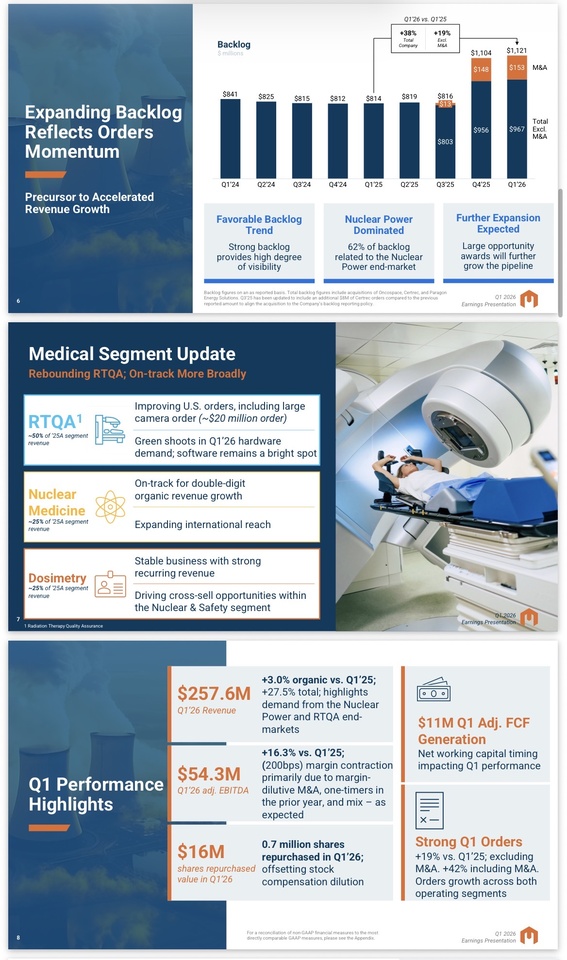
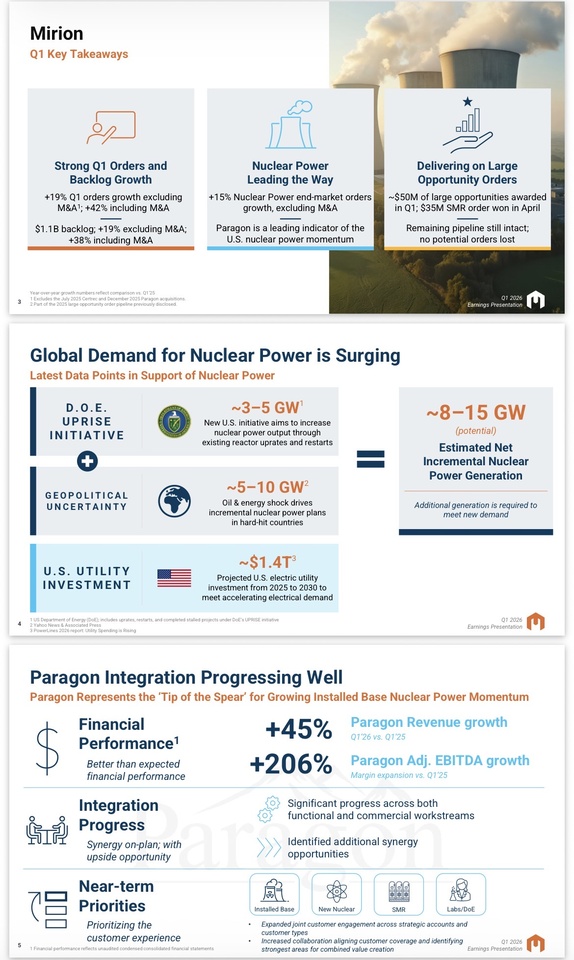
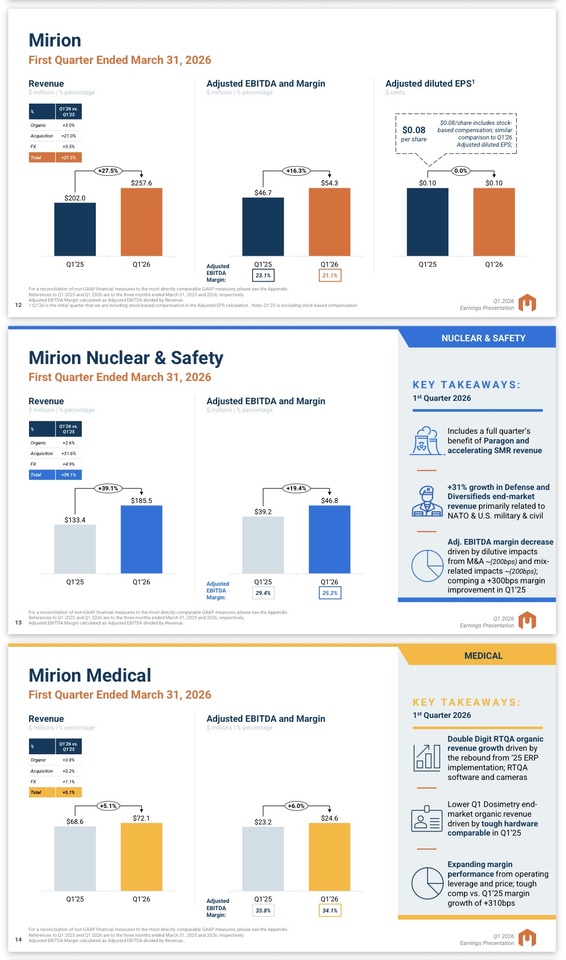
⑱ Scaling Amid Nuclear Growth: While the production of high-end sensors yields solid margins, profitability in the service and software sectors is skyrocketing. Organic order volume surged by a phenomenal +42% in Q1 2026 (including M&A), securing a massive pipeline for the coming years.


2. The Technology: Why Nuclear and Medical “Edge” Is Untouchable đŸ§Ș⚡

Mirion’s technological promise is absolute, error-free precision in extreme environments. If a sensor in cancer therapy displays the wrong dose or fails in a reactor’s cooling loop, the system collapses.

The regulatory safety moat: Every Mirion system $MIR (+3,26 %) must be certified by regulatory agencies such as the U.S. Nuclear Regulatory Commission (NRC). These processes take years and cost millions. A potential low-cost competitor from overseas would fail right at the bureaucratic and technological hurdle of initial approval.

The Medical Cloud Platform (Sun Nuclear): In the Mirion Medical segment, the company uses its software to standardize quality assurance in radiation therapy. Oncology clinics control their complex linear accelerators using Mirion software—an extremely sticky ecosystem that scales directly with demographic change and new cancer treatments (radiopharmaceuticals).

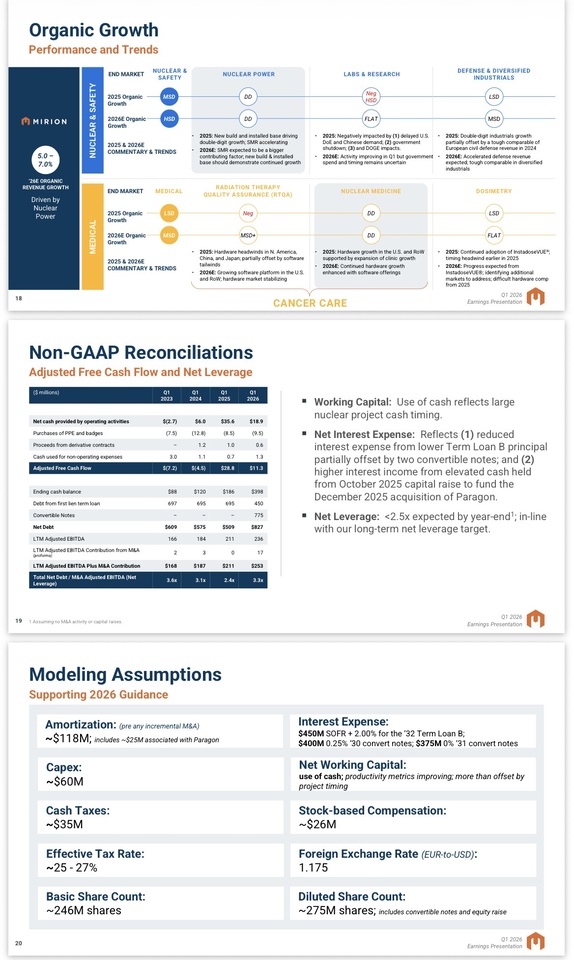
The SMR and Next-Gen Operating System: Mirion $MIR (+3,26 %) provides the sensor technology for the new Small Modular Reactors (SMRs). Since these reactors operate in a more digital and decentralized manner than older reactors, the software and sensor density per megawatt is significantly higher.
attachment
attachment
attachment


3. Key Figures (as of July 2026 / Q1 FY26) 📊

Stock Exchange Listing: Listed on the NYSE under the ticker MIR.


Market Capitalization: ~$4.18 billion.

Revenue & Momentum: In the most recent reported quarter (Q1 2026), revenue skyrocketed by a staggering 27.5% year-over-year to $257.6 million (driven by strong organic demand and M&A consolidation).


🚀Order Surge (Backlog): Orders rose by 19% (organically) or 42% including M&A in the first quarter to 288 million USD—a new record that far exceeds current revenue (book-to-bill ratio significantly greater than 1).

🚀Strong Margin Performance: The adjusted gross margin remains stable at a robust 45.8%. Adjusted EBITDA climbed to $54.3 million in Q1 (adjusted EBITDA margin at a comfortable 21.1%).

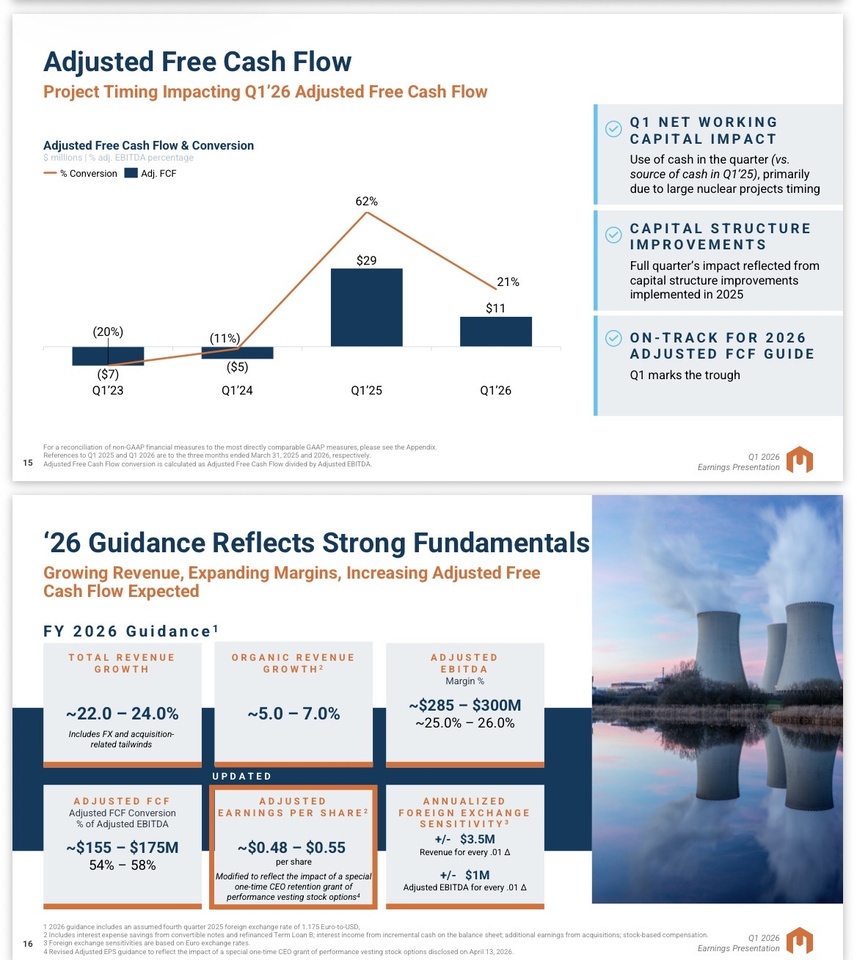
🚀The financial fortress (deleveraging): The deleveraging target is set: Management is focused on using strong free cash flow to sustainably push the leverage ratio (net debt / adj. EBITDA)—which was temporarily increased by M&A—below the critical comfort threshold of 3.0x by year-end.

🚀 Capital Efficiency (ROIC): With a historical ROIC of 1–2% (including massive M&A goodwill), Mirion is not, on paper, a classic, highly efficient compounder. Anyone investing here is making a deliberate bet that the Paragon and Certrec synergies will gradually drive up the real return on capital over the next few years.

🚀 Valuation: The adjusted forward P/E ratio for the full year 2026 is approximately 26x–28x (expected adjusted EPS of ~$0.60–0.65). Traditional GAAP earnings still show a slight loss due to M&A amortization (-$3.4M in Q1), which makes the stock appear artificially expensive when viewed through superficial filters.
attachment
attachment

4. Why is the stock particularly exciting right now? 🚀


1. The nuclear supercycle is becoming a reality

Whether it’s artificial intelligence in data centers or the decarbonization of industry, the demand for baseload electricity is leading to operating life extensions for existing nuclear power plants and massive new construction programs worldwide. Mirion $MIR (+3,26 %) earns revenue from every single one of these projects—without bearing the operational risk of a power plant operator.


2. The radiopharmaceutical boom in medicine

Medicine is undergoing a revolution driven by targeted alpha and beta therapies for cancer. These highly radioactive drugs must be monitored with extreme precision at every stage of logistics and administration. Mirion’s medical division is growing at a double-digit rate here as an indispensable supplier.


3. The End of SPAC Discounts

Wall Street hates opaque SPAC balance sheets with high debt levels. Since Mirion has now demonstrated in 2026 that its leverage ratio can be sustainably kept below 3x through strong free cash flow, the stock is undergoing an ongoing revaluation.


5. Competition & Moat ♟

The landscape:

The niche specialists (Thermo Fisher $TMO (-1,27 %) , Canberra/Areva history): Major laboratory equipment suppliers often have small divisions for radiation measurement but rarely offer the fully integrated depth of software, calibration, compliance management, and dosimetry from a single source.

Local Players: Often too small to compete in global tenders for major military contracts or multinational hospital chains.


Mirion’s Moat in Bullet Points:

Extreme switching costs: Once a hospital or nuclear power plant has implemented Sun Nuclear’s or Certrec’s software platforms into its daily safety workflows, switching is practically impossible. The recertification costs and regulatory risk are disproportionate to any potential savings.

Legally Guaranteed Revenue: Even if the global economy slips into a deep recession, no operator can cut its spending on radiation protection and dosimetry monitoring. Revenue is defensively locked in.
attachment

6. Additional Insider Facts (The “Deep Dive” Bonus) 💡

The AI Compliance Lever: Mirion $MIR (+3,26 %) is rolling out automated AI tools as part of the Certrec integration; these tools scan regulatory changes issued by authorities in real time and automatically update nuclear power plant operating manuals. This transforms the traditional consulting business into high-margin software revenue.

The Defense Catalyst: Due to the changing geopolitical landscape, NATO countries are modernizing their nuclear early-warning systems and NBC protection equipment (civil defense, military) at a record pace. Mirion $MIR (+3,26 %) is the primary supplier of mobile and stationary detection systems in this sector.


7. Risks ⚠

❗The M&A integration risk: Paragon and Certrec were expensive acquisitions. Synergies must be fully realized at the margin level in the second half of 2026; otherwise, adjusted EBITDA could be negatively impacted.

❗Delays in new reactor construction: Major nuclear projects (especially in EuropeđŸ‡ȘđŸ‡ș and the U.S. đŸ‡ș🇾) are notorious for years-long delays. If the construction of large reactors is delayed, Mirion’s hardware revenue will also be pushed into the future.

❗Political volatility: A sudden shift in sentiment toward nuclear power in key markets (e.g., following political shifts) could dampen long-term growth sentiment.


Earnings Preview (Q2 2026 – July 29, after U.S. market close)


The consensus: Expected ~$269.6 million in revenue (+21.0% YoY, driven largely by inorganic M&A effects) and adjusted (non-GAAP) EPS of ~$0.10–0.11.

What matters:

1. Genuine growth momentum: Will the organic revenue growth (excluding the acquisitions of Paragon/Certrec) once again reach a strong level (over 6–7%), and does order growth (Order Growth) pick up by 15–20%, as forecast by management?


2. Profitability & Dilution: Will the integration of the acquisitions and the high level of stock-based compensation (Stock-Based Compensation) weigh on the adjusted EBITDA margin, and will adjusted EPS stabilize after the weak first quarter?


3. Debt Reduction & Cash Flow Conversion: To what extent is the high net debt of ~$1.2 billion weighing on interest expense, and does the quarter provide the first concrete evidence that Mirion is on track to meet its full-year free cash flow guidance (USD 155–175 million) to rapidly reduce leverage?


My personal conclusion & Reaper Bonus 🧐


Mirion Technologies $MIR (+3,26 %) will deliver exactly what savvy value and infrastructure investors are looking for in 2026: a crisis-proof, regulatory-protected tolling business with strong organic momentum and an exploding order book. The transformation toward higher-value software and compliance revenues is underway. With the successful reduction of debt, the biggest risk is eliminated.

But if the integration of the new platforms is delayed, the costs of highly specialized engineers in the medical sector unexpectedly squeeze the operating margin, and at the same time Wall Street loses interest in the nuclear sector, the stock will quickly correct further. Without a flashy AI narrative, the mid-cap market won’t forgive margin-squeezing measures.


Jack’s Verdict:

“Mirion is the ultimate ‘boring business’ that you just want to leave sitting in your portfolio. Everyone’s looking at the tech giants that consume the electricity—but no one’s looking at the guys who make sure that energy source doesn’t blow up in our faces. A gross margin of over 45% on physical safety components shows that Mirion can dictate prices.”


REAPER RATING: 🟱 HOLD / WATCH

REAPER SCORE: 7.9 / 10 ·


@Get_Rich_Or_Die_Tryin @Tenbagger2024
@Raketentoni
@Stocktective
@Multibagger
@Dividendenopi
@schlimmschlimm and, of course, everyone else ✌

16
13 Comentarios

Imagen de perfil
Hey Brian,

First of all, hats off to you for this terrific deep dive! The story surrounding the “regulatory toll booth” and the moat created by extreme switching costs is presented in an absolutely brilliant strategic way. Looking at its business operations, Mirion is an extremely exciting pick for the infrastructure supercycle.

I ran your numbers through a fact-check and compared the whole thing with the current quantitative models. Here’s my take on it:

**1. The Fact-Check (You did a great job there)**
Your Q1 numbers are spot on. The 27.5% revenue growth to $257.6 million and the massive order intake of $288 million are hard facts that confirm the operational momentum. You also nailed the adjusted EBITDA of $54.3 million exactly.

**2. A Look Under the Hood (Where It Hurts)**
If we put the rosy narrative aside for a moment and apply our strict quality and cash flow metrics, Mirion currently presents two completely different faces:

* **Qualitative Growth (Revenue Growth + Operating Margin):** Here, the stock benefits enormously from the 27.5% revenue growth. Even though the hard, unadjusted operating margin is currently languishing in the very low single digits (only $3.7 million in operating income), the strong growth pushes the score into a very solid range above 25. Demand is undoubtedly there.
* **The Cash Flow and Profitability Check:** This is where the warning lights start flashing. You’ve already honestly addressed the M&A costs and the net result (a GAAP loss of -$3.4 million), but that’s really taking its toll. I’m currently missing the hard cash returns here. Without a significant dividend, free cash flow must go entirely toward debt reduction.

**3. Reality Check with the Algorithms**
I ran the report through Investing’s current quality check, and it perfectly illustrates the stock’s dilemma:

* The model gives the **cash flow rating a meager 2 out of 5**.
* It also only manages a **3** for the **profitability rating**.
* **Fair value:** This is the most critical point. The quantitative models currently calculate the fair value at 11.40 EUR, which—at a share price of 14.31 EUR—corresponds to a hefty **downside risk of -20.3%**.

**Conclusion:**
We have a massive conflict here between the “story” and the “hard numbers.” Analysts love the story (price targets around 23.90 EUR), but the sober valuation algorithms mercilessly penalize the weak GAAP results and legacy burdens.

For me, the exclusion rule still applies here: The story is (still) significantly bigger than the hard balance sheet figures at the moment, and the path to genuine, clean profitability (without “adjusted” window-dressing) has yet to be proven. It remains a bet on synergies. As a small, speculative satellite in the portfolio, Mirion is a great bet, but as a substitute for a fundamentally sound core position, it’s currently still too much “hope” and too little “hard cash” for me.

I’m definitely keeping an eye on the upcoming Q2 numbers, though. If organic growth holds up and debt declines, this stock is going to be red-hot!

---
‱
9
‱
Imagen de perfil
A "boring business" without dividends isn't for me. Either it's boring but pays out nice dividends, or it's growing but doesn't pay dividends. This one falls right in the middle for me.
‱
4
‱
Imagen de perfil
@Keineui When I read that, it's kind of like my strategy 😬 Either cash or risk. Screw the middle ground 😂
‱
3
‱
Imagen de perfil
It would be nice if it were to head back toward $14. That's where the 200-week EMA and a price gap are. However, a nice double bottom might be forming there right now, and if so, that would be the end of the downside potential.
‱
3
‱
Imagen de perfil
I think they're good. I'll add them to my biotech and medical tech portfolio at Trading 212.
‱
2
‱
Imagen de perfil
@Multibagger When are you getting on? 👀
‱
1
‱
Imagen de perfil
@Aktienhauptmeister An hour ago😂😉
‱
1
‱
Imagen de perfil
@Multibagger You're moving faster than the police allow đŸ˜‚đŸ€ but let's go 🚀
‱
1
‱
Imagen de perfil
Hey there, Brian!

It’s Rob here, the incorruptible gatekeeper of your hard-earned capital. Your buddy asked me to take a closer look at Mirion Technologies (MIR).

Mirion manufactures radiation detection devices for nuclear power plants, the medical field (cancer diagnostics/therapy), and the military. At first glance, it sounds like a crisis-proof high-tech gem with government backing. But we’re not evaluating fancy glossy brochures here—we’re looking at hard-nosed cash flows.

Buckle up, Brian. Now we’re going to completely tear this company apart using our 12-point “Boss Battle” checklist.

The “Boss Battle” Checklist: Mirion Technologies Inc. (NYSE: MIR)

1. Financial Check & Multiples

Exchange rate basis: 1 USD = 0.92 EUR (current daily dollar exchange rate of approx. 16.33 USD or 15.02 EUR).

Metric FY 2025 (Actual) FY 2026 (Guidance / Est.) FY 2027 (Outlook / Est.)
Revenue $925.4 million (approx. €851.4 million) $1,129 – $1,147 million $1,250 million
Revenue Growth +7.5% +22.0% – 24.0% (including M&A) +9.5%
EBITDA (Adj.) $227.9 million (approx. €209.7 million) $285.0 – $300.0 million $330.0 million
P/E Ratio (GAAP / Adjusted) 125x / 32x negative GAAP / 31x 85x / 23x
Net Debt / EBITDA 3.8x approx. 3.3x approx. 2.8x
Equity Ratio 53.3% approx. 51% approx. 50%
ROE / ROIC 1.5% / 2.1% approx. 2.5% / 3.5% approx. 4.5% / 5.5%

Rob’s Straight Talk: Revenue growth in 2026 looks spectacular on paper (+23%). But be careful: A massive portion of this growth is driven by expensive acquisitions (Certrec, Paragon Energy Solutions). Organic growth is a modest 5% to 7%.

2. Margin Ladder (Profitability)

Gross Margin: 45.5%

Net Margin (GAAP): 3.1% ($28.8 million net income in 2025—the first time the company has been profitable since its SPAC IPO!)

Free Cash Flow (FCF) Margin: 14.2% (Adjusted FCF of $131.0 million on $925.4 million in revenue).

VETO Review: The gold standard of an FCF margin > 15% is narrowly missed at 14.2%.

Root Cause Analysis: Mirion is saddled with massive interest expenses due to its enormous debt burden of over $1.2 billion. In addition, integration costs for M&A deals and high capitalized development costs are eating into operating cash flow. The trend is pointing upward thanks to profitability initiatives (“Operational Excellence”), but at present, it is not yet a true “cash flow monster.”

3. Piotroski F-Score (Combined)

Mirion barely manages to score 5 out of 9 points here—an absolutely average result.

Profitability Category (3/4): Positive net income (GAAP), positive operating cash flow, and cash flow exceeds net income. However, the return on assets (ROA) is extremely weak at less than 1%.

Financing & Liquidity Category (1/3): The current ratio is stable. However, leverage has risen again due to M&A, and the number of shares has increased due to dilution.

Category: Operational Efficiency (1/2): The gross margin has stabilized, but asset turnover is severely hampered because the balance sheet is inflated by goodwill from acquisitions.

4. Dividend & Shareholder Check

Anyone hoping for regular checks in their account will be bitterly disappointed.

Dividend yield: 0.00% (No dividends are paid; all funds go toward debt repayment and acquisitions).

Buybacks: None. Instead, there has been slight dilution for existing shareholders (the number of shares rose from 225 million to over 244 million).

Insider Transactions: Slightly negative. CEO Christopher Moore sold a large block of shares worth $165k in May 2026. Not a sign of confidence.

5. Regions & Moat

Geography: The U.S. accounts for approximately 60% of the business; Europe contributes about 30% (strong dependence on the euro in the Nuclear segment); the remainder is distributed globally.

Competitive Advantage (Very strong!): This is where Mirion shines. The products (radiation measurement in nuclear power plants, dosimeters in hospitals) are highly regulated. Switching costs for customers are extremely high—no nuclear power plant operator would replace functioning safety computers with a no-name product just to save 5%. Approvals from the FDA and nuclear regulatory agencies take years.

Market Shares: In many niches of nuclear sensor technology, Mirion holds global market shares of over 40% and operates in a duopoly.

Growth Factors & TAM: The “Nuclear Renaissance” hype (SMRs—Small Modular Reactors—and AI data centers that require their own nuclear power) is driving the order backlog. Mirion reported record order intake of over $1 billion (+26%) for 2025. The total addressable market (TAM) is growing rapidly due to Big Tech’s massive energy demand.

6. Guidance, News Flow & Predictable Revenue

Order Backlog: Excellent. The backlog rose by 36% thanks to M&A and strong organic orders.
Management’s Track Record: Thomas Logan (CEO) is delivering on the operational front. The guidance for adjusted EBITDA was confirmed in Q1 2026.

The Catch: In April 2026, there was an unwelcome “CEO retention” stock option grant. This immediately pushed the adjusted EPS guidance for 2026 down from $0.50–$0.57 to $0.48–$0.55. We shareholders don’t like that one bit!
7. Skeletons in the Closet / Risks

🚹 Severe Risks (Category: Red): The Debt Bomb Mirion is saddled with $1.23 billion in total debt, with a market capitalization of approximately $4 billion. The net debt-to-EBITDA ratio of 3.8x (as of the end of 2025) is far too high for a quality company. Every interest rate hike hurts.

Moderate Risks (Category: Yellow): Dilution & GAAP Profitability. On an adjusted basis, everything looks great. However, once you subtract stock-based compensation (SBC) and depreciation, there’s hardly any real GAAP profit left at the bottom line.
Minor Risks (Category: Green): High dependence on government nuclear budgets and project timelines.

8. Momentum Check and Sentiment

Technical analysis paints an extremely bleak picture. The hype surrounding “nuclear energy” has undergone a massive correction for now.

Current price: $16.33 (approx. €15.02)

GD50 (50-day moving average): $16.99 (price is below this level -> Negative)

GD200 (200-day moving average): $21.85 (price is miles below this level -> Strongly Negative)

Sentiment is currently at rock bottom. The stock is in an established downtrend.

9. Alpha & Beta Analysis + Rule of 40 Check

Beta: 1.54 (Very volatile, fluctuates significantly more than the broader market).

Alpha: Negative over the past 12 months. The S&P 500 has outperformed Mirion by a wide margin.

Rule of 40 Check:
Organic growth (approx. 6%) + FCF margin 14.2% = 20.2%.
As a pure growth stock scenario, Mirion fails miserably here.

10. DCF Analysis (Fair Value) and Current Valuation Level

We conservatively estimate a WACC of 9.0% (due to the high debt premium) and long-term FCF growth of 6%.

Fair Value (USD): $14.50
Fair Value (EUR): €13.34
Current Price: $16.33 (€15.02)
Upside/Downside: -11.2% downside (The stock is still slightly overvalued despite the pullback).

Compared to historical levels (P/E ratios of over 50x in some cases, adjusted), the stock has indeed become “cheaper,” but the high debt level simply precludes premium multiples here.

11. Strategy & Entry Zones (unrated)

Since the downtrend remains intact, we are definitely not chasing a falling knife here.

Aggressive Scenario (Buy on a slight pullback): €14.50 (First small position once fair value is reached).

Realistic Scenario (Wait for the bottom to form): €12.50 (A wider margin of safety applies here).

Conservative Scenario (The “safety net” buy): €11.00 (If panic drives the price down to this level, the debt is already priced in).

12. Final Fitting Score

We throw all the data into the blender of our incorruptible valuation framework:

Quality & Balance Sheet: FCF margin just below the limit, ROE/ROIC weak, F-Score only average. The extremely high debt (net debt/EBITDA of 3.8x) costs the company a massive number of points here.

Shareholder Value: A wash. No dividends, no buybacks—just dilution.

Moat & Market: An excellent competitive moat and top market share save the company from disaster.

Valuation & Rule of 40: The stock is still slightly overvalued; the Rule of 40 is clearly not met.

Momentum: Deep in the red (price below the 50-day and 200-day moving averages).
Overall Score: 7.8 / 15 points

Classification: Average (holding is okay; consider new purchases with caution).

Rob’s conclusion for your buddy Brian:

“Come on, Brian, keep your hands off that nuclear toy as long as the balance sheet is so contaminated!”

Mirion has a sensational moat from an operational standpoint. Once you’re inside the nuclear power plants and hospitals, no one can get you out. But management has pumped up the balance sheet with over $1.2 billion in debt through expensive acquisitions. At current interest rates, that’s simply eating away at too much of the company’s equity.

Add to that the bitter aftertaste of dilution and the fact that the stock is in free fall on the charts. Even the whole “Nuclear Renaissance” narrative doesn’t help. For our portfolio, this is currently a clear “no” right off the bat. If you already own the stock: You can hold onto it and hope the debt gets paid down. Buy new shares? Only once a true bottom has been established and prices are significantly lower!
‱
2
‱
Imagen de perfil
@Get_Rich_or_Die_Tryin There's my friend Rob đŸ€© Jack's analysis came out pretty much the same way đŸ€â™„ïž Thanks for the analysis, my best friend đŸ«¶
‱
1
‱
Imagen de perfil
@Aktienhauptmeister I just wanted to let him take the spotlight for you today.😁 As always: You're welcome, my dear.đŸ«¶đŸ»
‱‱
Imagen de perfil
Yay, thanks for the introduction—it’s ended up on my table quite a few times, too; I find myself there often as well 😅

But Jack needs to be a little careful—Mirion has nothing to do with reactor safety in the strict sense. So even if things go south, the stock price could still go up 📈

I have two corrections that could—or should—be made. First, it reads as if Mirion were needed on a large scale for shielding, but that’s not the case. As far as I know, they produce smaller-scale solutions, e.g., for everyday lab work, but the TAM for those is rather small, and many others can do that too. What’s interesting, though, are their turnkey solutions at the hospital level, where this add-on is simply included as a matter of course.

In the report, it sounds as if Jack still views Canberra as some kind of competitor? But in 2016, Mirion acquired and integrated the Canberra business from the former Areva. I would explicitly highlight this, if necessary, as it actually strengthens the investment case even further; otherwise, Mirion’s current infrastructure wouldn’t look nearly as strong, especially in the service business.

Otherwise, I also find Mirion very exciting, but I don’t think the competitive moat is quite where it could or should be right now. The company still operates in an oligopoly—Thermo Fisher, Bertin, Fuji
 There are many large manufacturers offering systems.
Management still needs to deliver on its M&A efforts; Canberra was a very valuable addition, but the ROIC is still far from solid. In addition, the two new business segments still need to take off; Mirion’s strategy isn’t really to acquire yet another strong niche but to further expand and strengthen its business through new investments. Here, management must demonstrate that the plan is working and that ROIC is rising over the long term.

Mirion could become interesting to me again if they can leverage their installed base with software and engineering, strengthen their competitive moat, and get their balance sheet in order. From a strong hardware business to a solid infrastructure ecosystem—but until that happens, they probably don’t deserve a spot in my portfolio (even though I’d actually love to have them in it) đŸ€Ł
‱
2
‱
Imagen de perfil
@Stocktective Thanks for the addition, my friend! I haven't quite finished analyzing the company myself yet—that was just a quick overview. And Jack just threw in his two cents as a quick thought, too 😆
It’s awesome that you know this company, too! Since I’ve lost one position, I’m now on the hunt for a replacement 😂
‱
1
‱
Únase a la conversación