
Weak sales development, a sharp rise in profits and then a slump in profits? At first glance, Kontron's development seems contradictory. But if you take a closer look, you might recognize a clear strategy behind it.
It's actually not that complicated
In my view, Kontron has been misunderstood for years and, on top of that, the share price has plummeted inexplicably.
In the end, the same reasons seem to be responsible for Kontron not being understood.
Kontron has been undergoing a strategic realignment for several years. Parts of the company were sold back in 2022 and, as Kontron achieved a good price, this led to a massive jump in profits.
This was followed by a supposed slump in profits, but this was caused by the elimination of this special effect and had nothing to do with the operational reality.
Part of the sales proceeds were distributed as a special dividend, which subsequently led to a "reduction in the dividend". If you consider this media classification to be nonsensical, you are not alone.
All of this will become important later on.
Since then, the operational successes on the stock market have only been received half-heartedly. Although the share price has risen considerably, it is lagging behind business developments.
Despite the recent price losses, the share price is still well above the low from 2022, but has been trending downwards again since the middle of last year.
Once again, the stock market does not seem to understand what is going on, although the current situation is essentially the same as in 2022.
How one-off effects are causing confusion
If you take a closer look, you will recognize a clear pattern: the company is trading volume for profitability.
Kontron develops and produces embedded computers, IoT platforms and software solutions that are primarily used in industrial applications. The products are used in trains, machines, communication networks and increasingly also in defense systems.
Traditionally, a large part of the business comes from hardware, such as computer-on-modules or industrial boards. These components are the backbone of many networked systems, but deliver comparatively low margins. This is precisely where the change in strategy comes in.
Instead of selling as much hardware as possible, Kontron is shifting towards software and integrated solutions.
This combination of device, operating system and service creates long-term customer loyalty and increases the added value per order. The company is thus following a clear trend in the industry: away from being a pure component supplier and towards becoming a solution provider with recurring revenues.
Why 2026 looks weak, but is not
The most visible step was the disposal of parts of the low-margin module business in the 2025 financial year, which once again artificially inflated profits.
However, anyone who is unaware of this and takes a superficial look at Kontron will only see a jump in profits and a supposedly weak forecast.
This is because this positive one-off effect will no longer apply in 2026, leading to an apparent decline in earnings.
None of this seems to be understood, but it's not that complicated. As I have been following live since 2022 how these developments are not understood, I assume that they are also insufficiently understood at present.
In addition, there are puzzling incidents such as on March 19, when the share price collapsed for no apparent reason.
We can only speculate as to what exactly triggered this: A so-called fat finger, a wave of stops triggered by this and a targeted short attack or a mixture of these.
Share buybacks, outlook and valuation
The Executive Board responded with tangible measures, both personally and at company level.
Since then, the CEO has bought back shares in the company several times, initially 5,000 shares at a price of EUR 17.62 and then a further 3,000 shares at EUR 18.74.
In addition, it was decided to buy back up to 2.9 million treasury shares, which corresponds to around 4.5% of all outstanding shares. In view of the company's valuation and capital resources, I believe this is the right decision.
According to consensus estimates, earnings of EUR 1.98 per share are expected for 2026. This gives Kontron a P/E ratio of 9.6.
That would be appropriate for an ailing group, but in my opinion this description does not apply to Kontron. In the last five years, the KGV averaged 15
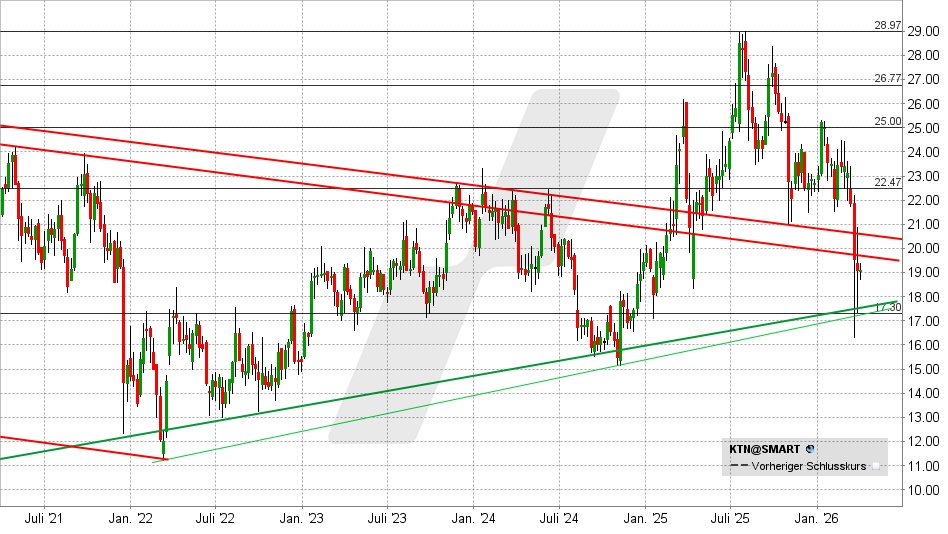
Kontron share: chart from March 31, 2026, price: EUR 18.95 - symbol: KTN | source: TWS
If the long-term downward trends at around EUR 19.60 and EUR 20.50 can be overcome again, this could trigger a recovery towards EUR 21 or EUR 22.00 - 22.50.
A procyclical buy signal would be issued above this level.
However, if the share falls below EUR 18.80, this could lead to a renewed setback towards the upward trend.
Source


