
energy $XLE (-0,51 %) and the long term US government bonds $TLT The reason for this is rising energy prices, which can have an inflationary effect. The markets then expect (in principle) a more restrictive monetary policy from the Fed, which leads to bond prices being depressed and yields rising. This $TLT would actually fall under such circumstances. But what would that mean in general? A rising energy sector coupled with weak bonds indicates that the market expects inflation to continue or at least energy prices to remain stable at a high level. However, it can also be interpreted differently! If $XLE (-0,51 %) rises while $TLT weak, this signals that the market is not currently thinking about lowering interest rates.
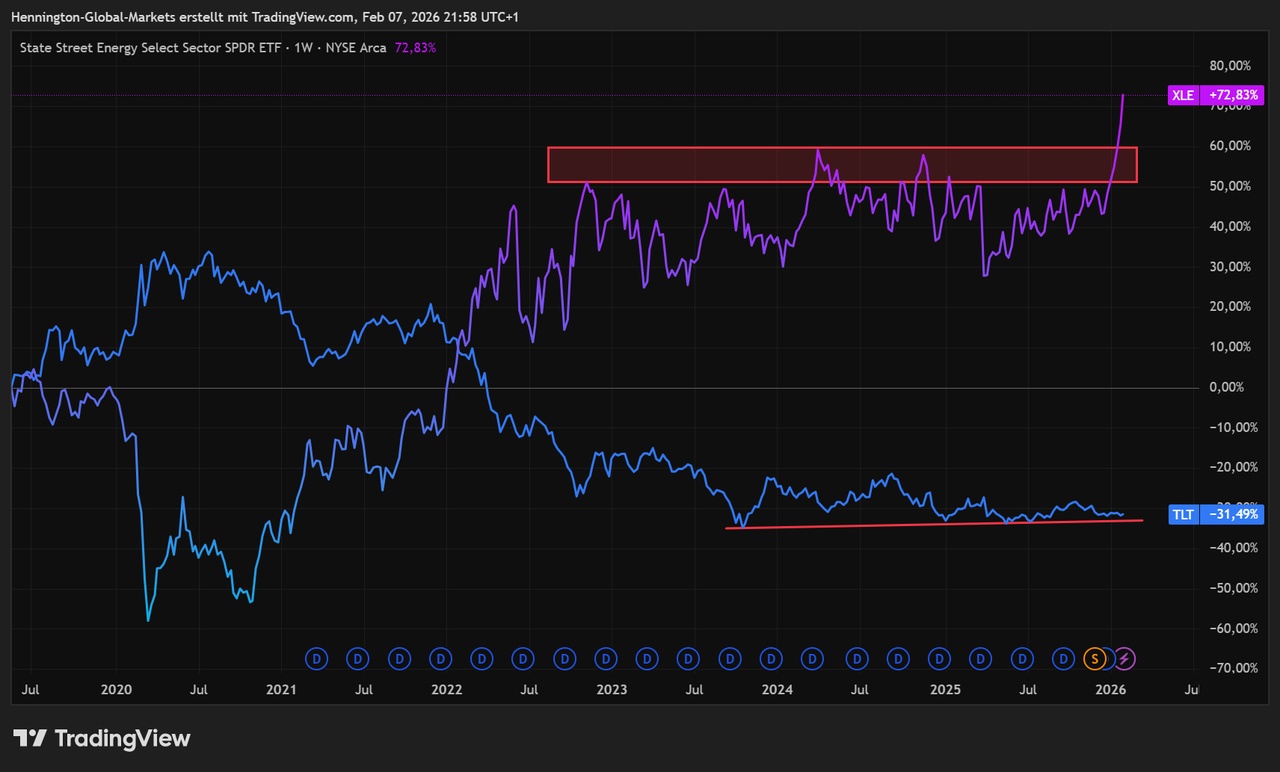
But what speaks against it? CPI data has fallen from 3.0% (Jan 2025) to 2.7% (Dec 2025). The forecasts for 2026 (2.0%-3.5%) and the PCE forecast of 2.5% point to a gradual decline towards the 2% target, not a rebound. The FED Watch Tool also looks different. This says that the markets and the FED expect interest rates to fall in 2026 (target 3.0%) and not rise.
What may favor the actual rise are the production cuts or the pause until March as far as OPEC policy is concerned and, of course, the current geopolitics in Iran, which is leading to risk premiums.
Nevertheless, there is another aspect that should lead to a slump in the $TLT when you look at it from a global perspective.
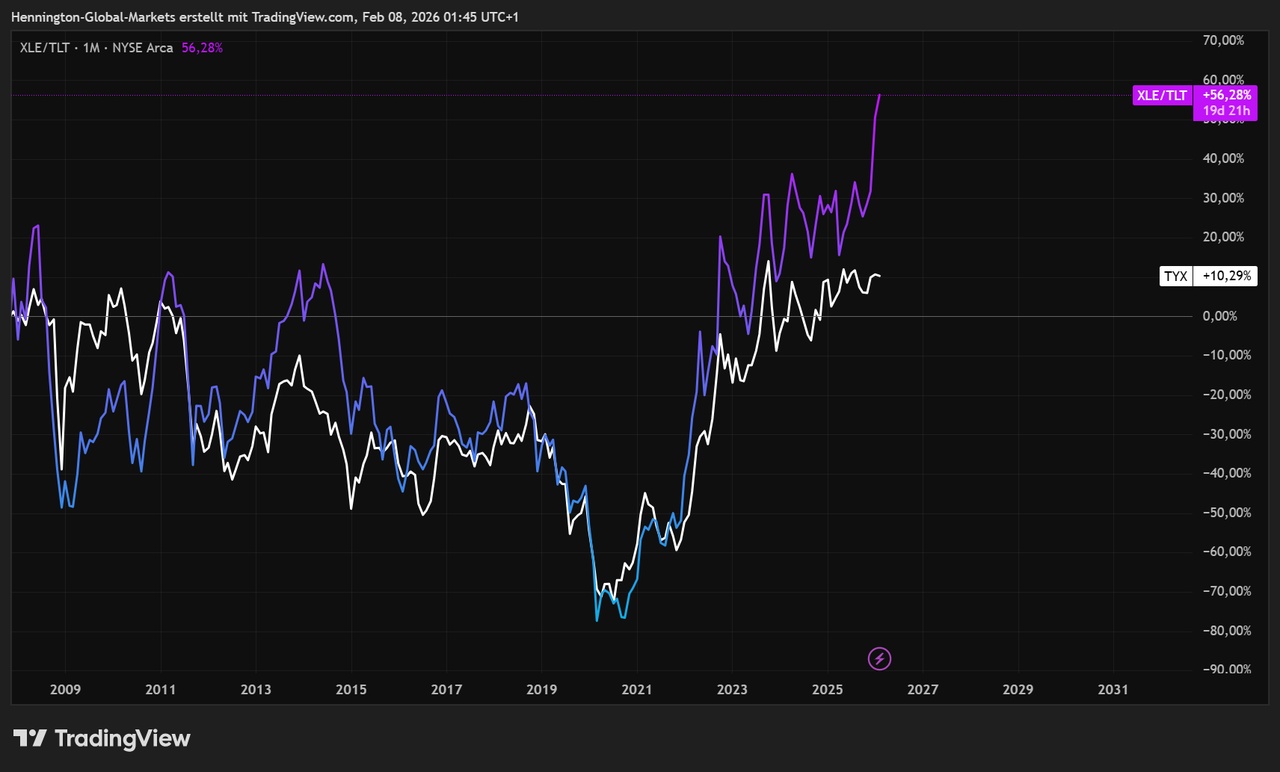
The picture shows that $XLE (-0,51 %)/$TLT compared to the $TYX (30YT). The ratio compares the performance of energy with that of long term bonds. A rising value means that energy stocks are outperforming bonds. The chart shows a certain correlation. Based on the correlation and purely technically, 30YT should shoot upwards. This is supported by international bond markets such as Japan or the UK, where yields are rising strongly, especially 30Y. Japan in particular is providing the leverage to push $TYX higher, which is due to the Bank of Japan ending its ultra-loose monetary policy. Japanese 10Y bonds have now reached 2.38%, a level not seen for over a decade. It will become particularly critical when yields in Japan are attractive enough and Japanese investors no longer have a reason to take the risk in US bonds.
