6D·

Company Presentation Before Midnight

Hello, everyone,

Today's post is about the topic


"Could weak quarterly results be an opportunity?"


To answer this question, we'll of course need the help of our favorite prompts once again.

(@Raketentoni / @Aktienhauptmeister )


But of course, we’ll also need comments from the entire community.


$6506 (+3,61 %)

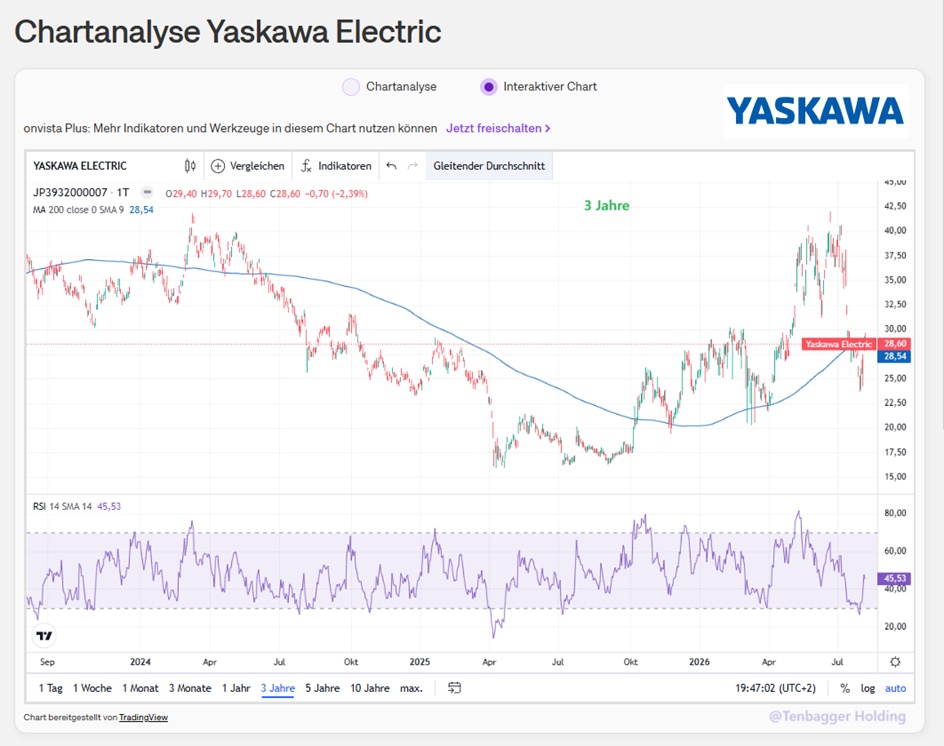
Yaskawa Electric: Weak quarterly results push stock to its lowest level since April

Published on July 14, 2026, at 6:20 a.m.

Yaskawa Electric slips following weak quarterly results and hits its lowest price since April. The stock fell on Tuesday by 11.8% to 5,265 yenon Tuesday, following a sell-off that had already begun on Monday.

Why is the stock falling?

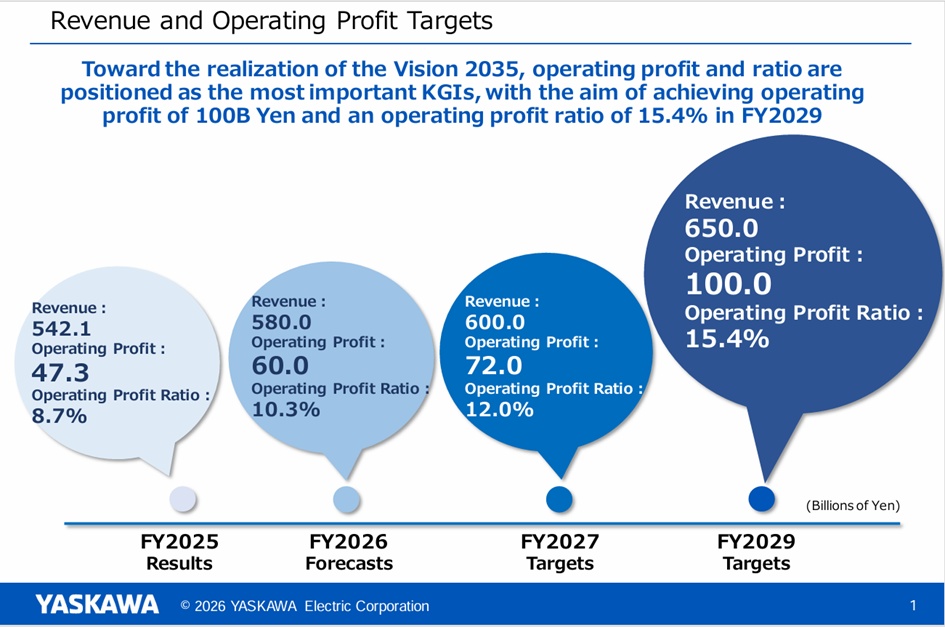
  • Operating profit down 19.2%, despite revenue up 10.6% in the first quarter.
  • Demand is strong—driven by semiconductor investments, AI infrastructure, and data centers —but operational issues are weighing on margins:
  • The transition to a new ERP system
  • restructuring costs in Europe

Market reaction

  • Investors had, due to the strong order backlog, an upward revision of the annual forecast .
  • Since Yaskawa did did not raise, skepticism is growing.
  • The markets are currently reacting more selectively: High valuations leave little room for operational disappointments.

An important bright spot

  • Highest order intake in 15 quarters → Demand remains robust.
  • Management describes the ERP issues as temporary.

Yaskawa Electric: Schwache Quartalszahlen drücken Aktie auf Tiefstand seit April Von Investing.com


Yaskawa Electric Corporation specializes in the development, manufacture, and marketing of mechatronic systems. The group also offers installation and maintenance services. Net revenue is broken down by product family as follows:

- Motion control systems for industrial machinery (45.2%);

- Industrial robots (35.8%);

- Energy control and monitoring systems (13%): primarily for the iron and steel, power generation, and drinking water supply sectors;

- Other (6%): computer systems (software and computer peripherals).

Net sales are broken down geographically as follows: Japan (34.9%), China (25.1%), Asia (10.7%), the Americas (15.1%), Europe (14.1%), and Other (0.1%).

Number of employees: 12,483
attachment
attachment


attachment


Somic and Yaskawa Automate Magazine Loading

Somic and Yaskawa have developed a solution for automated magazine loading for cardboard packaging machines. A cobot from Yaskawa plays a central role in this process.

Somic und Yaskawa automatisieren Magazinbeladung - packaging journal


Nvidia Collaborates with Japanese Robotics Companies on AI Development

TOKYO, July 16 (Reuters) – Nvidia announced Thursday that it is collaborating with Japanese companies, including Fanuc and Yaskawa Electric, to advance the development of robotics and AI.

“With AI, robots become intelligent, easily adaptable, and accessible,” said Nvidia CEO Jensen Huang at an event in Tokyo.

Nvidia arbeitet mit japanischen Robotikfirmen bei der KI-Entwicklung zusammen | Reuters


Einführung des kollaborativen Roboters MOTOMAN-HC35 mit einer Nutzlastkapazität von 35 kg und einer Reichweite

von 2030 mm – Verbesserte Nutzlastkapazität, Benutzerfreundlichkeit und Sicherheit, um die Bedürfnisse der Kunden besser zu erfüllen –


July 13, 2026

Yaskawa Electric und SoftBank Corp. validieren ein physikalisches, KI-basiertes System zur Manipulation verformbarer Objekte


YASKAWA Report 2025

Jahresbericht | IR-Materialien | Investor Relations | Yaskawa Global Site

Vision2035_en.pdf

attachment


attachment


attachment


attachment


Market Capitalization 1,395,917

Number of Shares (in thousands) 259,368

Date of Publication: April 10, 2026
attachment


attachment


@PikaPika0105

$6506 (+3,61 %)

20
8 Comentarios

Imagen de perfil
Yaskawa is an interesting company. A lot will depend on how bold its management is in the coming years. But I think they’re heading in the right direction. They’re currently collaborating with SoftBank on physical AI and have already demonstrated initial successes in this area. They’re also collaborating with NVIDIA. They want to participate in Japan’s future infrastructure for physical AI, which is being developed by the newly founded company Noetra. Once this new foundation model—designed exclusively for physical AI—goes live, they’ll likely be able to significantly boost their productivity. They’ll probably also benefit directly from Japan’s massive new investment agenda. It’s a company to keep an eye on.
3
Imagen de perfil
@PikaPika0105 I read that it involved SoftBank and Nvidia. That was definitely one reason for the strong performance ahead of the earnings report.
1
Imagen de perfil
@Tenbagger2024 I’m really curious to see what SoftBank has planned in the field of physical AI. It’s not yet clear exactly what they intend to do with ABB Robotics, but the acquisition was just completed. It could still turn out to be very interesting, though. They control ARM, a perfect fit for physical AI, and they’re the company with the most patent families for Gen AI in the world. Then there’s their leadership role at Noetra… Not to mention their other robotics investments, such as Agile Robots. Maybe we’ll learn something tomorrow during the earnings call!
Imagen de perfil
@PikaPika0105 And its relationship with the Nvidia CEO isn't bad either. I see SoftBank as a major player in AI and robotics.
Imagen de perfil
@Tenbagger2024 They are also building out a cloud business that could already encompass around 20 GW+ of computing power by the early 2030s. In addition, they are expanding their chip business. ARM will be able to significantly increase its revenue in the coming years, as it is now designing its own chips (so far, a CPU for data centers). It’s also an open secret that SoftBank is planning something even bigger: a competitor to NVIDIA’s GPUs. To that end, they acquired Graphcore, which is now working behind the scenes with ARM. In the medium term, they will install these chips in their own data centers. That’s also why they’ve invested in OpenAI (13%)—so they can use OpenAI as a customer for their cloud business and, by extension, their chips, just as is currently happening in Ohio, where SoftBank is building the world’s largest data center with OpenAI as the sole customer (though others were also interested). The investment is merely a means to an end. Many people don’t understand this and write nonsensical articles claiming that SoftBank is betting everything on OpenAI and believes in it, as if it were some kind of venture capital bet. They’re just using OpenAI as a springboard. Its success is only relevant in the short term. Once the new business lines have grown large enough, OpenAI can be replaced by any other company at will.
1
Imagen de perfil
@PikaPika0105 With the sheer flood of information, such important details are often overlooked. It’s often worth taking a look at the fine print.
1
Imagen de perfil
@Tenbagger2024 Good evening✌️ Need help? You’ve got it! Let’s go!

The Servo Toll Booth of Industry 4.0
Yaskawa Electric isn’t just some trendy software hype—it’s the indispensable muscle and nerve center of global automation. Anyone who manufactures microchips for AI data centers, welds automobiles, or assembles smartphones relies on Yaskawa servo motors and Motoman robots. Through the invention of “mechatronics,” Yaskawa has firmly established itself in the design plans of leading machine builders—a classic quality asset that benefits from megatrend-driven reindustrialization and semiconductor cycles.

🛠️ DNA Check
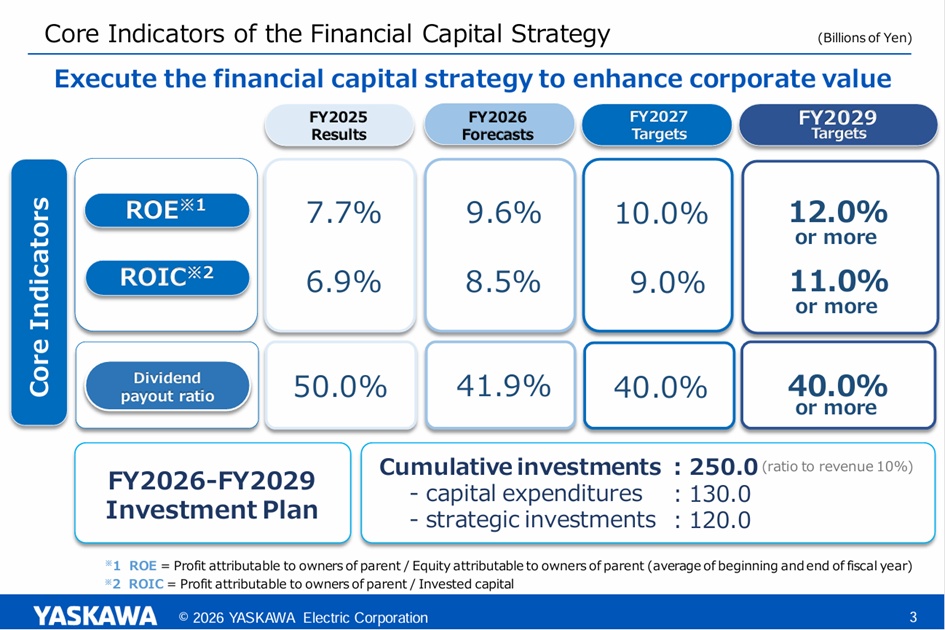
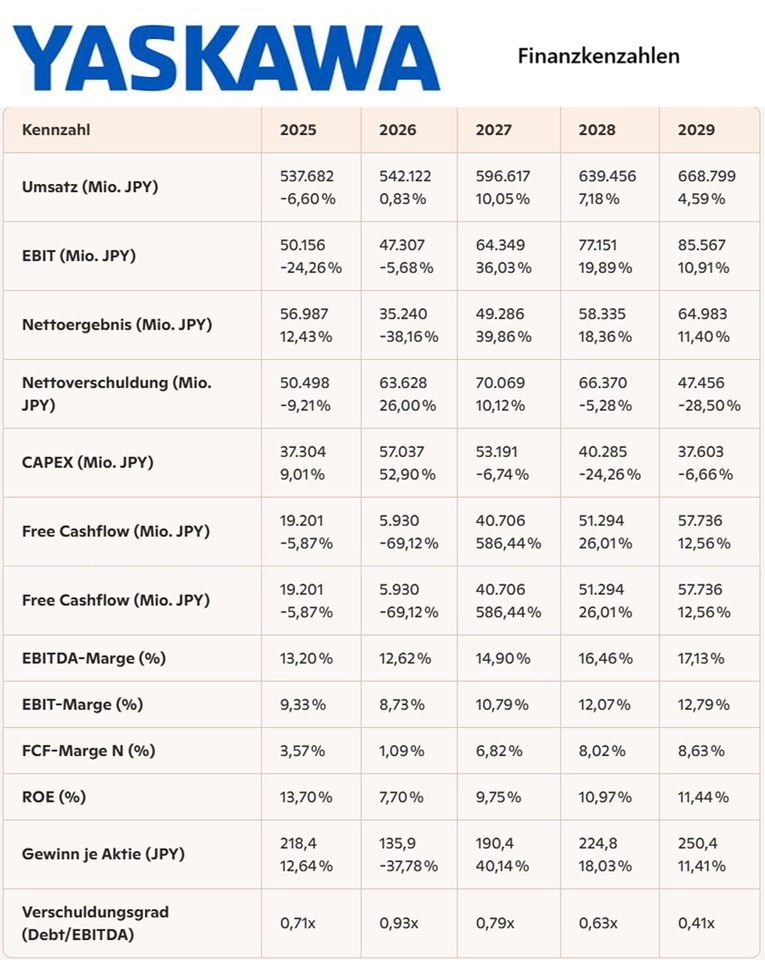
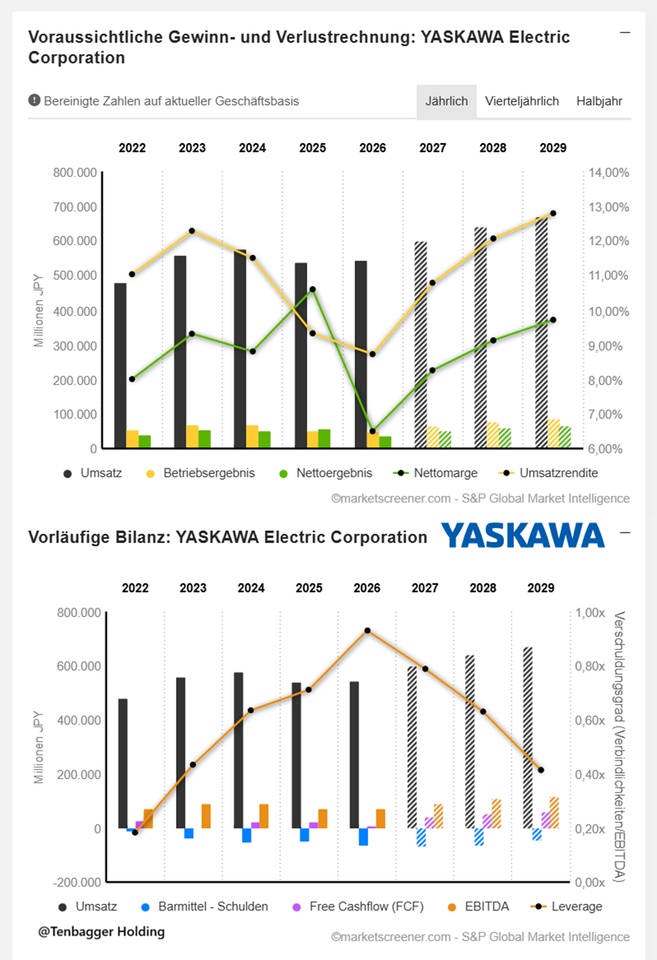
Solid balance sheet structure: With a net debt/EBITDA ratio of approximately 0.70x (net debt at ~47.1 billion JPY), the balance sheet is positioned to absorb shocks effectively.
Financial integrity: A Piotroski F-Score of 5/9 attests to a stable operating foundation, although cyclical pressure is weighing on margins.
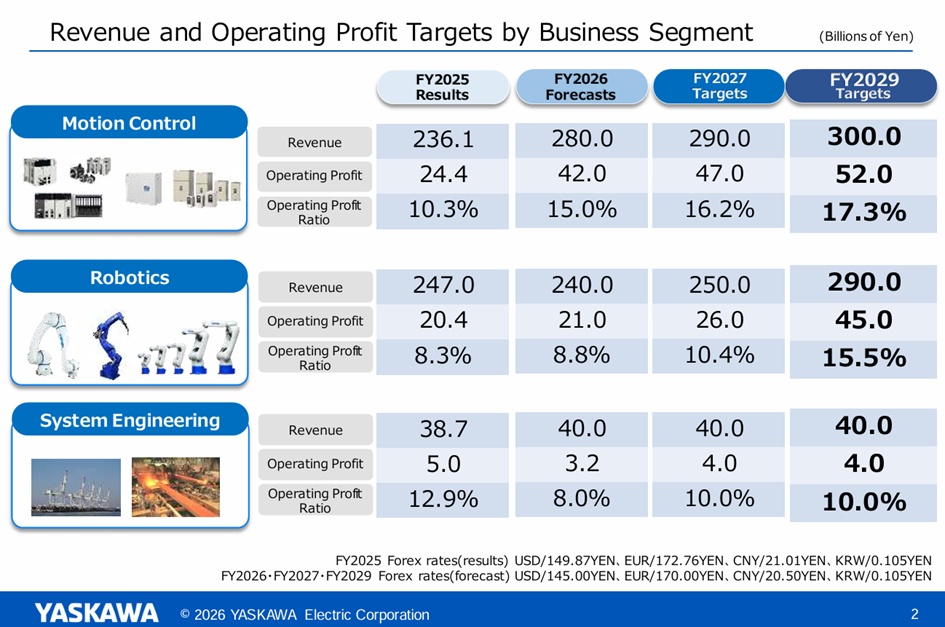
Global market leader: Strong market position in precision servo drives (~45–48% of revenue) and industrial robotics (~38–40% of revenue).
Solid Capital Return: Consistent focus on reinvestment in high-precision technology and direct distributions to shareholders.

🚀 Growth Drivers & Catalysts
Semiconductor & AI Capex: Next-generation AI chips and HBM memory require extremely high precision in manufacturing (CoWoS, wafer handling). Yaskawa supplies the critical components here.
Demographic Shift: The structural labor shortage in Japan, China, the U.S., and Europe makes factory automation indispensable.
i3 Mechatronics Ecosystem: Transition from a pure hardware vendor to a profitable, data-driven software and services provider for connected factories.

⚠️ Valuation & Risks
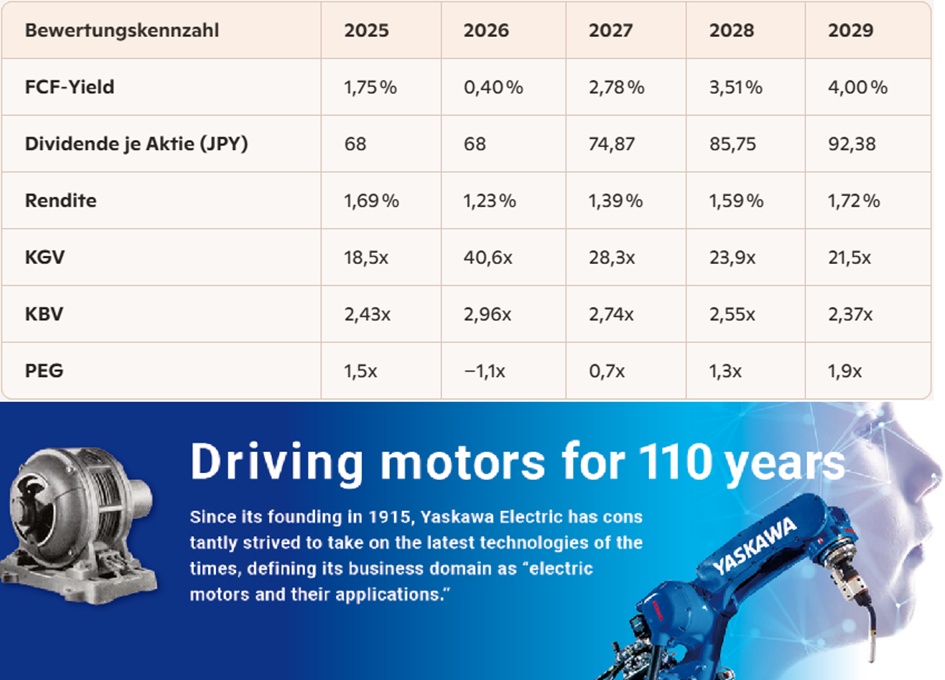
Cyclical Slowdown: A 5-year revenue CAGR of ~3.7% p.a. and an EPS CAGR of ~5.7% p.a. show that Yaskawa is fully tied to the global industrial and capital goods cycle.
Price Pressure from China: Local Chinese competitors (such as Inovance) are entering the market with aggressive pricing in the mid-tech segment.
Currency and Interest Rate Sensitivity: With over 70% of revenue coming from overseas, an unexpected appreciation of the Japanese yen (JPY) and high global benchmark interest rates are dampening customers’ willingness to invest.

Jack’s Conclusion for Yaskawa Electric (TYO: 6506):
“Yaskawa is the mechanical heart of global automation. Its business model has a genuine moat in precision drives, but current returns reflect the trough of the global industrial cycle. No reason to panic, but also no reason for blind euphoria at the current price.”

Status: 🔭 WATCH (Wait for a pullback or a cycle turnaround)
Reaper Score: 6.5/10
2
Imagen de perfil
@Aktienhauptmeister Thank you for the very quick response
1
Únase a la conversación