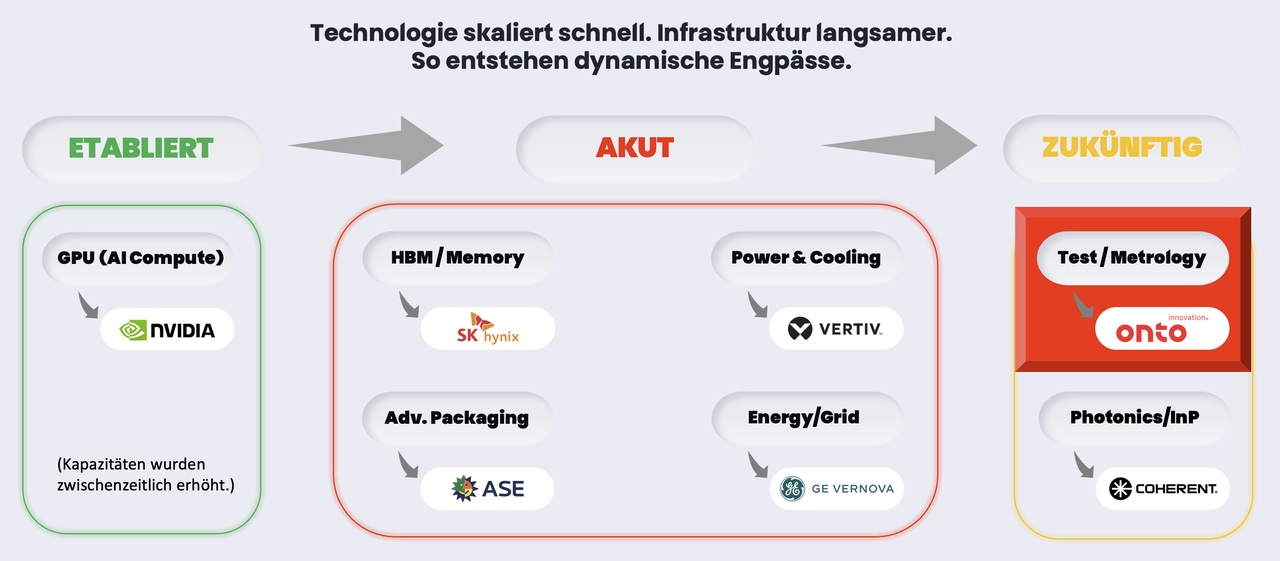
Today we are leaving the field of acute AI bottlenecks (HBM/Memory, Power & Cooling, Advanced Packaging, Energy/Grid) and take a look at future AI bottlenecks.
Here I see, among other things Test & Metrology, because modern AI systems are becoming increasingly complex. More layers, more integration, smaller structures and higher power densities. At the same time, fault tolerance is decreasing massively. Or to put it another way:
‼️ The industry is slowly moving towards "zero tolerance".
Even minimal deviations can affect yield, energy consumption or stability in the future. Precisely because of this This is precisely why the requirements for measurement, control, verification and precision along the entire production chain.
Level 1: Core Metrology (measurement & process control)
For me, this is the structural core. Put simply, it's about making the smallest deviations in modern production processes visible and controllable. Company $ONTO (+2,76 %) (Onto Innovation), $CAMT (-0,26 %) (Camtek) or even $FORM (+5,58 %) (FormFactor) address precisely this level.
Level 2: Test & Verification (functional testing & verification)
It is checked whether complex systems function stably at all. As integration density increases, the importance of test systems also grows considerably. It is often almost impossible to correct errors later on. Companies such as $TER (+3,59 %) (Teradyne) show how important Test & Verification becomes with increasing system complexity.
Level 3: Yield Engineering & Integration Control
This is where a lot of value is currently shifting within the stack. With topics such as HBM, chiplets or 3D integration, the requirements for precision, yield and thermal control are increasing massively. For me, for example $BESI (+3,67 %) (BE Semiconductor) is very close to this development.
Level 4: Specialized Metrology (high-precision special metrology)
Future optical systems and new integration architectures will further increase the requirements for precision and control. Increasingly, the bottleneck no longer lies in the integration itself, but in the ability to combine highly complex components without errors and maintain stable quality. Companies such as $BESI (+3,67 %) (BE Semiconductor) or $ONTO (+2,76 %) (Onto Innovation) are addressing precisely this development.
The more complex modern systems become, the more critical the ability to make minimal errors visible and controllable becomes.
Emerging areas such as photonics (optical data transmission), optoelectronics (combination of electronics and lighting technology) or CPO/Co-Packaged Optics (optical components directly next to the chip) are also driving this development, as increasingly complex stacks, optical connections and integration architectures are being created.