(This is not investment advice!)
$AAPL (+0,23 %)
$MSFT (+1,43 %)
$NVDA (-0,08 %)
$AMZN (+3,46 %)
$GOOGL (+0,76 %)
$META (+1,8 %)
$TSM (-0,54 %)
$GEV (-2,09 %)

Puestos
1103(This is not investment advice!)
$AAPL (+0,23 %)
$MSFT (+1,43 %)
$NVDA (-0,08 %)
$AMZN (+3,46 %)
$GOOGL (+0,76 %)
$META (+1,8 %)
$TSM (-0,54 %)
$GEV (-2,09 %)
As we do every week, here are the top news stories from the past week:
Monday:
Anthropic takes the next step toward an IPO and files its prospectus. The world’s largest initial public offering could thus take place in November. In the first half of the year, the company increased its revenue sixteenfold, from $1.2 billion in the first half of 2025 to $16.3 billion. However, it also posted a loss of $80.75 billion.
Tuesday:
$MBG (+1,83 %) Mercedes-Benz lowers its forecasts. The profit margin is expected to plummet to 2–3%. Severance agreements are also weighing on earnings. Analysts are not surprised by the new estimates.
Thursday:
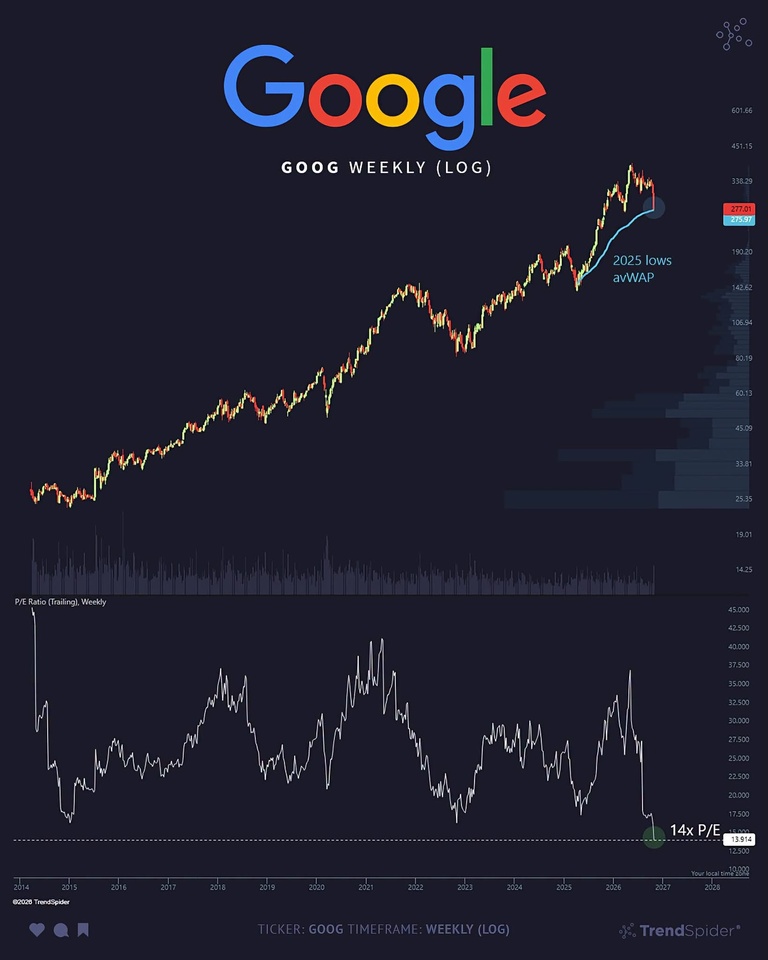
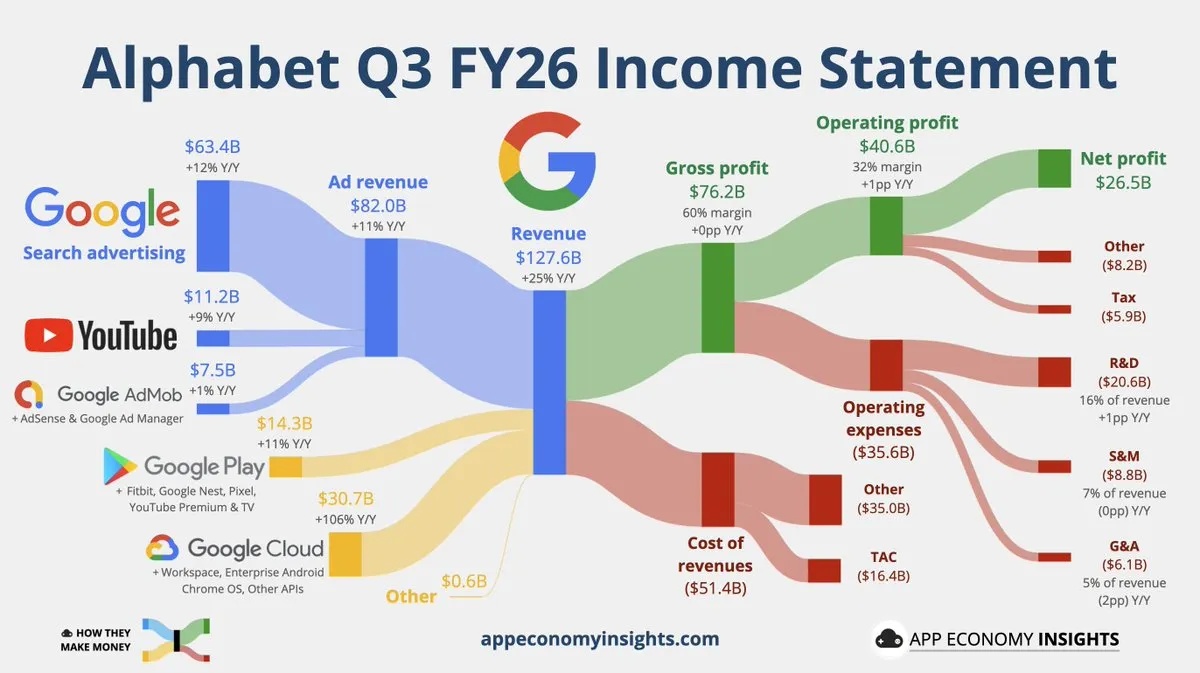
At $GOOGL (+0,76 %) Alphabet, expectations had risen so sharply that the company fell short of them. Alphabet’s profit fell significantly, while analysts had expected an increase. Revenue, however, rose by 25%. Fluctuations in the value of investments—such as those in SpaceX—also contributed to the profit trend.
Friday:
After $VOW (+2,08 %) VW had already reported a loss, Audi today reported a plunge in profits to 95 million euros. Revenue plummeted by more than 10% to 42 billion euros in the first nine months.
https://m.bild.de/politik/autokrise-krasser-gewinneinbruch-bei-audi-6ae44ed8981b80c0b7986840
The German economy is growing surprisingly strongly. GDP rose by 0.2% compared to the previous quarter. Private consumption, in particular, increased. If the water levels of the Rhine had been higher, growth could likely have been even greater.
Hackers—presumably from North Korea—have apparently carried out the largest crypto heist ever. At the exchange $BUSD (-0,52 %) Binance, assets worth 6.3 billion USD were stolen. In response, Bitcoin plummeted by 3%. Binance intends to cover 100% of the losses.
$BAYN (+2,74 %) Bayer has once again prevailed in court in a glyphosate case. The stock has risen significantly, as the ruling underscores the importance of the Supreme Court’s decision that plaintiffs can no longer rely on the absence of cancer warnings on packaging.
I received something quite interesting from a colleague today.
The exact source remains confidential for security reasons, and I’m only sharing a redacted version:
I’d like to show you the stock recommendation list from one of Switzerland’s largest universal banks and hear your thoughts on it:
THIS DOES NOT CONSTITUTE INVESTMENT ADVICE AND IS FOR INFORMATIONAL PURPOSES ONLY.
International growth stocks:
Technology (Top 3 – BUY):
$GOOGL (+0,76 %): BUY – Price target at 584.55 USD – Revenue growth 15.2%, net profit margin 32.8%
$MSFT (+1,43 %): BUY – Price target of 810 USD – Revenue growth 14.93%, net profit margin 36.15%
$NVDA (-0,08 %): BUY - Price target of 542 USD - Revenue growth 114.2%, net profit margin 55.85%
Consumer Staples (BUY):
$LISN (-0,16 %) Lindt & Sprüngli: BUY - Price target of 12,500 CHF - Revenue growth of 8.18%, net margin of 12.29%
Consumer Discretionary (BUY):
$AMZN (+3,46 %) Amazon: BUY - Price target at $405 - Revenue 12.38%, net margin 10.83%
$MELI (+0,56 %) Mercado Libre: BUY - Price target of 3,487 USD - Revenue 39%, net margin 6.9%
Also a BUY: $MC (+1,81 %)
LVMH and $CFR (+2,45 %) Richemont
Note:
Please keep in mind that this is a snapshot. The rating could change from BUY to SELL by the next day without being updated in this post.
If you find this post interesting, I may share something similar again in the future.
I find all the stocks mentioned here very interesting and have already given them some thought myself.
Just for fun, I opened a test portfolio and bought each of the mentioned positions at the current price for about CHF 1,000. Depending on the situation, I’ll sell them when they reach the stated price targets.
Let’s see what happens...
Let’s get rich... or something like that...
Feel free to save this post for later!
$GOOGL (+0,76 %)
Weakness in Search and sharply rising AI spending overshadow the boom at Google Cloud
⠀
The bottom line: Wall Street is cutting price targets left and right, and Citizens has downgraded the stock. Investors are questioning whether the AI trend can be monetized quickly enough to offset weaker growth in traditional search and the massive rise in infrastructure costs.
⠀
Average price target: $399
Potential from the current price of ~$288: ~39%
⠀
Current analyst estimates:
• Pivotal Research: Buy, $475 (unchanged) (+65%)
• Mizuho: Outperform, $460 (unchanged) (+60%)
• Canaccord: Buy, $450 (unchanged) (+56%)
• Guggenheim: Buy, $450 (unchanged) (+56%)
• Evercore ISI: Outperform, $435 (down from $450) (+51%)
• Barclays: Overweight, $405 (down from $425) (+41%)
• Susquehanna: Positive, $400 from $460 (+39%)
• KeyBanc: Overweight, $385 from $410 (+34%)
• BofA: Buy, $380 from $430 (+32%)
• Morgan Stanley: Overweight, $375 from $400 (+30%)
• Raymond James: Strong Buy, $350 from $400 (+21%)
• Bernstein: Market Perform, $325 from $385 (+13%)
• DA Davidson: Neutral, $300 from $350 (+4%)
• Citizens: Downgraded to Market Perform
⠀
Why the stock is falling:
• Search growth slowed to around 12%, below expectations and significantly weaker than in Q2
• AI-powered search queries are growing strongly but are still monetized less effectively than traditional search queries
• YouTube ad revenue growth also slowed to about 9%
• Operating income missed expectations due to higher AI R&D and TPU costs
• Free cash flow fell to approximately minus $9 billion, while quarterly Capex reached $51.4 billion
• Management anticipates a further significant increase in investments for 2027
⠀
What analysts continue to view positively:
• Google Cloud revenue surged 103% year-over-year to $30.7 billion
• Cloud operating income more than tripled to approximately $11.1 billion
• Cloud margin reached a record high of 36.2%
• Backlog rose to $561 billion
• TPU system sales are emerging as a significant new revenue driver
• Search query growth reached its highest level in five years
⠀
The key debate: Google is winning in AI adoption, but monetization is lagging behind. Investors now want evidence that AI-powered search and agent-based search can achieve similar long-term profitability to traditional Google search.
⠀
The Bull Case: Google Cloud could be significantly undervalued by the market. Mizuho believes that TPU revenue and margins could contribute much more to profits than currently factored into the consensus, thereby offsetting some of the weakness in Search.
⠀
The Risk: Alphabet is entering the most capital-intensive phase of its history, while at the same time its most profitable core business is experiencing weaker growth. If monetizing AI search takes longer than expected, free cash flow and margins could remain under pressure well into 2027.
⠀
Conclusion: AI demand isn’t Alphabet’s problem. The problem is monetization. Cloud revenue is skyrocketing, TPU demand is growing, and search engagement is strong. However, investors want to see this momentum translate into profits quickly enough to justify the massive AI investment cycle.

⠀
📊 𝐑𝐞𝐬𝐮𝐥𝐭𝐬
• GAAP EPS: $2.12 (Normalized Est. $2.97, not directly comparable).
• Revenue: $127.58B (Est. $127.91B) ❌, +25% YoY.
• Operating Income: $40.58B, +30% YoY.
• Operating Margin: 31.8%.
• Net Income: $26.47B (vs. $34.98B YoY).
• Operating Cash Flow: $42.29B.
• Free Cash Flow: -$9.07B.
• Capital Expenditures: $51.36B.
⠀
📌 𝐊𝐞𝐲 𝐓𝐚𝐤𝐞𝐚𝐰𝐚𝐲𝐬
• Q3 revenue missed consensus by ~0.3%, despite 25% YoY growth.
• Google Cloud revenue surged 103% to $30.71B, with operating income tripling to $11.12B.
• Google Search revenue increased 12% to $63.35B, with query growth reaching its highest YoY rate in five years.
• YouTube advertising revenue grew 9% to $11.21B.
• Google Services revenue increased 11% to $96.30B, with operating income reaching $39.16B.
• Gemini app reached 1B users, while first-party model APIs processed nearly 32B tokens per minute, more than 4x YoY.
• YouTube Music and Premium surpassed 150M subscribers globally, including trials.
• Q3 capital expenditures more than doubled YoY to $51.36B, exceeding operating cash flow and resulting in negative free cash flow.
• Net income was impacted by an $8.7B loss on equity securities, reducing EPS by approximately $0.55.
• Alphabet issued $12.4B in common stock and $28.7B in senior unsecured notes during Q3.
⠀
💬 𝐌𝐚𝐧𝐚𝐠𝐞𝐦𝐞𝐧𝐭 𝐂𝐨𝐦𝐦𝐞𝐧𝐭𝐚𝐫𝐲
“Google Cloud revenues grew 103%, powered by huge demand for our AI infrastructure and AI solutions. We’re also seeing strong demand for our TPU systems across a wide range of customers.”
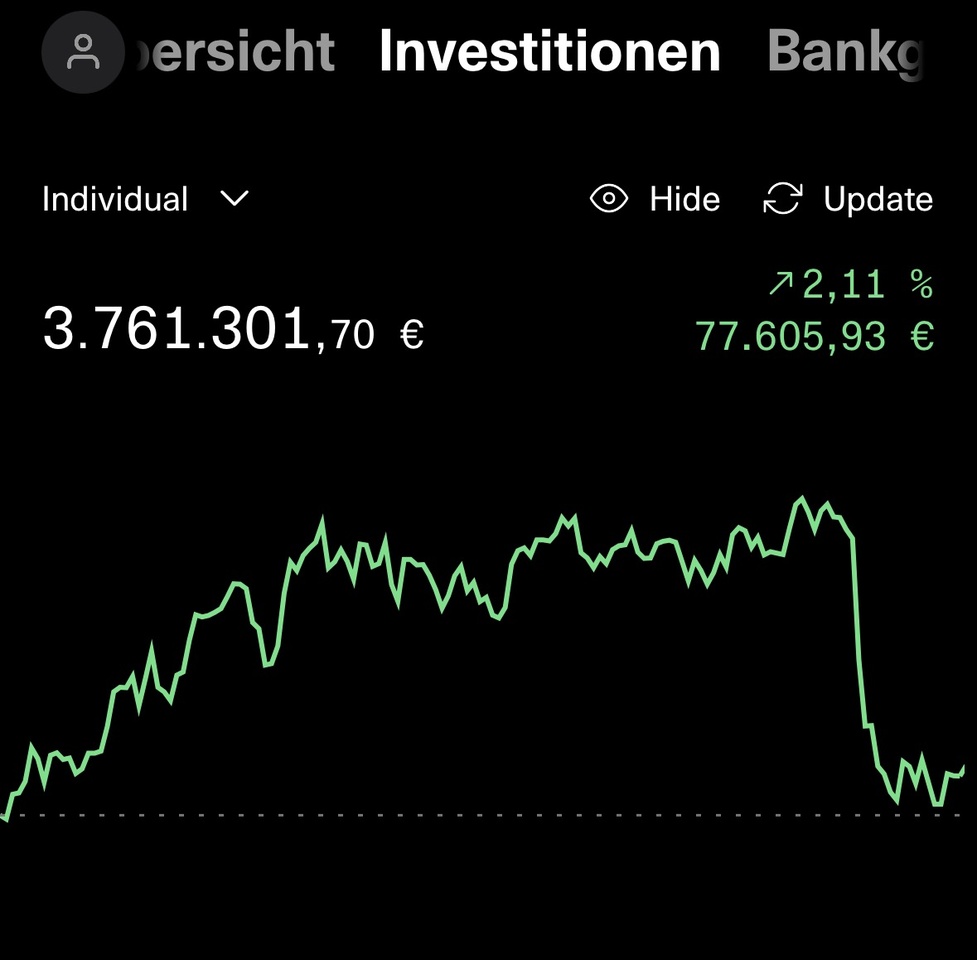
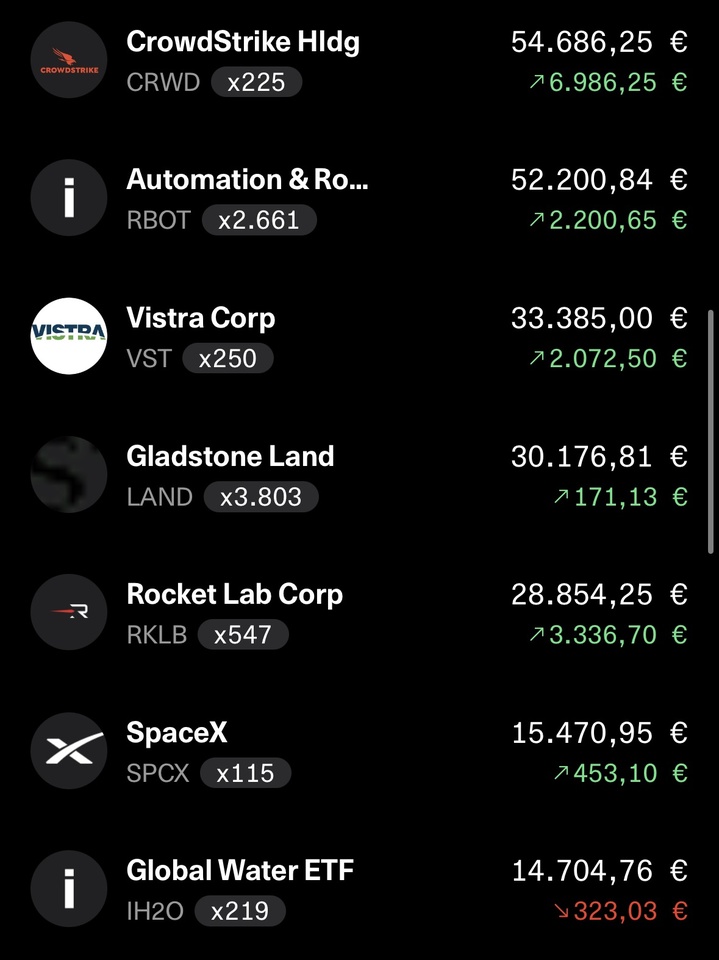
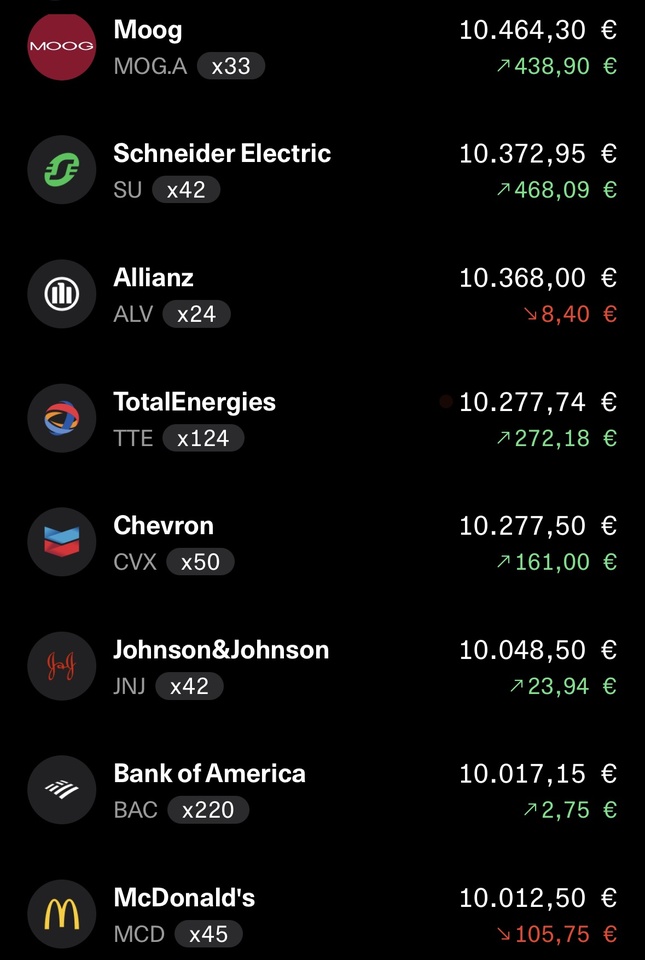
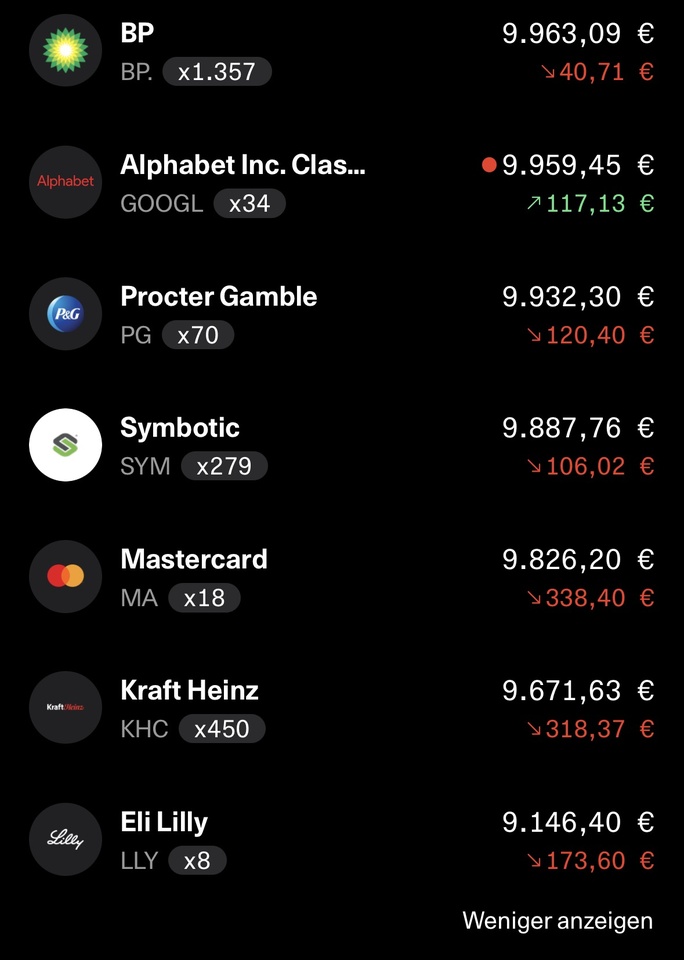
Sooooo… here you go—this is what the portfolio looks like right now. Core is the $GERD (+0,79 %) Plus $AINF (+1,38 %) and $RBOT (+1,21 %) and $IH2O (+0,96 %) .
$4GLD (+2,4 %) And $XEON (+0 %) are there to offset inflation and protect capital. $O (+0 %) , $MAIN (+0,33 %) and $LAND (+1,18 %) are the dividend-paying stocks that, as mentioned, cover vacations and the like.
The rest relates to banks, gas stations, AI storage, computing power, security, automation, rare earths, and healthcare.
We’re currently very confident, but we’re down just under 1.3% compared to the MSCI (excluding dividends); however, we believe things will turn around.
Tonight, we’re paying close attention to inflation data as well as quarterly earnings reports from $GOOGL (+0,76 %) as well as $MSFT (+1,43 %) .
I’m really looking forward to your comments, but I’m already used to quite a bit here after the last few days, so it’s all good.
Have a great Wednesday, and best regards ✌🏻.
+ 2
What happens to an industry where demand is skyrocketing but which suddenly can’t get any more money?
This question has been on everyone’s mind since yesterday. Elon Musk wrote on X that the credit markets had AI data center operators. Just a few days earlier, the Nebius CEO himself had admitted that key sources of capital had temporarily dried up.
1. The Statements
Context: Musk is a direct competitor to traditional Neoclouds, as he rents out GPU capacity himself—SpaceX could benefit from negative headlines.
2. Why a lack of capital affects the valuation:
Neoclouds build and buy first, but the money doesn’t come back for years.
This results in a simple chain:
1. Growth requires capital.
2. Capital becomes expensive or is no longer provided at all: CoreWeave bonds $CRWV (-2,61 %) maturing in 2031 yielded at times nearly 16%. At this price, projects are barely profitable, so this funding channel is largely closed.
3. Valuations factor in high growth: The market has priced in years of capacity expansion.
4. This growth cannot be delivered without capital: What isn’t financed won’t be built. Lower growth → lower stock prices. On top of that, companies are raising capital by issuing new shares at low prices, which dilutes the holdings of existing shareholders dilutes and creates further downward pressure.
5. Valuations are coming under pressure: Growth expectations are falling, while at the same time the interest rate used to discount future earnings is rising.
4. How are different types of financing affected?
Closed channels:
Open, but tighter and more expensive:
Outstanding:
5. Why isn’t a booming business getting funding?
Investors aren’t short on money. $GOOGL (+0,76 %), $AMZN (+3,46 %), $META (+1,8 %) and $ORCL (-1,01 %) have invested over $228 billion in bonds.
The reason lies in the lender’s logic:
Has this ever happened before?
The pattern is always the same: When the capital market closes for a capital-intensive industry, the balance sheet, not demand. In these examples, macro-driven freezes lasted weeks to months, while freezes affecting an entire industry lasted about one to three years.
6. Which Neoclouds are affected
The key factor is the business model:
7. Conclusion
Overall, Musk’s statement is exaggerated, but essentially correct: For companies that only sell GPU rentals and don’t have customers with high credit ratings, the credit market is currently closed.
However, there’s a contradiction in this situation: What isn’t financed won’t be built, and that further reduces supply further, while Musk himself speaks of exploding demand .
Companies that can finance their capacity are likely to benefit from this.
Customers who urgently need computing power will become more aware of this problem, which could potentially increase prepayments for contracts. In addition, customers could use their own creditworthiness as collateral for their AI computing power providers or become lenders themselves.
In my view, therefore, one question above all else will determine the future of the industry:
Who can secure financing to sustain these growth rates?
The quarterly results in November will provide answers; particular attention should be paid to the financing structure and prepayments.
Sources:
https://x.com/elonmusk/status/2114434646914068862
https://x.com/chamath/status/2114389987563381004
https://www.youtube.com/watch?v=ElxZFG9lfmQ
https://www.sec.gov/Archives/edgar/data/0001513845/000110465926117978/tm2628078d1_ex99-1.htm
https://www.cnbc.com/2026/10/14/coreweave-stock-bond-yields-ai-debt.html
https://www.advisorperspectives.com/articles/2026/10/21/surging-yields-biggest-debt-sale-delay
Last week's Neocloud crash has $CRWV (-2,61 %), $NBIS (-1,74 %) and $IREN (-3,25 %) sent it into a tailspin. What’s behind this, and what has actually changed for the future?
It all starts with the price of oil
Since the attacks on Iran, the price of oil has risen from ~$80 in August to over $106 per barrel. This is having a major impact on U.S. inflation:
The Fed raised interest rates on September 16 for the first time since 2023 raised interest ratesto 3.75–4.00%. The yield on 10-year U.S. Treasury bonds stood at over 5.2% at the end of September, the highest it has been since 2007. Added to this is a U.S. government that is sinking deeper and deeper into debt and must continually issue new bonds.
This is precisely where the problem with Neoclouds lies: The expansion of AI is largely financed by debt and competes for the same investors as the U.S. government. If a government bond yields over 5% with almost no risk, lenders will demand significantly more from a company that is still operating at a loss.
The trigger for the crash: CoreWeave’s bonds
On October 14, a chart went viral showing a CoreWeave bond worth $1.25 billion with a yield of just under 15% . It was issued in June at 9.625%. The credit default swap (CDS) is at a record high of 1,194.5 basis points; on October 6, it was still at 368.
According to standard calculations, this corresponds to a probability of default of over 60% within five years.
On the same day, Gartner added: By 2030, over 80% of Neocloud providers are expected to lose their independence. By then, AI data centers would generate at most $3.6 trillion in revenue, whereas $8.5 trillion would be needed.
Is this fear justified?
In CoreWeave’s case, partly yes. The higher market yield doesn’t affect the interest rate on existing bonds, but each new round of financing becomes more expensive, and CoreWeave’s growth depends on new loans. However, the 60% figure is a market price from a week of panic and not a forecast.
IREN and Nebius are in a different position
IREN has financed the Microsoft project $MSFT (+1,43 %) at ~6% with $3.6 billion. Microsoft accepted Horizon 1 in August, and revenue has been generated since then. Horizon 2 through 4 are scheduled to follow in the fourth quarter; contractually, there is a buffer until early Q2 2027.
Information is currently circulating on X that Microsoft $IREN (-3,25 %) is said to have provided incorrect network requirements, forcing the current Childress data centers to be have to be . Horizon 2 is reportedly delayed by ~45 days as a result; Horizon 1 will continue to operate and will continue to be paid for by Microsoft during the retrofit. Horizon 3 & 4 are not expected to be affected, as they will be completed directly with the correct network specifications. Thus, all four buildings are expected to generate revenue by the end of the year as planned. None of this has been officially confirmed.
In July, Nebius switched to a more capital-efficient model in which partners finance the data centers. In addition, advance payments from customers already amount to ~40–55% of the contract total, which alleviates a large portion of Neocloud’s financing risk. Added to this is the possibility of asset-backed financing, whereby the data centers themselves can be used as collateral for loans, thereby reducing interest rates. Nevertheless, the market treats the three companies—with their differing financing risks—as a single entity.
Demand points in the opposite direction
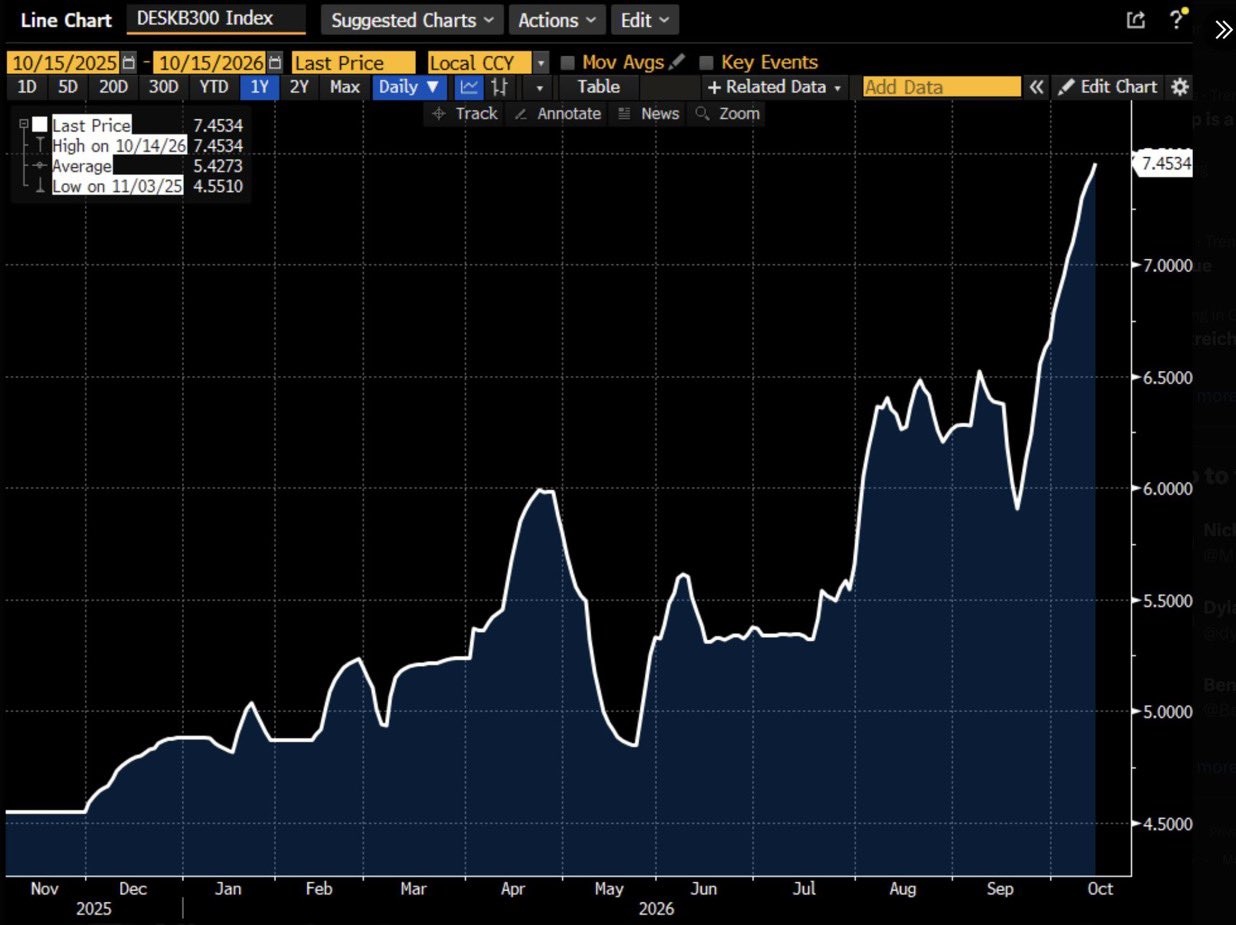
The GPU rental prices are rising: As of October 1, Nebius raised the price for B300 GPUs by 21% to $9.50 per hour—the second increase in three months.
The DESKB300 Rental Index, based on actual rental transactions at U.S. neoclouds, reached a record high in mid-October, driven in part by inference using open-source models. This does not bode well for concerns that GPUs are depreciating too quickly.
GPU rental prices could also be influenced by rising financing costs and thus increase—so overall, this is more of a neutral process.
Jensen Huang told Bloomberg in Berlin on October 16: “All of this is going to pass.” AI will transform every industry, he said, and we’re only at the beginning. According to Huang, CoreWeave’s cost of capital is actually falling. The bond market saw things differently this week.
Time is the real bottleneck
A data center isn’t built in a single quarter. Securing land and a power connection often takes years, and the construction itself is complex. Neocloud stocks are bets on where these companies will be in three to five years, but they’re traded as if they had to deliver every week.
Even with growing demand, not all of them will make it. Some will repeatedly dilute their shareholders, some will be acquired, and some will fail.
What matters is how management finances the expansion and whether it delivers on its promises.
Sharp sell-offs, months of stagnation, and rallies after which everyone suddenly turns bullish again are all part of this sector and should be clear to every investor. A five-year thesis is difficult to gauge based on year-to-date performance.
Overall, the market is pricing in a financing problem—one that is particularly acute for CoreWeave—and applying it to the entire sector. At the same time, demand for computing power shows no signs of weakness—quite the opposite.
High long-term interest rates are the main risk for all players
If government bond yields remain above 5% for the long term, every new round of financing will become more expensive, and that affects all three companies. CoreWeave, Nebius, and IREN are only at the beginning of their expansion and will need to raise many billions more for data centers and GPUs in the coming years. More expensive financing therefore puts direct pressure on future returns. Against this backdrop, the sell-off is understandable, even if demand itself remains intact.
Key events to watch include Nebius’s earnings report, expected on October 22; the Fed meeting in late October; and the acceptance of Horizon 2. Additionally, the course of the conflict (Iran & the U.S.) must be closely monitored, as it will significantly shape future developments.
Not investment advice
Sources:
https://www.bls.gov/news.release/cpi.nr0.htm
https://www.bls.gov/news.release/ppi.nr0.htm
https://www.sec.gov/Archives/edgar/data/0001878848/000187884826000052/iren-20260630.htm
$ORCL (-1,01 %)$APLD (-2,56 %)$CIFR (-6,93 %)$GOOGL (+0,76 %)$MSFT (+1,43 %)$AVGO (-0,2 %)$AMD (-1,01 %)$INTC (-2,12 %)$HUT (-4,11 %)