5J·

I closed my Enagás position with a 14% loss... and the position is still in the black. I'm reallocating to three beaten-down European stocks.

Source: Enagás ($ENG (+0,7 %)
)

  • Price: -14% since my purchase.
  • Dividends received on the position: ~50% of the investment → the overall trade is profitable.
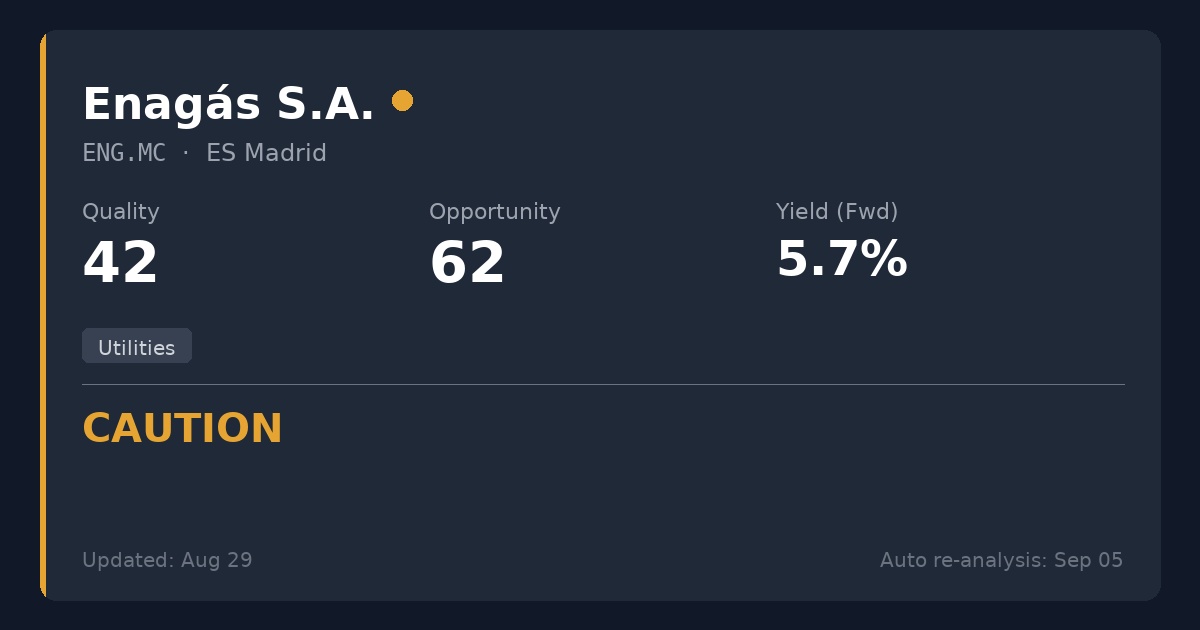
  • Why am I selling? The investment thesis has changed. The dividend was cut by 16.4% in 2024 to finance its shift to hydrogen, and the coverage ratio based on free cash flow is only 0.36x. My model rates it as 🟠 CAUTION (Quality 42 / Opportunity 62): fossil gas in structural decline + unproven bet.


Entry: 3 European stocks that the model rates as 🟢 OPTIMAL

  • Gecina ($GFC (-0,22 %)
    ) — Parisian REIT. Yield 7.86%, a discount of 49% off NAV. Quality 75 / Opportunity 85.
  • LEG Immobilien ($LEG (+0,81 %) )— German residential real estate. Yield 5.87%, a discount of 55% discount to NAV. Quality 75 / Opportunity 90.
  • Vinci ($DG (+0,18 %)
    ) — infrastructure. P/E 12.7, yield 4.23% + total shareholder yield of 10.76%. Quality 83 / Opportunity 85.


Same pattern across all three: non-monetary devaluations due to interest rates that are weighing on the price, while rent and cash flow remain solid. A temporary problem, not a broken business model.

To be honest: LEG took a hit in 2024 (-39.8%) as part of a strategic reset and has already rebounded (+10.2% in 2025), and Vinci’s toll road concessions expire between 2032 and 2036. They aren’t perfect—that’s why they’re cheap.


Do you see value in Gecina and LEG at these discounts, or is the European real estate sector still under pressure from interest rates?
attachment
1
7 Commentaires

image de profil
I see intererst rates under pressure and real estate thus not as an investment case stock wise. Some markets might become interesting in the near future like Germany in maybe 1 year but atm I´d not invest into them.
1
image de profil
@Keineui hi, it is very interesting your opinion. Why do you say is not a good investment?
image de profil
@investron can´t speak about Paris REIT. But German real estate market (residential) such as LEG is currently difficult. Valuations drop, interest rates uncertainty plus invesment demand for ESG all lead to a situation where I would not want to invest in these companies as such. Yes, fundamentals and dividend looks nice. But to me the market needs a correction. Affordability in rents is another topic. Although rents are rising the political pressure is enormous. Just look at Berlin. Just not confident enough this is a good investment.
Yes, housing is something that is in demand always. Notably this thesis can change in the new year, but atm I would keep caution.
image de profil
@Keineui thanks! It is much appreciated
1
image de profil
@investron Attached is a news item fresh off today's ticker:

Exit Pressure from Private Equity Could Drive Residential Transactions
The German residential investment market could receive additional momentum in the coming years from recapitalizations and secondary transactions. This became clear at the “JLL Living Talk.” According to the discussion, numerous closed-end private equity funds launched between 2016 and 2018 have so far realized less than half of their exits. Specifically, funds from the 2016 cohort have so far distributed less than 50% of their volume to investors; for the 2017 cohort, the figure is approximately 40%, and for the 2018 cohort, approximately 30%. The majority of the assets therefore remain in the funds, awaiting exit events. As a result, increasing selling pressure is building up in these funds. Instead of full sales, investors are currently increasingly exploring alternative capital measures. These include incorporating debt into the capital structure to “take some equity out,” said Johannes Gruss, Head of Real Estate Investment Banking DACH at JLL. Partial or full sales of portfolio holdings are also an alternative. “This will be the year of recapitalizations and secondary transactions,” Gruss added.

Summary: Private equity needs to exit the residential sector in the coming years, and thus pressure on prices is likely
1
image de profil
Thanks for the info @Keineui ! I've been thinking some time about it. It's true that a lot of the funds launched ~10 years ago (2016-2018) on cheap money are now reaching the end of their life and will have to sell.

Even so, I'm not sure that hits LEG negatively. Their AFFO payout is 11%, FCF coverage is 3.56x, and they already fixed the balance sheet with the 2024 dividend cut. I don't think they're a forced seller — if anything, they could buy cheap, since they can afford new debt at higher rates.

Most importantly: even if this delays the re-rating for a while, the dividend is covered on current numbers. And you know me... I'm here for the dividends.
Let me know if you think otherwise!
1
image de profil
Why not CIBUS real state instead of Leg ?
Participez à la conversation