
Infineon Technologies, Europe’s largest chipmaker based in Neubiberg near Munich, closed out fiscal year 2026 with a record quarter and announced a strong surge in growth for 2027. In the fourth quarter (July through September), revenue rose 13% from the previous quarter to €4.706 billion, while the segment profit margin climbed to 23.8%, exceeding analysts’ expectations. For the full year, Infineon generated €16.353 billion in revenue (+12%) and adjusted earnings per share of €1.73. For fiscal year 2027, the company plans to generate approximately €20 billion in revenue—representing more than 20% growth—and a segment profit margin in the mid-20s. Revenue from power supplies for AI data centers alone is expected to generate nearly €4 billion. The catch: Due to high capital expenditures of €3.0 to €3.5 billion, free cash flow—at around €1.8 billion—is significantly lower than analysts had expected. After hitting a record high in June, the stock had lost up to about 50% of its value and is now recovering strongly to around €51.80. Analysts’ average target price is around €86 to €89. From a technical analysis perspective, however, I don’t see a sustainable buy signal until the price rises above €54.
Key Points
- Q4 FY 2026: Revenue €4.706 billion (+13% quarter-over-quarter), segment profit margin 23.8% (consensus 23.3%)
- FY 2026: Revenue of €16.353 billion (+12%), adjusted earnings per share of €1.73, dividend expected to rise to €0.38
- Outlook for FY 2027: approximately €20 billion in revenue, margin in the mid-20s percent range, AI data centers at approximately €4 billion
- Weakness: Free cash flow in 2027 only around €1.8 billion (consensus around €2.26 billion) due to investments of €3.0 to €3.5 billion
- Analysts: Average price target around €86 to €89; Jefferies and JPMorgan confirm €96 following the earnings report
- Chart levels: Support at €47, buy signal above €54, targets at €69 and record high of €89.17, sell-off below €44.72 down to €38
What are the current key metrics for Infineon stock?
As of noon on November 10, 2026, the Infineon stock is trading at around €51.80, which is about 42% below its 52-week high of €88.83.
The previous day, it had already closed Xetra trading up 6.3% at €48.63; following the earnings report, it continued to rise. With approximately 1.3 billion shares, Infineon Technologies is valued at just over €68 billion, making it Europe’s most valuable chip company after ASML. According to Aktienfinder, the P/E ratio based on adjusted earnings stands at 29.5; for fiscal year 2027, it is projected to drop to 18.4. All prices are quoted in euros.
What news is currently driving Infineon’s stock?
Infineon stock is currently being driven primarily by the annual results announced on November 10, 2026: a record quarter, a revenue outlook of around €20 billion, and disappointing free cash flow.
Prior to that, the stock had plummeted by more than 8% during the AI sell-off following the U.S. midterm elections on November 5, 2026, falling to €44.72. The recovery began as early as November 9, 2026, with a daily gain of 6.3%; Infineon was the top performer on the DAX. My analysis of Siemens Energy Aktie —there, the expansion of power grids has triggered one of the most spectacular price rallies on the DAX.
What does Infineon’s management have to say about the annual results?
CEO Jochen Hanebeck sees Infineon entering the new fiscal year with sustained strong momentum following another record quarter and expects a significant increase in revenue and profitability for 2027.
This is driven by an ongoing cyclical recovery and strong demand in structural growth areas: data center power supply, the expansion and modernization of energy infrastructure, electromobility, and software-defined vehicles. Hanebeck also believes Infineon is exceptionally well-positioned in new fields such as robotics and edge AI, thanks to its portfolio, innovative strength, and manufacturing capabilities.
What went well: With revenue of €4.706 billion, the fourth quarter was the strongest in the company’s history; the segment operating margin jumped from 19.1% in the previous quarter to 23.8%, exceeding the consensus estimate of 23.3%. For the full year, Infineon achieved revenue of €16.353 billion, exactly meeting its raised target of approximately €16.3 billion. The key driver is power supply for AI data centers: While the target for 2026 was still over €1.6 billion, it is expected to reach nearly €4 billion in 2027—more than double the previous figure.
The catch: Adjusted earnings per share in the fourth quarter came in at €0.60, below the expected €0.64. Even more concerning is the cash flow outlook: Due to planned investments of €3.0 to €3.5 billion, free cash flow is expected to reach only around €1.8 billion in 2027, while analysts had anticipated around €2.26 billion. Adjusted free cash flow is projected at around €2.2 billion, compared to the expected €2.74 billion. Furthermore, the announced margin in the mid-20s percentage range is only roughly in line with the consensus of 24.9%.
Outlook: For the first quarter of 2027 (October through December), Infineon expects revenue of approximately €4.6 billion and a margin of about 23%. For the full year, revenue is expected to be around €20 billion, with an adjusted gross margin in the mid-to-high 40s, based on a euro-dollar exchange rate of 1.15. The Power Systems segment, which includes data centers, is expected to show the strongest growth, significantly above the Group average. For the Automotive segment, Infineon expects revenue growth in the mid-teens, and for Edge Systems, in the low teens. This does not include the sale of the NOR flash and F-RAM business to Winbond, which, according to Infineon, could generate up to €1 billion in additional free cash flow. The dividend is set to rise by €0.03 to €0.38 per share, bringing the total payout to approximately €494 million. The Annual General Meeting will vote on this in February 2027.
What does Infineon do—and how does the company make its money?
Infineon Technologies is Europe’s largest semiconductor manufacturer and a global leader in power semiconductors—chips that efficiently switch, convert, and control electricity—from electric cars and solar systems to AI data centers.
The company, headquartered in Neubiberg near Munich, employs approximately 58,100 people and generated revenue of €16.353 billion in fiscal year 2026 (ending in September). Since the fourth quarter, Infineon has been reporting under a new three-segment structure.
Automotive: The largest pillar of the business. Infineon supplies power semiconductors for electric drivetrains, as well as microcontrollers and sensors for driver assistance, braking, and steering. With the trend toward software-defined vehicles, the proportion of chips per car continues to rise. Just how much pressure the auto industry is under is illustrated by my analysis of Tesla Aktie – ironically, the electric-car pioneer is struggling with the very same price war that Infineon’s customers are also feeling.
Power Systems: Here, Infineon brings together power supplies for data centers, renewable energy, charging infrastructure, and industrial drives. At the heart of these solutions are chips made of silicon, silicon carbide (SiC), and gallium nitride (GaN), which reduce energy losses. Infineon aims to generate approximately €4 billion in revenue from power supplies for AI servers by 2027.
Edge Systems: Microcontrollers, sensors, security, and connectivity chips for industrial applications, home appliances, smartphones, and the Internet of Things. This business is benefiting particularly from the recovery of the chip cycle and new applications such as robotics and edge AI.
How Infineon Makes Money: Infineon develops and manufactures its chips primarily in its own facilities, including those in Villach, Dresden, and Kulim (Malaysia), and sells them to automakers, suppliers, server manufacturers, and industrial customers. Because its own factories have high fixed costs, margins rise disproportionately during a recovery—as evidenced by the jump from 19.1% to 23.8% in the fourth quarter.
Fundamental Analysis: Is the Infineon Stock Undervalued After the Plunge?
Fundamentally, Infineon stock, with an adjusted P/E ratio of 29.5, is currently more expensive than its ten-year average of 22.6; but based on earnings expectations for 2027, the P/E ratio drops to 18.4 according to Aktienfinder—and thus falls below the historical average.
Based on reported earnings, the P/E ratio stands at 40.2 (average: 34.8), the price-to-cash-flow ratio is 18.2 (average 13.9), and the price-to-sales ratio is 4.2 (average 3.1). So anyone buying today is paying a premium for past performance and betting that earnings in 2027 will grow by around 60% (adjusted) to 88% (reported), as expected by Aktienfinder.
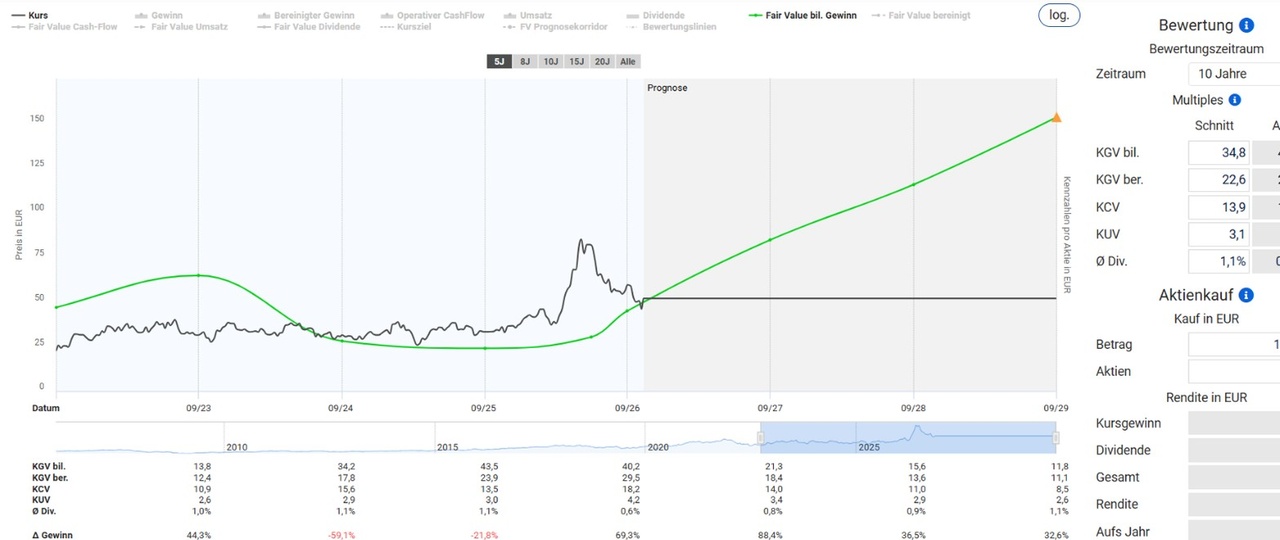
Fair Value: The chart shows the stock price over the past five years and the fair value based on earnings. After plummeting from nearly €89, the stock is now back near this fair value at around €51.80. If earnings rise as forecast, the fair value line will rise significantly in the coming years. Conversely, this means that if growth fails to materialize, there is little room for a decline.
Revenue and Margins: Infineon grew by 12% to €16.353 billion in fiscal year 2026, with segment earnings of €3.223 billion (margin of 19.7%). Momentum picked up significantly over the course of the year: Q3 generated €4.172 billion in revenue with a 19.1% margin, while Q4 already reached €4.706 billion with a 23.8% margin. For 2027, Infineon is forecasting approximately €20 billion in revenue and a margin in the mid-20s percentage range. Compared to 2026, this would represent an increase in profitability of about 5 percentage points.
Cash Flow and Investments: Free cash flow in 2026 was €993 million; adjusted for one-time items, it was €1.925 billion. For 2027, Infineon plans investments of €3.0 to €3.5 billion, primarily in new capacity for power semiconductors. As a result, free cash flow is expected to rise to only about €1.8 billion, or €2.2 billion on an adjusted basis—in each case, well below analysts’ expectations. The sale of the NOR flash and F-RAM business to Winbond could generate up to an additional €1 billion, but this is not yet included in the outlook.
Comparison with the Competition: Among the major European and U.S. suppliers of power and automotive chips—such as STMicroelectronics, NXP, and onsemi—Infineon is currently one of the few to forecast growth of more than 20% for the coming year. The reason is the AI data center: Every AI server requires significantly more power electronics than a traditional server, and Infineon is considered the market leader in this area. My analysis of Bloom Energy Aktie —it is precisely this demand that has triggered a surge in the stock price.
Infineon Stock Price Targets and Forecast for 2026
Analysts see an average price target of around €86 to €89 for Infineon stock; however, from a technical analysis perspective, I see a sustainable signal emerging only above €54—at which point targets would be €69 and, potentially, the record high of €89.17.
Jefferies and JPMorgan confirmed their price target of €96 immediately after the earnings report. My analysis of Palantir Aktie.
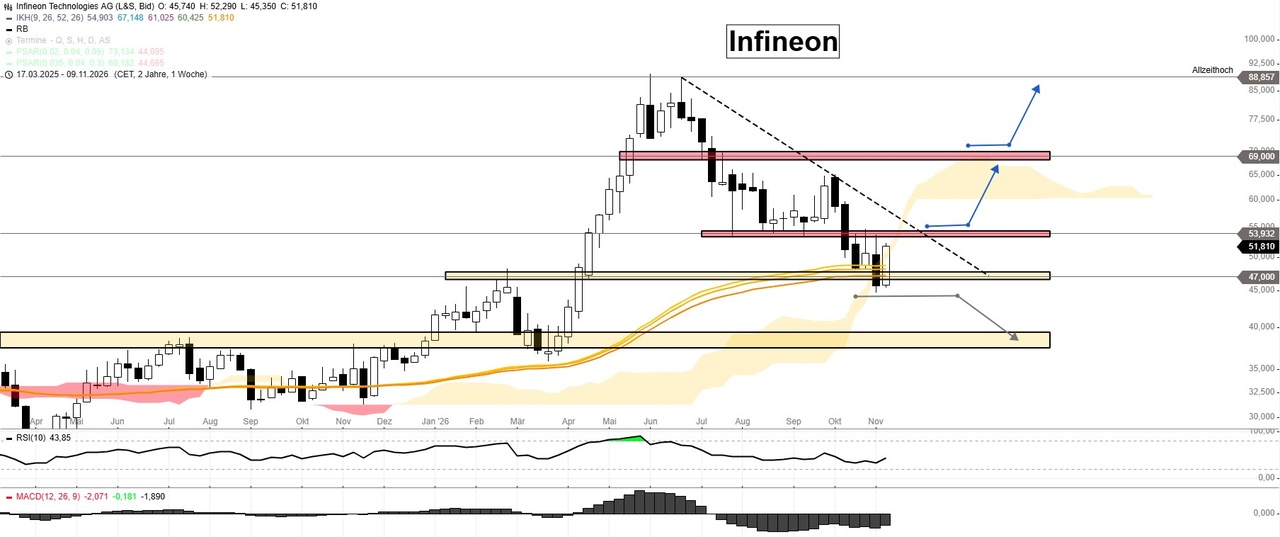
Key price levels:
- 52-week high: €88.83 (Xetra, June 2026); all-time high: €89.17 (Lang & Schwarz, June 2026)
- Current price: around €51.80 (Nov. 10, 2026, at noon; Xetra close on Nov. 9, 2026: €48.63)
- First resistance level and signal mark: €54 (red zone, €53.93)
- Second resistance level: €69 (red zone)
- Third resistance level: €89.17 (all-time high)
- First support level: €47 (yellow zone)
- Critical support level: €44.72 (previous week’s low)
- Target if broken: €38 (yellow support zone around €38 to €40)
Analysts’ price targets:
- Average price target: around €88.80 (finanzen.net, 10 price targets) or €86.08 (Investing.com, 24 analysts, range €50 to €124), as of November 10, 2026
- Jefferies: Buy, €96 (November 10, 2026, confirmed after earnings)
- JPMorgan: Overweight, €96 (November 10, 2026, confirmed after earnings)
- UBS: Neutral, €64 (last updated at the end of September 2026)
- Bernstein: Outperform, €102 (August 5, 2026, before the price drop)
- Goldman Sachs: Buy, €91 (August 7, 2026, before the price drop)
Chart Analysis:
Infineon’s weekly chart is really interesting. Following a steep rise in the spring, the stock hit an all-time high of €89.17 in June. Since then, it has been trending downward in several waves along a falling trend line, first breaking through the red zone at €69 and later also falling below the €54 mark. During last week’s AI-driven sell-off, the price temporarily slipped as low as €44.72. That’s exactly where something decisive happened: Support at €47, combined with the reported earnings, is now driving buyers back up. The weekly candle shows a strong counter-movement right up to the downward trend line. The RSI(10) is still in the neutral range at 43.85; the MACD is negative, but the downward momentum is noticeably easing.
A sustainable signal will only be confirmed above €54. Only then would the zone—which the stock broke through on the downside in October—be overcome, and the downtrend since June broken. At that point, a long position would make sense to me, with an initial target of €69. If this red zone is also breached, the record highs of €89.17 could even come back within reach. My personal scenario: Starting at €54, that would represent about 28% potential up to €69 and about 65% potential up to the record high—this is not investment advice.
A new weekly low below €44.72, on the other hand, would make another sell-off down to €38 likely. That’s where the broad yellow support zone lies, from which the stock began the year. Between €47 and €54, the situation remains a no-man’s-land for me: The earnings figures have given buyers a boost, but confirmation from the chart is still pending.
Opportunities and Risks of Infineon Stock
Opportunities:
- ✅ Record quarter: Revenue of €4.706 billion, margin of 23.8% above consensus
- ✅ Outlook for FY 2027: approximately €20 billion in revenue (more than +20%), margin in the mid-20s
- ✅ AI data centers: Revenue is expected to more than double to nearly €4 billion by 2027
- ✅ 2027e P/E ratio according to Aktienfinder is only 18.4 (10-year average: 22.6)
- ✅ Sale of Winbond could generate up to €1 billion in additional free cash flow
- ✅ A rise above €54 paves the way to €69 and the record high of €89.17
Risks:
- ⚠️ Free cash flow in 2027 only around €1.8 billion instead of the expected €2.26 billion
- ⚠️ Investments of €3.0 to €3.5 billion will weigh on cash flow
- ⚠️ Adjusted earnings per share in Q4 at €0.60, below consensus (€0.64)
- ⚠️ Heavy reliance on AI sentiment and the auto industry, competition from China
- ⚠️ Outlook hinges on a euro-dollar exchange rate of 1.15
- ⚠️ A break below €44.72 opens the way down to €38
Conclusion: Infineon Stock—20-Billion Target, Comeback, or Trap?
Infineon delivered with a record quarter and an outlook of around €20 billion in revenue, but the stock has yet to prove itself on the chart: For me, a sustainable buy signal only emerges once the price rises above €54.
Fundamentally, there’s a lot going for Infineon. The margin jumped to 23.8% in the fourth quarter, and the AI business—which supplies power solutions for data centers—is expected to more than double to nearly €4 billion by 2027, and with a P/E ratio of 18.4 based on 2027 earnings estimates, the stock is no longer expensive following its roughly 50% plunge. Major firms like Jefferies and JPMorgan see a target price of €96—nearly double the current price.
On the other hand, adjusted earnings per share are below expectations, free cash flow is significantly behind the consensus due to high investments, and the market has recently punished AI stocks mercilessly. From a technical perspective, the support level at €47 has brought buyers back in following the earnings report. However, a sustained upward signal will only emerge above €54, with targets at €69 and, potentially, the record highs of €89.17. Conversely, a new weekly low below €44.72 would make a further sell-off down to €38 likely.
Anyone who wants to understand why the AI hype surrounding chip stocks is swinging so wildly right now should definitely read my Nvidia Aktie Prognose —that’s where it will be decided whether the AI boom, on which Infineon also depends so heavily, will continue.
Sources
- Infineon Press Release: Infineon Closes FY 2026 with Record Quarter and Expects Strong Revenue Growth for FY 2027 (Nov. 10, 2026)
- Infineon press release including financial data for Q4 and FY 2026 (PDF, November 10, 2026)
- Infineon Statement: Q3 FY 2026 Earnings Call (PDF, August 5, 2026)
- Deutsche Börse: Infineon Technologies AG (Xetra)
- Prices: Xetra closing price Nov. 9, 2026: €48.625 (+6.27%), 52-week high: €88.83 / low: €31.27 (Alpha Vantage daily and weekly prices, Investing.com); Price as of noon on Nov. 10, 2026: Lang & Schwarz €51.81 (Stock3), Aktienfinder €51.88
- dpa-AFX (November 10, 2026, 7:36 a.m.) and Dow Jones Newswires (November 10, 2026, 7:39 a.m.): Infineon earnings, consensus, and outlook
- dpa-AFX Analysts via onvista and boerse.de (November 10, 2026): JPMorgan Overweight €96, Jefferies Buy €96; finanzen.net price targets (average €88.80, as of November 10, 2026); Investing.com (average €86.08, 24 analysts, November 10, 2026); finanzen.net: UBS Neutral at €64; dpa-AFX Analyser via finanzen.net (August 5, 2026, Bernstein; August 7, 2026, Goldman Sachs): Bernstein Outperform at €102, Goldman Sachs Buy at €91
- MarketScreener: Infineon financial calendar (Q1 FY 2027 expected February 3, 2027), as of November 10, 2026
- Google Trends, Google Search Suggestions, Google Ads Keyword Planner (Germany), and Google Search Console, as of November 10, 2026
- Stock3: Weekly chart for Infineon Technologies AG (Lang & Schwarz), as of November 10, 2026
- Aktienfinder: Fair Value and Multiples for Infineon Technologies, as of November 10, 2026
This is not investment advice—all information is provided solely for financial education purposes.
What are your current thoughts on $IFX (-2,49 %)?