2Sem.·

🇹🇭 Pension Fund: Basic Plan or Savings Plan—Which Is More Worth It?

attachment

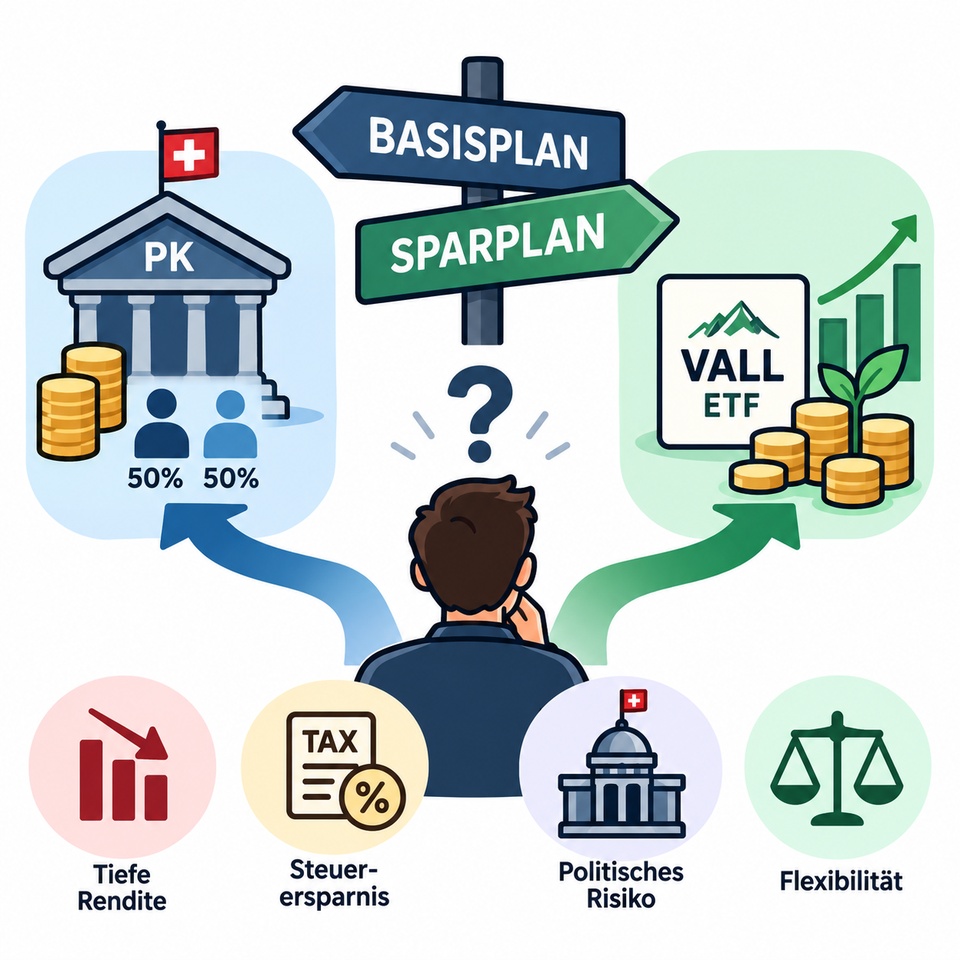
In Switzerland, many employers offer a choice of different pension savings plans. The contribution rates and the split between employer and employee vary depending on the pension fund and the employer.


In the basic plan, for example, the employer and employee split the contributions 50:50. In a savings plan, the employee voluntarily contributes more.


💰 The advantage: Higher pension fund contributions reduce taxable income and result in tax savings.


📈 The disadvantage: Pension funds often generate comparatively low returns. In the long term, therefore, investing independently in ETFs may be more worthwhile despite the lost tax savings. Last but not least, there is also a political risk, as future political reforms could change the framework conditions for pension funds and thus retirement planning.


🎯 My decision: I’ve opted for the basic plan and am now investing the saved contribution myself in the $VALU (-0,37 %)
ETF. I hope this will yield a higher return in the long run.


💬 How do you handle this? Do you make additional pension contributions for tax optimization, or do you prefer to invest in ETFs on your own?


#Schweiz
#Pensionskasse
#BVG
#Altersvorsorge
#ETF
#VALL
#Investieren
#Steueroptimierung
#Vermögensaufbau

22.10
302,89 CHF
5
7 Commentaires

image de profil
Basically, you should never make an investment just for tax reasons, since that should be more of a nice bonus than the main reason.
It’s impossible to make a blanket statement about whether a pension fund or personal assets are better, because so much depends on your personal circumstances, age, marital status, the quality of the fund, and whether you’d prefer to receive a pension later on or get the money all at once. In the end, there’s no one-size-fits-all solution—it simply has to be a good fit for the individual investor.
When it comes to annual investing, however, it makes sense to prioritize Pillar 3a above all else—even ahead of personal savings or a pension fund—and ideally set up six different Pillar 3a accounts by the time you retire, so you can withdraw the money later in a staggered manner without any stress.
‱
6
‱
image de profil
It really depends on the pension plan... With my pension plan—where my employer contributes more than double the statutory limits and which also generally yields a good return—a higher contribution definitely makes sense. You just have to make sure you don’t absolutely need that money for day-to-day expenses. For me, the long-term effect of compound interest, combined with the tax benefits, outweighs the initial investment.
But that’s really just nitpicking and fine-tuning at a high level
 As a Swiss citizen, you can certainly be more than happy with that. And on another note: Please never forget the 3a account. Even before you consider any pension fund!
‱
3
‱
With a pension plan like that, it's a whole different story. You probably have a higher interest rate than 1.25%, too. Good for you, of course :) I've had a better one than my current one, too.
‱‱
image de profil
First, I use the 3a for tax optimization, then I invest on my own. If I ever get a bigger bonus and the 3a limit is maxed out, I’ll also invest a portion in the pension fund.
‱
2
‱
I always start with 3a, but not just to save on taxes. There are plenty of investment options for that, after all. So it’s about much more than just saving on taxes. Next for me is the fourth pillar: stocks. There, I can invest in a much more personalized way. I’ve never made additional contributions to my pension fund—my current plan pays 1.25%. So it’s not really of interest to me...
‱
2
‱
image de profil
Thanks for the comments. 3a is, of course, a must. :) Definitely Viac or Finpension. I'll write a post about that, too. :)
‱
1
‱
image de profil
For me, as a cross-border commuter, there is another direct insurance plan that works in a similar way.
‱
1
‱
Participez Ă  la conversation