

It’s great to have you back at the Wintergarten! Coffee’s ready. Today we’re taking a look at a company that makes money off uninvited guests. Don’t worry: we’re not talking about your in-laws or the neighbor with the leaf blower—we’re talking about pests.
Rentokil Initial $RTO (+8,66 %) is one of the big names in pest control and hygiene. It’s actually a wonderfully unspectacular business: after all, restaurants, food processing facilities, and warehouses can’t just sit out a pest infestation until the next economic upturn.
Nevertheless, the stock has been anything but boring lately. After significant problems surrounding its North American business, there is now new hope. Is this enough for a sustainable recovery—or was the fly swatter just briefly brought out to combat the downward trend?
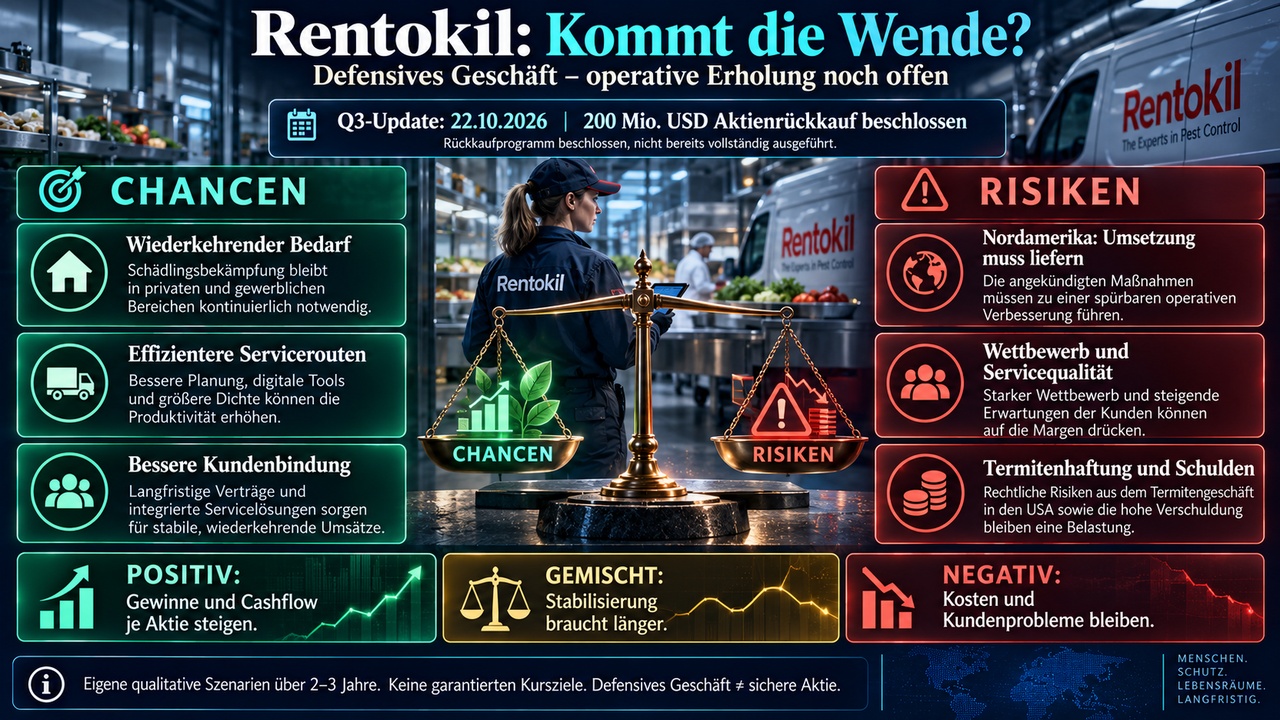
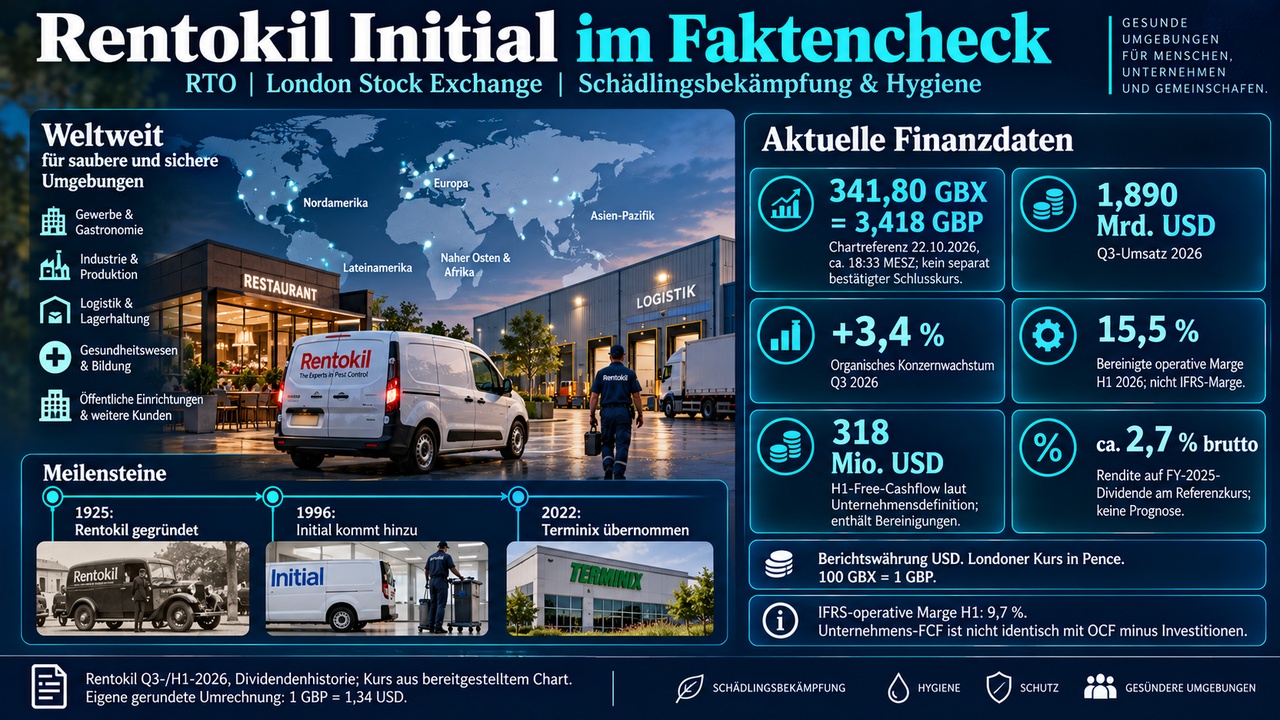
On **October 22, 2026**, Rentokil reported **$1.890 billion in revenue** for Q3, representing a **+4.4%** increase, with organic growth of **+3.4%**. North American Pest Control Services grew organically by **2.4%**.
The earnings outlook remains in line with market expectations; in addition, **$200 million in share buybacks** were approved.
With its recurring, relatively recession-proof business, Rentokil can generally serve as a defensive anchor in a portfolio—especially in turbulent times.
That’s one of the reasons why I think we should talk about this stock sometime.
**As of: October 22, 2026.** Calculation basis: 341.80 pence or 3.418 GBP, recorded at approximately 6:33 p.m. CEST; no separately confirmed closing price.
## 1. Business Model – What Does Rentokil Actually Do?
Rentokil was founded in 1925. The Initial brand was added in 1996 through the acquisition of BET; this was followed in 2022 by the major U.S. pest control company Terminix.
Today, the company focuses primarily on pest control as well as hygiene and restroom services. [1]
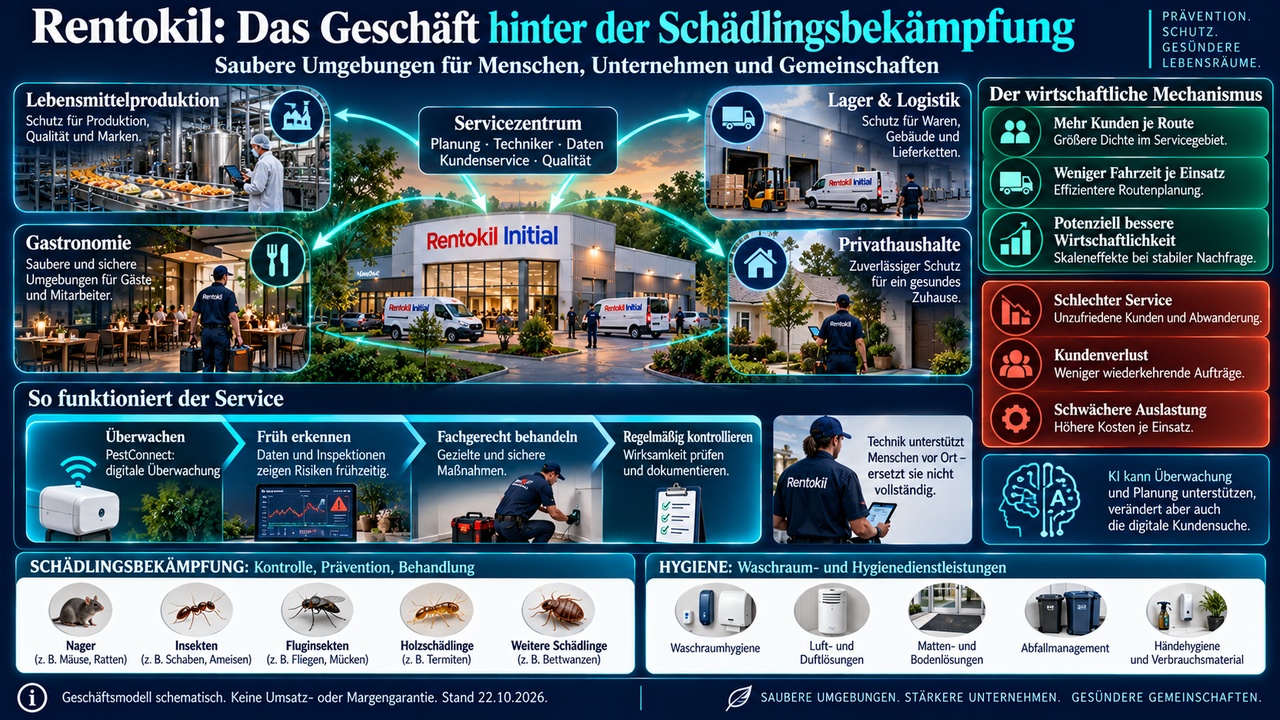
Revenue is generated through regular inspections and services, supplemented by one-time visits.
The appeal lies in recurring demand: Unfortunately, a mouse that’s been exterminated once doesn’t sign a lifetime cease-and-desist agreement.
The model is more defensive than many cyclical consumer businesses. However, it remains a labor- and service-intensive business—not a software license with automatically increasing margins.
## 2. Market Position & Moat – Size Helps, Good Service Makes the Difference
Brand awareness, expertise, and a dense network of branches are advantages. Many customers on a compact route mean less travel time and better utilization. Corporate customers also value documented inspections and reliable processes.
The moat, therefore, does not consist of a single patent, but rather of local presence, trust, and sound execution.
That is precisely where the weak spot lies: A big name offers no protection when appointments are canceled or customers are dissatisfied. The nearest regional provider is often not far away.
My verdict: a solid core business with economies of scale, but not an unassailable monopoly.
## 3. Core Quality Formula – Revenue Growth Plus Operating Margin
For H1 2026, on a reported basis: 6.7% revenue growth plus a 9.7% operating margin = **16.4 points**.
With currency-adjusted growth of 4.5% and an adjusted margin of 15.5%, the figure would be **20.0 points**—a different basis, but not an identical result. [2]
This range illustrates why I don’t simply pick the most appealing metric.
Rentokil is making money, but it still has to prove that the operational improvement, after accounting for actual costs, actually benefits shareholders. Right now, this is more of a recovery story than a flawless quality growth stock.
## 4. Cash Flow Quality Formula – Money Is Coming In, But Not All of It Is Free
H1 2026: operating cash flow of $427 million; capital expenditures and intangible investments totaling $90 million. Simple FCF: **$337 million**. After $94 million in lease payments, **$243 million** remains.
The company’s definition reaches **$318 million**, in part by adding $70 million in one-time payments. [2]
Cash generation is a plus. Nevertheless, I wouldn’t permanently ignore recurring “special costs.” And proceeds from sales are not proof of better operating profitability: a sold business no longer generates recurring profits afterward.
5. Dividend Filter – A Nice Bonus, Not a High-Dividend Machine
For 2025, a total of **12.39 U.S. cents per share** was distributed.
At the reference price, this corresponds to to **approximately 2.7% gross**.
The dividend is typically paid twice a year. Due to the switch to U.S. dollars, historical pence amounts are not directly comparable without conversion. [3]
For me, the dividend is a supplement to the potential recovery, not the main reason for buying. Anyone looking for a high current yield won’t automatically be satisfied here. The key factor remains that dividends, debt reduction, and necessary investments are in balance.
## 6. P/E Ratio – Has Become More Attractive, but Not Necessarily Cheap
The historical figures provided by various sources are not consistent:
The current market data query lists approximately 24.
Different earnings bases cannot simply be equated. [4]
If we use the estimated EPS of 0.28 USD for 2026, this results in a P/E ratio of approximately **16.4**. This is a tentative consensus estimate, not a confirmed IFRS forecast.
My take: The stock no longer requires perfect performance. However, it certainly requires earnings to stabilize. A lower multiple alone does not fix a weak service business.
## 7. EV/EBITDA – A Useful Second Look
Based on operating cash flow from continuing operations of **$872 million for 2025**, the current market capitalization yields a C/CF ratio of approximately **13.2**.
This is intentionally a FY 2025 calculation and not a claimed current 12-month figure. [5]
Important: The KCV does not yet fully account for investments and leasing requirements.
Therefore, when assessing actual distributable cash, it is more important to look at the remaining cash flow than at this single metric.
## 8. Price-to-Sales Ratio (PSR) – Revenue Alone Is Not the Solution
With **$6.908 billion in revenue from continuing operations for 2025**, the P/S ratio is approximately **1.7**. The currency and basis of calculation are the same as for the other calculations. [5]
This does not seem excessive. Nevertheless, the decisive factor is how much of this revenue remains. A euro of revenue generated through strong customer loyalty and short delivery routes is economically more valuable than one acquired through expensive new-customer advertising and corrective measures.
## 9. KBV – Book Value Is No Protection Against Portfolio Decline
With approximately **5.5 billion USD in equity as of June 30, 2026**, the P/B ratio comes to approximately **2.1**. [2]
For a company that has acquired other businesses, this is not a reliable liquidation value:
Goodwill and acquired customer relationships are not freely available cash. The value of such assets depends on whether the acquired businesses are actually generating solid profits.
Therefore, “close to book value” would not, in my view, be a standalone reason to buy here.
## 10. Current Figures & Catalysts – Today’s Update Matters
On **October 22, 2026**, Rentokil reported **$1.890 billion in revenue** for Q3, representing **+4.4%** year-over-year growth and **+3.4%** organic growth. North American Pest Control Services grew organically by **2.4%**.
The earnings outlook remains in line with market expectations; in addition, **$200 million in share buybacks** were approved. [6]
This is a positive sign, but not a complete all-clear. Share buybacks can support earnings per share, but they are no substitute for healthy business performance.
My interpretation: The market once again sees a more credible chance of stabilization.
## 11. Competition & Risks – The Biggest Rivals Aren’t Just in the Mouse Trap
Key competitors include Rollins with Orkin, as well as numerous regional providers and well-capitalized acquisition platforms. Rentokil must not only win customers but also retain them with reliable service.
Three risks remain central to me: the implementation of the North American restructuring,
debt, and legacy issues from the termite control business.
The corresponding total provision amounted to **$392 million** at the end of June; the figure of **$201 million** reported in the filing, however, refers to the additional allocation in 2025, not the total balance at that time. The previous target of a 20% North American margin for 2027 has been withdrawn. [2]
AI is unlikely to replace on-site technicians. However, it can influence which company a customer actually finds when searching for services. This is a sales risk, not evidence of the end of pest control.
## 12. Future Outlook – Three Possible Paths
**Positive:** Customer retention and new customer acquisition improve, processes become more efficient, and cash flow per share increases. Then, in addition to profits, the valuation can also recover.
**Mixed:** Business stabilizes, but the improvement takes longer. Dividends and small gains help, while a major stock price rally fails to materialize.
**Negative:** Customer issues, competition, and additional pressures erode the cost savings. In that case, the low valuation would not be an opportunity but a fair warning.
These are my own qualitative scenarios for the next two to three years—not probabilities or calculated price targets. “Defensive business” and “safe stock” are two different things.
## 13. Technical Analysis – Daily Chart Is Bullish, Weekly Chart Remains Cautious
For me, the weekly chart is the more important guide.
At **341.80 pence**, the price is still below the 50-week EMA of **395 pence** and the 200-week EMA of **429 pence**.
The weekly RSI at **40.7** shows a recovery, but not yet a strong long-term trend structure.
On the daily chart, it more positive:
The 50-day EMA at **331.6 pence** has been recaptured. However, the 200-day EMA is still at **391.1 pence**, and the daily RSI stands at **72.2** following the jump.
My take: a recovery momentum worth taking seriously, but not yet a fully confirmed long-term reversal. After a jump like this, there’s no need to rush in and buy right away.
14. Bargain Hunter’s List – where does it get interesting for me?
I’d first watch to see if a pullback toward **320–330 pence** is supported. A higher low followed by a recovery would be more convincing than a single green day.
I see further technical confirmation above **350–355 pence**, and then around **365–370 pence**. Such a breakout improves the chart but doesn’t automatically make the valuation more attractive.
Below **300 pence**—and at the latest upon a sustained break below the **293–295 pence** support zone—the attempt to find a bottom would need to be reassessed. These are levels to watch, not guaranteed stop-loss triggers.
For a long-term hold decision, I would primarily examine the following: Are customers staying, are service and cash flow improving, and are financial burdens becoming more manageable? A broken business thesis is more important than a temporary red candle.
## 15. My Personal Conclusion
To me, Rentokil is **an interesting turnaround stock with a defensive core business—but not yet a no-brainer quality buy**.
The company serves a lasting need, makes money, and has areas for improvement. On the other hand, there are operational challenges and a recovery in North America that hasn’t yet been convincingly completed.
For patient, risk-tolerant investors, a small, staggered entry into the stock could make sense. However, I wouldn’t blindly chase today’s price jump; instead, I’d prefer to see the stock stabilize or pull back a bit.
**In short: add it to your close watch list—yes. Buy the full position immediately after a strong day—not for me.**
Pest control experts can eliminate pests. But they still have to clean up the messes within their own company themselves.
What do you think of Rentokil: an exciting recovery candidate, or too many problems swept under the rug?
Greetings from Denmark
Raketentoni
General information and personal assessment; not individual investment advice.
## Sources and Calculation Basis
[1] [Rentokil Initial: Company History](https://www.rentokil-initial.com/about-us/our-story-so-far.aspx).
[2] [Rentokil Initial: 2026 Half-Year Report](https://www.rentokil-initial.com/~/media/Files/R/Rentokil/documents/2026-interim-result-statement.pdf), specifically IFRS/adjusted results, cash flow reconciliation, equity, and provisions.
[3] [Rentokil Initial: Dividends and History](https://www.rentokil-initial.com/investors/shareholder-centre/dividends.aspx).
[4] [StockAnalysis: London Original Share](https://stockanalysis.com/quote/lon/RTO/) as well as the InvestingPro Report dated October 19, 2026. Its estimated EPS is expressly used only as a conditional assumption. Do not treat different earnings bases and time periods as exactly comparable.
[5] [Rentokil Initial: 2025 Annual Results](https://www.rentokil-initial.com/~/media/Files/R/Rentokil/documents/2025-prelims-statement.pdf), continuing operations.
[6] [Rentokil Initial: Q3 Trading Update from October 22, 2026](https://www.rentokil-initial.com/~/media/Files/R/Rentokil/documents/2026-q3-trading-update-statement.pdf).
FX cross-check: [GBP/USD on the date of retrieval](https://alanchand.com/en/exchange-rates/gbp-usd), 1.3407; calculations intentionally rounded to 1.34. Market capitalization based on 3.418 GBP and approximately 2.516 billion shares: 8.60 billion GBP / 11.52 billion USD. Estimated P/E ratio: 3.418 × 1.34 / 0.28. KCV: 11.52 / 0.872. KUV: 11.52 / 6.908. KBV: 11.52 / approx. 5.516. No future buybacks anticipated.
and, of course, all the others :)


