4H·

Q3 VW Sales Figures — The Decline Is Accelerating

Because Volkswagen $VOW (-0,22 %) and Porsche $P911 (+1,16 %)
$PAH3 (+0,06 %) are among my biggest investments, here’s an update on the Q3 sales figures released today...


...and they really don’t look good:


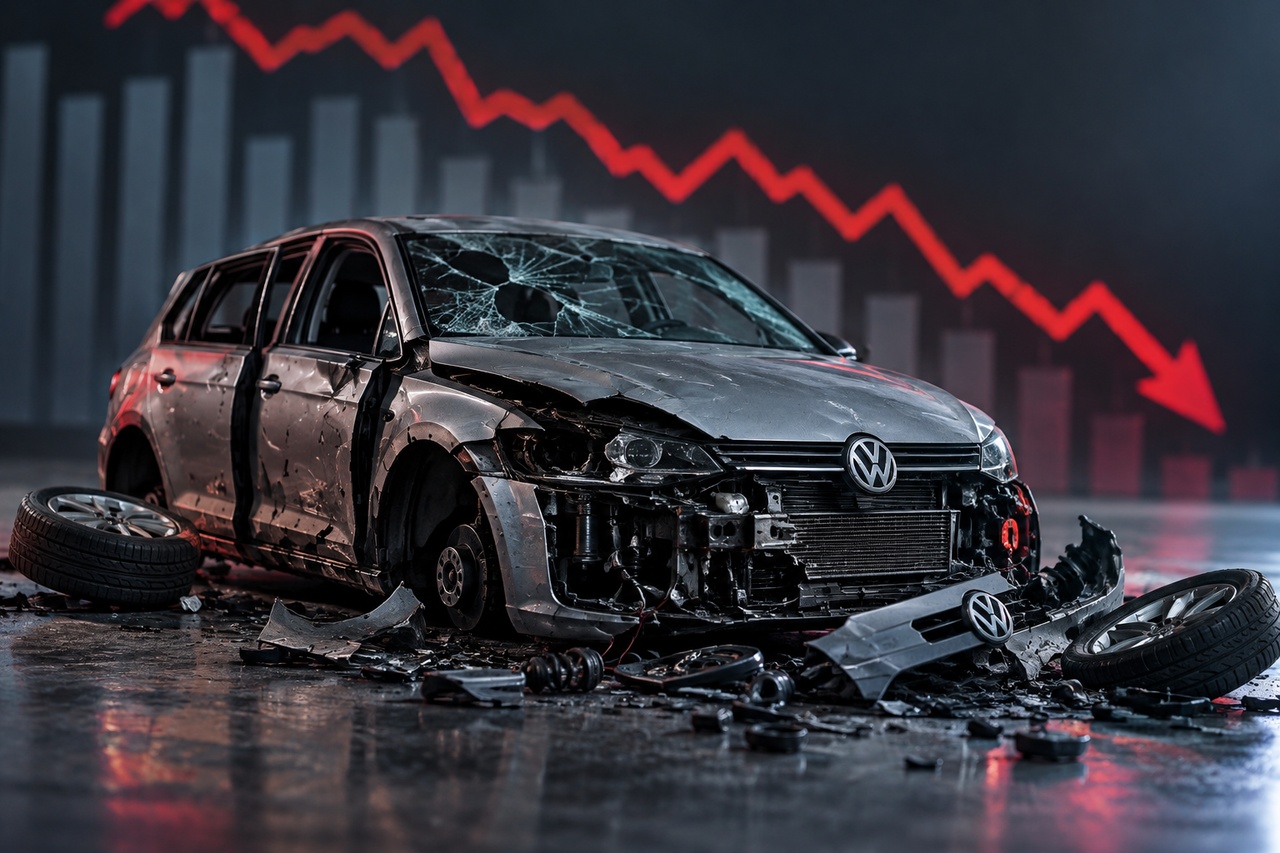
Global Global sales fell by 14.3% in the third quarter compared to Q3/25. That corresponds to about 315,000 fewer vehicles delivered. Once again, the main source of the crisis is CChina, with a decline of 38.5%. With the exception of Central and Eastern Europe, all global regions posted declines in the third quarter.


Particularly concerning is that the downward trend has accelerated. Here’s how the percentage change compares to the same quarter of the previous year (Q1, Q2, Q3; the worst quarter in each period is in bold):


🇪🇺 Western Europe: +4.2%, +1.8%, −2.8%

🌍 Central and Eastern Europe: +7.6%, +6.7%, +1.4%

🇺🇸 North America:
−13.3%, +7.7%, −5.8%

🌎 South America: +7.0%, +9.4%, −2.4%

🇨🇳 China: −14.8%, −36.6%, −38.5%

🌏 Rest of Asia/Pacific: −8.0%, −7.2%, −12.4%

🌍 Middle East/Africa: −5.3%, −1.9%, −10.0%


Total: −4.0%, −8.6%, −14.3%


The problems now affect virtually the entire group and are intensifying as the year progresses. So where do the problems lie?


🇨🇳 China: A toxic mix of consumer reluctance, an extremely competitive market, and the rapid rise of local manufacturers. When it comes to software, development speed, and, in some cases, price, Chinese brands are putting VW under enormous competitive pressure. A small glimmer of hope: VW reports that pure BEV deliveries in China rose by 30% in Q3? When measured against the total figures, however, this is likely completely negligible... unfortunately.


🇺🇸 U.S.: Tariffs and a more challenging market environment are weighing on business. Sales in North America fell by 5.8% in the third quarter. There’s likely no solution in sight here for the foreseeable future...


🇪🇺 Europe: Things are getting increasingly uncomfortable here as well. Chinese manufacturers are pushing into the market and putting pressure on VW, especially in the affordable electric car segment. While high gas prices are accelerating demand for electric cars, for VW this is both a blessing and a curse. Currently, capacity is insufficient to meet the demand for affordable electric models (e.g., the ID Polo), and margins in this segment aren’t high enough either.


The proposed plant closures in Germany suddenly no longer seem like a mere threat to me but are almost a necessity. Across the group, the plants are likely not operating at full capacity at the moment (especially in China). In the long term, production will likely have to be relocated. In Germany, only the luxury models will ultimately remain.


In any case, the sales figures are abysmal. There’s no sugarcoating it. Since Q3 was already largely over at the time the forecast was lowered, that should already be factored in. But I’m wondering about Q4. To meet the new forecast, Q4 has to be better than Q3; otherwise, they won’t even meet the new forecast. Or is the old “salami tactic” coming into play again here?? 🤔


But to end on a positive note:


The new entry-level electric models are apparently a hit 👍🏼

For the Electric Urban Car Family—which includes the VW ID. Polo, VW ID. Cross, Škoda Epiq, and CUPRA Raval—the group has now reported just under 150,000 orders. That’s a pretty impressive start, especially since deliveries haven’t even begun for all models yet.

The shared technical platform and production in Spain are expected to enable economies of scale. And I also see potential in the new ID. Tiguan (as far as I know, pre-orders start tomorrow?). They’ve done a lot right there (except for the charging speed)...


With that in mind, I really hope that VW finally gets its act together and stands up to the state of Lower Saxony and the IG Metall union once and for all. When I hear that they’re asking for another 5% pay raise here… It’s crazy.
attachment
6
10 Commentaires

image de profil
The AI VW's front end failed twice right after hearing this news...
•
8
•
image de profil
@Keineui You're right! :D I've already identified a potential cost savings! In the future, we'll only install one front panel per car. I'll pass this along right away 😉
•
4
•
To be honest, I don't get it either. If the company is doing so badly, I can't just squeeze even more out of it. Everyone has to do their part, including management. But asking for more just isn't possible—at least not right now. It's completely out of touch with reality...🙈
•
1
•
image de profil
@Johannes12345 I see it in a more nuanced way:

First of all, VW has consistently turned a profit in recent years:
• 2025: Operating income: €8.87 billion | Net income (after taxes): €6.67 billion
• 2024: Operating income: €19.06 billion | Net income (after taxes): €10.72 billion
• 2023: Operating profit: €20.90 billion | Net income (after taxes): €16.01 billion
• 2022: Operating profit: €22.50 billion (excluding special items) / approx. €15.8 billion
• 2021: Operating profit: €20.00 billion (excluding special items) / approx. €15.4 billion
• 2020: Operating profit: €8.91 billion | Net income (after taxes): €8.33 billion (COVID-19 year)
• 2019: Operating profit: €15.01 billion | Net income (after taxes): €13.35 billion
• 2018: Operating profit: €12.27 billion | Net income (after taxes): €11.83 billion
• 2017: Operating profit: €10.43 billion | Net income (after taxes): €11.35 billion
• 2016: Operating profit: €3.80 billion | Net income (after taxes): €5.14 billion

As an employee, I naturally want to share in my company’s profits in addition to my salary—I think that’s normal. At the same time, I’d always want to see compensation for inflation. Now, I don’t recall when the last pay raise was or who this demand is for. But in 2022 and 2025, the collective bargaining agreement included a pay freeze. Was that the case for management, too? But I don’t think it’s a completely unreasonable demand that salaries should rise, and in a situation like VW’s right now, it’s not outlandish either. That should also be kept separate from job cuts. Another question: What would you think if your employer offered you a -10% pay cut but still ended up making billions?
•
1
•
@Keineui Basically, I agree with you there. It goes without saying to me that salaries should rise when the company is profitable and that those increases should be distributed fairly. I’m not 100% invested in VW right now, but when you hear that tens of thousands of jobs are being cut and sales figures have been declining for years, there are, in my opinion, more appropriate times to demand pay raises.
That goes for management, too.
As for employers: Of course, it’s not really a 10% cut—inflation obviously erodes salaries in the end, but that’s just how it is during these phases. For decades, the industry was doing well, and above-average salaries were paid for relatively simple work. In my opinion, it was only a matter of time before this couldn’t continue if the economy wasn’t performing as well anymore.
•
2
•
image de profil
@Keineui In principle, I do agree with you that employees should share in the company’s success, but in this case, I disagree with you.

In the past, it was certainly true that VW employees were rewarded—whether through large one-time payments, the 34/37-hour workweek, or absurdly high salaries. Where else are there companies where virtually unskilled assembly-line workers can earn an annual salary of 80k+ and clerical staff can earn 90k?

That worked as long as VW was doing well. But over the past two years, the situation has fundamentally changed. Now, one can argue about who and what the causes are and were, but that doesn’t matter right now. The fact is that production costs in Germany are at least twice as high as they should be. In Germany, the all-in cost per employee-hour in production is 60 euros; in Hungary, it’s 15–20 euros; and in China, it’s significantly less still.

To be able to produce in a way that’s competitive with the market, costs simply have to come down! Otherwise, VW won’t be able to survive in the long run (at least in Germany). VW has, after all, given its employees a choice: either cut costs (wage cuts and everything that goes with them) or the plants will simply be closed. At the end of the day, this isn’t exactly a social project...

As an employee, I know how I’d decide. Anyone who feels they’re being treated unfairly is free to apply for jobs on the open market. Spoiler: they’re in for a rude awakening...
•
2
•
image de profil
The sales figures highlight the structural problem: VW is looking more and more like a dead horse that people are trying in vain to ride. Anyone who continues to cross-subsidize unprofitable sales in China from Europe is wasting valuable resources and, in the end, also putting the core European business at risk.
•
1
•
image de profil
@Olli68 Why would sales in China be unprofitable? Production costs in China are only a fraction of what they are here in Germany. How else could VW, with its AUDI brand (not to be confused with our Audi with the four rings), offer cars priced up to 35,000 euros that easily cost 70k here?

I see the problem (aside from the plummeting sales figures for highly profitable internal combustion engine vehicles) more in the shift toward electric vehicles in Europe. Because, due to the high production costs here, they’re significantly less profitable—and VW doesn’t have a competitive moat here either. It will take a few more years before they’ve caught up technologically.
••
image de profil
@Part_Time_Joe Of course, that's only true if cars in China are sold at list price. In reality, however, VW has recently had to offer extremely high discounts there just to stay in business.
••
image de profil
@Olli68 I think you have to distinguish based on where the car comes from. If it was built in China, then it will certainly still be profitable even after discounts. If it comes from Europe—especially Germany—well, who knows.

Ultimately, though, every car sold that covers fixed costs is a good thing. And the cars sold in China will certainly do that, too. So anything that increases capacity utilization is a positive step—even if it means offering discounts.
••
Participez à la conversation