

Zalando is back in the black: In the third quarter of 2026, Europe’s largest fashion platform increased revenue by 5.1% to €3.17 billion and adjusted operating profit (EBIT) by 10.6% to €107 million. The main driver of growth was the B2B business—which provides logistics and software to other retailers—which grew by 28% and more than doubled its profit. However, due to restructuring and integration costs related to About You and the Erfurt logistics center, the company posted a net loss of €18 million. The stock closed at €28.03 on Xetra on November 16, up about 11% from the start of the year. From a technical perspective, a falling trend line at around €28 is currently acting as resistance; a pullback to €24.79 would not be unlikely. On a broader scale, however, the stock is attempting to reach new highs: A break above €30.45 would trigger a buy signal with potential targets of €34.91 and €38.85. Analysts have an average price target of €35.50.
Key Points
- Q3 2026: Revenue €3.17 billion (+5.1%), Gross Merchandise Value (GMV) €4.54 billion (+7.5%)
- Adjusted EBIT for Q3: €107 million (+10.6%), margin 3.4%
- B2B revenue +28% to €354 million, B2B margin 11.9%
- Net income for Q3: −€18 million due to restructuring costs
- 2026 forecast confirmed: adjusted EBIT of €680 million to €720 million
- Xetra closing price on Nov. 16, 2026: €28.03, 52-week high €30.43
- Analysts: Average price target €35.50; Jefferies and Deutsche Bank both at €35
- Chart levels: Buy signal above €30.45 (targets €34.91 and €38.85), support at €24.79, below that €19.74
What are Zalando’s current key metrics?
With a market capitalization of approximately €7.0 billion and an adjusted P/E ratio of around 15 based on 2027 earnings estimates, Zalando stock is valued more attractively than it has been in a long time: On average over the past ten years, investors paid a multiple of that.
In terms of revenue, the stock is trading at just 0.5 times revenue; the ten-year average was 1.4 times. Zalando does not pay a dividend; the company invests its funds in growth, logistics, and artificial intelligence.
- Price (Xetra: ZAL): €28.03 (close Nov. 16, 2026)
- 52-week high: €30.43 (July 30, 2026)
- 52-week low: €18.61 (May 2026)
- All-time high: approximately €105.90 (July 2021)
- Year-to-date performance: approximately +11% (November 16, 2026)
- Market capitalization: approx. €7.0 billion (November 16, 2026)
- Revenue Q3 2026: €3.17 billion (+5.1%) (November 3, 2026)
- Gross Merchandise Value (GMV) for Q3 2026: €4.54 billion (+7.5%) (November 3, 2026)
- Adjusted EBIT for Q3 2026: €107 million (+10.6%, margin 3.4%) (November 3, 2026)
- B2B revenue Q3 2026: €354 million (+28%) (November 3, 2026)
- Net income for Q3 2026: −€18 million (previous year: +€12.5 million) (November 3, 2026)
- Revenue for the first 9 months of 2026: €9.6 billion (+16.0%) (Nov. 3, 2026)
- Adjusted EBIT for the first 9 months of 2026: €376 million (+14.5%) (Nov. 3, 2026)
- Active customers: 63.2 million (+2.9%) (September 30, 2026)
- Cash and cash equivalents: approximately €1.2 billion (September 30, 2026)
- Adjusted P/E ratio 2026e / 2027e: approximately 19.1 / 15.2 (Aktienfinder, November 17, 2026)
- Current P/E ratio / 10-year average: 0.5 / 1.4 (Aktienfinder, Nov. 17, 2026)
- Average analyst price target: €35.50 (+27%) (finanzen.net, November 13, 2026)
- 2026 Forecast: Adjusted EBIT €680–720 million (confirmed Nov. 3, 2026)
- Dividend: none (—)
- Next Date: 2026 Annual Results on March 11, 2027 (Zalando IR)
- Index: DAX (—)
- WKN / ISIN / Ticker: ZAL111 / DE000ZAL1111 / ZAL (—)
What news is currently affecting Zalando’s stock?
Following the release of its Q3 results on November 3, Zalando stock initially fell by 6.3% to €25.29 because the gross margin was slightly below expectations and the company posted a net loss—but it fully recovered from the decline over the next two trading days.
Since then, the stock has been hovering around €28. Analysts remained largely optimistic following the results: Jefferies and Deutsche Bank reaffirmed their “buy” ratings with a target price of €35. By contrast, my analysis of LVMH Aktie.
- November 5, 2026 – Stock Recovers from Post-Earnings Drop: After falling 6.3% on earnings day, the stock closed at €28.48 on Nov. 5, above its pre-earnings level. (Bullish)
- November 3, 2026 – Analysts after Q3: Jefferies (Buy, €35), Deutsche Bank (Buy, €35), and UBS (Buy, €33.50) maintain their Buy ratings; JPMorgan remains Neutral. (Bullish)
- November 3, 2026 – Q3: B2B +28%, EBIT +10.6%: Revenue €3.17 billion (+5.1%), adjusted EBIT €107 million, net loss €18 million. 2026 forecast confirmed. (Neutral)
- November 3, 2026 – Launch of Zalando Extended: An AI agent uses the Zalando app to purchase products from other online stores on behalf of customers. The first pilot partner is Westwing. (Bullish)
- Oct. 13, 2026 – UBS lowers price target: Price target lowered from €35 to €33.50; “Buy” rating confirmed. Reason: Weather and weaker demand for sporting goods in Q3. (Bearish)
- August 4, 2026 – Forecast narrowed: 2026 growth now expected only in the lower half of the 12–17% range; adjusted EBIT €680–720 million. Stock falls by about 13% on Aug. 4. (Bearish)
What does Zalando’s management say about the Q3 figures?
Zalando sees itself on track after the third quarter and confirms its forecast for 2026: merchandise volume and revenue are expected to grow in the lower half of the 12–17% range, while adjusted EBIT is expected to reach €680–720 million.
CFO Anna Dimitrova emphasized that the integration of About You is going well one year after the acquisition and continues to deliver synergies. According to the presentation, these synergies generated approximately €15 million in the third quarter.
What went well: The B2B business is growing at a double-digit rate and is becoming profitable. Revenue from logistics and software solutions for other retailers rose by 28% to €354 million; adjusted EBIT more than doubled to €42 million; and the margin climbed from 7.1% to 11.9%. New major clients for the ZEOS logistics division include Lascana, LC Waikiki, and Champion. In the consumer business, the number of active customers rose by over 600,000 during the quarter to 63.2 million, and the share of partner business in B2C merchandise volume reached 33.6%.
The catch: Revenue in the B2C retail business grew by only 2.8%, and adjusted EBIT there fell from 77 to 64 million euros. Zalando is investing in discounts and marketing, and the Group’s gross margin fell by 0.9 percentage points to 38.7%. Due to costs associated with the closure of the Erfurt logistics center and the About.You integration, reported EBIT was only €13 million, resulting in a net loss of €18 million.
Outlook: In addition to confirming its forecast, Zalando is focusing on AI. With Zalando Extended, an AI agent within the app purchases products from other online stores on behalf of the customer; the first partner is Westwing, with in-app payments set to begin in 2027. Zalando will present its 2026 annual results on March 11, 2027.
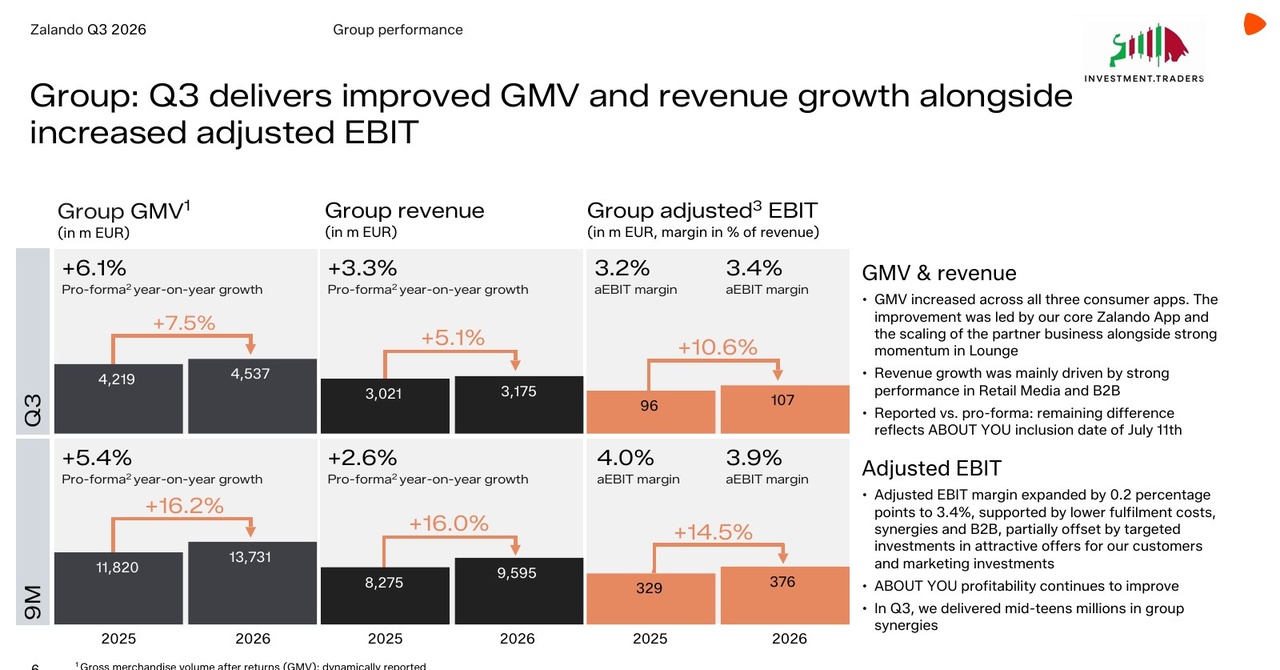
Zalando (ZAL) Group Financials: Merchandise Volume, Revenue, and Adjusted EBIT for Q3 and 9M 2026 (as of Nov. 17, 2026) – Source: Zalando Investor Relations / Christian Lill
What does Zalando do, and how does the company make money?
Zalando is Europe’s leading online platform for fashion and lifestyle and operates three consumer apps: Zalando, About You, and the shopping club Lounge by Zalando.
The Berlin-based company was founded in 2008, has been publicly traded since 2014, and is listed on the DAX. Since July 2025, its Hamburg-based competitor About You has also been part of the group.
Two segments: In its B2C retail business, Zalando sells its own merchandise and, through its partner program, acts as an intermediary for brands and retailers in exchange for a commission. In addition, the company generates advertising revenue from brands on the platform (retail media), which grew by nearly 18% in the third quarter. In its B2B business, Zalando leases its logistics (ZEOS) and software (SCAYLE, Tradebyte) to other retailers—still small with quarterly revenue of €354 million, but significantly more profitable than B2C with a 11.9% margin.
How Zalando Makes Money: The key factor is gross merchandise volume (GMV), i.e., the value of all products sold, including partner merchandise. By 2026, it is expected to reach between €19.7 billion and €20.6 billion, with the lower end of that range being more likely. The larger the partner’s share, the less inventory risk Zalando itself bears. Among the most important suppliers are sports brands, whose development is highlighted in my analysis Adidas Aktie highlights.
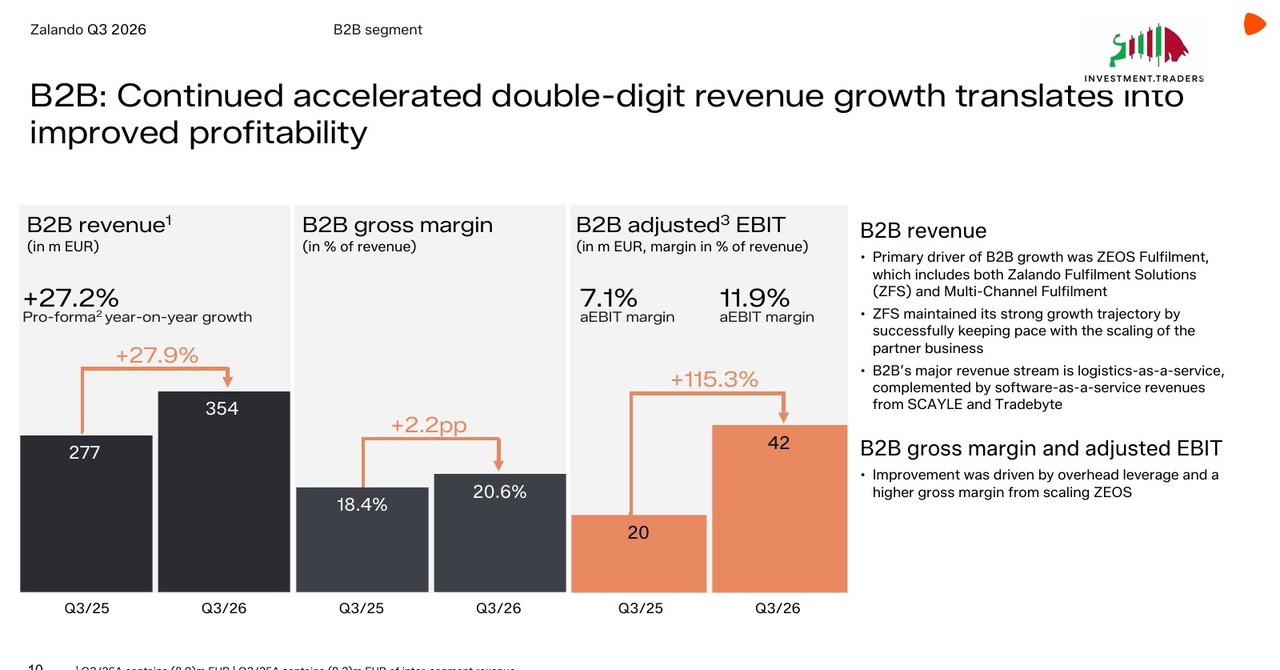
Zalando Stock (ZAL) B2B Segment: Revenue, Gross Margin, and Adjusted EBIT for Q3 2026 (as of Nov. 17, 2026) – Source: Zalando Investor Relations / Christian Lill
Zalando Stock Fundamental Analysis: Is the Zalando Stock Undervalued Right Now?
Fundamentally, Zalando stock is attractively valued based on earnings estimates: According to Aktienfinder, the adjusted P/E ratio stands at around 19 for 2026 and around 15 for 2027; in terms of revenue, investors are paying only 0.5 times.
The reason for the discount is the thin margin in the core business and the net loss in the third quarter.
Growth: Thanks to the acquisition of About You, Zalando’s revenue grew by 16.0% to €9.6 billion and its merchandise volume by 16.2% to €13.7 billion in the first nine months of 2026. Adjusted for the acquisition (pro forma), however, revenue growth was only 2.6%, and merchandise volume growth was 5.4%.
Margins: The adjusted EBIT margin rose from 3.2% to 3.4% in the third quarter; after nine months, it stands at 3.9%. This is solid for an online retailer, but far from platform margins. The improvement was driven by lower logistics costs, synergies with About You, and the more profitable B2B business.
Cash Flow and Balance Sheet: Zalando had approximately €1.2 billion in cash and cash equivalents at the end of September. For 2026, the company plans to invest between €240 million and €300 million in logistics centers, automation, and software. Zalando does not pay a dividend.
Valuation: Based on the adjusted earnings estimates from 13 analysts and the average P/E ratio over the past ten years, the Stock Finder calculates a fair value of approximately €151 as of the end of 2027. However, this figure is heavily skewed, as during the boom years up to 2021, investors paid as much as 90 to 180 times earnings for Zalando. A look at the current multiples is more meaningful: With an adjusted P/E ratio of around 15 for 2027, the stock is cheap for a growth stock—provided Zalando delivers on its earnings growth. The tonies Aktie.
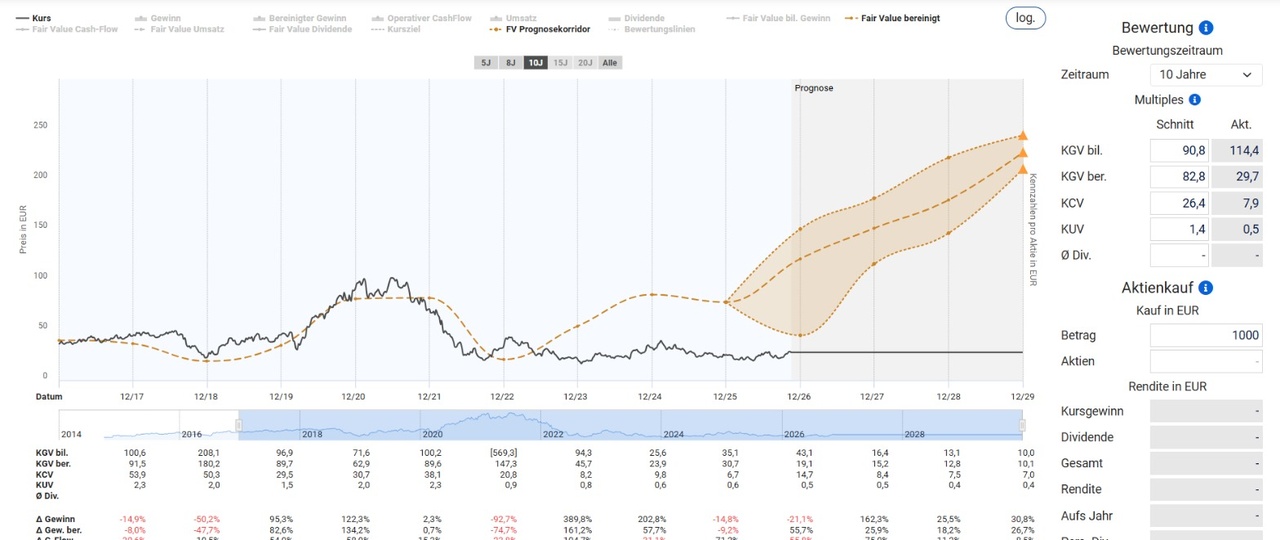
Fair Value Valuation of Zalando Stock (ZAL) for 2027 (as of Nov. 17, 2026) – Source: Aktienfinder / Christian Lill
Zalando Stock Price Targets and Forecast for 2027
On average, analysts see a price target of €35.50 for Zalando stock, representing about 27% upside potential—from a technical analysis perspective, a buy signal emerges above €30.45 with potential targets of €34.91 and €38.85.
In the short term, a falling trend line at €28 is acting as resistance; a pullback to €24.79 is not unlikely. Below that level, there is a risk of a drop to €19.74. My analysis of Lufthansa Aktie.
Key price levels:
- 52-week high: €30.43 (July 30, 2026), all-time high around €105.90 (2021)
- Current price: €28.03 (Xetra close on Nov. 16, 2026)
- Resistance: downward trendline at around €28
- Buy signal: above €30.45
- Price targets after breakout: €34.91 and €38.85
- Support: €24.79
- Critical downside level: €24.79; below that, a drop to €19.74
Analyst price targets:
- Average price target: €35.50 (finanzen.net, Nov. 13, 2026)
- Barclays: Overweight, €37 (August 5, 2026)
- Jefferies: Buy, €35 (November 3, 2026)
- Deutsche Bank Research: Buy, €35 (November 3, 2026)
- UBS: Buy, €33.50 (November 3, 2026)
- JPMorgan: Neutral (November 3, 2026)
- RBC: Outperform (November 2, 2026)
- Bernstein: Market Perform, €25 (July 10, 2026)
Chart Analysis:
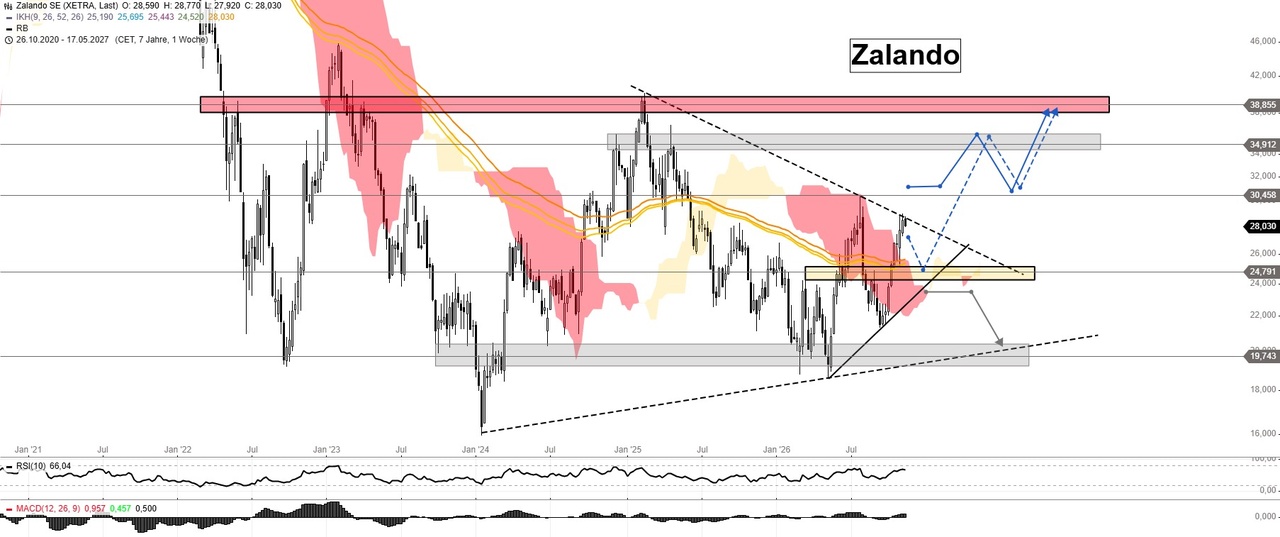
Zalando Stock (ZAL) Chart Analysis and Price Targets for 2027 (as of Nov. 17, 2026) – Source: Stock3 / Christian Lill
On the weekly chart, the Zalando stock shows a broad consolidation phase between approximately €19.74 and €38.85, which has been ongoing since early 2024. Since the high in early 2025 at around €38.85, a downward trend line has been in place, currently capping the stock at around €28. At the same time, an upward trend line has been rising since the low in May 2026, meaning the stock is forming higher lows and moving into a triangle. The price is trading above the moving averages and above the Ichimoku cloud; the RSI stands at 66, and the MACD is in positive territory.
The pullback (blue dashed arrow): Since the downward trend line is acting as resistance at €28, pullbacks to €24.79 would not be unlikely. The next key support level lies within this yellow zone, where the moving averages also converge.
The overall trend (blue arrow): Overall, the stock is attempting to reach new highs. A procyclical breakout above €30.45 would unlock potential up to €34.91 and subsequently up to €38.85. The zone around €34.91 represents the gray resistance level from 2025, while the red resistance zone at €38.85 is where the stock has already reversed in 2022, 2023, and early 2025.
The contrarian opportunity: For those who don’t want to wait for the breakout, the pullback to the support level at €24.79 presents a contrarian opportunity. From there, the path back up via the trendline would remain open.
The risk (gray arrow): A sustained drop below €24.79 would send Zalando tumbling to €19.74. That’s where the gray support zone lies, at which the stock reversed higher in 2024 and in May 2026.
Conclusion: Zalando Stock – Buy or Sell?
Zalando is returning to profitability and building new revenue streams through B2B and AI—from a technical perspective, the stock is attempting to reach new highs on a broader scale, with a procyclical buy signal emerging above €30.45.
Factors in Zalando’s favor include its rapidly growing and profitable B2B business, 63.2 million active customers, the confirmed forecast, synergies from the About.You acquisition, and an adjusted P/E ratio of around 15 for 2027. My analysis of Deutsche Telekom Aktie.
Factors weighing against the stock include weak growth in the retail business, a slim margin of 3.4%, declining gross margins due to discounts, and the net loss in the third quarter. From a technical perspective, the falling trend line at €28 is acting as a resistance; a pullback to €24.79 would not be unlikely and could present a contrarian opportunity. A breakout above €30.45 would unlock upside potential to €34.91 and €38.85. Conversely, a sustained move below €24.79 would trigger a decline to €19.74.
✅ Opportunities
- B2B grows by 28%, margin rises to 11.9%
- 63.2 million active customers, partner share 33.6%
- Synergies from the About.You acquisition
- AI agent Zalando Extended opens up new revenue streams
- Adjusted P/E ratio around 15 through 2027, P/S ratio just 0.5
- Above €30.45: Buy signal with targets of €34.91 and €38.85
⚠️ Risks
- B2C revenue grows by only 2.8%
- Adjusted consolidated margin at just 3.4%
- Net loss of €18 million in the third quarter
- Gross margin declines due to discounts and marketing
- Downward trend line acts as a resistance level at €28
- Below €24.79, a drop to €19.74 looms
Sources
- Zalando Press Release: Third-Quarter 2026 Results (November 3, 2026)
- Zalando Investor Relations: Q3 2026 Earnings Presentation
- Zalando Press Release: Second-Quarter 2026 Results (August 4, 2026)
- Zalando Investor Relations: Financial Calendar
- dpa-AFX Analysts via finanzen.net, finanzen.at, and finanznachrichten.de: Jefferies, Deutsche Bank, UBS, JPMorgan, RBC (November 2–4, 2026), UBS (October 13, 2026), Barclays (August 5, 2026), Bernstein (July 10, 2026); Average price target on finanzen.net (November 13, 2026)
- Trade media: FashionUnited, Logistik Heute, retail-news.de (November 3, 2026)
- Xetra prices: Alpha Vantage (daily and weekly data through November 16, 2026), Stock3
- Stock3: Weekly chart for Zalando SE (Xetra), as of Nov. 17, 2026
- Aktienfinder: Fair value calculation (adjusted earnings), Zalando valuation metrics, as of November 17, 2026
This is not investment advice—all information is provided solely for financial education purposes.
What are your current thoughts on $ZAL (+1,42 %)?