+++ Football and stock market +++
(CCF Post of the Week 3 November 2022)
In Germany there are an estimated 47.9 million football coaches [1], about 1.8 million active players and 25,544 clubs around the ball sport... [2] and exactly 2 football clubs in Germany, which can also be traded on the stock exchange. ⚽️
TL;DR: Football is not an investment! Tradition beats commerce, or...?
- Football History
- The offside rule
- German soccer clubs on the stock exchange
- A "general" meeting of a different kind
- Conclusion
(and trip to Nuremberg)
- Football history
First traces of conducted soccer games are found, contrary to the widespread belief, not in Great Britain, but in China in the 3rd century B.C. The football-like game Cuju was conducted as part of military training. The exact rules have been lost. In the course of the Zhou dynasty, the game also became popular among the population and was subjected to stricter rules, as violent confrontations in the game occurred repeatedly.
The first references to a professional league in China exist from 600 A.D. In these years, the air-filled ball including goals, goalkeepers and captains was invented, which until then had been sewn together from pieces of leather and filled with animal hair and feathers.
Various precursors of modern soccer were also discovered in other countries and parts of this "ball-round" planet. Among others, there were football-like, partly ritualized sports in Turkey, but also in Central America, before the mother country of modern soccer, Great Britain, appeared on the scene at the beginning of the 19th century.
The oldest soccer rules date back to 1845, whereas the first soccer rules were written down in 1848 by students at Cambridge University. According to these rules, teams still consisted of 15-20 players each and the ball could be taken in the hand in certain situations, but not carried as in rugby. In 1843, the oldest soccer club still in existence was founded: Guy's Hospital Football Club is still active in rugby football today [3].
The world's first club for classical soccer was founded on October 24, 1857 with Sheffield FC [4].
The first soccer match of modern soccer was held on December 26, 1860 against Hallam FC. In 1863, the Football Assciation (FA) was founded in London, which promoted and constantly developed the extensive set of rules of modern soccer.
On the European continent, soccer became popular primarily with our neighbors in Switzerland. Here, too, it was the English students who imported the sport from their homeland and established it in private schools.
In 1895, the Swiss Football Association was founded with eleven Swiss clubs.
The first soccer match in Germany is attested from 1865 in Stuttgart. Here, however, it was played according to the rugby rules. In 1874, modern soccer was established at a grammar school (the Martino-Katharineum in Braunschweig) by Konrad Koch. Koch's primary goal was to combat the lack of exercise.
In 1875, it was also Koch who wrote down the first rules of a soccer club, which even then were similar to the rules still in force today. Terms such as offside, half-time and corner kick are Konrad Koch's neologisms. Until the 20th century, soccer was derogatorily known in Germany as "footlumming" or even as an "English disease" and was played in the early years by British students, entrepreneurs and technicians.
Also, the ball sport was predominantly played by higher earners, as workers lacked the financial means for equipment and therefore tended to join gymnastics clubs.
The oldest soccer club still in existence in Germany today is BFC Germania 1888 from the Tempelhof district of Berlin [5]. 👴
One could now lament about other clubs and also mention the corrupt FIFA... all possible, but unnecessary, because there is only one club "Der Glubb" - 1.FC Nürnberg, founded May 4, 1900 😇🥰
- The offside rule
The offside rule is a provision in soccer (and not only there), which prevents a certain position on the field of play of an attacking player in relation to the defender of the opposing team and thus the attack. The offside rule thus prevents offensive players from waiting for long passes behind defensive players and near the goal.
The origin of the basic "offside" rule dates back to the early days of soccer in England, as it was believed at the time that it was "unfair to score a goal behind the opponent's back."
For a detailed look at offside, see ran.de.
- German soccer clubs on the stock market
In Germany, there are currently only two soccer clubs that are listed on the stock exchange. Borussia Dortmund and Spielvereinigung Unterhaching. BVB has been listed on the stock exchange since 2000, while Unterhaching has been listed since 2019.
Borussia Dortmund:
Why Dortmund decided to go public is quickly and easily explained: As with most companies, the IPO is done for financial reasons. And so it was that the club's IPO brought in 130 million euros. What happened afterwards is history. BVB used the capital to finance its investments in the first team and the club and ultimately became German champion in 2002. Money did score goals at that time... (and sometimes still does today).
The extent to which the share price is linked to sporting success can be seen in the development of Borussia's stock market value, which fell to a low of 0.80 euros per share by 2009. Under Jürgen Klopp and the sporting success, the club's stock market value rose again and led to a first dividend payment to shareholders in 2012.
Since the IPO, the club has been able to successfully carry out three capital increases and buy back its own stadium. This has also enabled BVB to establish itself as reasonably crisis-proof, as the Corona pandemic impressively demonstrated. Although the share price halved again and is currently back at around 3.50 euros per share certificate, people are no longer looking too anxiously at the balance sheet.
Nevertheless: One must be clear when investing in the "club" that the share price will continue to depend on sporting success in the future. A strong fan base also seems to be a capital driver, as jersey and merchandise sales also flow into the company's balance sheet. It is not for nothing that BVB is also regularly on the road in European or even intercontinental soccer.
Selected key figures of BVB:
Number of shares: 110,396,220 shares
Market capitalization: 383 million euros
Free float: approx. 67.2%
Equity as of 06/30/2022 : 308.9 million euros
Sales revenue 2021/22: 419.6 million euros (previous year: 323.5 million euros)
Despite the increased sales revenue, the net loss for the year was reported at -35.4 million euros.
Forecast for the financial year 2022/23: Net profit of 2.0 million to 7.0 million euros
IR from BVB: https://aktie.bvb.de/
It is difficult to make a comparison with other listed companies in the soccer sector (after all, there are 13 European listed "clubs"), as they are naturally also in other leagues and therefore face different conditions.
SpVgg Unterhaching:
Haching's stock shows that a club traded on the stock exchange does not automatically promise success. The club dared to go public on the Munich Stock Exchange in 2019 to enable financing of the club and set-up for promotion to the 2nd Bundesliga. Significantly, Manfred Schwabl, the managing director of the KGaA from Unterhachingen, also spoke of an investment in "stones and legs" at the time of the IPO - as the BVB managers had described it 19 years earlier when they went public. To this day, the Signal Iduna Stadium is one of the biggest tangible assets of the Dortmund club.
And yet... to this day, the club from Unterhachingen still owes its shareholders one thing: a return on investment. 📉
Because based on the course of the price of this club (since start: -54.21%) is also sporting so far no country to see. Most recently, the club played in the Bavarian regional league.
The proceeds from the IPO amounted to around 2.7 million euros.
IR from Hachingen: https://www.spvggunterhaching.de/boerse/investoren/#ahz-uhg-finanzberichte
- "Annual" meeting of a different kind
Since my heart club from Nuremberg "Der Glubb" is not a listed club, there is this Saturday, 19.11.2022 the annual general meeting.
For several years, the club has been trying to spin off the professional soccer department and thus make it future-proof. To what extent this step is "future-proof" has long been a subject of dispute among the members of our traditional club (9x German champion!). 💪
Naturally, "fresh money" is cited as the leading argument on the part of those responsible at the club for spinning off the professionals into a corporation. For years, the Glubb from Franconia has been notoriously plagued with money problems, as sporting mistakes or expensive maintenance of dismissed coaches and players have unfortunately often gone hand in hand.
It is also questionable, however, whether consistent financing can be achieved in the long term with a spin-off - the example of Hachingen should be enough of a reminder. Apart from that, we currently have completely different problems on a sporting level... which then also has possible financial consequences. An IPO (or spin-off of the professional team) cannot be seen as an automatism for sporting success.
The most important point against a spin-off: Tradition beats commerce. Of course, club soccer and any club that has a social responsibility cannot ignore money and power. Without money, it is just a shooting gallery and would make no difference to the local amateur bowling club.
And yet: The right to have a say, the right to participate in shaping the club and regional solidarity in the club and its club life is just for many soccer enthusiasts still in the first place. As a member and supporter, you can overlook the fact that you probably won't make it to the sporting olympics any time soon.
But if you do make it (like our DFB Cup victory in 2007), then generations are torn by these experiences. That connects. ♥️
And one more thing:
I dare to say that club fans and other fans of other clubs who are suffering are the toughest investors. After all, we know what suffering means, so a bit of the stock market can't upset us. I imagine the investor life of a Bayern or PSG fan to be much more nervous. 😶🌫️
- Conclusion
Investing in soccer is a risky venture for me. The business figures are strongly dependent on the sporting success. In addition, other points such as injuries to expensive players, bad investments in real estate (expensive stadiums, etc.), but also simply sympathy or antipathy offer decisive external risks that I personally would not be willing to bear.
For me, soccer clubs are not companies in the classical sense, have a social responsibility (see 1. FC Nuremberg - source 6) and do not belong on the stock exchange! Hachja... I just still dream the naive dream... 🥴
Enclosed still the principles:
- Effervescent & cans does not belong in soccer. 👎
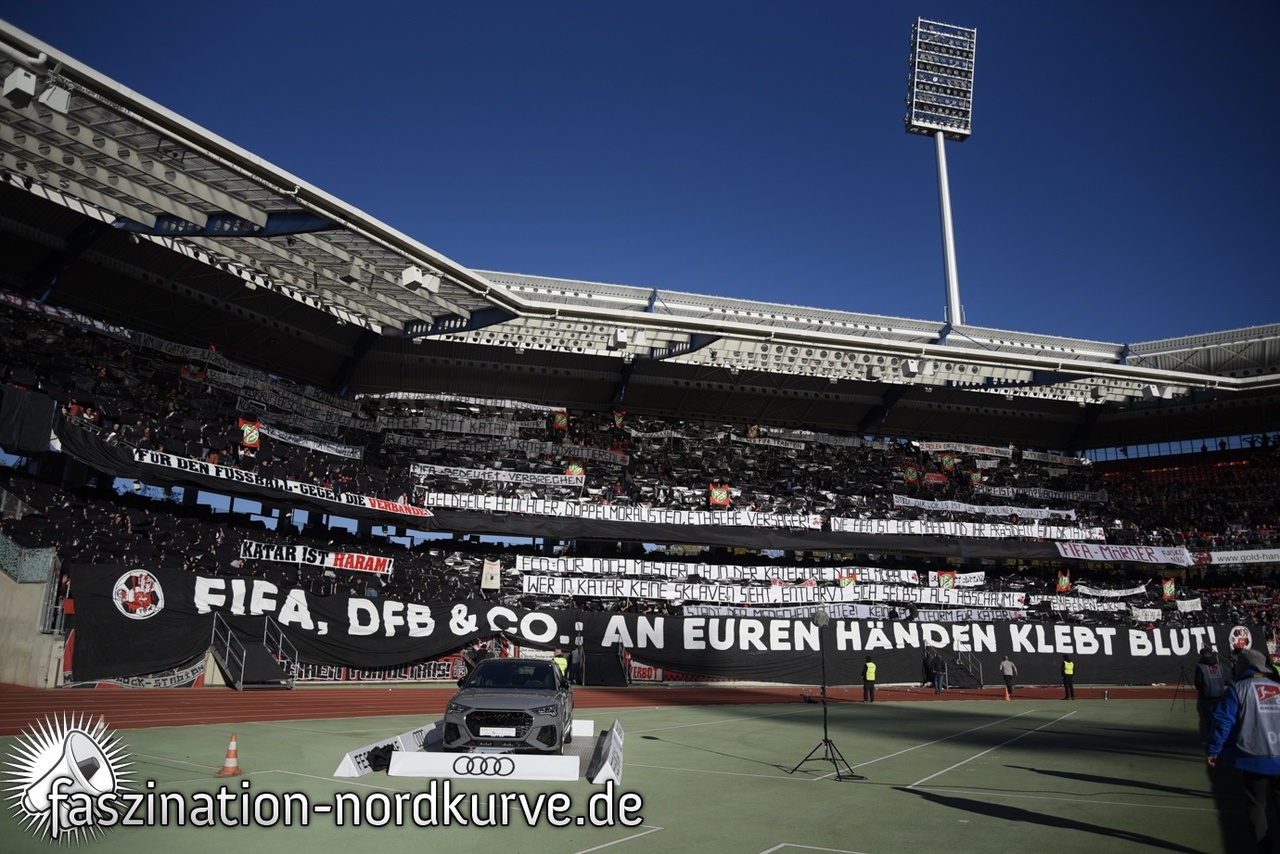
- DFB = Mafia! 🖕
- FIFA = corrupt! 💰
- Qatar: boycott! ❌
Last but not least and the reason for the post: 😜
I will be traveling to Nuremberg for the members meeting this coming Saturday and will be attending. Maybe there are actually investors here who live in this beautiful city, are members of the Glubb and will be there themselves? Three in the Weckla and drink the world's best beer! Will have it yes only mentioned... not that it is called at the end: "Why did you say nothing ...?" 😉
Greetings go out to the Schalker 🔵⚪️ and Rapdiler 🟢⚪️!
ONLY THE FCN! ⚫️🔴
Sources:
[1] Football fans in Germany (https://de.statista.com/statistik/daten/studie/727901/umfrage/fussball-fans-in-deutschland-nach-alter/)
[2] DFB statistics (members and clubs) (https://www.sportschau.de/fussball/amateurfussball/dfb-verband-mitgliederschwund-auch-durch-corona-sp-100.html)
[3] Guy's Hospital Football Club (https://www.pitchero.com/clubs/guyshospitalrfc)
[4] Sheffield FC (https://www.sheffieldfc.com/)
[5] BFC Germania 1888 (https://www.bfcgermania88.de/)
[6] Our Club - Community Platform (https://unserclub.de/aktuelles)
The post is meant to entertain. I am fully aware of the explosive nature of being a fan - yet I look forward to the exchange. Separated in the colors - united in the matter: Finance. 😉