I don't think I would ever stop completely. It already starts with the fact that as a private individual you are asked to pay for health insurance etc. My plan would therefore be to cut back significantly 😀 but of course, you have to know what standard of living you have and therefore how big the deposit needs to be.
@Dividend_Donny I think the tool takes this into account, depending on how realistically you handle the stored data. I can see a certain complexity, especially with the German tax issue.
I agree with the majority that it is difficult to make a concrete assessment here without concrete figures. It very much depends on your personal situation, your intended standard of living and your existing assets.
In principle, it is of course possible and desirable to switch to the private life in your 50s. Although you are older at 50, you are generally still in good health, so you can enjoy life without a job for a while longer. You just need to make sure that you don't over-calculate your retirement and allow enough of a buffer for inflation and unforeseen events.
I 'retired' at the age of 49 and, to be honest, I underestimated the expenses somewhat. Nevertheless, I felt it was 'high time' because a lot of things in my job annoyed and upset me. I'm glad that I got out of it and made the leap.
What helped me to do this?
1) I never paid into the state pension. I was therefore able to invest freely and didn't have to adhere to any regulations or laws. I'm not interested in any minimum limits or pension points. I haven't paid anything in and I don't get anything out. For me, that's a great deal.
2) I started making private provisions very early on. My portfolio isn't huge for my age. But that's because I'm mainly invested in real estate. For me, that's my thing - slow, unagitated and calculable income with additional appreciation and tax-relevant depreciation. I like it, others may see it differently. I am not a missionary here.
3) I have reduced my costs. I lived in a nice area in Munich. I always loved the city, but I moved to a big city in eastern Germany almost 10 years ago. This brought my cost of living down and I was able to rent my apartment in Munich at a high price.
Is that a blueprint for the best way to go about it? No - of course it's not. You just have to calculate your own exit in detail.
From my point of view, it's a combination of projected income and cost reduction.
I think you need professional advice (advisors etc.) to do the math properly. Quitting your job completely is already a tough cut. It's easy to do the math for the remaining years until regular retirement age. Nobody suddenly wants to cut back on their accustomed standard of living after 35-40 years of full-time work. The sensible approach would be to plan this in stages. However, this must also be feasible from the employer's point of view. Another issue is possible cash flow events along the way. A maturing private pension plan may change the picture (payout on what terms, tax situation...). And yes, it is far too individual a topic for a blanket plan.
@NichtRelevant I'm 54 and have just decided to stop working in my current job. According to my calculations, I'll be fine until I retire and maybe look for another small job that I enjoy. My previous job no longer does that. Maybe a headhunter will come around the corner and have a great offer for me. First of all, I find the idea of living off my dividends liberating and nice.
@KevinE That can happen, right. It's just always difficult to calculate with something like that, as you usually want your parents to live as long as possible 🙂
@KevinE That's how it is. Nevertheless, most of the heirs accept the respective legacy, don't they? In my case, the upcoming cash flow event concerns a private pension fund + BR. I won't be thanking them for the payout after tax 😉
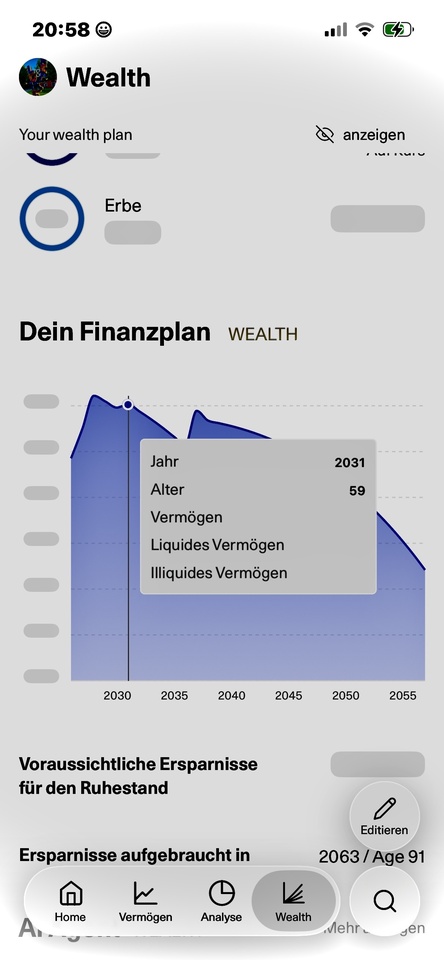
What is anyone supposed to say about such a sceenshot?
Maybe you can share something like:
If, at the age of x, I have y times an annual spending volume on the side, z% of which is allocated to shares: Can I then start my privateer existence.
@financial_wizard_xasbb May I ask about your age and how long you have been working / working in your current job? The term "hamster wheel" in my post is not to be seen in an exclusively negative context, as you probably understood it. That should be clear from the course of events.
@MozartsGeist I may well have misinterpreted it. I've been working for 35 years, had a job a long time ago that felt exactly like the hamster wheel, thought at first, who cares, with that salary I'll be out by my mid-50s at the latest. Then I changed jobs. Much lower salary but also much more enjoyment of life. This year I'm in my mid-50s and I don't care that I can't get out financially yet, but that's because I have enough free time to spend most of my money now that I can. Often when I read here how many see collecting money by doing without as the ultimate goal, I just think to myself that this can also go wrong. Unfortunately, I've seen it all too often in my environment that people have been saving for the future for too long and when the time finally came, they were all able to realize their dreams. That would be the worst idea ever for me. I live now and not in the future. The money has to be enough, but the job has to give you so much that it doesn't feel like a hamster wheel. That was my point.
I still really enjoy my job. But I understand what you mean! When I'm in my mid-50s, I assess the weighting of my lifetime and what I put into my job differently.
@financial_wizard_xasbb I used to think that too - but I found out (for myself) that I'm simply not happy in my job.
I have a good salary, nice colleagues and a great boss. But every day, including breaks and travel time (when I'm not working from home), I lose about 10 hours of my day.
I'm 36 and will be "through" in about 5 years. On every sunny day, I wish I didn't have to look outside through the glass, but could use the day for myself - for leisure.
I love sport, which I always miss out on because of my work. I love preparing a good BBQ all day and having friends over in the evening. I love spending time with my dog. I would like to explore Europe by bike. I plan to climb all three thousand meter peaks in the Alps (I'm at 193/ approx. 3,600 😅 ).
Oh yes - I'm still married and the time I spend with my wife isn't too bad. If there were kids now...
If the day had 36 hours, 10 hours of work wouldn't be so bad for me. But as it is, I miss out on my private projects.
I've thought a lot about whether there's a job that would be more compatible with my private life. Apart from seasonal work (usually badly paid) and project work (difficult to do only in the winter), I don't know how I could do it.
I think maybe 10-20% of people find a job that really fulfills them deeply. The rest just do it because it fills the dinner table (some are more satisfied, others less).
I maintain that at least 80% of people would no longer do "traditional" work as soon as there is no longer a monetary incentive (e.g. through a high UBI).
I absolutely enjoy my job, if it wasn't for that I would have made a change long ago. However, it does have a calming effect when the feeling of "no longer having to" gradually comes to fruition. It's completely individual, I realize that.
@MozartsGeist I'm glad I'm not an American. Until 67 to have full pay and only about 12 days vacation. He works about 4 years longer than we do to retire just because of the difference in vacation days.
But yes, not having to do that anymore is the feeling I want to achieve and I can understand that very well
@GoDividend However, you must not forget that the Americans are granted significantly more flexibility by the state in terms of taxes and pension options. The prerequisite is a corresponding income and there are reductions in the usual benefits "still" available from the state in Germany.