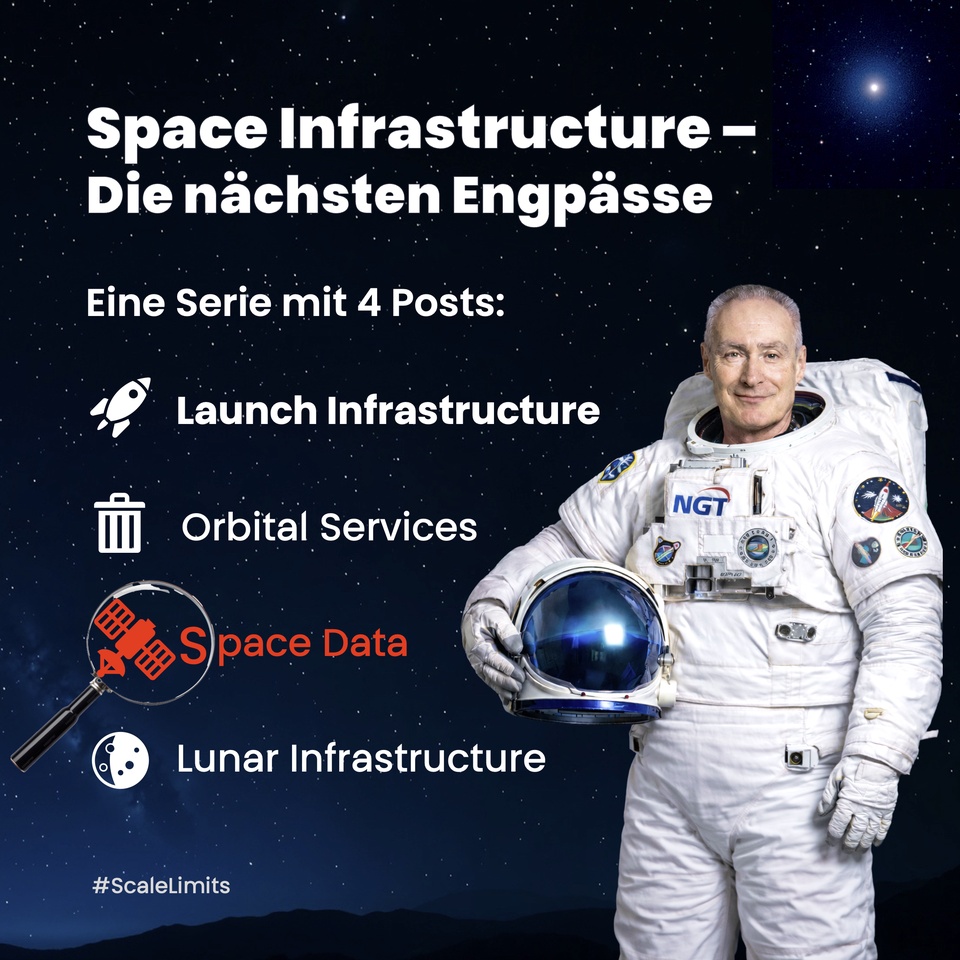
Satellites alone do not create a strategic advantage. The decisive factor will be who can build permanently usable data, communication and information systems from orbital infrastructure.
The focus is therefore slowly shifting from physical access to orbit to the utilization of the use of the data streams generated there.
This is because the requirements for communication, navigation, reconnaissance and real-time data are increasing significantly in parallel with the growing number of satellites. Orbit is gradually developing into an additional
information and network layer of the global infrastructure.
Space data encompasses much more than traditional satellite images. Among other things, it becomes critical:
- Earth Observation - Real-time data on infrastructure, climate and movement patterns
- Direct-to-Device Communication - direct satellite connection with smartphones
- resilient communication networks - independent infrastructure during crises and conflicts
- Tracking and navigation data - precise position and movement information
- maritime and military surveillance - Visibility of critical infrastructure and sea routes
- orbital data platforms - Processing and provision of large data streams
- low latency - fast transmission of time-critical information
- Frequency and spectrum utilization - limited communication capacities in orbit
The importance of independent communication and reconnaissance systems is likely to increase further, particularly in the event of geopolitical tensions or disruptions to terrestrial infrastructure.
$PL (+0 %) (Planet Labs) addresses the area of earth observation and global image data infrastructure. $ASTS (-7,85 %) (AST SpaceMobile) is working on direct-to-device communication via satellites - conveniently via standard smartphones. $OHB (+0,19 %) (OHB) is increasingly moving along European satellite and infrastructure programs. Companies such as $BKSY (Black Sky) or $SPIR (-1,08 %) (Spire Global) are offering early data-driven space services.
However, many of these areas are still in an early early phase. Numerous companies are small, highly specialized or hardly investable. At the same time, an independent infrastructure ecosystem is slowly emerging around data, communication and orbital information systems.
The real value in the space sector will therefore often no longer lie in the satellites themselves, but in the data, communication and control systems behind them.
The final part of the series will deal with lunar infrastructure and the question of what new bottlenecks could arise as soon as space travel expands permanently beyond Earth orbit.