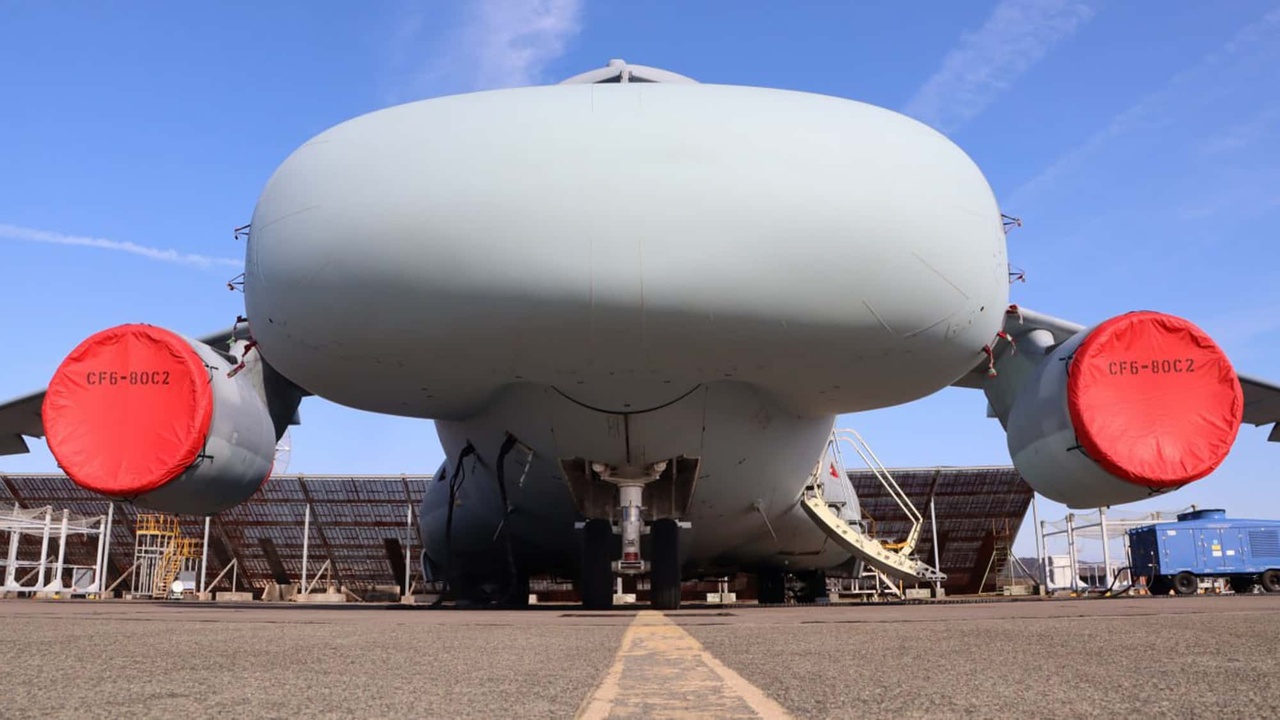
Japan's Air Self-Defense Force recently published photos showing Kawasaki's new EC-2 EloKa aircraft for the first time. This is a special version of the C-2 transporter - with a very thick lip.
Japan's latest and largest fighter aircraft is visually quite disfigured - but looks are rather secondary when it comes to the Kawasaki EC-2. For the time being, it remains the secret of the Kawasaki designers how the pompous attachments on the nose, roof and tail affect the aerodynamics and flight characteristics. The test pilots who have the honor of taking a seat in the cockpit of the EC-2 will soon find out.
What is clear, however, is that the "sprayed-on lips" on the nose, the two humps on the back of the fuselage and the side panels on the tail conceal state-of-the-art technology for electronic warfare - and that the EC-2 is intended to succeed the old EC-1 as a jamming aircraft, which retired in 2025 after almost four decades of service, leaving an operational gap at the Japanese company.
The photos of the EC-2, published by the Development and Test Command of the Japanese Air Self-Defense Forces, show the newly modified aircraft on the ground at Gifu Air Base. The identification 68-1203 can be read on the tail - which means that the EC-2 airframe is already nine years old and has had a "first life" as a normal C-2.
Up to four EloKa-Kawasakis for Japan
While the predecessor EC-1 remained a one-off throughout its existence, Japan is reportedly planning to put a total of four EC-2s into service. However, this is not yet final; the Japanese Agency for Procurement, Technology and Logistics (ATLA) emphasizes that the required number of EC-2s is "currently being reviewed".
The provisional schedule envisages testing the modified aircraft in the current financial year and it is expected to enter service around mid-2027. The new EloKa-Kawasakis will be based at Iruma Air Base, where the Japanese Electronic Warfare Squadron, which also operated the EC-1 until 2025, is stationed. Meanwhile, the conversion of the 1203 will reduce the number of C-2s currently used by Japan as transport aircraft to 16 (out of a total of 18 delivered). One aircraft previously also used as a transporter, the 15-year-old 18-1202, which was built as a second prototype, was already converted into the EC-2 electronic reconnaissance aircraft in 2018.
Interference systems largely secret
Exactly which systems are hidden under the EC-2's bulges remains unknown. The excessively wide nose is presumably due to the antenna system of the electronic jamming device J/ALQ-5 from Toshiba, which is used to combat enemy radar stations and already provided a similarly striking front section in the predecessor EC-1. The other beads are also likely to include systems for signal jamming and suppression as well as satellite communication, although the details of these remain under wraps.
In addition, the EC-2 has a series of optical sensors on the fuselage, which are presumably part of the self-protection and missile defense system.