I haven't written much here in the past few weeks. Not because nothing has been happening in the markets—quite the opposite, actually. But sometimes work just takes up all my time. And things aren't getting any better right now. That makes what's happening at Photonics .
I’ve been following this topic for a while now; I’ve written a few posts about it. The current earnings season is now providing some pretty concrete indications that Photonics, as a bottleneck within AI infrastructure.
1. Demand is outpacing capacity
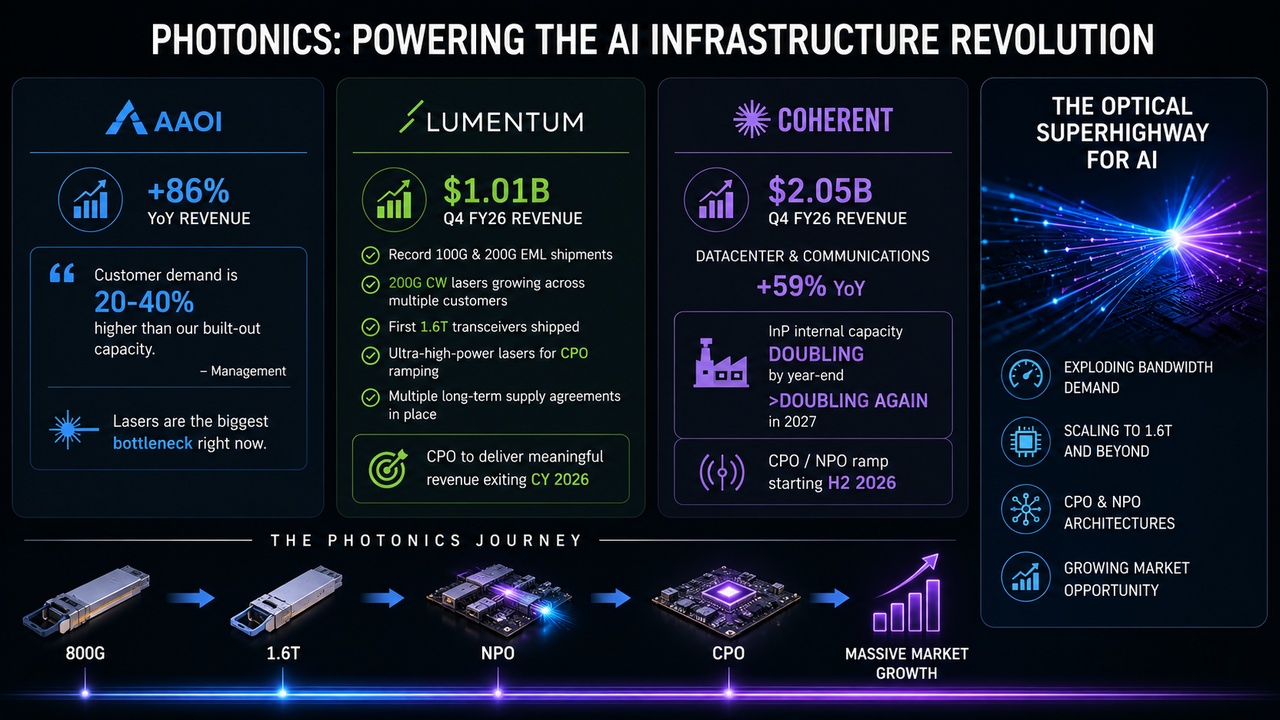
Applied Optoelectronics $AAOI (-9,71 %) reported an 86% year-over-year increase in revenue for Q2. Even more interesting, however, were statements made during the earnings call.
Management explained that customer demand is 20–40% above the capacity that has already been expanded. At the same time, CEO Thompson Lin identified lasers as the current biggest bottleneck in the transceiver business. This is noteworthy: The problem isn’t a lack of demand. The problem is being able to produce enough components.
2. 1.6T and CPO are beginning to ramp up
At Lumentum $LITE (-5,53 %) , the next phase is already taking shape. The company reported revenue of $1.01 billion for Q4 FY26, up from $808 million in the previous quarter. At the same time, the non-GAAP operating margin rose to 36.6%. Even more important than the numbers themselves are several operational statements:
• Record shipments of 100G and 200G EMLs
• Rising sales of CW lasers to several transceiver customers
• First shipments of 1.6T transceivers
• Increasing shipments of ultra-high-power lasers for CPO
• Several long-term supply contracts in the Scale-Across segment
Lumentum expects CPO to make a significant contribution to revenue as early as the end of calendar year 2026.
3. Manufacturers are massively expanding capacity
Coherent $COHR (-7,25 %) confirms this trend. Revenue in the Datacenter & Communications segment rose from approximately $1.0 billion to $1.6 billion within a year. At the same time, Coherent aims to double its internal InP output by the end of the year and more than double it again by 2027. CPO/NPO is expected to emerge as an additional growth driver starting in the second half of 2026.
This is slowly painting a fairly consistent picture:
800G → 1.6T → NPO → CPO
With each stage, the demand for optical components increases. At the same time, the necessary laser and InP capacity cannot be scaled up as quickly as desired.
That’s why I find the latest quarterly reports so interesting. They don’t just show that photonics could become important at some point. They show that the bottleneck is already becoming apparent today.
And if 1.6T, NPO, and CPO do indeed scale up more significantly in the coming quarters, a market that’s already tight today could turn into an even much bigger bottleneck.
For me, that’s why photonics is currently one of the most exciting areas within AI infrastructure. Because several companies are now independently sending the same signal: Demand is growing faster than the available optical capacity.